
Most businesses assume that handing off old equipment to a recycling vendor ends their responsibility. It does not. The role of recycling vendors extends far beyond pickup and disposal. Your organization remains legally accountable for what happens to that equipment long after it leaves your loading dock. Get the vendor selection wrong, and you are looking at environmental violations, data breach exposure, and civil penalties that can cripple your operation. This article breaks down what recycling vendors actually do, how to evaluate them properly, and why the stakes are higher than most compliance teams realize.
Table of Contents
- Key takeaways
- The role of recycling vendors in e-waste management
- How to select and evaluate recycling vendors
- Regulatory requirements and legal stakes
- Managing downstream vendor oversight
- Data security and environmental responsibility
- My take on where businesses keep getting this wrong
- How Usedcartridge can help your organization stay compliant
- FAQ
Key takeaways
| Point | Details |
|---|---|
| Vendor responsibility extends downstream | Your legal liability covers all downstream handlers, not just the first recycling partner you hire. |
| Certifications are not equal | R2v3 and e-Stewards differ significantly in export rules and data destruction requirements. |
| Penalties for noncompliance are severe | Civil violations can exceed $80,000 per day, making vendor vetting a financial priority. |
| Documentation is your legal defense | Chain-of-custody records for at least 3 years are required under current universal waste regulations. |
| Verify certifications independently | Never rely on a vendor-supplied certificate image. Cross-check against official registries like SERI’s R2 directory. |
The role of recycling vendors in e-waste management
Recycling vendors are not just haulers. They are regulated partners in a chain of environmental and legal accountability that runs from your facility to the final material destination. Understanding the actual functions of recycling services changes how you approach procurement.
At the most basic level, a recycling vendor receives, sorts, and processes end-of-life electronics. But the responsibilities that matter for your compliance posture go considerably deeper:
- Chain-of-custody documentation. Vendors must track every device from intake through final disposition. This is not optional paperwork. It is your legal proof that materials were handled correctly.
- Hazardous material management. Electronics contain lead, mercury, cadmium, and other substances subject to federal and state hazardous waste regulations. A qualified vendor handles these under strict environmental controls.
- Data destruction. For any device that stored sensitive information, the vendor must securely wipe or destroy storage media and provide a certificate confirming the method and outcome.
- Downstream oversight. Reputable vendors track where materials go after initial processing, including smelters, refiners, and material brokers.
- Regulatory reporting. In many jurisdictions, vendors must file waste shipment reports and maintain records accessible for audits.
Certified recyclers provide documented chains of custody and data destruction compliance, directly reducing your reputational and legal exposure. The benefits of recycling vendors go beyond convenience. They are a structural part of your compliance program.
Pro Tip: Ask every prospective vendor for a sample certificate of data destruction and a sample chain-of-custody report before signing a contract. If they cannot produce both promptly, that tells you everything.
How to select and evaluate recycling vendors
Knowing how to select recycling vendors correctly is one of the most undervalued skills in corporate environmental compliance. Most organizations start and stop at asking whether a vendor is “certified.” That question is necessary but nowhere near sufficient.
Certification standards: R2v3 vs e-Stewards
The two dominant certification frameworks for electronics recycling vendors are R2v3 (Responsible Recycling, version 3) and e-Stewards. They are not interchangeable, and the differences between R2v3 and e-Stewards affect your risk exposure in specific ways.
| Criteria | R2v3 | e-Stewards |
|---|---|---|
| Data destruction requirement | Risk-based; NAID AAA optional | NAID AAA certification mandatory |
| Export policy | Allows exports to 32 OECD countries | Prohibits exports to non-Basel Convention signatories |
| Compliance approach | Flexible, risk-based | Stricter, uniform rules across all sites |
| Downstream visibility | Required with documentation | Required with documentation |
| Best fit for | Broad IT asset disposition | High-security, sensitive data environments |
Organizations often choose dual certification to cover all client and regulatory demands, which is the strongest signal of a mature, serious vendor.
Evaluating vendors beyond the certificate
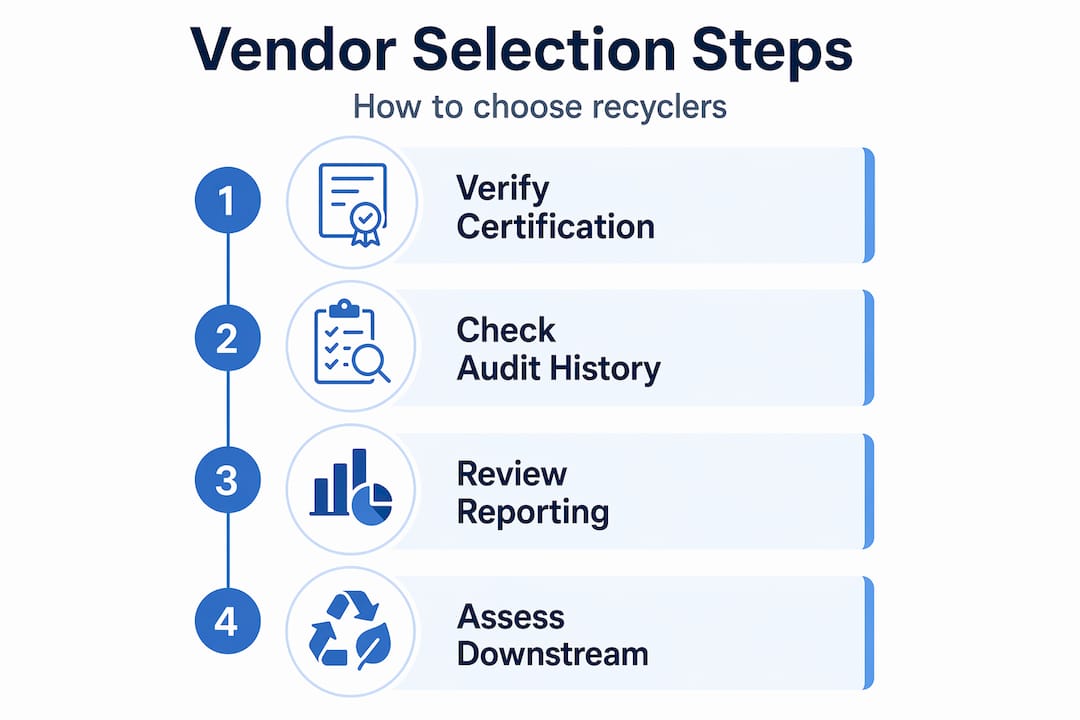
How to evaluate recycling vendors properly means going beyond what they hand you in a sales meeting. Verifying vendor compliance requires documented proof, not just a certificate image. Here is what to look for:
- Independent registry verification. Check R2-certified vendors directly in SERI’s online directory. Check e-Stewards vendors through the e-Stewards registry. Never accept a PDF alone.
- Audit history. Ask when the vendor’s last surveillance audit occurred and whether any nonconformances were found. A vendor with zero audit history in the past 18 months should raise questions.
- Downstream transparency. Request a list of the downstream facilities the vendor uses, including smelters and material processors. If they refuse, walk away.
- Insurance and bonding. Confirm that the vendor carries environmental liability insurance and that your organization is listed as an additional insured party.
Using risk-based segmentation simplifies downstream oversight complexity by focusing your most intense scrutiny on high-risk vendor categories, such as uncertified processors or foreign exporters.
Pro Tip: Build a vendor scorecard with weighted criteria covering certification status, audit history, downstream transparency, data destruction capability, and insurance coverage. Score every candidate before any contract discussion.
Regulatory requirements and legal stakes
The legal framework surrounding e-waste disposal is more demanding than most organizations realize, and recycling vendor partnerships are central to meeting it. Businesses must maintain chain-of-custody records for at least 3 years for universal waste shipments under current 2026 regulations.

The consequences of getting this wrong are not abstract. Civil penalties can exceed $80,000 per day per violation, with the added possibility of criminal charges for executives in cases of willful noncompliance. A single improper shipment traced back to your organization can trigger an enforcement action that outlasts any cost savings you achieved by cutting corners on vendor selection.
Key regulatory requirements that your recycling vendor must help you satisfy include:
- Hazardous waste manifests. For regulated hazardous waste streams, federal law requires a paper or electronic manifest accompany every shipment.
- Universal waste tracking. Electronics classified as universal waste require documented accumulation time limits and proper labeling at your facility before handoff.
- State-specific requirements. Many states impose stricter rules than federal minimums, including mandatory take-back programs and state-registered facility requirements.
- Data privacy laws. HIPAA, GLBA, and state privacy statutes require certified data destruction for covered devices, with documentation retained for compliance audits.
| Regulatory area | Requirement | Consequence of failure |
|---|---|---|
| Universal waste records | 3-year retention minimum | Audit exposure, civil penalties |
| Hazardous waste manifests | Required for every regulated shipment | Criminal liability, facility shutdown |
| Data destruction | Certified method and documentation | Data breach liability, regulatory fines |
| State e-waste programs | Varies by state | State-level enforcement actions |
Certified recycling vendors help you build an audit-ready compliance file, meaning that if a regulator ever asks questions, your documentation answers them before you have to.
Managing downstream vendor oversight
Here is where most organizations fall short. They select a solid primary recycling partner and assume the job is done. R2v3 makes clear that organizations are accountable for the environmental and legal compliance of all downstream vendors, not just first-tier partners. Your primary vendor’s subcontractors and material buyers are also your responsibility.
Practical downstream oversight involves several ongoing activities:
- Documented vendor lists. Your primary recycling partner should provide and regularly update a list of all downstream facilities, including the processes performed at each site.
- Risk tiering. Assign a risk level to each downstream vendor based on the materials they handle and their certification status. High-risk vendors warrant annual audits or third-party verification. Lower-risk vendors may need only periodic document reviews.
- Performance tracking. Track any incidents, violations, or regulatory actions involving downstream vendors. Set up Google Alerts for their facility names and monitor industry enforcement databases.
- Contractual flow-down. Your contract with the primary vendor should require them to impose the same environmental and data security standards on their downstream partners.
Economic pressure from informal recyclers creates real supply diversion risks, where materials meant for certified processing end up in uncontrolled environments. Formal documented chains of custody are your only protection against that outcome.
The balance between thorough oversight and operational practicality is real. R2v3 emphasizes documentation of decision rationale to avoid both over-control and under-control. You do not need to audit every smelter monthly. You do need to show that your oversight approach was deliberate, documented, and proportionate to the risk.
Data security and environmental responsibility
Data security is where the importance of recycling vendors becomes most concrete for organizations handling sensitive information. The two major frameworks treat data destruction differently, and that gap matters enormously for regulated industries.
| Certification | Data destruction standard | Export prohibition | NAID AAA required |
|---|---|---|---|
| R2v3 | Risk-based, flexible method | No, allows OECD exports | No |
| e-Stewards | NIST SP 800-88 aligned | Yes, non-Basel countries | Yes, mandatory |
| Dual certified | Meets both frameworks | Stricter e-Stewards rules apply | Yes |
NAID AAA certification means the vendor’s data destruction operations have been independently audited against the National Association for Information Destruction’s standards. NIST SP 800-88 compliance means the specific sanitization method (overwrite, degauss, shred) meets federal guidelines for the media type being destroyed. For healthcare, financial services, and government contractors, these are not nice-to-haves.
The refurbished electronics market grew 15% annually to reach $68 billion globally in 2025. That growth is an opportunity for value recovery but also a risk vector. Devices that should be destroyed sometimes get diverted to resale without proper data sanitization. A certified vendor with documented destruction protocols closes that gap with a paper trail you can defend in court.
For organizations handling regulated data, look specifically for e-waste logistics partners who carry both NAID AAA certification and R2v3 or e-Stewards status. That combination gives you the broadest compliance coverage and the strongest position in a regulatory audit.
My take on where businesses keep getting this wrong
I have seen this play out repeatedly across organizations of every size. The assumption that handing equipment to a vendor transfers all liability is the single most expensive mistake in e-waste management. In my experience, most compliance gaps are not caused by choosing a fraudulent vendor. They are caused by choosing a mediocre one without doing the verification work.
The downstream oversight issue is where I see the most systemic failure. Companies invest real effort in vetting their primary recycling partner and then treat everything downstream as someone else’s problem. That framing will not survive an enforcement investigation. Regulators follow the material, not the contract.
What I have found actually works is treating recycling vendor partnerships the same way you treat any critical supplier relationship. Periodic reviews, documented performance assessments, and contract terms that enforce your standards throughout the supply chain. It is not glamorous compliance work, but it is the kind that protects you.
My strongest recommendation is to stop evaluating vendors purely on price and certification status. Ask them to walk you through their downstream vendor list. Ask what happens when a downstream partner loses certification. Ask for their incident response history. The vendors who can answer those questions clearly are the ones worth contracting with.
— Keith
How Usedcartridge can help your organization stay compliant
Running a compliant e-waste program requires more than good intentions. It requires a certified partner who can back up every claim with documentation.

Usedcartridge operates as a specialized e-waste recycling and secure data destruction provider built specifically for organizations that cannot afford compliance gaps. From chain-of-custody documentation to on-site destruction with certification, every service is designed to give your compliance team the paper trail it needs. Whether you are managing a one-time IT refresh or an ongoing equipment retirement program, Usedcartridge provides certified electronics recycling with the transparency and audit readiness that regulated industries demand. Request a free quote and see how straightforward compliant e-waste disposal can be.
FAQ
What is the role of recycling vendors in e-waste compliance?
Recycling vendors manage the physical handling, documentation, data destruction, and downstream tracking of end-of-life electronics on your behalf. Your organization remains legally accountable for vendor performance throughout the entire disposition chain.
How do I evaluate recycling vendors before signing a contract?
Verify certifications independently through SERI’s R2 directory or the e-Stewards registry, request audit history, review downstream vendor lists, and confirm the vendor carries environmental liability insurance with your organization listed as an additional insured party.
What happens if my recycling vendor is not certified?
Using an uncertified vendor can expose your organization to civil penalties exceeding $80,000 per day per violation, plus potential criminal liability for executives in cases of willful noncompliance with hazardous waste regulations.
What is the difference between R2v3 and e-Stewards certification?
R2v3 uses flexible, risk-based compliance and allows exports to 32 OECD countries, while e-Stewards applies stricter uniform rules, mandates NAID AAA certification for data destruction, and prohibits exports to countries outside the Basel Convention.
How long must I keep e-waste chain-of-custody records?
Under 2026 universal waste regulations, businesses must maintain chain-of-custody records for a minimum of 3 years, and those records must document certified destination facilities for every regulated shipment.