
Most businesses treat electronic waste recycling as a logistics problem. You schedule a pickup, hand over the old equipment, and check the box. What almost no one accounts for is that the hard drive still inside that retired laptop contains employee records, customer financial data, and proprietary files. Simply recycling the hardware without verifying data destruction is how breaches happen. This guide breaks down why data privacy in recycling is a legal and operational obligation, what regulations apply to your industry, and exactly what you need to do to protect your organization before a single device leaves your building.
Table of Contents
- Key takeaways
- Why data privacy in recycling is a regulatory and legal obligation
- Data destruction methods that actually work
- Building a secure recycling workflow
- The role of data privacy in sustainable recycling
- Your data privacy checklist before recycling
- My take on why businesses keep getting this wrong
- Secure your data before it leaves the building
- FAQ
Key takeaways
| Point | Details |
|---|---|
| Recycling alone is not enough | Sending devices to recycling without certified data destruction leaves sensitive data legally and physically exposed. |
| Regulatory penalties are severe | HIPAA, EPA, and FCRA violations from improper disposal can cost organizations hundreds of thousands of dollars. |
| Factory resets do not work | Resetting a device only removes file pointers, not the data itself. Physical destruction or certified wiping is required. |
| Documentation closes the liability gap | Certificates of destruction linked to specific devices are required proof during compliance audits. |
| Privacy and sustainability are connected | As recycling programs collect more behavioral data, privacy-by-design practices protect both consumers and your brand. |
Why data privacy in recycling is a regulatory and legal obligation
When a business retires old IT equipment, it is not just disposing of hardware. It is making a decision about every piece of data that hardware ever stored. Customer records, employee personally identifiable information, financial transactions, and healthcare data do not disappear when you hand a device to a recycler. They stay on the storage media until someone deliberately destroys them.
The regulatory exposure is significant. Improper data disposal can trigger EPA penalties up to $37,500, HIPAA violations ranging from $145 to $73,000 per incident, and FCRA fines up to $1,000 per consumer per violation. For a mid-size organization disposing of hundreds of devices, those numbers compound fast.
The main regulations businesses need to understand include:
- HIPAA (Health Insurance Portability and Accountability Act): Covers any entity handling electronic protected health information. HIPAA requires six years of documentation proving proper data disposal, including certificates of destruction.
- GDPR (General Data Protection Regulation): Applies to any organization handling EU residents’ data. Data must be rendered permanently unrecoverable, and organizations must demonstrate compliance on request.
- CCPA (California Consumer Privacy Act): Requires businesses to protect consumer data through its entire lifecycle, including disposal.
- FCRA (Fair Credit Reporting Act): Covers organizations handling consumer credit information, with specific rules about secure disposal.
- EPA regulations: Govern the physical handling of electronic waste materials, with penalties for improper processing.
What businesses often overlook is the documentation requirement. Without a verified audit trail linking specific devices to specific destruction standards, you have no legal defense if a breach is traced back to a recycled device. Compliance is not just about destroying the data. It is about proving you destroyed it.
Data destruction methods that actually work
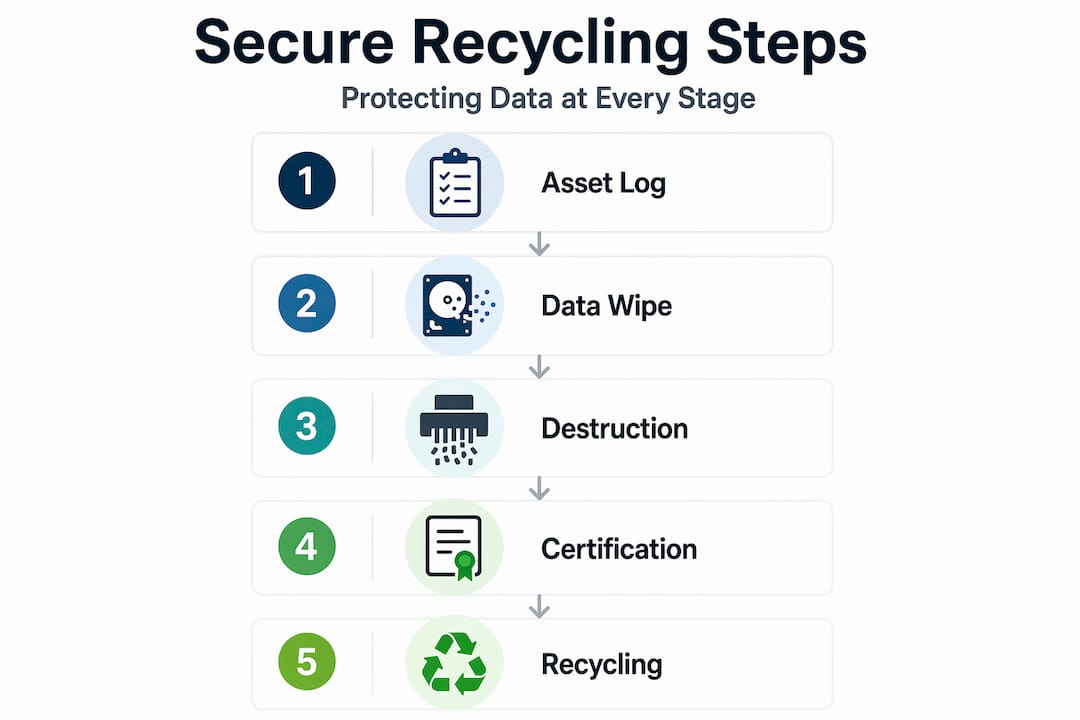
The most common mistake organizations make is equating “deletion” with “destruction.” Deleting files removes the visible path to the data, not the data itself. Factory resets often only remove file system pointers, leaving fragments of sensitive data recoverable by anyone with basic forensic tools. Think of it as removing the table of contents from a book. The chapters are still there.
There are three proven destruction methods, and choosing the right one depends on your data sensitivity classification.
| Method | Best for | Data recovery risk | Certification standard |
|---|---|---|---|
| Software wiping | Low to medium sensitivity data | Very low if done correctly | NIST SP 800-88 |
| Degaussing | Magnetic media (hard drives, tapes) | Near zero | NSA/CSS EPL listed |
| Physical shredding | High sensitivity, end-of-life devices | Zero | NAID AAA, e-Stewards |
Software wiping to NIST SP 800-88 standards overwrites every sector of a drive with random data multiple times. It works well for devices being reused or resold, since the hardware survives the process. Degaussing uses a powerful magnetic field to scramble stored data on magnetic media and is faster than wiping but renders the device unusable. Physical shredding is the only method that guarantees zero recovery. Devices are fed through industrial shredders and the output is granular material with no retrievable data.

Pro Tip: Match destruction method to device sensitivity before you schedule disposal. A decommissioned server handling customer payment data warrants shredding, even if wiping would technically meet a baseline standard. The cost of over-destroying data is minimal compared to the cost of a breach.
Misclassifying data sensitivity before disposal is one of the most common and costly mistakes in IT asset disposition. Not every device needs physical destruction, but high-risk media does. Getting that classification wrong in either direction costs you money or exposes you to liability.
Building a secure recycling workflow
Understanding why data privacy in recycling matters is step one. Actually integrating it into your operations is what protects you. The difference between organizations that survive a data breach inquiry and those that face massive fines almost always comes down to whether they had a documented process in place. Documented disposal programs are directly correlated with lower penalties and faster incident resolution.
Here is how to build that process:
-
Classify all devices and data before disposal. Create an inventory of every device being retired. Note the type of data stored, the applicable regulations, and the required destruction method. Do not rely on informal knowledge about what was on which machine.
-
Assign internal ownership. Name a specific person or team responsible for overseeing IT asset disposition. This person coordinates with vendors, collects documentation, and maintains records. Shared responsibility means no one is accountable.
-
Vet your recycling vendors thoroughly. Ask for certifications (NAID AAA, R2, e-Stewards), proof of insurance, and examples of certificates of destruction they have issued. If a vendor cannot provide sample documentation before you hire them, that is a clear signal. Learn more about secure equipment recycling and what verified vendors should offer.
-
Require certificates of destruction for every device. A certificate should include the device serial number, the destruction method used, the date, the technician, and the standard applied. Vague certificates with no device-level detail are not acceptable.
-
Retain records for the required period. Under HIPAA, that is six years. Other regulations may vary. Store records in a secure, accessible location so you can produce them in an audit.
-
Conduct annual audits of your disposal process. Vendor certifications expire. Regulations change. Processes drift. An annual review catches gaps before they become violations.
Pro Tip: Require your recycling vendor to sign a Business Associate Agreement (BAA) if you are subject to HIPAA. Without it, you are legally exposed even if the vendor handles destruction correctly.
The role of data privacy in sustainable recycling
The intersection of environmental sustainability and data privacy is newer territory for most businesses, but it is growing fast. Extended Producer Responsibility (EPR) programs, which hold manufacturers accountable for end-of-life product management, increasingly rely on detailed consumer recycling data to track product flows and measure program effectiveness.
That data creates real privacy risks. When recycling programs collect behavioral data at scale, including what households recycle, when, and how often, that data can be repurposed for commercial surveillance if proper safeguards are not in place. Regulations are shifting toward data minimization and purpose limitation principles, requiring organizations to collect only what is necessary and prohibit repurposing that data beyond its original intent.
“Data privacy in the circular economy demands balancing individual privacy rights with the need for high-granularity data to track product flows for sustainability programs.”
For businesses participating in EPR programs or using AI-driven recycling platforms, this means building privacy-by-design into the technology itself. Anonymize recycling data where possible. Audit what your program collects and how long it retains it. And be transparent with consumers and partners about data usage. Privacy and sustainability are not in conflict. Designed correctly, they reinforce each other.
You can learn more about how responsible e-waste management connects to legal compliance and data protection requirements.
Your data privacy checklist before recycling
Before any device leaves your organization for recycling, every item on this list should be complete:
- Confirm the device is included in your disposal inventory with serial number and data classification
- Verify the required destruction method based on data sensitivity and regulatory requirements
- Select a certified vendor with documented credentials (NAID AAA, R2, or e-Stewards)
- Obtain a chain-of-custody document from the moment the device leaves your facility
- Require a device-level certificate of destruction on completion
- Store all documentation in a secure compliance record for the required retention period
- Report any devices that cannot be accounted for immediately, before assuming they were recycled
- Review your disposal policy annually and update it when regulations or operations change
When you review how to safely handle electronics before resale or disposal, the same rigor applies. Whether devices are being recycled or resold, data removal must be verified, not assumed.
My take on why businesses keep getting this wrong
In my experience, the organizations that suffer data breaches tied to recycled equipment are rarely careless about security in general. They have firewalls, endpoint protection, and access controls. What they missed is the exit point. They were focused on keeping bad actors out and never thought seriously about what leaves with the hardware.
I have seen companies spend six figures on breach response and regulatory defense for incidents that trace back to a single hard drive that was not properly wiped before going to a recycler. The frustrating part is that certified destruction for that drive would have cost less than a hundred dollars. The math is not complicated.
What I have learned from watching organizations build this right is that it comes down to treating the recycling workflow with the same rigor as any other compliance process. You would not skip a firewall audit. Do not skip a destruction certificate. Vendor selection matters more than most people realize. A recycler’s environmental certifications tell you about their handling of the physical waste. Their data security certifications tell you whether they actually protect your information.
My honest take is that data privacy in e-waste recycling is also a competitive advantage. Companies that can demonstrate to customers, partners, and regulators that they manage data responsibly through its entire lifecycle build trust that shows up in relationships and contracts. Secure recycling is not just risk mitigation. It is part of being a trustworthy organization.
— Keith
Secure your data before it leaves the building

Usedcartridge provides certified electronic waste recycling and hard drive destruction services designed specifically for organizations that cannot afford compliance gaps. Every device processed through Usedcartridge’s service comes with device-level certificates of destruction and full chain-of-custody documentation, meeting the standards required by HIPAA, CCPA, and other major regulations. If you are managing a fleet of retiring devices and need verified data destruction alongside responsible recycling, explore Usedcartridge’s e-waste recycling services for businesses or get details on certified hard drive destruction to find the right approach for your data security requirements.
FAQ
What does data privacy in recycling actually mean?
Data privacy in recycling means verifying that all sensitive information stored on electronic devices is permanently destroyed before those devices are processed for recycling. It covers the methods used, the documentation produced, and the regulatory standards that apply to your industry.
Why is a factory reset not enough before recycling?
A factory reset removes the file system index but leaves actual data on the drive intact. Forensic tools can recover data from reset devices, which is why certified wiping or physical destruction is required for any device containing sensitive information.
What certifications should I look for in a recycling vendor?
Look for NAID AAA certification for data destruction, and R2 or e-Stewards certification for responsible e-waste handling. These certifications require third-party audits and confirm the vendor meets documented security and environmental standards.
How long do I need to keep data destruction records?
Under HIPAA, records proving secure disposal of electronic protected health information must be retained for six years. Other regulations vary, but maintaining records for a minimum of six years is a defensible baseline for most industries.
What happens if my organization cannot prove data was properly destroyed?
Without documentation, you face legal exposure during audits and breach investigations. Penalties vary by regulation but can reach $73,000 per HIPAA violation or $37,500 per EPA violation, with fines potentially multiplying across every affected record or device.