
Batteries are piling up faster than most people realize. From the lithium-ion pack in your laptop to the lead-acid unit under your car hood, improper disposal of these devices creates real hazards: toxic leachate contaminating groundwater, fires in recycling facilities, and heavy metals accumulating in soil. Learning how to manage battery recycling is no longer optional for responsible individuals and organizations. The U.S. EPA identifies lack of awareness on battery identification and safe disposal as the primary barrier to higher recycling rates. This guide gives you the practical framework to fix that, step by step.
Table of Contents
- Key Takeaways
- How to manage battery recycling starts with chemistry
- Preparation: collection, storage, and transport
- Vetting and working with certified recyclers
- Emerging technologies and policies in 2026
- Common challenges and how to solve them
- My honest take on battery recycling management
- Ready to handle battery and e-waste recycling the right way?
- FAQ
Key Takeaways
| Point | Details |
|---|---|
| Know your battery chemistry | Different chemistries require different handling and recycling routes; misidentifying them creates safety risks. |
| Tape terminals before storage | Cover battery terminals with non-conductive tape before bulk collection to prevent short circuits and fire. |
| Audit your recycling vendor | Require R2v3 or e-Stewards certification and a documented chain-of-custody before signing any contract. |
| Follow emerging policy shifts | Producer responsibility laws like Illinois’ new mandate are changing who pays and how batteries get collected. |
| Separate damaged batteries immediately | Swollen or recalled lithium-ion batteries need non-combustible containment and specialized disposal routes. |
How to manage battery recycling starts with chemistry
Most people treat batteries as a single category. They are not. The chemistry inside determines how reactive a battery is, what toxins it contains, and which recycling process can safely handle it. Getting this wrong causes fires, wasted recovery, and regulatory violations.
Here is a practical reference table covering the chemistries you are most likely to encounter:
| Battery type | Common uses | Key hazards | Recycling options |
|---|---|---|---|
| Alkaline (AA, AAA, 9V) | Remotes, flashlights | Low toxicity; mercury-free since 1996 | Many curbside programs accept these now |
| Lithium-ion (Li-ion) | Laptops, phones, e-bikes | Fire and thermal runaway risk | Drop-off programs, certified e-waste recyclers |
| Nickel-cadmium (NiCd) | Power tools, older electronics | Cadmium is highly toxic and regulated | Call2Recycle and similar take-back programs |
| Lead-acid | Car batteries, UPS systems | Sulfuric acid; high lead content | Auto parts retailers; near-universal take-back |
| Lithium primary (CR2032, etc.) | Watches, sensors, medical devices | Reactive if punctured; lithium metal | Specialty collection; mail-in programs |
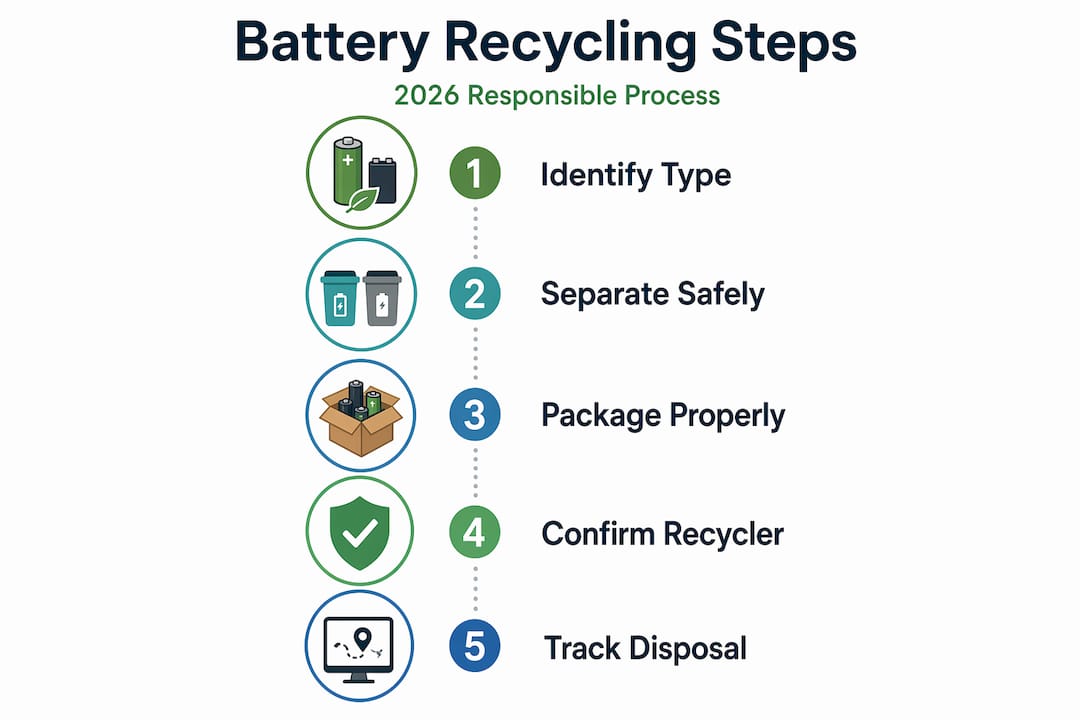
Reading the battery label matters. Look for the chemistry abbreviation printed near the positive terminal or on the case. “Li-ion” or “LiPo” signals lithium-based chemistry and triggers higher-care handling protocols. “NiMH” or “NiCd” signals regulated heavy metals. If the label is gone, check the manufacturer’s documentation for the device.
Understanding these distinctions is not technical trivia. Batteries designed for easy disassembly with consistent materials improve recycling efficiency and the purity of recovered materials. Knowing what you have helps you route it to the right processor.
Preparation: collection, storage, and transport
Safe preparation is where most individuals and organizations fail. You cannot just throw batteries in a bin and call it recycling. Physical handling mistakes cause fires in transit and contaminate collection loads.
Here are the non-negotiable steps to follow before any battery leaves your hands:
- Tape every terminal. Battery terminals should be taped individually with non-conductive tape or placed in separate plastic bags before bulk storage. A loose 9V bouncing against another in a cardboard box can arc and start a fire.
- Never overfill containers. Pressure or mechanical deformation on lithium-ion cells triggers thermal runaway. Keep containers loosely packed and leave room for expansion.
- Sort by chemistry. Mixing chemistries in one bin makes the recycler’s job harder and increases the chance that hazardous types get misrouted.
- Label your storage containers. Mark them clearly: “Mixed alkaline,” “Li-ion only,” or “Lead-acid.” This matters for staff awareness and for any transport documentation you may need.
- Check local regulations. Many states classify lithium-ion and NiCd batteries as hazardous waste for transport purposes. California, New York, and several others impose specific quantity thresholds before you need a hazardous waste manifest.
Pro Tip: For organizations collecting batteries in bulk, assign a single trained employee as the “battery point person” who inspects every deposit for damage before it enters the main storage container. This one step prevents the vast majority of storage-related incidents.
Damaged or swollen lithium-ion batteries deserve a separate call-out. Damaged Li-ion batteries must be stored in non-combustible containers and segregated immediately from standard collection points. Standard drop-off locations are not equipped to handle them. If you find a battery that is puffed, cracked, leaking, or emitting heat, do not put it in a drawer or a regular recycling bin. Contact a hazardous waste disposal company directly.
“Treat a swollen lithium-ion battery like a minor emergency. Isolate it in a metal container, keep it away from flammables, and arrange specialist pickup within 24 hours.”
Vetting and working with certified recyclers
Handing batteries to a recycler does not guarantee responsible processing. The downstream chain of custody matters as much as the hand-off. Batteries handed to an uncertified broker have ended up landfilled in developing countries, which is both an environmental failure and a legal liability for the original generator.
Follow these steps when selecting and managing a recycling vendor:
- Verify certification. Look for R2v3 (Responsible Recycling) or e-Stewards certification. Both require audited downstream tracking and prohibit export of hazardous materials to non-OECD countries. Auditing vendors for these certifications is the baseline for any serious battery recycling program.
- Request a chain-of-custody report. A credible recycler provides documentation showing where each battery chemistry went after pickup, what process was applied, and what was recovered. Ask for a sample report before you sign anything.
- Clarify refurbishment vs. full recycling. This distinction matters financially. Commercial recyclers often prioritize full recycling over refurbishment even when batteries still have usable capacity, which reduces the value you can recover. Ask specifically what percentage of batteries are evaluated for second-life use.
- Negotiate value-sharing. If your organization generates significant battery volume, recovered metals like lithium, cobalt, and nickel have market value. Contracts with a recovered-value sharing model align the recycler’s incentives with yours better than flat-fee agreements.
- Set reporting intervals. Monthly or quarterly recycling reports give you data to demonstrate compliance, track environmental impact, and identify gaps in your collection program.
Pro Tip: Request a facility tour or a virtual walkthrough before committing to a vendor. Legitimate recyclers welcome the scrutiny. Those who resist or deflect that request are telling you something important.
For organizations managing laptop batteries or IT equipment at scale, Usedcartridge offers laptop battery recycling services with documented chain-of-custody and compliance support built in. For broader guidance on vetting recyclers across electronics categories, their B2B recycling compliance guide walks through the full vendor evaluation framework.
Emerging technologies and policies in 2026
Battery recycling is changing fast, and staying current gives you better options and better economics. Two forces are reshaping the field: automation and legislation.
On the technology side:
- Hydrometallurgical recycling can recover up to 93% of lithium, nickel, and cobalt at temperatures under 200 degrees Celsius. Compared to pyrometallurgy (the older high-heat approach), it uses less energy and produces cleaner recovered material. More certified recyclers are adopting this process, which means better value recovery for batteries you hand off.
- The EU mandates 50% minimum material recovery from batteries by 2027, which is accelerating adoption of AI-assisted disassembly lines. These systems use laser cutting and machine vision to safely process EV battery packs at volume without human hands near reactive cells.
- Automation combined with AI diagnostics can extend battery life by up to 30% through second-life applications, reducing the volume that needs to go through full recycling in the first place.
On the policy side, Illinois passed a law mandating that producers fund statewide battery recycling for medium-format batteries up to 25 lbs or 2,000 watt-hours, covering e-bikes, scooters, and power tools. This extended producer responsibility (EPR) model shifts costs to manufacturers and expands public collection infrastructure. Other states are watching Illinois closely, and similar legislation is advancing in several others. If you manage a recycling program for an organization, EPR laws may create new free or subsidized drop-off points in your area within the next 12 to 24 months.
Common challenges and how to solve them
Even well-intentioned programs run into problems. Here is a quick-reference guide to the most common issues and the recommended fix:
| Challenge | Common mistake | Recommended solution |
|---|---|---|
| Damaged or swollen batteries | Storing them with regular collection | Isolate in metal container; contact hazardous waste specialist |
| Limited local drop-off options | Waiting for a convenient option indefinitely | Use mail-in programs (Call2Recycle, battery manufacturer take-back) |
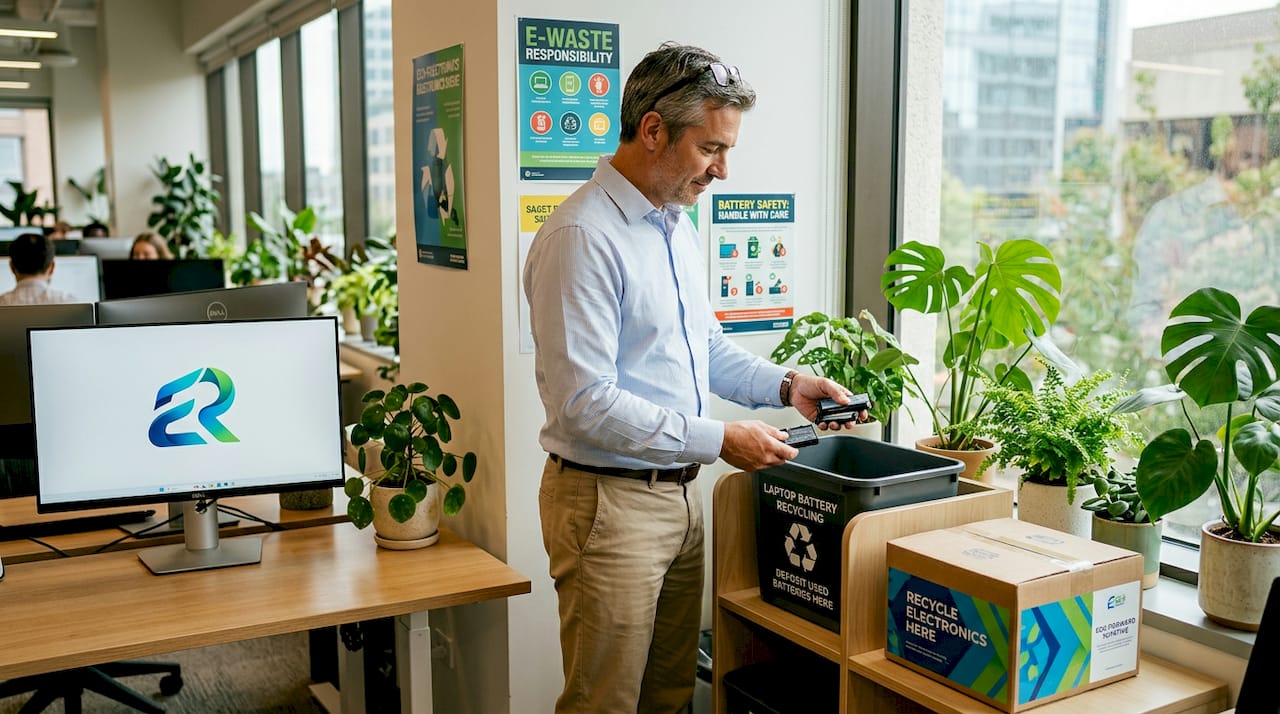
| Staff or household non-compliance | Posting a policy and assuming it works | Post visual guides at collection points; do brief regular reminders |
| Mixed or unknown chemistry batteries | Guessing and routing incorrectly | Flag for vendor inspection; never assume; check manufacturer spec |
| Complex hybrid or multi-cell packs | Attempting DIY disassembly | Send intact to certified recycler; never open lithium packs yourself |
The EPA’s own guidance notes that improving consumer labeling and collection accessibility are the two highest-leverage interventions for raising recycling rates. For organizations, that translates directly: put clearly labeled collection bins where people already are, and make the visual instructions impossible to miss. For individuals, it means knowing your local options before you have a problem, not after.
If you handle electronics with embedded batteries such as laptops, tablets, or power banks, responsible recycling of these devices requires treating the embedded battery as a hazardous component, not an afterthought.
My honest take on battery recycling management
I have worked alongside enough recycling programs and vendor relationships to have strong opinions on where people get this wrong. The most common failure is not ignorance. It is optimism. People assume that handing a bag of batteries to a drop-off bin is the end of their responsibility. It is not.
The chain of custody after that bin is where the environmental risk either gets addressed or gets exported somewhere else. I have seen organizations with excellent internal sorting practices unknowingly send batteries to brokers who landfill them offshore. That is not recycling. That is outsourced guilt.
What actually works is treating battery recycling like any other compliance obligation: document it, audit it, and verify the outcomes. The vendor vetting steps I described above are not optional add-ons for large organizations. They are the minimum standard for anyone who wants to make an honest claim about eco-friendly battery management.
I am genuinely optimistic about hydrometallurgical processing and the wave of EPR legislation. These are structural improvements that reduce the burden on individuals and create real market incentives for responsible handling. But technology and policy will not do the whole job. They still require people and organizations who pay attention, ask the right questions, and refuse to accept vague answers from vendors.
The most durable recycling programs I have seen share one trait: someone in the organization owns the topic personally. Not as a checkbox. As a responsibility. If that is you, this guide gives you the foundation. The rest is follow-through.
— Keith
Ready to handle battery and e-waste recycling the right way?
If managing battery recycling in-house feels complex, Usedcartridge can take the burden off your team. Their certified e-waste recycling services cover batteries, laptops, computers, and other electronics with verified chain-of-custody documentation and full compliance support.

Whether you need scheduled pickup, on-site processing, or help structuring a compliant recycling program for your organization, Usedcartridge provides professional handling that meets environmental and data security standards. Their sustainable recycling solutions are built for businesses that want results they can actually verify and report. Request a free quote today and stop guessing about what happens after the drop-off.
FAQ
What types of batteries can be recycled?
Most battery chemistries including lithium-ion, nickel-cadmium, lead-acid, and alkaline can be recycled through appropriate channels. Each type requires a different collection and processing route based on its chemical composition and hazard profile.
How do you safely store batteries before recycling?
Tape each terminal with non-conductive tape or place batteries in individual plastic bags before storing them in a container. Keep lithium-ion batteries away from flammables and never overfill storage containers.
What certifications should a battery recycler have?
Look for R2v3 or e-Stewards certification, both of which require audited downstream tracking and prohibit irresponsible export of hazardous battery materials. Always request a chain-of-custody report before partnering with a recycler.
What should I do with a swollen or damaged lithium-ion battery?
Place it immediately in a non-combustible metal container, keep it away from other materials and heat sources, and contact a hazardous waste specialist for pickup. Standard drop-off bins are not equipped to handle damaged lithium-ion cells safely.
How are producer responsibility laws changing battery recycling?
Laws like Illinois’ 2026 mandate require manufacturers to fund public battery collection programs for medium-format batteries, which expands drop-off infrastructure and shifts costs away from consumers and municipalities.