
Safe disposal of IT assets is defined as the structured process of securely erasing or physically destroying sensitive data on retired devices while managing those devices responsibly to prevent unauthorized access, regulatory penalties, and environmental harm. The industry term for this practice is IT Asset Disposition, or ITAD. Every organization that retires computers, servers, hard drives, or mobile devices faces the same core risk: residual data on decommissioned hardware is a live liability until it is verifiably destroyed. According to IBM’s 2025 Cost of a Data Breach Report, data breaches cost an average of $4.44 million globally and $10.22 million in the United States alone. That figure reframes ITAD from an operational afterthought into a financial imperative. Frameworks like NIST 800-88, certifications like R2v3 and NAID AAA, and regulations like HIPAA and GDPR all converge on one requirement: documented, verifiable destruction.
Why safe disposal of IT assets is a non-negotiable business obligation
The risks of improper IT asset disposal fall into four categories: financial, legal, reputational, and environmental. Each one is serious on its own. Combined, they represent an existential threat to organizations that treat disposal as a low-priority task.
Financial exposure is the most quantifiable risk. The $10.22 million U.S. average breach cost cited above does not include regulatory fines, which can compound the damage significantly. HIPAA penalties reach $1.9 million per violation category per year. GDPR fines cap at 4% of global annual revenue. A single improperly wiped hard drive can trigger both.

Legal liability extends further than most organizations realize. Under frameworks like RCRA and data privacy mandates, originating organizations remain liable for disposed assets throughout the entire disposal chain, even after handing them to a third-party vendor. Outsourcing disposal does not transfer legal responsibility. It only transfers physical custody.
Reputational damage is harder to price but often more lasting. Morgan Stanley paid $60 million to settle claims after a vendor decommissioned thousands of servers and hard drives without proper data destruction, leaving customer data exposed. The incident did not just cost money. It cost years of trust rebuilding with regulators and clients.
The difference between compliant organizations and those in breach headlines is the ability to produce a Certificate of Destruction and transparent reporting on every retired asset.
The risks compound when you factor in environmental liability. Only about 22% of e-waste is properly collected and recycled globally. Organizations that send IT equipment to unqualified recyclers or landfills face penalties under state and federal environmental statutes, including the Resource Conservation and Recovery Act.
What are the best practices and standards for secure IT asset disposal?
NIST 800-88 Rev. 1 is the foundational standard for data sanitization. It defines three levels of destruction, each suited to different risk profiles and device types.
- Clear uses software-based overwriting to remove data from storage media. This method works for devices being redeployed internally where the risk of interception is low.
- Purge applies cryptographic erasure or more intensive overwriting techniques. This is appropriate for devices leaving organizational control, such as those sold or donated.
- Destroy covers physical destruction through shredding, disintegration, or incineration. NIST 800-88 defines Destroy as the appropriate method for highly sensitive data where no residual risk is acceptable.
Choosing the right level depends on the sensitivity of the data the device held, not just the device type. A decommissioned laptop from HR holds a different risk profile than a server from a general conference room.
Certificates of destruction and chain of custody
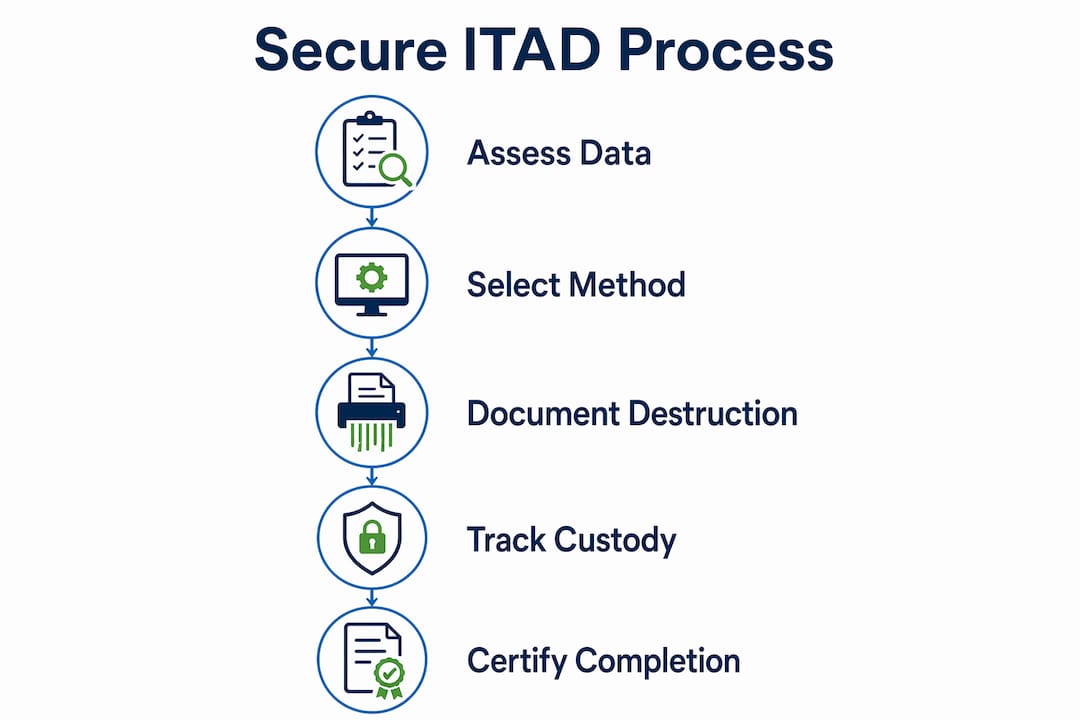
A certificate of destruction is not a formality. It documents the destruction method used, the timestamp, the asset serial number, and the technician responsible. Certificates of destruction serve as auditable proof during regulatory reviews, insurance claims, and litigation. Without one, your organization cannot demonstrate compliance, regardless of what actually happened to the device.
Chain-of-custody tracking closes the gap between intent and proof. A documented chain of custody tracks every asset from the moment it is decommissioned through final destruction or disposition, reconciling serial numbers at each handoff. This matters because breaches linked to disposal often occur during transit, not at the destruction facility itself.
Selecting a certified ITAD vendor
Vendor certification is where many organizations make a costly mistake. Logos on a vendor’s website may reflect expired certifications. Verify current R2v3, NAID AAA, and ISO 27001 certifications through official directories maintained by Responsible Recycling (R2) and the National Association for Information Destruction (NAID). A vendor whose certification lapsed six months ago offers no compliance protection.
Pro Tip: Request a sample certificate of destruction and a sample chain-of-custody report before signing any ITAD vendor contract. If a vendor cannot produce both within 24 hours, that is a disqualifying signal.
How does IT asset disposal balance security, environment, and financial recovery?
A structured ITAD program does more than protect data. It generates measurable returns and limits environmental liability simultaneously. Organizations that treat retired assets as pure cost centers leave real money on the table.
Financial recovery through remarketing
Refurbishing and remarketing retired assets converts disposal from a cost into a revenue offset. A three-year-old server that no longer meets your performance requirements may still hold significant resale value in secondary markets. ITAD vendors with remarketing capabilities assess residual value before defaulting to destruction, which means organizations recover hardware costs that would otherwise be written off entirely.
Environmental responsibility and regulatory pressure
The environmental impact of IT waste is no longer a soft concern. California’s SB 253 ties emission and e-waste reporting together for large organizations, demanding transparent, documented disposal practices as part of broader ESG disclosures. Organizations that cannot demonstrate responsible disposal face both regulatory exposure and investor scrutiny.
Responsible recycling prevents toxic materials like lead, mercury, and cadmium from entering soil and water systems. Partnering with an R2-certified recycler ensures that components not suitable for resale are processed through eco-friendly equipment disposal channels that meet federal and state environmental standards.
Pro Tip: Build your ITAD program to generate a disposal report that maps directly to your ESG disclosure requirements. The documentation you need for data compliance and the documentation you need for environmental reporting overlap significantly. One audit trail can serve both.
Comparing disposal outcomes
| Disposal method | Data security | Environmental impact | Financial outcome |
|---|---|---|---|
| Physical destruction | Highest: no residual data risk | Requires certified recycling of remnants | No resale value recovered |
| Certified erasure and resale | High: verified to NIST Purge standard | Low impact: extends device lifecycle | Highest financial recovery |
| Responsible recycling | Medium: depends on vendor rigor | Low impact: materials recovered properly | Minimal recovery, cost offset |
| Uncontrolled disposal | None: data exposure certain | High impact: toxic materials released | No recovery, high liability |
The table makes the case plainly. Uncontrolled disposal is the only option that produces no benefit and maximum risk across every dimension.
How to implement a compliant IT asset disposal program
Building a defensible ITAD program requires process discipline at every stage, not just at the point of destruction. The following steps reflect current best practices for organizations subject to HIPAA, GDPR, or state-level data privacy laws.
- Conduct a full asset inventory. Map every device in your environment, including endpoints, servers, networking equipment, and mobile devices. You cannot dispose of what you have not tracked. Asset lifecycle management tools like ServiceNow and Lansweeper automate this process for large environments.
- Define data destruction policies by risk tier. Not every device requires physical shredding. Classify assets by the sensitivity of data they held and assign the appropriate NIST 800-88 sanitization level to each tier.
- Vet and contract certified ITAD vendors. Verify R2v3, NAID AAA, and ISO 27001 certifications through official directories. Require contractual commitments to chain-of-custody documentation and certificate issuance for every asset.
- Maintain a complete audit trail. ITAD programs document every step, providing auditable proof required by regulatory frameworks and ESG reporting. Store certificates of destruction and chain-of-custody records for a minimum of seven years, or longer if your industry mandates it.
- Review and update the program annually. Regulations change. Vendor certifications expire. New device types enter your environment. An annual review of your ITAD policy and vendor relationships prevents compliance gaps from accumulating unnoticed.
- Incorporate third-party risk management. Effective ITAD programs treat retired assets as high-risk objects until data destruction is verified and documented. Apply the same vendor due diligence to ITAD partners that you apply to cloud providers and payroll processors.
For organizations managing hard drive disposal at scale, on-site destruction with witnessed shredding and real-time certificate generation eliminates transit risk entirely and simplifies audit documentation.
Key takeaways
Safe IT asset disposal requires verified destruction, documented chain of custody, and certified vendor partnerships to protect organizations from financial, legal, and environmental liability.
| Point | Details |
|---|---|
| Data breach costs are severe | U.S. breaches average $10.22 million, making verified disposal a direct cost-control measure. |
| Legal liability follows the asset | Organizations remain liable through the entire disposal chain, even after vendor handoff. |
| NIST 800-88 sets the standard | Use Clear, Purge, or Destroy based on data sensitivity, not device type alone. |
| Certificates of destruction are mandatory | Without documented proof of destruction, regulatory compliance cannot be demonstrated. |
| Disposal can generate financial returns | Certified erasure and remarketing recover hardware value that uncontrolled disposal eliminates. |
What I’ve learned about where IT asset disposal programs actually fail
Most disposal failures I have seen do not happen because organizations chose the wrong destruction method. They happen because someone assumed the process was handled and never verified it. A department ships a box of old laptops to a vendor. No one requests a certificate of destruction. No one reconciles serial numbers. Six months later, a breach investigation traces the exposure back to one of those devices.
The uncomfortable truth is that outsourcing disposal creates a false sense of security. Organizations hand off physical custody and mentally close the file. But legal liability does not transfer with the hardware. If that vendor cuts corners, your organization answers to the regulator, not the vendor.
Documentation is the only thing that converts disposal from a risk into a controlled process. A certificate of destruction tied to a serial number, a timestamp, and a named technician is not bureaucratic overhead. It is your defense in a regulatory audit or a class-action lawsuit. Organizations that treat documentation as optional are not saving time. They are accumulating unpriced liability.
The other pattern I consistently observe is ad hoc disposal triggered by office moves or hardware refresh cycles. These events create pressure to move fast, which is exactly when process discipline breaks down. Build your ITAD program before you need it urgently. The organizations that handle disposal well treat it as a standing operational process, not an emergency response.
— Keith
Secure, certified IT asset disposal with Usedcartridge

Usedcartridge provides certified e-waste recycling, secure data destruction, and IT asset recovery services designed for organizations that need audit-ready documentation and verified compliance. Every disposal engagement includes chain-of-custody tracking, certificates of destruction tied to individual asset serial numbers, and processing through R2-certified facilities. Whether you are retiring a single server or decommissioning an entire data center, Usedcartridge handles the full process from pickup through final disposition. Get a free quote for your IT asset recovery needs, or explore the full range of e-waste disposal services available for businesses of every size.
FAQ
What is IT asset disposal and why does it matter?
IT asset disposal, formally called IT Asset Disposition (ITAD), is the structured process of securely destroying data on retired devices and managing those devices responsibly. It matters because improperly disposed assets expose organizations to data breaches, regulatory fines, and environmental penalties.
What are the risks of improper IT asset disposal?
Improper disposal exposes residual data to unauthorized access, triggers HIPAA and GDPR penalties, and creates environmental liability under statutes like RCRA. U.S. data breaches linked to improper disposal average $10.22 million in total costs.
What certifications should an ITAD vendor hold?
Verify that any ITAD vendor holds current R2v3, NAID AAA, and ISO 27001 certifications through official directories. Logos displayed on vendor websites may reflect expired credentials, so always confirm certification status directly with the certifying body.
What is a certificate of destruction and do I need one?
A certificate of destruction documents the destruction method, date, asset serial number, and technician responsible for each disposed device. You need one for every asset to demonstrate compliance during regulatory audits, insurance reviews, or litigation.
Can IT asset disposal generate financial returns?
Yes. Certified erasure followed by remarketing recovers residual hardware value that would otherwise be lost. ITAD vendors with asset remarketing capabilities assess resale potential before defaulting to physical destruction, converting disposal costs into partial hardware budget offsets.