
Auditing IT asset disposal is the formal process of verifying that retired IT equipment is tracked, sanitized, and destroyed in compliance with regulatory mandates and security standards. IT asset disposition (ITAD) audits give organizations documented proof that sensitive data never leaves their control chain. Without that proof, NIST SP 800-88 violations become the most frequent and highest-risk category of audit findings. The consequences range from regulatory penalties to data breaches that cost far more than any disposal program. For IT managers, understanding why audit IT asset disposal processes exist is the first step toward building a program that survives scrutiny.
Why audit IT asset disposal: the core compliance case
An ITAD audit verifies three things: that every retired asset was inventoried by serial number, that each device was sanitized or destroyed according to an approved method, and that a Certificate of Destruction (CoD) exists for every device in scope. When any of those three elements is missing, auditors flag it as a control failure.
Auditors spend about 60% of their audit time reconciling CoD data against asset inventory records. That single statistic explains where most audit preparation effort belongs: not in the destruction room, but in the records room. A device can be physically destroyed correctly and still generate an audit finding if the paperwork does not match.

Regulatory frameworks make this non-negotiable. NIST SP 800-88 defines approved sanitization methods and requires documented evidence for each. HIPAA, SOX, and GDPR each impose their own record-keeping obligations on top of that baseline. Auditors use these frameworks as checklists, and every gap in your documentation is a potential line item in their findings report.
The role of audits in IT asset disposal also extends to governance. Auditors confirm that your organization has formal policies covering decommissioning, that those policies were followed, and that responsible parties can be identified for each step. That chain of accountability is what regulators and internal stakeholders need to see. Without it, disposal looks like an uncontrolled process rather than a managed one.
What causes IT asset disposal audits to fail?
83% of IT asset disposition audit findings arise from documentation gaps rather than sanitization failures. That number reframes the entire problem. Most organizations focus their compliance energy on choosing the right destruction method, when the real risk sits in how they record and reconcile what happened.
The most common documentation failures fall into four categories:
- Incomplete serialized inventories. 78% of organizations face audit findings because their asset inventories fail to reconcile with destruction records. Batch-level CoDs that list quantities rather than serial numbers are the leading cause.
- Compliance blind spots in transit. 52% of organizations fail audits due to tracking gaps for assets in transit or staging. A device that leaves your data center but has no logged handoff to the destruction vendor is an unaccounted asset in an auditor’s eyes.
- Ghost assets. Up to 40% of enterprises carry ghost assets: devices removed from active service but never formally tracked for disposal. These devices inflate your asset register, create unresolved inventory discrepancies, and represent live data security risks.
- Missing exception reports. Assets marked for destruction but lacking a CoD must have a documented explanation. Auditors classify missing certificates without explanation as major compliance failures, even when the device was returned under a lease or replaced under warranty.
Retrospective documentation is the single most detectable audit failure. Auditors are trained to identify records created after the fact. Fragmented timestamps, inconsistent formatting, and missing chain of custody entries all signal that records were assembled rather than captured in real time. Creating documentation concurrently with each disposal step is the only approach that holds up under scrutiny.
Pro Tip: Build exception reporting into your disposal workflow from day one. Every asset that exits your inventory without a matching CoD needs a documented reason: lease return, warranty swap, loss report, or transfer. Auditors treat unexplained gaps as the highest-risk findings on their list.
How to prepare documentation that passes an ITAD audit
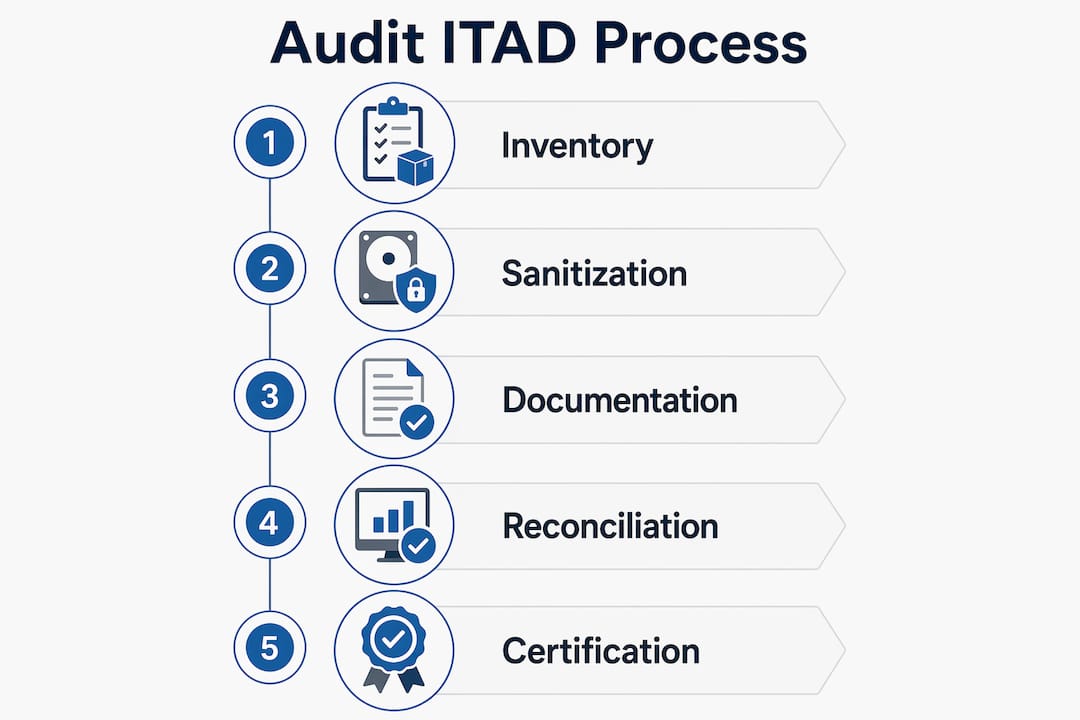
Audit-ready documentation is not a binder you assemble before the auditor arrives. It is a continuous record built in real time from the moment a device is decommissioned. The real measure of ITAD compliance is a tamper-evident chain of custody record that follows each asset from decommissioning through final destruction, not merely possession of a Certificate of Destruction.
A complete ITAD audit documentation package covers four control categories. The average package requires 14 specific document types across governance documents, operational logs, CoD data, and chain of custody records. Building toward that standard gives you a clear target.
Here is how to structure your preparation:
- Assign serial-number-level tracking from decommission. Every device gets a unique record the moment it leaves active service. Batch tracking is not sufficient for audit purposes.
- Log every custody handoff. Record who transferred each device, to whom, when, and under what authorization. This applies to internal moves as well as handoffs to your disposal vendor.
- Require serial-number-level CoDs from your vendor. Batch-level destruction certificates that do not link to specific device serial numbers cause frequent audit flags. Reject any CoD that does not match your inventory line by line.
- Run monthly reconciliation. Compare your decommissioned asset list against received CoDs every month. Gaps identified monthly are correctable. Gaps identified during an audit are findings.
- Document every exception. Any device that exits your disposal pipeline without a CoD needs a written explanation filed in the same system as your other disposal records.
- Integrate automated tracking where possible. Automated, real-time logs that bridge decommissioning and final disposition reduce compliance gaps. Platforms that connect your asset management system with sanitization software eliminate the manual reconciliation step that creates most errors.
You can also review the IT disposal documentation process for a detailed breakdown of compliance documentation requirements by control category.
Pro Tip: Convert your monthly reconciliation from a manual spreadsheet exercise to an automated database query. When your asset management system and your vendor’s destruction records share a common serial number field, reconciliation takes minutes instead of days and produces a timestamped audit log as a byproduct.
What benefits does auditing IT asset disposal provide beyond compliance?
Compliance is the minimum outcome of a well-run ITAD audit program. The operational benefits extend well beyond satisfying a regulator.
- Ghost asset elimination. Ghost assets can consume up to 25% of IT budgets through inflated software licenses, maintenance contracts, and insurance premiums on devices that no longer exist in active service. An audit forces reconciliation that surfaces these assets and removes them from your cost base.
- Data breach risk reduction. Every untracked device is a potential breach vector. Auditing your IT asset recovery process closes the gap between what you think was destroyed and what was actually destroyed.
- Governance transparency. Audited disposal programs produce records that satisfy internal stakeholders, board-level risk committees, and external regulators without requiring a separate reporting effort. The documentation built for audit readiness doubles as your governance evidence.
- Smarter lifecycle decisions. Disposal audit data reveals patterns in how assets are decommissioned. If devices consistently reach end of life two years before their scheduled replacement, that signals a procurement or lifecycle policy problem worth correcting.
- Sustainability verification. Verified disposal records confirm that devices were recycled or destroyed through compliant channels rather than sent to landfill. That documentation supports sustainability reporting and environmental compliance goals.
The role of IT asset recovery in this picture is often underestimated. Recovering residual value from retired assets before destruction reduces net disposal costs and creates a financial incentive to decommission devices on schedule rather than letting them accumulate as ghost assets. Audited recovery programs also produce the documentation needed to prove that recovered assets were handled securely before resale or recycling.
Asset tracking plays a direct role in making all of this work. You can learn more about asset tracking in recycling and how it connects disposal records to operational outcomes. For organizations managing IT assets under ISO 27001 or similar frameworks, asset management and ISO 27001 compliance provides additional context on how disposal audits fit into broader information security governance.
The audit documentation problem is worse than most IT teams realize
The pattern I see most often is this: an IT team runs a solid physical destruction process, works with a reputable vendor, and genuinely believes their program is compliant. Then an auditor arrives and flags three findings before lunch. Every one of them is a documentation issue.
The physical destruction was fine. The vendor was certified. The problem was that the CoDs listed quantities, not serial numbers. The transit logs had a four-day gap when devices sat in a staging area. And two devices from a lease return were never formally removed from the disposal scope with an exception report. None of those failures involved a single byte of data being exposed. But all three are audit findings, and in a regulated environment, findings have consequences.
The uncomfortable truth about IT asset disposition audits is that they test your record-keeping discipline more than your security practices. Organizations that treat documentation as an afterthought will fail audits even when their destruction processes are technically sound. The safe disposal of IT assets is not just a physical act. It is a documented chain of events that an auditor can follow from decommission to destruction without encountering a single gap.
My recommendation: treat audit readiness as a continuous operational state, not a pre-audit sprint. Real-time tracking, monthly reconciliation, and exception reporting built into your standard workflow cost far less than a remediation effort after findings are issued. Compliance is not a burden when it is built into the process from the start. It becomes the process.
— Keith
How Usedcartridge supports audit-ready IT asset disposal
Usedcartridge provides certified IT asset recovery and destruction services built around the documentation requirements that ITAD audits demand. Every disposal engagement generates serial-number-level Certificates of Destruction tied directly to your asset inventory, eliminating the batch-level CoD problem that causes most audit flags.

The chain of custody documentation Usedcartridge produces covers every handoff from pickup through final disposition, giving your team a complete, tamper-evident record ready for auditor review. For organizations managing electronic waste disposal at scale, Usedcartridge also offers on-site destruction with real-time logging, so your compliance record is complete before the vendor truck leaves your facility. Request a quote for IT asset recovery services and get a documentation package that holds up under audit scrutiny.
Key takeaways
Auditing IT asset disposal protects organizations from data breaches, regulatory penalties, and ghost asset costs by enforcing a documented, serial-number-level chain of custody from decommissioning through destruction.
| Point | Details |
|---|---|
| Documentation drives audit outcomes | 83% of ITAD audit findings come from documentation gaps, not sanitization failures. |
| Serial-number CoDs are non-negotiable | Batch-level Certificates of Destruction cause frequent audit flags; require device-level records from every vendor. |
| Real-time logging prevents failures | Retrospective documentation is detectable and treated as a governance failure by auditors. |
| Ghost assets carry real costs | Untracked devices can consume up to 25% of IT budgets and create active data security risks. |
| Exception reports close compliance gaps | Every asset leaving disposal scope without a CoD needs a documented explanation to avoid a major audit finding. |
FAQ
What is an IT asset disposal audit?
An IT asset disposal audit is a formal review that verifies retired devices were tracked by serial number, sanitized according to approved standards such as NIST SP 800-88, and supported by Certificates of Destruction that reconcile with the asset inventory.
Why do most ITAD audits result in findings?
83% of ITAD audit findings arise from documentation gaps rather than sanitization failures. Incomplete serialized inventories and batch-level CoDs are the two most common causes.
What is a ghost asset and why does it matter for audits?
A ghost asset is a device removed from active service but never formally tracked for disposal. Up to 40% of enterprises carry ghost assets, which inflate IT budgets and create unresolved discrepancies that auditors flag as control failures.
How often should organizations reconcile disposal records?
Monthly reconciliation of decommissioned asset lists against received Certificates of Destruction is the standard practice. Gaps caught monthly are correctable; gaps found during an audit become formal findings.
What documents does a complete ITAD audit package include?
The average ITAD audit documentation package requires 14 specific document types across four control categories: governance documents, operational logs, Certificate of Destruction data, and chain of custody records.