
WEEE compliance is the legal obligation for producers and sellers of electrical and electronic equipment to manage the collection, recycling, and safe disposal of their products at end of life. Formally grounded in the EU WEEE Directive (Directive 2012/19/EU) and its national equivalents worldwide, this framework operates on the principle of Extended Producer Responsibility (EPR). EPR shifts the cost and organization of waste management directly onto producers, not taxpayers or local governments. For business owners and compliance managers selling electronics in Europe or the UK, understanding what WEEE compliance means is not optional. The penalties for getting it wrong are severe, and the rules vary significantly by country.
What is WEEE compliance and who does it apply to?
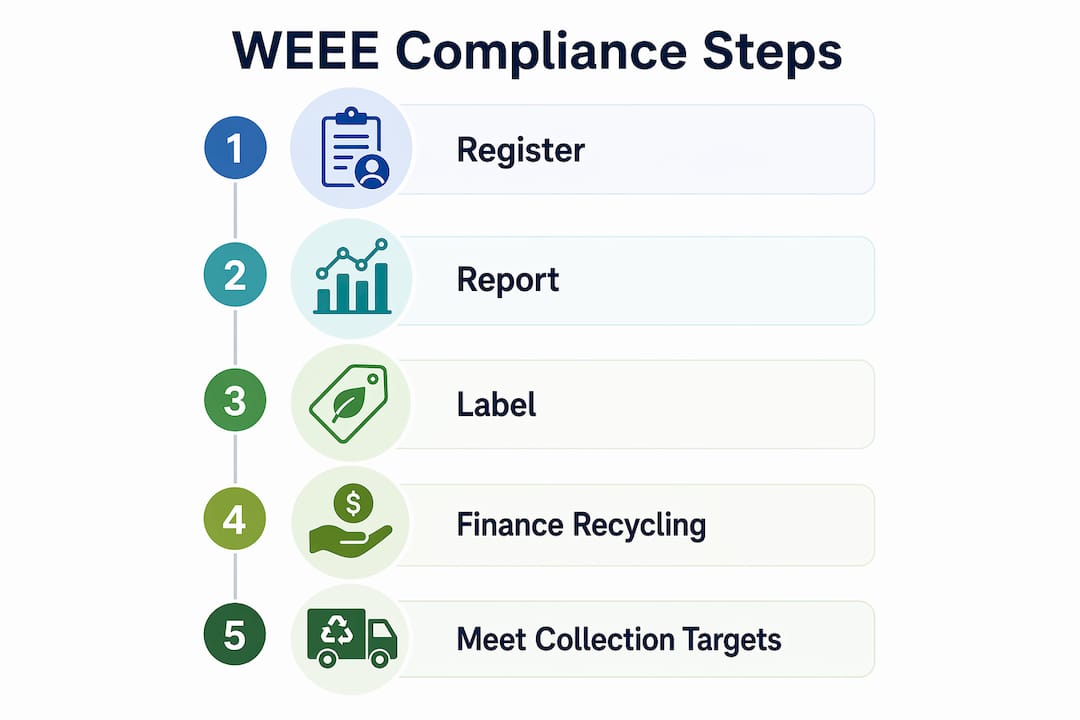
WEEE compliance requires producers of electrical and electronic equipment (EEE) to register with national authorities, report volumes placed on the market, finance recycling programs, and label products correctly. The term “producer” covers a wider group than most business owners expect. Manufacturers, importers, brand owners, distance sellers, and retailers who sell EEE under their own brand all qualify as producers under the directive.

The open-scope regime since 2018 covers virtually all electrical and electronic equipment, including small components and consumables at the point of discarding. That scope is broader than most compliance managers initially assume. If a product uses electricity or contains electronic components, it almost certainly falls under WEEE rules.
The environmental goal behind all of this is clear. EPR incentivizes manufacturers to design products that are easier to recycle and repair, advancing circular economy goals. Compliance is not just a legal checkbox. It directly shapes how products are designed and how waste is handled at scale.
Which products and businesses fall under WEEE rules?
The scope of WEEE compliance covers six broad product categories under the open-scope regime. Compliance managers must map their entire product line against these categories carefully.
Covered product types include:
- Large household appliances: refrigerators, washing machines, dishwashers
- Small household appliances: vacuum cleaners, toasters, clocks
- IT and telecommunications equipment: computers, laptops, printers, phones
- Consumer electronics: televisions, cameras, audio equipment
- Lighting equipment: fluorescent lamps, LED fixtures
- Electrical and electronic tools: drills, sewing machines, welding equipment
- Medical devices: monitoring equipment, dialysis machines (with some exclusions)
- Monitoring and control instruments: thermostats, smoke detectors
- Automatic dispensers: vending machines, ATMs
- Toys, leisure, and sports equipment: electronic games, treadmills
Certain categories are excluded. Military equipment, large-scale fixed installations, and some implanted medical devices fall outside the directive’s scope. However, the open-scope nature of WEEE means compliance managers must diligently map product lines and check even small components for inclusion.
Online sellers and distance sellers face a specific challenge. If you sell into another EU member state without a physical presence there, you must appoint an authorized representative in that country. That representative takes on legal responsibility for your WEEE obligations in that jurisdiction. Ignoring this requirement is one of the most common and costly mistakes cross-border sellers make.
What are the main WEEE compliance obligations?
WEEE compliance involves a set of concrete, recurring obligations. Missing any one of them can trigger enforcement action. Here is the standard sequence businesses must follow:
-
Register with national authorities. No single EU-wide registration covers all member states. You must register separately in every country where you place products on the market. Online marketplaces now verify registration status and block listings for unregistered producers.
-
Report annually on volumes placed on the market. Producers must maintain weight-based tracking of EEE sold and WEEE collected to demonstrate achievement of minimum recovery and recycling rates per product category. This data is submitted annually to national regulators.
-
Label products correctly. WEEE products must carry the crossed-out wheeled bin symbol and a date code. Producers must also provide consumers with clear instructions on how to return or recycle the product.
-
Finance and organize take-back and recycling. Producers must either join a Producer Compliance Scheme or independently arrange financing for collection, treatment, and recycling. In the UK, producers placing over 5 tonnes of EEE annually must join a Producer Compliance Scheme. Those under 5 tonnes can register directly with environmental regulators.
-
Share technical information with recyclers. Within one year of placing a product on the market, producers must provide treatment information to re-use centers and recyclers. This includes details on hazardous materials, component locations, and disassembly instructions.
-
Maintain records and cooperate with audits. Documentation of compliance activities must be kept and made available to national authorities on request.
Pro Tip: Join a Producer Compliance Scheme early, even if your volumes are low. Schemes handle reporting, collection financing, and regulatory updates on your behalf, which reduces the administrative burden significantly for smaller businesses.
How is WEEE compliance enforced, and what happens if you fail?
Enforcement of WEEE compliance sits with national authorities in each member state, and the consequences of non-compliance are serious. Penalties must be effective, proportionate, and dissuasive under the directive’s requirements. In practice, that means financial penalties, market access bans, and full liability for waste management costs.
In Germany, non-compliance with WEEE laws can result in fines up to €100,000, and authorities may block market access or force product recalls. Similar strict enforcement applies across the EU, with penalties designed to be effective and dissuasive.
The enforcement mechanism that catches most online sellers off guard is marketplace blocking. Major e-commerce platforms now check producer registration numbers before allowing listings. An unregistered producer cannot sell on those platforms in the relevant country. This is not a theoretical risk. It is an operational reality that has forced many cross-border sellers to halt sales while scrambling to register.
Distance sellers face the sharpest exposure. Cross-border sellers without authorized representatives face registration blocks and full waste management cost liability. Appointing a representative in each destination state is a legal requirement, not a best practice. The cost of appointing a representative is modest compared to the cost of a market ban or a six-figure fine.
Fragmented national implementations create additional complexity. A business that is fully compliant in France may be out of compliance in Poland due to procedural differences in registration deadlines, reporting formats, or scheme membership requirements. Multi-jurisdictional tracking is not optional for businesses selling across borders. You can review the current electronic disposal regulations that apply to businesses to get a clearer picture of what each jurisdiction requires.
What practical steps ensure WEEE compliance across multiple countries?
Building a reliable WEEE compliance program across multiple jurisdictions requires a structured approach. Ad hoc responses to individual country requirements create gaps and increase risk.
Start with these foundational steps:
- Map your markets. Identify every country where your products are placed on the market. Include online sales channels, not just physical retail. Each country of sale triggers separate registration obligations.
- Register in each jurisdiction. Complete national registration before placing products on the market in that country. Do not wait until you receive a penalty notice.
- Appoint authorized representatives. For distance sales into EU member states where you have no physical presence, appoint a representative via written mandate. This is a legal requirement under Directive 2012/19/EU.
- Join Producer Compliance Schemes. Schemes simplify reporting, manage collection financing, and keep you updated on regulatory changes. They are the most practical route for businesses without dedicated compliance teams.
- Implement volume tracking systems. You need accurate weight-based data on EEE placed on the market and WEEE collected. Spreadsheets work for small volumes, but purpose-built compliance software handles multi-country reporting more reliably.
- Update labeling and consumer information. Confirm that every product carries the crossed-out wheeled bin symbol, the correct date code, and recycling instructions in the local language of each market.
- Audit your compliance annually. Review registration status, reporting submissions, and scheme membership in every active jurisdiction before annual deadlines.
Pro Tip: Set calendar reminders for annual reporting deadlines in each country where you are registered. Deadlines vary by member state, and missing one can trigger penalties even when your underlying compliance program is sound.
The EU member state collection target adds another layer of accountability. EU member states must collect at least 65% of average EEE placed on the market or 85% of WEEE generated annually. This target is under review by december 31, 2026. Producers who contribute to collection programs help their member states meet these targets, which reduces the risk of regulatory tightening in future years.
For businesses managing hardware recycling challenges across multiple sites or countries, the operational complexity of WEEE compliance compounds quickly. Building the right systems early is far cheaper than fixing compliance failures after enforcement action.
Key Takeaways
WEEE compliance requires producers to register, report, label, and finance recycling in every country where they sell electrical or electronic equipment, with no single registration covering all EU member states.
| Point | Details |
|---|---|
| EPR is the core principle | Producers bear full cost and responsibility for end-of-life waste management of their products. |
| Open scope covers nearly everything | Virtually all EEE sold since 2018 falls under WEEE rules, including small components. |
| Registration is country-specific | Separate registration is required in each EU member state where products are placed on the market. |
| Penalties are significant | Non-compliance can result in fines up to €100,000, market bans, and full waste liability in Germany and across the EU. |
| Authorized representatives are mandatory | Distance sellers must appoint a legal representative in each destination member state or face registration blocks. |
The compliance complexity no one talks about enough
Most articles on WEEE compliance focus on the obligations themselves. What gets less attention is how much the fragmented national implementations actually cost businesses in time and money, even when they are trying to comply in good faith.
I have seen businesses with solid compliance programs in their home market get blindsided when they expand into a new EU country. The registration process, the scheme membership requirements, the reporting deadlines, and even the labeling rules differ enough between member states to create real operational friction. A business that handles France correctly will not automatically handle the Netherlands correctly.
The upcoming EU directive review, due by the end of 2026, is likely to tighten collection targets and possibly harmonize some national procedures. That is good news in the long run, but it also means compliance programs built today may need updating within the next 12 to 24 months. Building flexibility into your compliance infrastructure now is the right move.
My honest recommendation: treat WEEE compliance as a business process, not a one-time registration task. Assign ownership to a specific person or team. Schedule annual audits. Budget for authorized representatives in each market. And work with a compliance service provider or a Producer Compliance Scheme that actively monitors regulatory changes. The cost of proactive compliance is a fraction of the cost of enforcement action. Beyond the legal obligation, businesses that demonstrate genuine commitment to environmental standards in e-waste management build stronger reputations with customers and partners who care about sustainability.
— Keith
How Usedcartridge supports your WEEE compliance and e-waste needs
Usedcartridge specializes in e-waste logistics, secure data destruction, and electronics disposal planning for businesses that need compliant, documented solutions.

Whether you are managing end-of-life IT equipment, planning a device refresh, or working through the logistics of WEEE-compliant disposal across multiple sites, Usedcartridge provides the operational support to get it done correctly. Services include e-waste logistics and recycling, secure data destruction with certification, and structured electronics disposal planning tailored to your business size and regulatory obligations. Contact Usedcartridge for a free quote and find out how straightforward compliant disposal can be.
FAQ
What does WEEE compliance mean for a business?
WEEE compliance means your business must register with national authorities, report volumes of electrical and electronic equipment placed on the market, finance recycling programs, and label products with the crossed-out wheeled bin symbol in every country where you sell.
Does WEEE compliance apply to online sellers?
Yes. Online and distance sellers are treated as producers under the WEEE Directive and must register in each EU member state where they sell. They must also appoint an authorized representative in destination countries where they have no physical presence.
What is the WEEE Directive?
The WEEE Directive (Directive 2012/19/EU) is the EU law that establishes Extended Producer Responsibility for electrical and electronic equipment, requiring producers to manage the collection, treatment, and recycling of their products at end of life.
What are the penalties for WEEE non-compliance?
Penalties vary by country but must be effective and dissuasive under EU law. In Germany, fines can reach €100,000, and authorities can block market access or force product recalls. Unregistered distance sellers also face full liability for waste management costs.
Do UK businesses need to comply with WEEE regulations?
Yes. The UK has its own WEEE Regulations, which require producers placing over 5 tonnes of EEE annually to join a Producer Compliance Scheme. Producers under that threshold can register directly with environmental regulators such as the Environment Agency.