
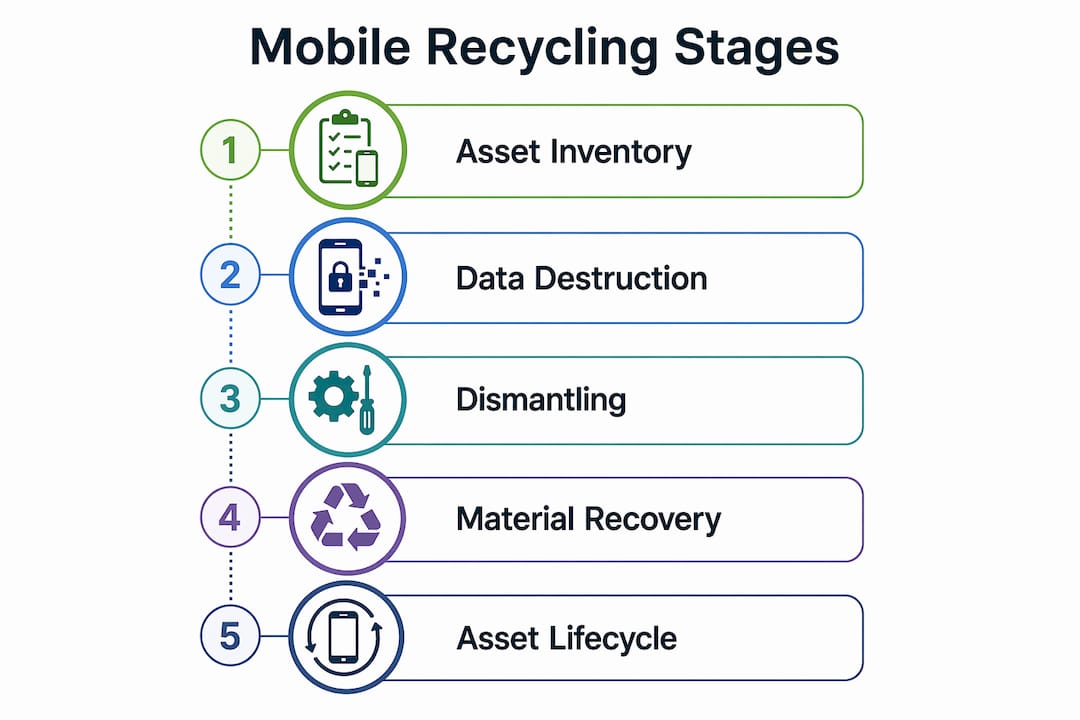
A mobile device recycling workflow is a structured, multi-stage process that covers secure data destruction, compliant dismantling, and material recovery for businesses disposing of obsolete smartphones and tablets. Without a formal process, organizations face two compounding risks: data breaches from inadequately wiped devices and regulatory penalties from improper e-waste disposal. NIST SP 800-88 sets the federal standard for data sanitization, and environmental regulations govern how lithium-ion batteries and hazardous materials must be handled. A well-built smartphone recycling workflow protects corporate data, recovers material value, and keeps your organization audit-ready.
What does a mobile device recycling workflow require to work?
Every effective mobile device recycling workflow starts with a complete asset inventory. Each device must be logged with its serial number, IMEI, assigned user, and current MDM enrollment status before it moves anywhere. Certified recycling facilities maintain chain-of-custody documentation and issue certificates of recycling, which are the foundation of audit transparency and compliance.
Core tools and prerequisites
The logistics layer matters as much as the data layer. GPS-tracked transport and tamper-evident packaging prevent unauthorized access during transit. Mobile Device Management (MDM) integration lets IT teams trigger wipe commands and confirm enrollment status before physical handoff.

The table below outlines the minimum requirements for a compliant workflow:
| Requirement | Purpose |
|---|---|
| Asset inventory with IMEI and serial numbers | Enables chain-of-custody tracking from collection to final disposition |
| MDM enrollment records | Confirms wipe status and flags offline devices before handoff |
| GPS-tracked, tamper-evident transport | Prevents unauthorized access during transit |
| Vendor certification documentation | Verifies recycler compliance with environmental and data security standards |
| Decommissioning authorization policy | Creates an auditable approval trail for each device retirement |
Key policy elements your organization needs in place before processing begins:
- Written decommissioning authorization signed by IT and the device’s assigned manager
- A vendor audit checklist confirming the recycler holds current R2 or e-Stewards certification
- A defined escalation path for offline devices that cannot receive remote wipe commands
- Retention schedule for certificates of destruction and recycling records
Pro Tip: Log every device’s MDM enrollment status at the point of collection, not at the point of disposal. Discovering an unenrolled device after it has left your facility creates a compliance gap that no certificate can close.
How do you securely destroy data on mobile devices?
Data destruction is the highest-risk step in the entire mobile recycling process. Factory resets leave sensitive data recoverable on 73% of smartphones, which means the default consumer approach is not acceptable for corporate devices. NIST SP 800-88 defines three sanitization levels that set the compliance bar for enterprise disposal.
NIST SP 800-88 sanitization levels explained
Clear overwrites storage with non-sensitive data and works for low-risk devices being reassigned internally. Purge uses cryptographic erasure or multi-pass overwriting to defeat laboratory-grade forensic recovery. Destroy means physical destruction, typically shredding or crushing, and applies when a device cannot be verified as sanitized by software alone.
Certified erasure tools use multi-pass overwriting and cryptographic erasure with automated reporting, which creates the audit trail NIST compliance requires. Cryptographic erase works by destroying the encryption key that protects stored data, rendering the remaining ciphertext unreadable without any physical intervention.
Common pitfalls that create compliance gaps
- Relying on factory reset alone. Forensic tools recover data from factory-reset devices at a high rate. Factory reset does not meet NIST Purge or Destroy standards.
- Skipping offline device retrieval. Remote MDM wipe commands fail on 23% of corporate devices that have been offline for seven or more days. Those devices require physical retrieval and on-site destruction.
- Ignoring activation locks and carrier data. Activation locks persist through a factory reset and can expose corporate network credentials to whoever receives the device next.
- Omitting DEP and ABM de-enrollment. Enterprise Device Enrollment Program and Android Business Manager profiles survive factory resets and can automatically reinstall MDM configurations on a new user’s device, granting unintended network access.
- No verification documentation. Destruction without a serialized certificate of destruction leaves your organization unable to prove compliance in an audit.
For high-security environments, dual-method destruction combining cryptographic erasure with physical shredding satisfies both the NIST Purge and Destroy levels simultaneously. Learn more about NIST-compliant sanitization standards and how they apply to mobile devices.
Pro Tip: Always clear SIM cards, eSIM profiles, and carrier accounts as a separate checklist item. Carrier deactivation is one of the most frequently skipped steps in bulk corporate disposal, and it leaves data vulnerable even after a successful device wipe.
What happens during dismantling, battery handling, and material recovery?
Physical dismantling is where eco-friendly mobile recycling and regulatory compliance intersect. The process follows a strict sequence to protect workers, prevent environmental contamination, and recover maximum material value.
Lithium-ion batteries must be removed and processed separately under hazardous materials regulations. Improper battery handling creates fire risks and releases toxic compounds into soil and groundwater. Certified facilities use specialized discharge equipment and store batteries in fire-resistant containers before sending them to dedicated battery recyclers.
After battery removal, devices are dismantled into their constituent material categories:
- Plastics and glass: Sorted by polymer type for downstream plastic recyclers
- Printed circuit boards: Sent to smelters that recover copper, tin, and lead
- Precious and rare-earth metals: Cell phones contain gold, silver, copper, and rare-earth elements that certified smelters reclaim, feeding back into the supply chain
- Displays and screens: Processed separately due to indium and other regulated compounds
The material recovery phase directly supports circular economy goals. Reclaiming metals from retired devices reduces the demand for virgin mining, which carries its own environmental and geopolitical costs. The table below summarizes key materials and their regulatory handling requirements:
| Material | Handling requirement |
|---|---|
| Lithium-ion batteries | Separate processing under hazardous materials regulations |
| Printed circuit boards | Certified smelting for metal recovery |
| Precious metals (gold, silver) | Refinery processing for circular supply chain reuse |
| Display panels | Separate stream due to indium and regulated compounds |
| Plastics | Polymer sorting for downstream recycling |
How does recycling integrate with corporate asset lifecycle programs?
Mobile device lifecycle management works best when recycling is built into the asset refresh schedule, not treated as an afterthought. Enterprise best practices recommend a 36-month refresh cycle for corporate mobile fleets, balancing security patch coverage, device performance, and resale value. Devices retired at 36 months still carry meaningful secondary market value, which offsets procurement costs for the next fleet cycle.
MDM platforms play a central role in synchronizing the wipe and decommission process at scale. When a device reaches its retirement date, MDM can trigger an automated wipe command, flag the device for physical retrieval if it goes offline, and update the asset register simultaneously. This reduces the manual coordination burden on IT teams managing hundreds of devices at once.
A complete lifecycle policy covers these elements:
- Defined retirement triggers: age, performance threshold, or security patch end-of-life
- Authorization workflow: manager approval, IT sign-off, and asset register update
- Vendor audit schedule: annual review of recycler certifications and chain-of-custody practices
- Sustainability metrics: weight of materials recovered, CO2 offset estimates, and landfill diversion rates for corporate ESG reporting
Sustainability reporting is now a procurement and investor expectation for many organizations. Certified recyclers provide the serialized data you need to populate ESG dashboards accurately. Explore responsible device repurposing as a complementary strategy that extends device life before the recycling stage.
Pro Tip: Schedule device collection drives two to three months before the fiscal year closes. Devices retired early enough in the cycle retain higher resale value, and the proceeds can be documented as an offset against IT procurement costs in your annual budget.
For organizations managing remote workers, understanding mobile security service gaps is critical before initiating any bulk device retirement program.
Key Takeaways
A compliant mobile device recycling workflow requires certified data destruction, documented chain-of-custody, and material recovery processes that together protect corporate data and meet environmental regulations.
| Point | Details |
|---|---|
| Factory reset is not sufficient | 73% of factory-reset devices remain vulnerable; use NIST SP 800-88 cryptographic erasure or physical destruction. |
| Offline devices need physical retrieval | Remote MDM wipes fail on 23% of offline devices, making on-site destruction the only compliant option. |
| Battery handling is regulated | Lithium-ion batteries require separate processing under hazardous materials rules to prevent fire and contamination. |
| Chain-of-custody documentation is mandatory | Serialized tracking and certificates of recycling are required for audit transparency and regulatory compliance. |
| Integrate recycling with the 36-month refresh cycle | Retiring devices on schedule maximizes resale value and keeps the asset lifecycle program audit-ready. |
The detail most organizations miss until it costs them
After working through dozens of corporate device retirement programs, the pattern I see most often is not a failure of intent. Organizations genuinely want to do this right. The failure is almost always in the gap between policy and execution at the device level.
The factory reset assumption is the most expensive mistake. IT teams know, in theory, that a factory reset is not enough. But under deadline pressure, with hundreds of devices to process, the reset becomes the default because it feels like “doing something.” The 73% forensic recovery rate is not a theoretical risk. It is a documented outcome that has driven real regulatory investigations.
The second gap is carrier and activation lock clearance. I have seen organizations complete a certified wipe, receive a certificate of destruction, and still have devices circulating with active corporate Apple IDs or Google Workspace accounts attached. The wipe addressed the storage. Nobody cleared the identity layer. Those are two separate tasks, and both need to appear on the checklist.
The organizations that run this well treat recycling as a security control, not a disposal task. They assign it to the same team that manages endpoint security, they budget for certified vendor audits, and they track material recovery data for ESG reporting. That framing changes everything. When recycling is a security control, offline device retrieval gets resourced. When it is just disposal, it gets delegated to whoever has time.
The environmental side is not a soft benefit either. Recovering gold, silver, and rare-earth elements from retired devices reduces reliance on mining supply chains that carry real geopolitical and environmental costs. That argument lands with procurement and sustainability officers in ways that pure compliance framing does not.
— Keith
Usedcartridge handles secure recycling from collection to certification
Businesses that need a verified, end-to-end solution for retiring mobile devices can rely on Usedcartridge for certified data destruction, chain-of-custody documentation, and compliant material recovery. Every device processed receives serialized tracking and a certificate of destruction that satisfies NIST SP 800-88 audit requirements.

Usedcartridge provides secure e-waste logistics services for organizations of all sizes, including on-site destruction for offline devices that cannot receive remote wipe commands. The team also supports IT asset recovery and disposition planning, helping businesses recover resale value from retired fleets while maintaining full compliance. Request a free quote to get a tailored plan for your next device retirement cycle.
FAQ
What is a mobile device recycling workflow?
A mobile device recycling workflow is a structured process covering asset inventory, certified data destruction, compliant dismantling, and material recovery for retired corporate devices. It ensures data security and environmental compliance at every stage.
Why is a factory reset not enough for corporate device disposal?
Factory resets leave sensitive data recoverable on 73% of smartphones. NIST SP 800-88 requires cryptographic erasure or physical destruction to meet enterprise data sanitization standards.
What happens when a device is offline and cannot receive a remote wipe?
Remote MDM wipe commands fail on 23% of corporate devices offline for seven or more days. Those devices require physical retrieval and on-site destruction to close the compliance gap.
What materials are recovered during mobile device recycling?
Cell phones contain gold, silver, copper, and rare-earth elements that certified smelters reclaim during the recycling process. Lithium-ion batteries are removed and processed separately under hazardous materials regulations.
How often should businesses refresh and recycle their mobile device fleets?
Enterprise best practices recommend a 36-month refresh cycle for corporate mobile fleets. Devices retired at that interval retain secondary market value and remain within active security patch support windows.