
A proper monitor disposal procedure is defined as the documented process of securely erasing data, categorizing equipment, and routing monitors to certified recycling or trade-in channels in full compliance with environmental and data security law. Skipping any step exposes your organization to regulatory fines, data breach liability, and ESG reporting gaps. The two governing frameworks businesses must know are NIST 800-88 for data sanitization and R2v3 or e-Stewards certification for recycling vendors. Getting this right is not optional. Improper landfill disposal is illegal in many U.S. jurisdictions, and enforcement is tightening heading into 2026.
What are the legal and environmental requirements for monitor disposal?
Monitors contain a short list of materials that make them legally hazardous waste in most U.S. states. Those materials include lead in older CRT glass, mercury in CCFL backlights, cadmium in circuit components, and brominated flame retardants throughout the casing. Each of these substances is regulated under federal and state environmental law. Sending a monitor to a general landfill does not just create an environmental problem. It creates a legal one.
More than 25 states have enacted explicit e-waste landfill bans. Several states, including California, operate extended producer responsibility programs that require manufacturers to fund take-back and recycling infrastructure. Your organization’s obligation under these laws depends on your state, your monitor volume, and whether you qualify as a large-quantity generator of electronic waste. Penalties for non-compliance range from civil fines to criminal liability for repeat offenders.

The environmental stakes are concrete. Hazardous substances like mercury, lead, and cadmium contaminate soil and groundwater when monitors are improperly discarded. Responsible recycling removes and processes these components under controlled conditions, preventing release into the environment. That is why the choice of recycling vendor matters as much as the decision to recycle.
Certified recyclers holding R2v3 or e-Stewards certification follow strict environmental and hazardous waste protocols. These certifications are audited by third parties, which means a certificate from a qualified facility carries legal weight in a compliance review. Working with an uncertified vendor transfers liability back to your organization.
Key legal obligations to verify before disposal:
- Confirm your state’s specific e-waste landfill ban and take-back requirements
- Verify that your recycling vendor holds current R2v3 or e-Stewards certification
- Retain all manifests and certificates as proof of compliant disposal
- Check whether your monitor volume triggers large-quantity generator rules
- Confirm that your vendor handles state-level take-back mandates on your behalf
How do you securely erase data from monitors before disposal?
Modern monitors are not passive screens. Many enterprise-grade and smart displays contain embedded storage, onboard processors, and network credentials that persist after the device is powered off. A monitor connected to a corporate network may retain Wi-Fi passwords, display configuration data, or cached credentials. Treating these devices as simple glass panels during disposal is a compliance failure waiting to happen.
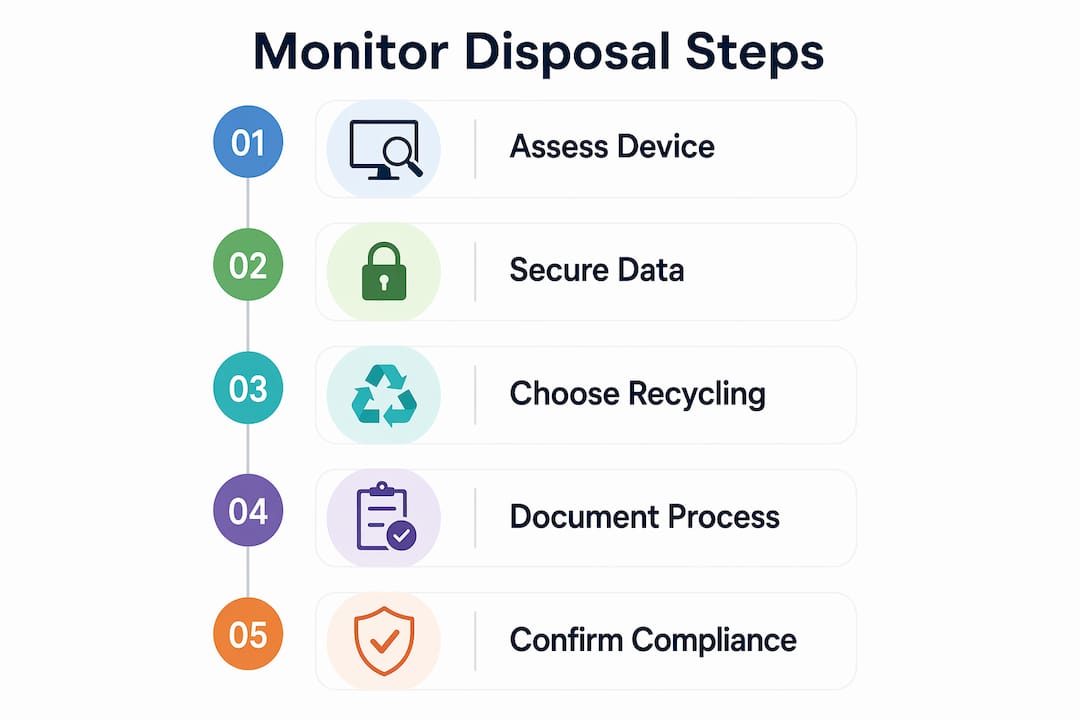
Data sanitization must comply with NIST 800-88 guidelines, and the process must be documented with a Certificate of Data Destruction for each device or batch. That certificate is mandatory evidence under ISO 27001 audits. Without it, your organization cannot demonstrate that sensitive data was properly handled, which creates an audit gap that regulators and insurers will flag.
The three accepted sanitization methods under NIST 800-88 are:
- Clear — overwrite data using software tools; appropriate for low-sensitivity storage
- Purge — use cryptographic erase or hardware-level commands to render data unrecoverable
- Destroy — physical destruction of storage media; used when purge is not technically feasible
Cryptographic erase is the fastest compliant option for monitors with flash-based storage. It renders all stored data unreadable by destroying the encryption key. For devices where embedded storage cannot be accessed through standard interfaces, physical destruction of the storage component is the only compliant path. Usedcartridge provides certified data destruction services that cover both approaches and issue documentation suitable for ISO 27001 audits.
Pro Tip: Never rely on a factory reset to sanitize a smart monitor before disposal. Factory resets do not meet NIST 800-88 standards and leave recoverable data on embedded storage. Always use a certified wiping service or cryptographic erase, and get the certificate in writing.
Connecting data sanitization to broader secure data destruction practices is especially critical for organizations handling regulated data under HIPAA, GLBA, or state privacy laws. The certificate you receive is not just a receipt. It is a legal record that proves your organization met its duty of care.
What are the main monitor recycling methods for businesses?
Not every monitor should follow the same disposal path. The right channel depends on the device’s age, condition, and embedded technology. Routing a two-year-old LED monitor to a shredder when it qualifies for trade-in is a financial and environmental mistake that procurement teams make more often than they should.
Monitors under four years old with modern LED backlighting are strong candidates for trade-in or professional refurbishment. EPEAT Renew certification validates that refurbished monitors meet quality and data sanitization standards, giving buyers confidence in the secondary market. Trade-in programs typically return financial credit that offsets the cost of new equipment, making them the highest-value disposal path for newer devices.
| Disposal pathway | Best for | Key benefit | Key risk |
|---|---|---|---|
| Trade-in or resale | Monitors under 4 years old, LED backlit | Financial recovery, EPEAT Renew eligible | Requires certified data sanitization first |
| Professional refurbishment | Functional monitors with minor wear | Extends product life, reduces e-waste | Must meet quality standards for resale |
| Certified recycling | End-of-life or damaged monitors | Full compliance, hazardous material handling | No financial return |
| OEM take-back program | Any age, bundled with new purchase | Simplified documentation, state compliance | Availability varies by manufacturer |
Older monitors with CCFL backlighting require a separate handling process. CCFL lamps contain mercury, and certified facilities use enclosed extraction systems to prevent mercury vapor release during disassembly. Sending CCFL monitors to a general recycler without this capability creates both an environmental violation and a worker safety risk.
Pro Tip: Schedule monitor disposal to coincide with your next equipment refresh order. Many certified vendors and OEM trade-in programs will coordinate pickup of old monitors at the same time as delivery of new equipment, reducing logistics costs and simplifying documentation.
What documentation do you need to prove disposal compliance?
Documentation is where most organizations fail their audits. The problem is not that businesses skip recycling. The problem is that they manage each document separately, creating gaps that auditors call “orphaned assets.” An orphaned asset is a monitor that appears in your inventory but has no corresponding sanitization or recycling certificate. That gap is treated as a potential data breach in a compliance review.
Fragmented compliance documentation increases audit risk significantly. The solution is a single chain-of-custody document that links three records: the original asset inventory entry, the Certificate of Data Destruction, and the recycling or transfer certificate from the certified facility. When these three documents connect to the same serial number, the audit trail is complete.
Required documents for a compliant disposal record:
- Asset inventory record — serial number, model, condition, and assigned user at time of disposal
- Certificate of Data Destruction — confirms NIST 800-88 compliant sanitization with method used
- Recycler certification — current R2v3 or e-Stewards certificate from the receiving facility
- Signed transfer manifest — chain-of-custody document signed at pickup and receipt
- Recycling completion certificate — confirms final processing and material recovery
OEM trade-in programs often bundle reverse logistics, sanitization, and recycling into one contract, which produces consolidated documentation automatically. This is the lowest-friction path to audit readiness. These programs also handle state-level take-back requirements, removing one more compliance variable from your team’s plate.
Complete disposal records also feed directly into ESG reporting. Scope 3 emissions reporting under frameworks like GHG Protocol requires data on the end-of-life treatment of sold or disposed products. A clean chain-of-custody record gives your sustainability team the verified data they need without additional tracking work.
How to implement a monitor disposal procedure step by step
A repeatable disposal process starts with a complete asset inventory, not with a call to a recycler. Organizations that skip the inventory phase routinely discover monitors that were never logged, devices assigned to departed employees, and equipment sitting in storage rooms with no record of their data status.
- Conduct a full asset audit. Catalog every monitor by serial number, model, age, backlight type (LED or CCFL), and current condition. Flag devices with embedded storage or smart functionality for priority data sanitization.
- Categorize by disposal pathway. Group monitors into trade-in candidates (under four years old, LED backlit), refurbishment candidates (functional but older), and certified recycling (end-of-life or damaged). This step determines financial recovery potential before any device leaves the building.
- Complete data sanitization before transfer. Apply the appropriate NIST 800-88 method for each device type. Collect a Certificate of Data Destruction for every serial number before the device moves off-site.
- Contract a certified vendor. Select a recycler or trade-in partner holding current R2v3 or e-Stewards certification. Confirm that the vendor provides signed transfer manifests and recycling completion certificates as standard deliverables.
- Schedule pickup to align with refresh cycles. Coordinate disposal logistics with incoming equipment delivery to reduce handling costs and keep the asset inventory current.
- Consolidate all documents into a single chain-of-custody record. Link the asset inventory entry, sanitization certificate, and recycling certificate for each serial number. Store records for a minimum of three years, or longer if required by your industry’s data retention rules.
Your electronics disposal planning process should treat monitors as a distinct category from general IT equipment, because the combination of hazardous materials and potential embedded storage creates a dual compliance obligation that standard IT disposal workflows often miss.
Key Takeaways
A compliant monitor disposal procedure requires data sanitization under NIST 800-88, a certified recycling vendor with R2v3 or e-Stewards credentials, and a consolidated chain-of-custody record linking every serial number from inventory to final processing.
| Point | Details |
|---|---|
| Legal compliance is mandatory | Landfill disposal is illegal in most U.S. states; fines and criminal liability apply to repeat violations. |
| Data sanitization must be certified | NIST 800-88 methods and a Certificate of Data Destruction are required for ISO 27001 audit readiness. |
| Match monitors to the right pathway | Monitors under four years old qualify for trade-in or EPEAT Renew refurbishment, recovering financial value. |
| Chain-of-custody prevents audit gaps | One consolidated document linking inventory, sanitization, and recycling certificates eliminates orphaned assets. |
| Vendor certification reduces liability | Only R2v3 or e-Stewards certified recyclers transfer legal protection to your organization. |
Why the documentation gap is the real disposal risk
I have reviewed disposal programs at organizations that genuinely believed they were compliant. They had recycling contracts, they had vendor certificates, and they had good intentions. What they did not have was a single document that connected a specific monitor’s serial number from the asset register all the way through to the recycling completion certificate. That gap is what auditors find. And when they find it, the question immediately becomes: where did that device go, and what data was on it?
The fix is not complicated, but it requires discipline at the front end of the process. Run the asset audit before you call the vendor. Sanitize before you transfer. Collect the certificate before you close the work order. I have seen organizations save significant time and money by bundling data sanitization, reverse logistics, and recycling into a single vendor contract rather than managing three separate relationships. The documentation consolidates automatically, and the audit trail is clean from day one.
The other mistake I see regularly is defaulting to recycling for every device without evaluating trade-in first. Procurement teams that skip the trade-in assessment for newer monitors leave real financial value on the table. A monitor that qualifies for EPEAT Renew refurbishment has residual market value. That value offsets disposal costs and supports your organization’s sustainability metrics at the same time. Run the evaluation. The math almost always favors trade-in for devices under four years old.
— Keith
Usedcartridge makes compliant monitor disposal straightforward
Businesses managing large monitor fleets face a real coordination challenge: data sanitization, certified recycling, and compliance documentation all need to happen in the right sequence, with the right vendors, and with complete records. Usedcartridge handles all three as an integrated service.

Usedcartridge provides e-waste logistics and certified recycling for businesses disposing of monitors and other IT equipment, with chain-of-custody documentation included as standard. For organizations with smart displays or storage-enabled monitors, Usedcartridge’s equipment destruction services deliver NIST 800-88 compliant sanitization and issue Certificates of Data Destruction suitable for ISO 27001 audits. If your organization is planning a hardware refresh or needs to clear a backlog of end-of-life monitors, Usedcartridge offers free quotes and pickup coordination to simplify the entire process.
FAQ
What makes a monitor disposal procedure legally compliant?
A legally compliant procedure requires routing monitors to a certified recycler holding R2v3 or e-Stewards certification and retaining signed transfer manifests and recycling certificates. Most U.S. states ban e-waste landfill disposal, so using a certified vendor is both a legal and environmental requirement.
Do all monitors require data sanitization before disposal?
Any monitor with embedded storage, smart functionality, or network connectivity requires NIST 800-88 compliant sanitization before disposal. Standard displays with no onboard storage present lower risk, but a documented assessment confirming that status is still best practice for audit readiness.
How much does it cost to recycle a CRT monitor?
CRT monitor recycling costs range from $25 to $35 through private recyclers, while some government programs charge $10 or less. The cost reflects the specialized handling required to safely extract lead-containing glass and other hazardous components.
What is a Certificate of Data Destruction and why does it matter?
A Certificate of Data Destruction is a formal document confirming that a specific device was sanitized using a NIST 800-88 approved method. It is mandatory evidence in ISO 27001 audits and serves as legal proof that your organization met its data security obligations during disposal.
Where can businesses recycle computer monitors responsibly?
Businesses should use certified recyclers holding R2v3 or e-Stewards certification, OEM take-back programs, or professional IT asset recovery services like Usedcartridge. These channels provide the documentation and hazardous material handling that general recyclers cannot.