
Product stewardship for electronics is the shared responsibility across producers, sellers, users, and downstream handlers to minimize environmental and data-security risks throughout an electronic product’s lifecycle. According to the Product Stewardship Institute, the U.S. Environmental Protection Agency (EPA), and the National Conference of State Legislatures (NCSL), this framework often takes the form of Extended Producer Responsibility (EPR) at the state level, meaning your organization may face real legal obligations, not just voluntary best practices.
Two things your business must control from day one:
- Core operational controls: secure data destruction, documented chain-of-custody from pickup through final processing, and certificates of destruction and recycling for every device batch
- Vendor verification: confirm your recycler or IT asset disposition (ITAD) partner holds current R2 (Responsible Recycling) or e-Stewards certification before signing anything
Pro Tip: Before scheduling any pickup, pull the certification number from your vendor’s R2 or e-Stewards certificate and verify it directly on the certifying body’s public registry. Expired certificates are a common audit failure point.
Table of Contents
- Why product stewardship matters to your organization
- How does product stewardship work across U.S. states?
- What are your concrete responsibilities as a business?
- What data destruction standards should you follow?
- How do you vet a recycler or ITAD vendor?
- What costs and timelines should you plan for?
- How do you get started this quarter?
- Key Takeaways
- The part most businesses get wrong about stewardship
- Usedcartridge handles secure, compliant e-waste disposal for businesses
- Useful sources for electronics stewardship compliance
Why product stewardship matters to your organization
Stewardship affects three things simultaneously: legal compliance, data security, and material recovery value. Treat any one of them in isolation and you create exposure in the other two.
EPR programs for e-waste are now mandated in multiple U.S. states, according to NCSL. That number has grown steadily, and businesses operating across multiple states face a patchwork of registration, reporting, and collection obligations that do not align neatly with each other. Missing a state registration deadline can trigger fines; using an uncertified recycler can expose you to data-breach liability if devices resurface with intact data.
The tangible business impacts of ignoring stewardship:
- Audit exposure: regulators and enterprise clients increasingly request chain-of-custody documentation during vendor audits
- Data-breach risk: improperly wiped drives sent to informal recyclers have appeared in secondary markets with recoverable data
- Regulatory fines: state EPR non-compliance can result in civil penalties
- Lost material value: resource recovery from electronics (precious metals, copper, glass) can offset disposal costs when processed through certified channels
- Brand reputation: customers and partners increasingly scrutinize environmental and data-security practices during procurement reviews
How does product stewardship work across U.S. states?
Federal guidance provides the framework; state laws create the actual obligations. The EPA’s National Strategy for Electronics Stewardship outlines four federal pillars: greener product design, federal procurement leadership, increased domestic recycling capacity, and reducing harmful e-waste exports. None of these pillars carry direct enforcement teeth for private businesses. That enforcement lives at the state level.

| Dimension | Details |
|---|---|
| States with EPR laws | 25 states (NCSL) |
| Financing models | Producer-funded EPR (most states) or advanced recycling fees (consumer-paid at point of sale) |
| California fee example | Historical advanced recycling fee of $6–$10 per device at point of sale |
| Federal pillars | Design, procurement, domestic recycling, export reduction |
| Cross-border risk | Obligations can change when assets move across state lines |
The difference between voluntary stewardship and mandatory EPR matters practically. Under EPR, producers bear financial and operational responsibility for end-of-life collection. As a business disposing of equipment, you are a downstream handler, not a producer, but you still must use compliant collection channels and document the handoff. Shipping assets across state lines can trigger different reporting requirements, so verify the destination state’s rules before any transfer.
Actions businesses must take to stay compliant:
- Check state EPR registries (your state environmental agency’s website is the starting point)
- Confirm whether your equipment category is covered under your state’s program
- Follow any labeling or collection-point rules the state program specifies
- Retain proof of registration and collection receipts for audits
What are your concrete responsibilities as a business?
Businesses must manage environmental impacts and protect data through documented processes and verified vendor controls. Stewardship obligations are legal requirements, not optional corporate social responsibility gestures, and the Product Stewardship Institute is explicit on this point.
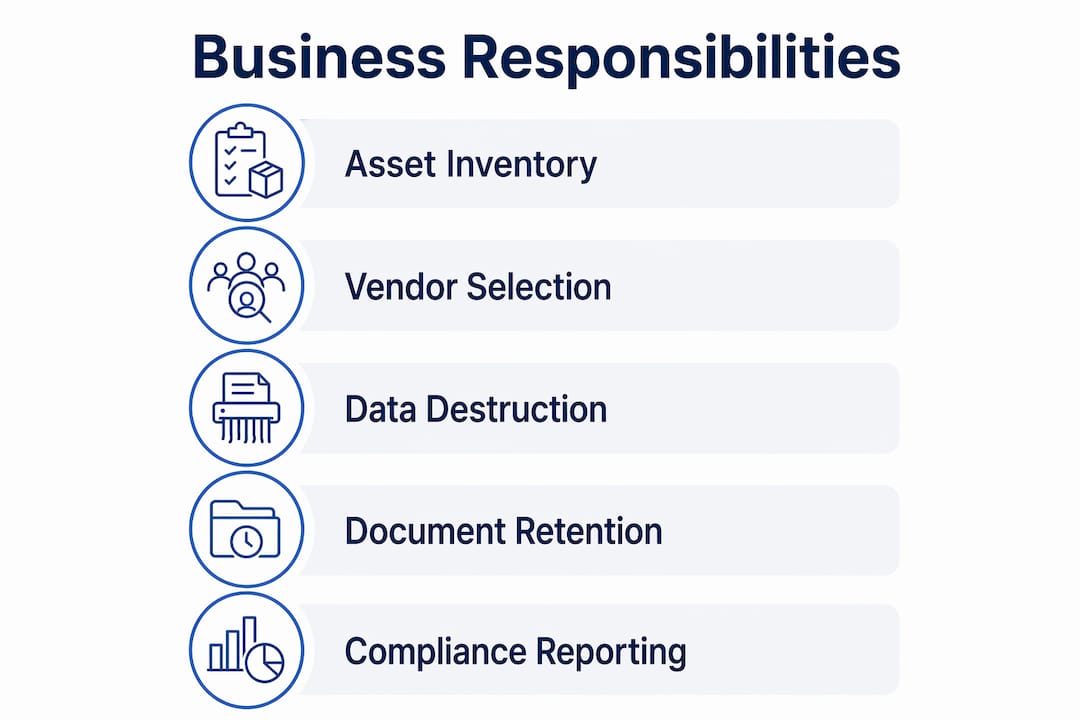
A step-by-step compliance checklist:
- Inventory and classify all electronics, separating data-bearing devices (laptops, servers, phones, storage media) from non-data-bearing equipment
- Determine state obligations for each location where devices originate or will be shipped
- Select a certified ITAD vendor or recycler holding current R2 or e-Stewards certification
- Obtain chain-of-custody documentation before the first pickup, not after
- Collect certificates of data destruction and recycling for every batch processed
- Meet reporting and registration requirements for any state EPR program covering your equipment
- Retain vendor insurance certificates and third-party audit summaries on file
Mandatory trust documents to collect and keep: Certificate of Data Destruction, Certificate of Recycling, chain-of-custody records, vendor certificate of insurance, third-party audit summaries, and state EPR registration proof. For electronics disposal planning, a structured approach to each of these steps reduces last-minute scrambling before audits.
Pro Tip: Keep a centralized asset-disposition log that ties each device’s serial number to its purchase record, pickup date, destruction method, and certificate number. That single document answers 90% of auditor questions.
What data destruction standards should you follow?
Follow NIST Special Publication 800-88 for data sanitization and document the specific method used on every certificate of destruction. NIST 800-88 defines three accepted approaches: clearing (logical overwrite for reusable media), purging (degaussing or cryptographic erase for higher-sensitivity data), and physical destruction (shredding or crushing for media that cannot be reused). The method must match the data classification of the device being processed.
On-site destruction keeps the chain of custody entirely within your facility or parking lot, which is the right call for classified data, healthcare records, or financial data. Off-site destruction costs less per unit but requires stronger contractual controls and verified downstream transparency to compensate for the gap in direct oversight.
Certifications and trust signals your vendor must hold:
- Current R2 or e-Stewards certification (verify the certificate number, not just the logo)
- SSAE 18 SOC reports where available for larger ITAD operations
- Published third-party audit findings, not just a summary letter
- Documented downstream processor lists showing where materials go after initial processing
Downstream transparency is where most informal recycling risks concentrate. A certified facility that cannot or will not name its downstream processors is a red flag regardless of its primary certification status. The EPA’s guidance on harmful e-waste exports identifies undisclosed downstream handling as the primary pathway for illegal export and unsafe processing. Demand the full processor list in writing before any engagement.
How do you vet a recycler or ITAD vendor?
Require verifiable third-party certification and documented downstream transparency before any engagement. A vendor’s marketing materials are not a substitute for a certificate number you can check yourself.
A reproducible vetting checklist:
- Verify current R2 or e-Stewards certification on the certifying body’s public registry
- Request sample certificates of destruction and recycling from recent client projects
- Ask for written chain-of-custody procedures, including downstream processor disclosure
- Confirm insurer limits and indemnity coverage in writing
- Request published third-party audit findings or SSAE reports
Recommended contract clauses: audit rights for your organization, downstream processor disclosure obligations, data-destruction standards explicitly tied to NIST 800-88, and breach notification timelines.
Red flags to walk away from:
- Vague or verbal chain-of-custody descriptions with no written procedure
- Refusal to disclose downstream processor names
- Certificates that lack serial numbers, device counts, or destruction method details
- Ambiguous answers about offshore export practices
For e-waste removal at the regional level, local collection partners can handle logistics while your primary ITAD vendor manages certified destruction. Separating collection from destruction is common for large-volume projects.
What costs and timelines should you plan for?
Costs vary by device type, destruction method, volume, and whether on-site service is required. Timelines typically run from same-day pickup for small batches to several weeks for large-scale enterprise projects.
Key cost drivers:
- Per-unit processing fees vs. bulk-rate pricing for high-volume projects
- On-site destruction premium vs. lower off-site rates
- Transportation and logistics, especially for geographically dispersed assets
- Certification and audit fees built into vendor contracts
- State EPR fees or advanced recycling fees where applicable (California’s historical model used a $6–$10 per-device fee at point of sale)
Producer-funded EPR programs in most states shift the primary financial burden to manufacturers, but businesses still absorb logistics and vendor costs. Resource recovery value from precious metals and copper in processed electronics can partially offset those costs when working through certified channels.
Timeline milestones to build into your project plan: asset inventory → vendor selection and contract → pickup or on-site destruction → data sanitization and physical processing → certificate issuance → state reporting submission.
How do you get started this quarter?
Prioritize three moves to reduce immediate risk: complete your asset inventory, select a certified vendor, and lock in your documentation process. Everything else follows from those three.
Quick-start steps:
- Run a full asset inventory and flag all data-bearing devices by data classification
- Identify state-specific EPR obligations for each location in your footprint
- Shortlist certified ITAD vendors, request chain-of-custody documentation, and verify certifications
- Schedule your first pickup or on-site destruction event
- Retain all final certificates and update your asset records immediately after processing
Sample questions to ask vendors before signing:
- What is your current R2 or e-Stewards certificate number, and where can I verify it?
- Who are your downstream processors, and can you provide that list in writing?
- What NIST 800-88 methods do you use for each media type?
- What are your insurer limits and indemnity terms?
- Can you provide published third-party audit findings from the past 12 months?
- What is your typical turnaround from pickup to certificate issuance?
Ownership by role: IT owns the asset inventory and device classification; procurement owns vendor selection and contract terms; compliance or legal owns state EPR registration, reporting, and certificate retention. For a detailed B2B compliance walkthrough, the overlap between these roles is where most organizations drop the ball.
Key Takeaways
Product stewardship for electronics is a legal compliance obligation in 25 U.S. states, not a voluntary program, and businesses that skip certified vendors and documented chain-of-custody face audit exposure, data-breach liability, and regulatory fines.
| Point | Details |
|---|---|
| Stewardship is often mandatory | EPR laws in 25 states create real legal obligations for businesses, not just producers. |
| NIST 800-88 is the data standard | Document the specific sanitization method (clear, purge, or destroy) on every certificate. |
| Certification is the primary trust signal | Verify R2 or e-Stewards certificate numbers on public registries before any vendor engagement. |
| Documentation simplifies audits | A centralized asset-disposition log tied to serial numbers and certificates answers most auditor questions. |
| Usedcartridge covers the full workflow | Usedcartridge provides certified pickup, on-site destruction, and certificates of destruction for U.S. businesses. |
The part most businesses get wrong about stewardship
The conventional framing treats product stewardship as an environmental initiative with a compliance checkbox attached. That framing gets the priority order backwards. The data-security risk is immediate and personal: a drive that leaves your facility without a verified destruction certificate is a liability that can resurface years later. The environmental obligation is real, but it rarely shows up in a breach notification.
Two trade-offs come up constantly in practice. On-site destruction is faster and keeps the chain of custody airtight, but it costs more per unit. Off-site destruction is cheaper at scale, but it demands stronger contractual controls and verified downstream transparency to compensate for the reduced direct oversight. Neither is universally right. The decision should track your data classification, not your budget preference.
The organizations that handle this well share one habit: they maintain an auditable asset-disposition ledger from the moment a device is flagged for retirement. Not after the pickup. Not when the certificate arrives. From the moment the device leaves active service. That single discipline closes most of the gaps that create audit problems later.
Usedcartridge handles secure, compliant e-waste disposal for businesses
Certified e-waste disposal without the coordination headache: Usedcartridge provides secure pickup, on-site data destruction, and full documentation for U.S. businesses that need to meet stewardship and EPR requirements without building an internal program from scratch.

Services that matter for compliance-focused organizations:
- On-site hard drive shredding and physical destruction with NIST 800-88-aligned methods
- Chain-of-custody documentation from pickup through final processing
- Certificates of Data Destruction and Recycling issued for every project
- R2/e-Stewards-compliant processing through verified downstream partners
- Logistics support for multi-location and high-volume asset retirement projects
The concrete next step: request an ITAD quote or review Usedcartridge’s equipment destruction services to confirm the right destruction method for your device types and data classification. Both pages include options for scheduling and free quotes.
Useful sources for electronics stewardship compliance
These primary sources are worth bookmarking for ongoing compliance work:
- Product Stewardship Institute: Definitions, legal framing, and strategic guidance on stewardship vs. EPR distinctions
- NCSL Product Stewardship page: State-by-state EPR law tracker and legislative updates
- EPA Electronics Stewardship: Federal guidance on R2, e-Stewards, and resource recovery
- EPA National Strategy for Electronics Stewardship: The four federal pillars and policy objectives
- EPA on harmful e-waste exports: Downstream transparency requirements and export risk guidance
- SWANA Product Stewardship policy: Industry-level definitions and measurable performance standards
- NIST Special Publication 800-88: The authoritative standard for media sanitization methods (clearing, purging, physical destruction); available at nist.gov
Check your state environmental agency’s EPR registry at least annually, since covered product categories and reporting deadlines change. Keep copies of all certificates, chain-of-custody records, and state registration confirmations for a minimum of three years, or longer if your industry has specific retention requirements.
This article is general informational guidance, not legal or compliance advice. Confirm current state EPR requirements and data-destruction obligations with your state environmental agency or a qualified compliance professional for your specific situation.