
For most U.S. businesses looking for looptechesolution.com alternatives, the strongest starting point is Usedcartridge, a certified e-waste recycler and ITAD provider offering on-site data destruction, IT asset recovery, and audit-ready certificates. Beyond Usedcartridge, two other provider categories are worth evaluating: national ITAD firms with coast-to-coast pickup networks, and regional state-approved collectors verified through directories like CalRecycle.
Your immediate next steps:
- Request an IT asset recovery disposition quote and include your device list, preferred destruction method, and required certificates
- Confirm any candidate vendor appears in your state’s approved collector registry
- Ask for a sample chain-of-custody manifest before signing anything
Pro Tip: If your organization handles HIPAA-regulated data or classified government equipment, prioritize vendors with NAID AAA certification for data destruction before comparing price.
Table of Contents
- Which looptechesolution.com alternatives fit your needs?
- How do you choose the right ITAD or e-waste vendor?
- What does each provider type actually do?
- What does ITAD and e-waste service actually cost?
- What compliance paperwork should you require?
- Key Takeaways
- The certification gap most procurement teams miss
- Usedcartridge handles the whole ITAD picture, not just pickup
- Useful sources for verifying vendor claims
Which looptechesolution.com alternatives fit your needs?
The table below maps provider types to the service dimensions that matter most in an ITAD procurement decision.
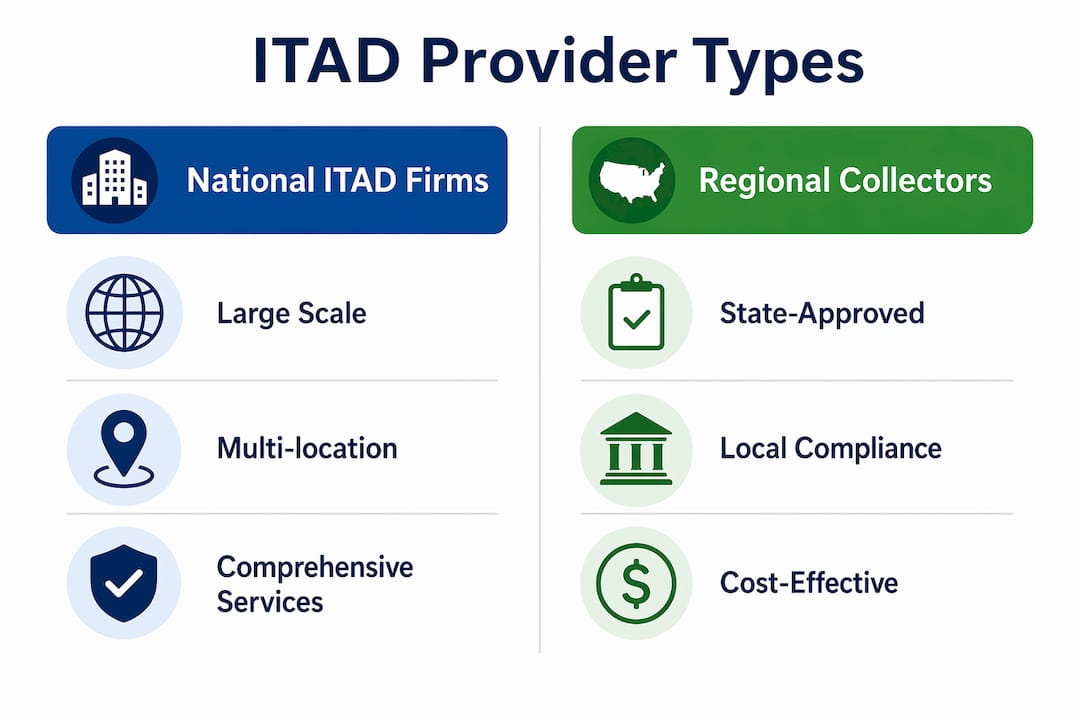
| Dimension | Usedcartridge | National ITAD firms | Regional/state-approved collectors | Mobile on-site destruction specialists |
|---|---|---|---|---|
| Core services | E-waste recycling, data destruction, IT asset recovery, batteries/solar panels | Full ITAD suite, logistics, remarketing | E-waste recycling, basic data destruction | On-site shredding/degaussing, certificates |
| On-site destruction | Yes | Yes (most) | Limited | Yes (primary offering) |
| Nationwide coverage | Yes, with pickup options | Yes | Regional/state-specific | Varies by fleet size |
| Certifications | Audit-ready certs, compliance documentation | R2, e-Stewards, NAID AAA | State-approved (e.g., CalRecycle) | NAID AAA typical |
| Asset recovery/buyback | Yes | Yes | Rarely | No |
| Pricing model | Quote-based, fee-for-service | Contract or per-device | Per-pound or flat fee | Per-event or per-device |
| Chain-of-custody docs | Yes | Yes | Varies | Yes |
| Turnaround | Varies by service type | 1–4 weeks typical | Days to weeks | Same-day |
Provider categories worth knowing:
- Usedcartridge: Best for businesses that need e-waste recycling, secure data destruction, and asset recovery in one engagement, with certificates issued after service
- National ITAD firms (e.g., Electronic Recyclers International, Sims Lifecycle Services, Iron Mountain ITAD, Securis, TES): Best for large enterprises with multi-site, high-volume hardware refreshes requiring R2 or e-Stewards certification
- Regional/state-approved collectors: Best for organizations with California or other state-regulated assets and a preference for local logistics
- Mobile on-site destruction specialists: Best when data sensitivity is so high that drives cannot leave the building
Pro Tip: For high-sensitivity data, choose a vendor that brings the shredder to you and hands you a certificate of destruction before the truck leaves. For large hardware volume with resale value, prioritize asset-recovery capability and ask for a buyback estimate upfront.
How do you choose the right ITAD or e-waste vendor?
Getting this decision wrong carries real risk. Improper disposal exposes your organization to data-breach liability, environmental fines, and audit failures.
Decision criteria to evaluate every vendor against:
- Data destruction method: Does the vendor offer degaussing, shredding, or DoD-standard overwriting? Can they perform it on-site?
- Certifications: R2 and e-Stewards cover environmental handling; NAID AAA covers data destruction. Require current certificates, not just claims.
- Insurance: Ask for a certificate of insurance showing general liability and errors-and-omissions coverage with limits appropriate to your asset value.
- Chain-of-custody documentation: Every device should be logged from pickup to final disposition, with serial numbers or asset tags recorded.
- Asset recovery process: How does the vendor assess resale value? Do they provide an itemized buyback offer before pickup?
- Geographic reach: Can they service all your locations, or will you need multiple vendors?
- Environmental handling: How are batteries, solar panels, and hazardous components handled? Ask for specifics, not just “responsibly.”
Red flags that should end a vendor conversation:
- Refuses to provide a sample certificate of destruction or chain-of-custody manifest
- Cannot name the downstream recycler or remarketer receiving your assets
- Declines to allow an audit or on-site destruction option for sensitive equipment
- Provides only verbal assurances with no written SLA on pickup timing
Questions to ask in your first vendor call or RFP:
- “Can you perform on-site destruction at our facility, and what equipment do you bring?”
- “What certificates will we receive, and how quickly after service?”
- “Who are your downstream partners, and are they R2 or e-Stewards certified?”
- “How do you handle laptop batteries and solar panels?” (Certified hazardous-material handling matters here; see guidance on certified hazardous material removal)
- “What are your minimum quantities, and what is your pickup lead time?”
Contract terms to require before signing:
- SLA specifying pickup window and destruction completion date
- Indemnification clause covering data breach liability during transit and processing
- Certificate of destruction issued within a defined number of business days
- Manifest retention period (three to seven years is standard for audit purposes)
- Audit-access clause allowing your team to inspect the facility or destruction process
What does each provider type actually do?
Usedcartridge
Usedcartridge handles e-waste recycling across computers, batteries, and solar panels, paired with secure on-site and off-site data destruction and IT asset recovery with value assessment. After service, clients receive certificates of destruction and chain-of-custody documentation suitable for compliance audits. The fee-for-service model means no long-term contract is required to get started.
Best for: Mid-size businesses and organizations that need recycling, data destruction, and asset recovery handled in a single vendor relationship, with certificates issued per engagement.
Procurement teams often underestimate how much time they lose coordinating separate vendors for recycling, data destruction, and asset remarketing. A provider that handles all three under one chain-of-custody document cuts that coordination overhead significantly and gives you a single audit trail.
National ITAD firms
Providers like Electronic Recyclers International (ERI), Sims Lifecycle Services, Iron Mountain ITAD, Securis, and TES operate at enterprise scale. Most hold R2 and/or e-Stewards certification and offer NAID AAA-certified data destruction. They typically serve Fortune 500 clients with multi-site hardware refreshes, and their pricing reflects that scale. Minimums can be high, and contract terms tend to be longer.
Best for: Large enterprises retiring hundreds or thousands of devices across multiple locations, where a national logistics network and formal SLAs are non-negotiable.

Regional and state-approved collectors
These vendors appear in state registries like the CalRecycle approved collector directory. Looptechesolution.com itself is listed there, with a recently approved application. Regional collectors are often the right fit for organizations with California-regulated covered electronic waste, but their data-destruction capabilities and asset-recovery programs vary widely. Always verify current approval status before scheduling a pickup.
Best for: California-based organizations with covered electronic waste (CEW) disposal requirements, or businesses that prefer a local vendor for smaller, recurring pickups.
Mobile on-site destruction specialists
These providers bring industrial shredders or degaussers directly to your facility. The drive never leaves your building, which eliminates chain-of-custody risk during transit. They typically issue a certificate of destruction on-site before departing. Asset recovery is not part of their model.
Best for: Healthcare, legal, financial, and government organizations where data sensitivity makes off-site transport unacceptable.
What does ITAD and e-waste service actually cost?
Pricing in this market is not standardized, and vendors rarely publish rates publicly. Here is how the models typically break down.
Common pricing structures:
- Per-device itemized rates: Each device class (laptop, desktop, server, monitor) carries a separate fee or recovery credit
- Per-pound or per-ton rates: Common for bulk e-waste with low resale value
- Flat pickup fees: A base logistics charge, sometimes waived above a volume threshold
- Asset-recovery payouts: Working equipment may generate a credit or direct payment that offsets recycling costs
Major cost drivers:
- Device class and condition (servers and networking gear typically carry higher recovery value than CRT monitors)
- On-site vs. off-site destruction (on-site commands a premium, usually $100–$300 per event plus per-device fees, though exact figures vary by vendor and location)
- Hazardous components such as lithium batteries and solar panels, which require separate handling streams
- Data sanitization method (shredding costs more than overwriting; on-site shredding costs more than off-site)
- Transportation distance and minimum quantity thresholds
| Cost element | Typical model | Notes |
|---|---|---|
| E-waste recycling | Per-device or per-pound | Varies by device class |
| Data destruction (off-site) | Per-device fee | Certificate included |
| Data destruction (on-site) | Per-event + per-device | Premium over off-site |
| Asset recovery payout | Credit or direct payment | Depends on device age and condition |
| Battery/solar panel handling | Separate line item | Hazmat handling required |
| Transportation/logistics | Flat fee or included | Often waived above minimums |
Pro Tip: When requesting quotes, ask vendors to break out handling, data-destruction, transportation, and asset-recovery fees as separate line items. A single bundled price makes it impossible to compare vendors fairly or identify where costs can be reduced.
What compliance paperwork should you require?
Every compliant ITAD engagement should produce a specific set of documents. Missing any of them creates an audit gap.
Document checklist:
- R2 or e-Stewards certificate (if the vendor claims either certification, request the current certificate with expiration date)
- NAID AAA certificate for data destruction services
- Certificate of data destruction (per-device or per-batch, with serial numbers or asset tags)
- Chain-of-custody manifest covering origin, device identifiers, weight, date and time, personnel names, and final destination
- Certificate of insurance from the vendor
- Downstream recycler documentation showing where materials go after processing
Key fields to verify on a chain-of-custody manifest:
| Field | Why it matters |
|---|---|
| Device serial numbers / asset tags | Links destruction to specific assets in your inventory |
| Date and time of destruction | Establishes the compliance timeline |
| Personnel names and signatures | Creates accountability at each transfer point |
| Destination facility name and address | Confirms downstream compliance |
| Weight or quantity | Supports environmental reporting |
For California-based assets, verify the vendor’s current status in the CalRecycle participant directory. The directory shows physical address, contact phone, and approval date. Looptechesolution.com’s entry (CEWID 127389, located at 11625 Industry Ave, Fontana, CA 92337) is one example of what a valid state-approved collector record looks like. Apply the same verification step to any regional vendor you consider, regardless of state. For a deeper look at how to verify state recycling listings, the process is consistent across most state-run directories.
Understanding secure data destruction methods and what certificates to request is also worth reviewing before you finalize your vendor requirements.
Key Takeaways
The strongest looptechesolution.com alternative for most U.S. businesses is Usedcartridge, which combines e-waste recycling, on-site data destruction, and IT asset recovery with audit-ready certificates under a single chain-of-custody document.
| Point | Details |
|---|---|
| Start with a certified vendor | Require current R2, e-Stewards, or NAID AAA certificates before any pickup is scheduled. |
| Demand itemized quotes | Ask vendors to separate handling, destruction, transportation, and asset-recovery fees for a fair comparison. |
| Verify state registry status | Check CalRecycle or your state’s equivalent directory to confirm any regional vendor’s current approval. |
| Require full documentation | A certificate of destruction, chain-of-custody manifest, and insurance certificate are non-negotiable for audit readiness. |
| Usedcartridge as primary option | Usedcartridge covers recycling, data destruction, and asset recovery in one engagement with certificates issued per service. |
The certification gap most procurement teams miss
The most common procurement mistake in ITAD is treating certification claims as equivalent to certification proof. A vendor can print “R2 certified” on a proposal without holding a current, third-party-audited certificate. The same applies to NAID AAA. Both certifications require annual audits and can lapse, and a lapsed certificate means your chain-of-custody documentation may not hold up in a regulatory review.
Usedcartridge’s model addresses this directly: the company issues certificates of destruction and chain-of-custody documentation per engagement, which means your compliance file is built as the work happens, not assembled after the fact. For organizations managing batteries, solar panels, or large server deployments, that per-engagement documentation is what makes an audit survivable. The environmental risks of improper disposal are real and documented, but the compliance risk from missing paperwork is what actually triggers fines and breach notifications.
Usedcartridge handles the whole ITAD picture, not just pickup
Most vendors solve one piece of the problem: they recycle, or they destroy data, or they recover asset value. Usedcartridge covers all three in a single service engagement, which means one vendor relationship, one chain-of-custody document, and one set of certificates for your compliance file.

For businesses replacing laptops, retiring servers, or clearing out solar panel arrays, that consolidation matters. You get a quote that breaks out recycling, data destruction, and asset-recovery value separately, so you can see exactly what you’re paying for and what you’re getting back. Pickup options and on-site destruction are both available, and certificates are issued after every service.
Request your IT asset recovery disposition quote and include your device list, preferred destruction method, and the certificates your compliance team requires. That’s the fastest way to get a comparable, apples-to-apples number.
Useful sources for verifying vendor claims
When vetting any ITAD or e-waste vendor, these are the registries and pages worth checking directly.
- CalRecycle approved collector directory: Confirms state approval status, approval date, and CEWID for California-regulated e-waste collectors. Check the “Application Last Approved” date to confirm currency.
- CalRecycle eRecycle participant record: Shows physical address and contact phone for a specific collector, useful for confirming the vendor’s operating location matches what they claim.
- Usedcartridge service overview: Lists device classes covered, certificates issued, and pickup options, which gives you a baseline for comparing scope across vendors.
- Secure data destruction guide: Explains destruction methods and certificate types, useful for writing your RFP requirements before soliciting quotes.
- IT asset disposal compliance guide: Covers what procurement teams should require from vendors on environmental handling and data security documentation.
For any vendor not listed in a state directory, request their R2 or e-Stewards certificate directly and verify it against the certifying body’s public registry before scheduling service.