
Prioritizing secure IT asset recovery (refurbish → reuse → remarket) over end-of-life recycling is the single highest-impact action for reducing your organization’s downstream electronics carbon footprint. Keeping usable assets in service avoids the manufacturing and disposal emissions that recycling alone cannot offset. Start here this week:
- Update your sanitization policy to reference NIST SP 800-88 Rev.2 as the governing standard.
- Require R2v3, e-Stewards, and NAID AAA evidence from every vendor before signing a contract.
- Pilot cryptographic erase (CE) on your next laptop fleet refresh to preserve resale value.
- Capture per-device chain-of-custody from decommission through final disposition.
- Contact Usedcartridge for a disposition quote before your next refresh cycle.
Key Takeaways
Prioritizing refurbishment and remarketing over recycling produces the largest documented reductions in electronics-linked downstream emissions, and every claim requires per-device records to survive an audit.
| Point | Details |
|---|---|
| Reuse beats recycling for emissions | Remarketing a working device avoids manufacturing emissions that recycling cannot offset. |
| NIST 800-88 Rev.2 is the standard | Update all sanitization policies to Rev.2; remove references to superseded DoD wipe methods. |
| Per-device records are non-negotiable | Certificates of destruction must include serial number, method, NIST level, date, and technician. |
| Batch quarterly for cost efficiency | Quarterly pickup lots lower per-unit transport fees and improve remarketing lot economics. |
| Usedcartridge delivers audit-ready ITAD | Per-device chain-of-custody, NIST-aligned certificates, and ESG-ready disposition reports on every job. |
Table of Contents
- Why does IT asset recovery reduce scope 3 electronics emissions more than recycling?
- When should you refurbish versus recycle or destroy a device?
- What sanitization method should you use for each device type?
- What should your ITAD vendor contract actually require?
- How do you build a repeatable ITAD program with clear roles?
- How do you measure and report avoided emissions from ITAD?
- What do ITAD services typically cost, and how long do they take?
- How Usedcartridge supports your Scope 3 reduction program
- What most teams get wrong — and three fixes that work immediately
- Usedcartridge: audit-ready ITAD for your next refresh cycle
- Sources
Why does IT asset recovery reduce scope 3 electronics emissions more than recycling?
IT asset recovery (ITAD) secures, evaluates, and safely disposes of unused IT equipment through a sequence of reuse, refurbishment, remarketing, and certified recycling. The emissions logic is straightforward: every laptop or server that gets refurbished and resold displaces the need to manufacture a new device. That avoided manufacturing load is far larger than the emissions credit from shredding the same device and recovering raw materials.
Keeping usable assets out of the waste stream is significantly more effective than downstream recycling for reducing an organization’s electronics footprint. Remarketing a working laptop extends its useful life by two or more years, deferring the energy and resource cost of producing a replacement. Recycling recovers some material value but does nothing about the emissions already embedded in the replacement device a buyer purchases instead.
A well-run ITAD program captures four compounding benefits:
- Avoided manufacturing emissions from devices that stay in service rather than triggering new production.
- Avoided disposal emissions from keeping hazardous components (batteries, circuit boards) out of landfill or low-grade smelting.
- Documented ESG reporting inputs from per-device disposition records and resale receipts.
- Recovered revenue that offsets program costs and makes the sustainability case easier to fund.
Managed IT recycling examples show how organizations that integrate remarketing into their ITAD programs capture both the environmental and financial return simultaneously.
When should you refurbish versus recycle or destroy a device?
Disposition choice should be driven by device condition, data sensitivity, regulatory constraints, and resale marketability — not by default habit. Sending every decommissioned asset straight to shredding is the most common and most costly emissions mistake.
Run each asset through this checklist before assigning a disposition path:
- Residual market value: Is the device model still in demand? Laptops under five years old and servers under seven typically have resale potential.
- Firmware and support status: Has the device reached its Auto-Update Expiration (AUE) or vendor end-of-support date? Post-AUE devices carry security risk in redeployment.
- Battery condition: Degraded batteries below roughly 80% capacity reduce resale value and may trigger hazardous-materials handling requirements.
- Hazardous components: Devices with damaged lithium batteries or legacy CRT displays require specialized handling regardless of condition.
- Data classification: Assets that held classified, HIPAA-covered, or PCI-scoped data may require destruction even when the hardware is otherwise resalable.
| Device class | Condition | Recommended disposition |
|---|---|---|
| Laptop (under 5 years) | Functional, battery healthy | Refurbish and remarket |
| Laptop (under 5 years) | Functional, sensitive data | CE or purge, then remarket |
| Laptop (5+ years or post-AUE) | Any | Recycle via R2/e-Stewards vendor |
| Server (under support period) | Functional | Wipe and remarket or redeploy |
| SSD (any age) | Any | Cryptographic erase or physical destroy |
| Mobile device | Functional | Factory reset + CE, then remarket |
| Lithium battery pack | Degraded | Certified battery recycler only |
Some regulatory contexts require destruction even when reuse would reduce emissions. Document the rationale either way — auditors expect to see why a device was destroyed rather than remarketed.
What sanitization method should you use for each device type?

Choose the least-destructive method that satisfies your data-classification and compliance requirements, then document the rationale. That single principle, drawn from NIST SP 800-88 Rev.2 guidance on program-level sanitization decisions, prevents both over-destruction (shredding resalable hardware) and under-sanitization (wiping drives that held regulated data).
| Method | Appropriate for | Verification evidence |
|---|---|---|
| Clear | Low-sensitivity media being reused internally | Erasure software log with device serial |
| Purge | HDDs leaving organizational control | Degausser certificate + serial-numbered log |
| Cryptographic erase (CE) | Self-encrypting drives, modern SSDs, mobile devices | CE completion log, key destruction record |
| Physical destroy | SSDs with regulated data, damaged media, post-AUE devices | Certificate of destruction, witnessed photos/video |
Pro Tip: CE is the preferred method for SSDs and self-encrypting drives because it preserves the hardware for remarketing while meeting NIST purge-equivalent standards — but only when the device’s encryption was active before data was written. Verify encryption status before relying on CE.
Assets that leave organizational control without appropriate sanitization create both data-breach risk and regulatory exposure. Minimum records to retain per device:
- Serial number and asset tag
- Sanitization method applied and NIST level
- Date of sanitization and technician or vendor identity
- Erasure log file or certificate of destruction
- Final disposition (reuse, resale, recycle, destroy) and recipient
ISO/IEC 27040 provides complementary storage security guidance that aligns with NIST 800-88 Rev.2 at the program level, particularly for organizations subject to international data-protection frameworks.
What should your ITAD vendor contract actually require?
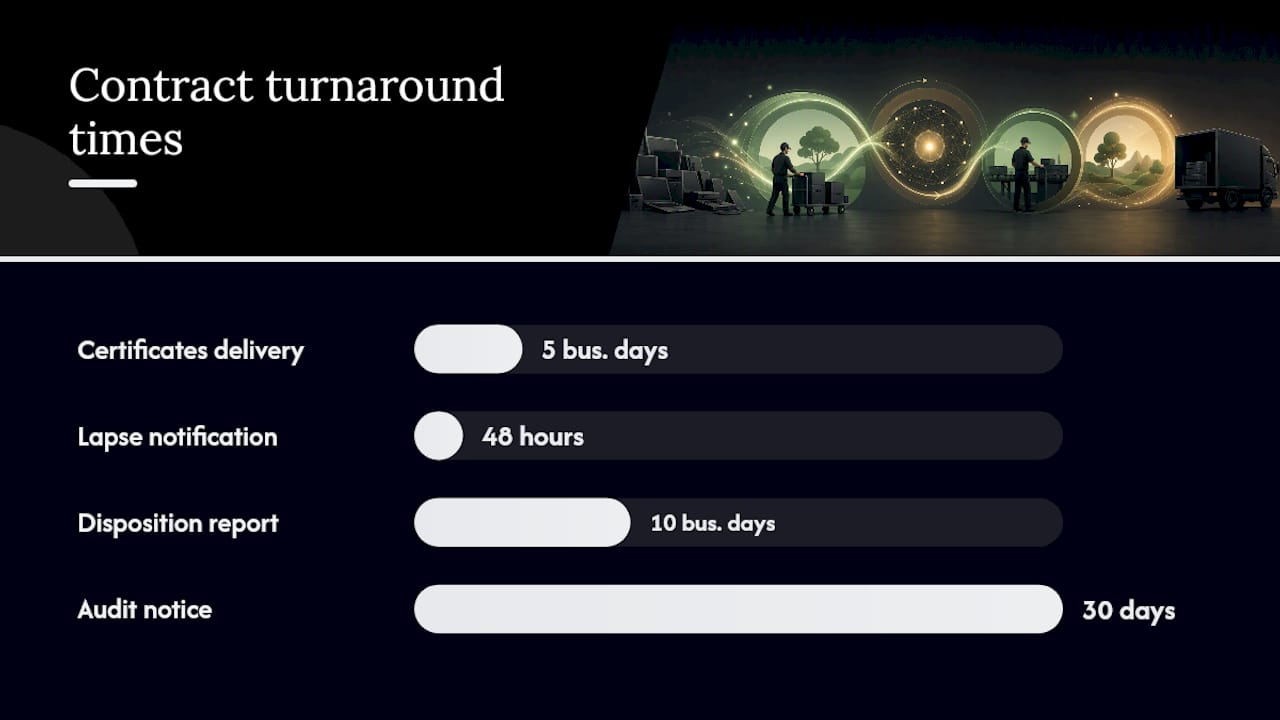
Require certifications, method transparency, and per-device documentation up front — written into the contract, not assumed from a vendor’s marketing page. Verbal assurances are not audit evidence.
Certifications to require in every RFP and SOW:
- R2v3 (Responsible Recycling, current version) for downstream material handling
- e-Stewards certification for hazardous-material controls
- NAID AAA certification for secure data destruction (onsite and facility-based)
- ISO 14001 for environmental management
- ISO/IEC 27040 alignment documentation for storage security
Sample contract clauses:
- Vendor shall provide current certification certificates (R2v3, e-Stewards, NAID AAA) within five business days of contract execution and notify the client within 48 hours of any lapse.
- Vendor shall track each asset by serial number from pickup through final disposition and deliver a per-device disposition report within 10 business days of job completion.
- Certificates of destruction shall include: asset serial number, destruction method, NIST SP 800-88 Rev.2 level applied, date, technician name, and vendor facility address.
- Client retains the right to audit vendor facilities and downstream processors with 30 days’ notice; vendor shall provide downstream processor certifications on request.
- Vendor shall carry general liability insurance of no less than $2 million per occurrence and errors-and-omissions coverage; proof of coverage due at contract signing.
Required documents vendors must deliver after each job:
- Signed chain-of-custody manifest (per pickup)
- Per-device erasure logs or certificates of destruction
- Environmental disposition report (recycled weight, materials recovered)
- Resale/remarketing receipts for assets sold
- Downstream processor certifications for recycled materials
Compliance resources for IT disposal can help you cross-reference these requirements against current U.S. state e-waste regulations, which updated materially in 2025–2026.
How do you build a repeatable ITAD program with clear roles?
A repeatable, auditable program combines policy, asset flows, sanitization gates, and documented verification. Without a written policy, sanitization decisions get made ad hoc and chain-of-custody gaps appear exactly where auditors look first.
Workflow from decommission to reporting:
- Decommission: IT manager flags asset for retirement; asset tag and serial number logged in CMDB.
- Inventory and condition assessment: Facility or IT team grades device condition and data classification.
- Sanitization decision: Procurement or IT security applies the disposition matrix (see Section 3) and selects method.
- Transport or onsite action: Vendor collects under signed chain-of-custody manifest, or onsite destruction is scheduled.
- Disposition: Refurbish/remarket, recycle, or destroy per decision; vendor delivers per-device records.
- Reporting: Sustainability officer logs disposition outcomes for ESG and Scope 3 reporting.
Roles summary: IT owns decommission and inventory. Procurement owns vendor contracts and certification verification. Facilities coordinates logistics and onsite access. The sustainability officer owns Scope 3 reporting inputs and ESG documentation.
How do you measure and report avoided emissions from ITAD?
Count documented avoided emissions for assets that were refurbished and redeployed or remarketed; use per-device emission factors and preserve sales or transfer documentation. An avoided-emissions claim without supporting records is not defensible in an ESG audit.
Worked example (simplified):
Example: If a significant portion of a laptop fleet is remarketed, organizations can avoid emissions associated with manufacturing new devices, resulting in measurable avoided greenhouse gas emissions.
This figure requires: device serial list, condition assessment records, resale receipts naming the buyer, and the emission factor source cited in your ESG report.
Reporting checklist for an avoided-emissions claim:
- Per-device serial numbers and disposition codes
- Date of sanitization and transfer to buyer or recycler
- Buyer or recipient name and address (for remarketed devices)
- Resale receipts or signed transfer records
- Emission factor source and methodology note
Glossary of key terms:
- Avoided emissions: Greenhouse gas emissions that did not occur because a device was reused rather than replaced by new manufacturing.
- End-of-life diversion: Redirecting a device from landfill or low-grade recycling to a higher-value disposition path (reuse, certified recycling).
- Life extension: Adding usable years to a device through refurbishment or resale, deferring the emissions cost of replacement.
What do ITAD services typically cost, and how long do they take?
Per-unit costs vary primarily by data sensitivity (onsite vs. offsite destruction), device type, hazardous handling needs, and remarketing potential. Onsite destruction commands a premium because it requires a mobile shredding unit and witnessed documentation; offsite processing at a certified facility is typically lower cost but adds transport and chain-of-custody steps.
Primary cost drivers:
- Onsite destruction (mobile shredding or degaussing): highest per-unit cost, justified for classified or HIPAA-covered media.
- Battery and hazardous-materials handling: lithium battery packs and CRT monitors carry surcharges for compliant processing.
- Shipping and chain-of-custody: distance, pallet count, and manifest complexity all affect transport fees.
- Certification costs: R2v3 and NAID-audited vendors price in their compliance overhead.
- Testing and repair for refurbishment: adds labor but is offset by remarketing revenue on qualifying devices.
Typical timelines:
- Scheduled pickup: 3–10 business days from quote acceptance for most U.S. metro areas.
- Onsite destruction job: same-day or next-day once scheduled; documentation delivered within 5–10 business days.
- Downstream resale cycle: 2–6 weeks for standard enterprise laptops; longer for servers or specialized hardware.
- Cross-border shipments: add 4–8 weeks minimum; EU Waste Shipment Regulation changes in 2025–2026 require updated pre-shipment classification and documentation.
Pro Tip: Batching decommissions into quarterly pickups rather than ad hoc calls reduces per-unit transport fees and improves lot economics for remarketing — larger, uniform lots attract better resale prices from secondary-market buyers.
How Usedcartridge supports your Scope 3 reduction program
Usedcartridge delivers secure IT asset recovery, NIST-aligned sanitization, onsite and offsite destruction, certified recycling, and per-device documentation that directly supports documented Scope 3 reductions. Every job produces the chain-of-custody records, certificates of destruction, and disposition reports your sustainability team needs for ESG filings.
Service features:
- Secure scheduled pickup with signed chain-of-custody manifests
- Onsite and offsite sanitization options (CE, purge, physical destroy)
- R2/e-Stewards/NAID-aligned processes with certification documentation
- Per-device serial tracking from collection through final disposition
- Certificates of destruction with NIST method and level noted
- Disposition and resale reporting for avoided-emissions calculations
What you receive after a job: per-device disposition log, erasure audit logs, certificates of destruction, environmental disposition report for ESG filings, and resale receipts for remarketed assets.
Request an IT asset recovery disposition quote to get a scoped assessment before your next refresh cycle.
What most teams get wrong — and three fixes that work immediately
The most common gap is not a missing certification. It is an outdated sanitization reference: teams still citing NIST 800-88 Rev.1 or a generic “DoD 5220.22-M wipe” in their policies, which creates a compliance gap the moment an auditor checks the standard date. The second most common gap is missing per-device certificates — a single batch certificate covering 200 assets with no serial numbers attached is not audit evidence under HIPAA, PCI DSS, or SOX.
Three fixes you can implement this week:
- Update your policy document to cite NIST SP 800-88 Rev.2 as the governing sanitization standard and remove any reference to the superseded Rev.1 or DoD wipe methods.
- Add R2v3 and e-Stewards evidence requirements to your vendor qualification checklist and reject any vendor that cannot produce current certificates within five business days.
- Pilot cryptographic erase on your next SSD or laptop fleet refresh and verify that device encryption was active before data was written — CE only qualifies as purge-equivalent when that condition is met.
Usedcartridge can step in at any of these points, whether you need a vendor that already meets the certification bar or a same-day onsite destruction job with full per-device documentation.
Usedcartridge: audit-ready ITAD for your next refresh cycle

Usedcartridge is the direct alternative to a generic recycler for organizations that need both documented Scope 3 reductions and airtight data security. Where a standard recycler hands you a batch certificate and a weight receipt, Usedcartridge delivers per-device chain-of-custody, NIST-method certificates of destruction, and resale documentation your sustainability officer can drop straight into an ESG report. There is no guesswork about whether your vendor’s downstream processor is R2v3-certified — that evidence comes with every job. Onsite destruction is available for high-sensitivity assets, and scheduled quarterly pickups keep per-unit costs down without sacrificing compliance. Request a disposition quote or review e-waste recycling and compliance services to scope your next program.
Sources
The sources below are the primary standards, certification bodies, and guidance documents referenced throughout this article.