
FERPA doesn’t tell you how to wipe a hard drive. It tells you that student PII must stay protected until the moment it’s gone, and that certain written agreements, like those covering studies, audits, or evaluations, must spell out a destruction method and a firm deadline. The technical part is yours to solve. That’s where NIST SP 800-88 Rev. 2 and a signed Certificate of Destruction come in: they turn a vague legal duty into something you can actually prove.
TL;DR:
- Districts must document destruction methods and timelines in written agreements for data disclosed under FERPA study, audit, or evaluation exceptions.
- Proper classification, scheduling, and documentation of destruction decisions are essential to avoid legally required retention and audit issues.
- Using risk-based, device-specific sanitization methods like cryptographic erase or physical destruction ensures data security for different media types.
- Verifiable Certificates of Destruction, chain-of-custody logs, and on-site destruction proof are critical for audit readiness and legal defense.
- Regular policy reviews, staff training, and vendor evaluations prevent common documentation gaps and improper destruction practices.
Table of Contents
- What does FERPA actually require for data destruction?
- When should you keep records instead of destroying them?
- Clear, purge, and destroy: choosing a sanitization method
- Which destruction method fits which device?
- What paperwork proves you actually destroyed the data?
- Building a district checklist that actually gets used
- How do you train staff to handle this correctly?
- What happens if a district doesn’t destroy data properly?
- How do you build a policy that survives an audit?
- What most districts get wrong about data destruction
- Get certified, on-site destruction that holds up to an audit
- Sources
What does FERPA actually require for data destruction?
FERPA’s core destruction obligation lives in its exceptions. When a district discloses personally identifiable information under the studies, audit, or evaluation exceptions, the written agreement must require destruction and name a time period for when that destruction happens. Outside those specific exceptions, FERPA doesn’t mandate a technical standard. It mandates protection, and destruction is one way you demonstrate that protection ended cleanly.
A compliant written agreement under these exceptions generally includes:
- A designation of the outside party as a “school official” with a legitimate educational interest
- The specific purpose for which PII is being disclosed
- A precise description of the PII covered
- A destruction requirement with an explicit time period
- Language holding the receiving party to the same use limitations as the district
“Reasonable methods” is the operative phrase throughout this guidance. It means your district stays responsible for confirming that any authorized representative, vendor, or researcher actually follows through on destruction, not just promises to. Layer in your state’s own retention statutes, IDEA-specific timelines for special education records, and any open records-inspection request, and you get a compliance picture that’s less about picking a shredder and more about sequencing decisions correctly.
When should you keep records instead of destroying them?
Retention and destruction are two separate decisions, and treating them as one is how districts end up destroying something they legally needed to keep. Education records under FERPA cover a wide range: transcripts, disciplinary files, special education plans, health notes. Some of that data has a mandatory retention floor set by state law or IDEA; some of it should go the moment it stops serving a purpose.
A workable process looks like this:
- Classify the record. Identify what it is, who created it, and which retention rule (state, federal, or district policy) applies.
- Check for holds. Confirm there’s no open records-inspection request, litigation, or longitudinal research need attached to it.
- Schedule the destruction event. Assign a date, method, and responsible party rather than leaving it to “eventually.”
- Document the decision. Record why the item was destroyed when it was, including who approved it.
That fourth step is the one districts skip most often, and it’s the one that saves you during an audit.
Clear, purge, and destroy: choosing a sanitization method
NIST SP 800-88 Rev. 2 organizes every sanitization decision into three categories, and understanding the difference keeps you from over-destroying assets you could have safely reused.
- Clear uses standard read/write commands to overwrite data, appropriate for media staying inside your organization’s control.
- Purge applies more intensive techniques, including cryptographic erase, that resist even lab-level recovery attempts.
- Destroy physically disfigures the media so data recovery becomes infeasible by any known method.
Choosing among the three is a risk calculation, not a default setting. Ask how sensitive the data was, whether the device will be resold or redeployed, what condition it’s in, and what destruction actually costs versus what reuse could recover in resale value. NIST’s own guidance on the trade-off pushes toward a risk-based approach specifically to avoid destroying assets that didn’t need it.
Pro Tip: Cryptographic erase is often the fastest legitimate purge option on modern drives, but only if the encryption was strong from day one and the keys are fully, verifiably destroyed. A half-implemented encryption scheme gives you false confidence, not compliance.
Which destruction method fits which device?
Media type changes the calculus completely, and a one-size-fits-all wipe policy is where a lot of districts get exposed.
- Hard drives: Overwriting works for reuse-bound drives in good condition; degaussing or physical shredding is faster and safer for anything holding sensitive student records headed for disposal.
- SSDs and mobile devices: Traditional overwriting can miss data hidden in wear-leveling and reserved blocks. Verified cryptographic erase or outright physical destruction is usually the only dependable option.
- Cloud and virtual storage: You can’t watch a provider delete anything. Require contractual destruction language and a verifiable Certificate of Destruction rather than assuming “deleted” means gone.
- Removable media, optical discs, tape, and paper: Shredding, pulverizing, or incineration are the standard techniques, and failed or damaged drives that won’t accept a wipe command should go straight to physical destruction.
What paperwork proves you actually destroyed the data?
A destruction event that leaves no paper trail is functionally invisible to an auditor, no matter how thoroughly the drive was wiped. Your written agreements should specify the destruction timeframe, the method used, whether any equipment gets returned or transferred, and what happens if a breach occurs before destruction happens.
On the vendor side, demand:
- A signed Certificate of Destruction listing method, date, equipment serial numbers, and a vendor signatory
- Chain-of-custody logs covering pickup through final destruction
- Proof of insurance and, where relevant, audit or on-site inspection rights before you accept the certificate as sufficient
Pro Tip: Store every Certificate of Destruction in your district’s records management system, not in an IT staffer’s inbox. When an auditor asks for proof five years later, you need to be able to pull it in minutes, not hunt for who still has the file.
Building a district checklist that actually gets used
Good policy on paper means nothing if nobody follows it during the actual pickup. A working implementation plan runs through five steps:
- Adopt a written retention and destruction policy mapped to record categories, state law, and FERPA’s written-agreement requirements.
- Run a risk assessment on each media category to decide clear, purge, or destroy before equipment ever leaves the building.
- Build destruction into your IT asset workflow, not as an afterthought after equipment sits in a closet for two years.
- Train staff on what triggers a destruction event and who has authority to approve it.
- Run periodic verification tests and log the results, with a clear escalation path when something doesn’t match policy.
Districts that treat this as a recurring calendar item, not an annual scramble, catch gaps before an audit does.
How do you train staff to handle this correctly?
Most FERPA destruction failures aren’t malicious. They’re a registrar who doesn’t know an old enrollment spreadsheet counts as PII, or an IT technician who assumes a factory reset is the same as a NIST-grade wipe. Training closes that gap, and it needs to reach further than your compliance office.
Front-office staff need to recognize which records qualify as protected education records in the first place. A folder of report cards sitting in a supply closet is a FERPA liability whether anyone treats it like one or not. Give registrars and counselors a simple rule: if it identifies a student and it’s not actively needed, it goes on the destruction schedule, not in a drawer marked “someday.”

IT staff need something more technical: a clear map of which sanitization method applies to which device, and explicit authority for who can sign off on a destruction event. Without that authority chain, equipment sits in storage indefinitely because nobody wants to be the person who authorized wiping the wrong drive.
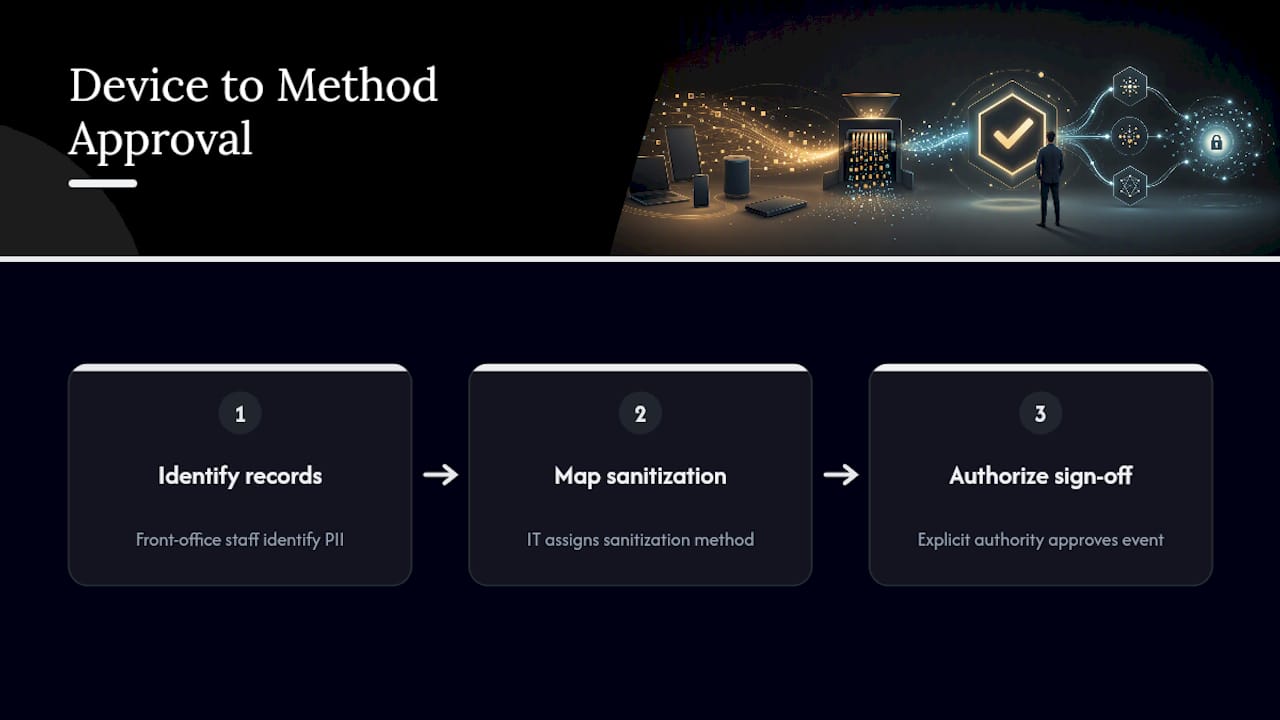
Refresher training matters more than initial training. Staff turnover in school offices is high, and a policy taught once during onboarding fades fast. Build a short annual review into your compliance calendar, tied to the same cycle as your retention schedule audit. Include a walk-through of what a proper Certificate of Destruction looks like, so front-line staff can spot a vendor’s incomplete paperwork before it becomes your problem during an audit.
What happens if a district doesn’t destroy data properly?
FERPA enforcement runs through the Student Privacy Policy Office, and the ultimate lever the Department of Education holds is the withdrawal of federal funding for a district found in violation. That’s rare in practice, but it’s not the only exposure. A written agreement that promised destruction and a timeframe, and then didn’t get followed, creates a documented breach of contract independent of FERPA itself, which opens the door to separate legal claims from the party whose data was mishandled.
State law adds another layer. Many states carry their own student data privacy statutes with penalties that apply regardless of what happens at the federal level, and a district operating across a few different state guidance documents needs to check the strictest one rather than assume federal compliance covers everything. The NYS sanitization and secure disposal standard is a good example of a state requirement that goes further than the federal baseline on facility controls and verification.
Reputational cost is often the real damage. A data breach tied to old, improperly disposed equipment, a hard drive with student records surfacing at a surplus auction, a laptop that never got wiped, becomes a local news story fast, and it erodes parent trust in ways that outlast any fine. The Student Privacy Policy Office’s own guidance treats documentation as the primary defense here, because a district that can produce a clean paper trail rarely ends up as the story.
How do you build a policy that survives an audit?
A policy that lives only in a PDF on a shared drive isn’t a policy. It’s a document waiting to fail its first real test. Start by mapping every record category your district generates against its retention requirement, whether that comes from FERPA, IDEA, or state statute, and tie a destruction trigger to each one.
Write your written agreements before you need them, not after a researcher or auditor asks for data. Every agreement covering the studies, audit, or evaluation exceptions should already contain the mandatory destruction clause and timeframe, so nobody is drafting compliance language under deadline pressure.
Pair your policy with a vendor evaluation step. Before signing with any destruction or recycling provider, confirm they’ll issue a full Certificate of Destruction and allow audit or inspection rights on request. A partner focused on data protection and retention scheduling can help districts formalize the retention side of this before destruction ever becomes a question.
Finally, build in a review cycle. Policies written once and never revisited drift out of sync with new device types, new state requirements, and new vendor relationships. An annual review, tied to your training refresher, keeps the policy actually usable instead of theoretical.
What most districts get wrong about data destruction
Documentation gaps sink more districts than bad wiping technology ever does. A vendor might genuinely destroy a drive properly, but if the Certificate of Destruction is missing serial numbers, a date, or a signatory, that certificate is worthless in an audit. The paper trail is the compliance, not just evidence of it.
The other common failure runs the opposite direction: destroying equipment that didn’t need it. A district under audit pressure sometimes shreds drives that could have been safely wiped and resold, burning both budget and a legitimate sustainability opportunity in one move. On-site destruction with a documented chain of custody solves both problems at once. You get verification without guessing what happened after the truck left, and you get a partner that can distinguish between what genuinely needs physical destruction and what can be sanitized and returned to service.
— Keith
Get certified, on-site destruction that holds up to an audit
Some providers offer on-site destruction in front of your staff and provide a Certificate of Destruction generated the same day instead of promised weeks later. That’s the concrete gap between “we sent it somewhere for wiping” and having proof, serial numbers, method, and a signatory, in hand before the truck leaves your parking lot.

Every job should include chain-of-custody documentation and environmentally responsible handling, so retired hard drives and devices don’t just disappear into a landfill after they’re sanitized. That combination, auditable paperwork plus responsible disposal, is exactly what a FERPA written agreement or a district audit is looking for. If your equipment has resale value left in it, Usedcartridge’s IT asset recovery process assesses that before anything gets destroyed, so you’re not shredding assets that could offset your disposal costs.
Request a quote or schedule an on-site equipment destruction assessment to see where your current process has documentation gaps before an auditor finds them for you.
Sources
- Guidelines for Media Sanitization (NIST SP 800-88 Rev. 2)
- Guidance for Reasonable Methods and Written Agreements (Student Privacy Policy Office)