
The defensible answer is a matched combination: degauss magnetic tape on NSA-evaluated equipment sized to the cartridge’s coercivity, then follow with physical destruction, disintegration, or incineration when the data warrants the highest assurance level. Whatever method you choose, the deliverable that actually protects you in an audit is a serialized Certificate of Destruction backed by chain-of-custody logs. Some providers build both into a single documented workflow.
TL;DR:
- Degaussing must be performed with equipment calibrated for the tape’s coercivity to ensure complete data erasure, especially on high-density formats like LTO-9.
- Physical destruction techniques such as disintegration or high-temperature incineration are preferable for high-security tapes, as shredding alone can leave recoverable fragments.
- Off-site destruction services are permitted under HIPAA with proper security controls and documentation, but require strict custody, chain-of-custody logs, and Certificates of Destruction.
- It is essential to verify and record equipment calibration, serials, and formats before destruction to meet compliance and audit requirements.
- Prioritize thorough documentation, including equipment IDs, calibration logs, and serial reconciliation, over choosing the cheapest or most convenient destruction method.
Table of Contents
- What Counts as “Destroyed” Under NIST and NSA Guidance?
- Degaussing vs. Shredding vs. Incineration: What Each One Actually Does
- Should You Choose On-Site or Off-Site Tape Destruction?
- Which Tape Formats Need Special Handling?
- How Do You Prepare and Schedule a Tape Destruction Job?
- What Should You Budget for Tape Destruction Services?
- How UsedCartridge.com Handles Compliant Tape Destruction
- The Real Gap in Most Tape Destruction Advice
- Get a Quote for Secure Tape Destruction
- Sources
What Counts as “Destroyed” Under NIST and NSA Guidance?
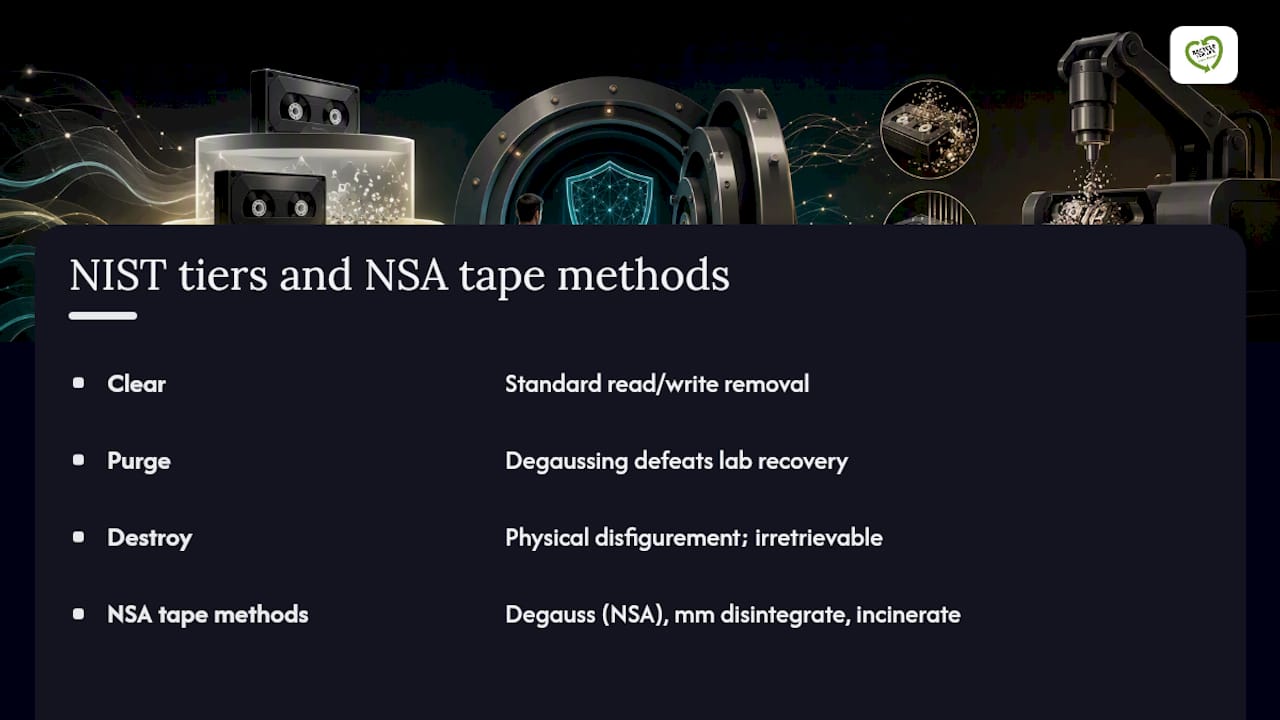
NIST SP 800-88 Revision 2 splits sanitization into three tiers: clear, purge, and destroy. Clear removes data using standard read/write commands. Purge uses techniques like degaussing to defeat even laboratory data recovery. Destroy goes further still, physically disfiguring the media so no state-of-the-art lab technique can reconstruct usable data.
That last tier is where tape media disposal gets tricky. NIST lists disintegrate, incinerate, melt, pulverize, and shred as acceptable destroy techniques, but it also flags something most vendors won’t volunteer: shredding and pulverizing alone can fall short for higher security categories. Tape’s thin magnetic ribbon and dense recording layer mean a coarsely shredded strip can still hold recoverable fragments under magnetic microscopy, unlike a drive platter smashed into pieces.
The NSA/CSS Policy Manual 9-12 fills that gap for magnetic tape specifically. It names degaussing with NSA-evaluated equipment, disintegration to particle sizes measured in millimeters, and high-temperature incineration as acceptable paths for classified or high-assurance destruction. Together, NIST and NSA form the backbone every compliance officer should cite when writing a media sanitization policy, because both speak directly to what “irretrievable” has to mean in practice, not just in theory.
Degaussing vs. Shredding vs. Incineration: What Each One Actually Does
Degaussing works by exposing tape to a magnetic field strong enough to scramble the domain alignment that stores your data. The catch: the degausser’s output has to exceed the tape’s own coercivity, or the erase is only partial. A degausser calibrated for older DLT cartridges may not fully purge a high-density LTO-8 or LTO-9 tape, which is why equipment logs matter as much as the process itself.
Mechanical methods take a different route entirely:
- Shredding cuts tape into strips; effective only when strip width is small enough to defeat recovery attempts.
- Disintegration grinds media into particles, generally the safer bet for tape given its resilience to naive cutting.
- Incineration burns cartridges at temperatures that destroy both the shell and the magnetic coating.
- Pulverizing crushes media, though NIST cautions this alone may not satisfy destroy-level requirements for sensitive categories.
For most organizations, degaussing followed by physical destruction is the belt-and-suspenders approach. When a degausser can’t be confidently matched to a tape’s coercivity, NSA/CSS Policy Manual 9-12 points toward certified disintegration or incineration instead of gambling on an uncertain purge.
Pro Tip: Ask any vendor for the degausser’s equipment ID and its most recent calibration date before you sign off on a job. A machine that hasn’t been recalibrated against current NSA specs may be erasing tapes below the field strength your media actually needs.
Should You Choose On-Site or Off-Site Tape Destruction?
On-site destruction lets your team physically watch cartridges get degaussed or shredded, which eliminates transport risk entirely. Off-site processing usually costs less and gives providers access to industrial-scale disintegrators, but it shifts the security burden onto custody controls during transit and storage.
HIPAA explicitly permits off-site destruction of protected health information, provided equivalent security controls and documentation are in place, including a signed business associate agreement. That single allowance is why off-site models remain viable for regulated industries, as long as the paperwork holds up.
Before you sign a contract with any provider, confirm these custody controls:
- Barcoded, tamper-evident containers with recorded seal IDs at pickup.
- A transport log showing chain-of-custody handoffs, ideally with GPS tracking.
- Dual-control procedures requiring two authorized staff for any container access.
- Named technician IDs tied to every destruction event, not just a company name.
- A Certificate of Destruction listing method, date, equipment ID, and itemized serial ranges.
Ask for photo or video evidence and serial reconciliation against your original inventory whenever the data justifies extra scrutiny. It costs little and closes the gap between “trust us” and proof.
Which Tape Formats Need Special Handling?
Most compliant providers handle the full spread of enterprise and legacy formats: LTO (all generations), DLT and SDLT, DDS/DAT, AIT, Travan, QIC, and the IBM 3480/3592 cartridge families. Confirm this coverage before booking, since legacy formats sometimes get quietly excluded from standard pricing.
Cartridge design and coercivity drive method selection more than most IT teams expect. Higher-density formats like LTO-9 demand stronger degaussing fields, while older QIC and DAT cartridges are often destroyed just as effectively through disintegration alone. Enterprise cartridges (3592, 3480) sometimes include embedded memory chips that store metadata separately from the tape itself, which means a thorough sanitization plan has to account for that chip, not just the reel.
- Capture serial numbers and barcodes before destruction, not after.
- Flag any cartridges with embedded memory for separate verification.
- Segregate legacy formats that may require different equipment than current LTO stock.
How Do You Prepare and Schedule a Tape Destruction Job?
A clean destruction job starts well before the truck or shredder shows up. Follow this sequence:
- Inventory every cartridge, recording serials, barcodes, and format type.
- Confirm your retention policy and any legal holds don’t cover the tapes you’re targeting for destruction.
- Package cartridges in labeled, tamper-evident containers, segregated by sensitivity level if needed.
- Book on-site or off-site service, request equipment IDs and calibration logs in advance, and decide whether you need a witness present.
- Review the contract for BAA language if PHI is involved, liability terms, and recycling commitments for shredded material.
- Confirm how evidence, Certificates of Destruction, photos, and custody logs, will be delivered and in what format.
Skipping step two is the most common mistake. Destroying tapes still under legal hold or inside a mandated retention window, even backups nobody has touched in years, can create bigger legal exposure than the data risk you were trying to eliminate.
What Should You Budget for Tape Destruction Services?
Pricing scales with a few predictable levers: total cartridge count or pallet volume, media mix (a bin of mixed LTO and DAT costs more to sort than uniform stock), whether you need on-site mobilization, transport distance, and how much verification documentation you’re requesting.
Timelines run anywhere from same-day for small on-site jobs to one to two weeks for larger off-site projects, with certificate delivery typically following completion within a few business days. Delays usually trace back to incomplete inventories or last-minute additions to the batch.
Before signing, confirm four things in writing: a defined SLA for evidence delivery, liability and indemnity language covering data breach during transport, a BAA if any tapes touch PHI, and clear terms on how shredded material gets recycled versus landfilled. Organizations in regulated sectors, including upstream oil and gas operators managing long retention windows, should align destruction scheduling with retention obligations before requesting quotes.
How UsedCartridge.com Handles Compliant Tape Destruction
Some providers run both on-site and off-site tape destruction with audit-ready Certificates of Destruction issued after every job, giving IT asset managers a paper trail that matches NIST and NSA expectations rather than a generic receipt.
The operational backbone includes equipment tracking, calibration documentation, and chain-of-custody forms tied to each pickup, the same items procurement teams should demand from any vendor regardless of who they choose. Quotes and pickup scheduling are available for organizations clearing out legacy tape libraries alongside broader IT asset recovery projects, and the disposal of data process is built around the same auditable standard this article has walked through.
The Real Gap in Most Tape Destruction Advice
Most guidance on this topic treats degaussing and shredding as interchangeable options, pick whichever is cheaper. That’s backwards. The right method depends on the tape’s coercivity and your data’s sensitivity, not on vendor convenience, and NIST’s own caution about shredding and pulverizing falling short for higher security categories gets buried in most vendor marketing because it complicates the pitch.
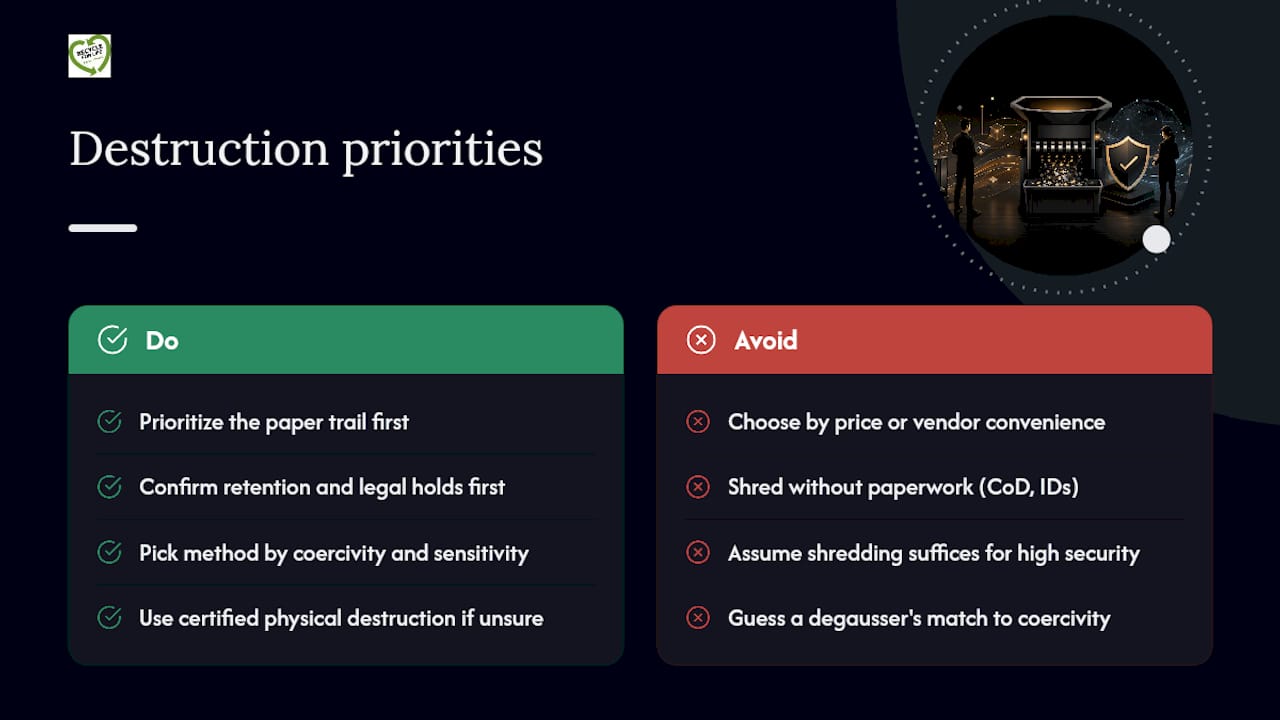
The conventional advice also underweights documentation. Organizations obsess over which destruction method sounds most aggressive, incineration feels satisfying, when the audit risk almost always comes down to whether you can produce a Certificate of Destruction with equipment IDs, calibration logs, and serial reconciliation. A perfectly destroyed tape with no paperwork is functionally useless in a compliance review.
Prioritize the paper trail first, then the method. Confirm retention policy and legal holds before anything else touches a shredder. And when in doubt about whether your degausser matches a high-density cartridge’s coercivity, skip the uncertainty and go straight to certified physical destruction. Guessing is the one move that has no defensible answer if a regulator asks.
— Keith
Get a Quote for Secure Tape Destruction
If you’re sitting on boxes of legacy backup tapes and need them gone the right way, some providers handle secure on-site and off-site tape destruction with the documentation to back it up. That’s the real advantage here: you get a compliant, verifiable process without having to coordinate degaussing, shredding, and disposal through three separate vendors yourself.

Every job includes an itemized Certificate of Destruction and chain-of-custody records, so your compliance file is complete the day the tapes leave your building. Requesting a quote is straightforward: submit your cartridge count and format mix through the equipment destruction page, and pickup scheduling is available at no cost to get the process started.
Sources
- NIST Special Publication 800-88 Revision 2, Guidelines for Media Sanitization
- U.S. Department of Health & Human Services — HIPAA
- NSA — Media destruction guidance and Evaluated Product Lists