
Isolate the battery immediately, stop using or charging it, and never puncture, crush, or soak it in water or saltwater. Move it to a cool, ventilated spot away from combustibles, watch for heat or smoke, and call emergency services if it vents or ignites. Once stable, package it under DOT and EPA guidance and route it to a certified hazardous-waste transporter or recycler since regular trash and curbside bins are off-limits.
TL;DR:
- Proper packaging and labeling are crucial for damaged lithium batteries, including taping terminals and storing each in non-conductive containers with absorbent material.
- Storage locations should be cool, ventilated, and isolated from combustibles, with specific handling precautions for swollen cells that must not be punctured or rewrapped.
- Shipping damaged batteries requires compliance with DOT and RCRA regulations, avoiding air transport and ensuring proper manifesting and documentation.
- Certified hazardous waste recyclers or facilities should handle disposal, never curbside trash or non-certified scrap collectors, with prior coordination essential for damaged units.
- In fire incidents, large volumes of water and thermal imaging are key, and extended monitoring is necessary due to the risk of re-ignition from residual heat or energy.
Table of Contents
- Damaged Lithium Battery Handling: The First 30 Minutes
- How Do You Safely Store a Damaged Battery Before Disposal?
- What PPE and Tools Do You Need to Handle Damaged Batteries?
- What Are the DOT and RCRA Rules for Shipping Damaged Batteries?
- Where Can You Recycle or Dispose of a Damaged Battery?
- How Should You Handle a Lithium Battery Fire and Its Aftermath?
- When Should You Bring in a Certified E-Waste and Hazardous-Waste Service?
- The Real Gap in Most Battery Safety Advice
- Get Compliant Battery Disposal Without the Guesswork
- Sources
- FAQ
Damaged Lithium Battery Handling: The First 30 Minutes
The first half hour after discovering a damaged battery decides whether you’re filing an incident report or writing a paragraph in next month’s safety newsletter. Damaged lithium battery handling starts with a fast, disciplined triage, not a debate about whether the pack “still works fine.”
Look for the obvious red flags first: smoke, a hissing sound, heat you can feel from a few feet away, a chemical or sweet odor, or visible electrolyte residue. Any one of those means you evacuate the immediate area, close doors if you can do so safely, and call 911 or your internal fire brigade before you do anything else. A battery that’s actively venting or burning is a fire department problem, not a facilities problem.
If there’s no active venting or flame, work through this sequence:
- Clear the area. Remove nearby paper, cardboard, aerosol cans, and other combustibles from a several-foot radius.
- Kill ignition sources. No open flames, no smoking, no static-generating activity nearby.
- Assess without touching bare cells. Note whether the pack is hot, swollen, leaking, dented, or simply scuffed.
- Isolate on a non-combustible surface. A concrete floor or metal tray beats a carpeted office or a wooden workbench.
- Notify the right people. Internal EHS staff for a stable, cool, non-venting battery; 911 or your fire brigade for anything hot, swollen, or smoking; the manufacturer or a certified hazardous-waste handler once the immediate danger has passed.
A simple mental checklist helps here: hot or venting means evacuate now, swollen means isolate and never repackage, leaking means contain the runoff, and merely dented or scuffed means document and store with caution.
Pro Tip: Keep a fire-rated bucket and a bag of sand or cat litter within reach of any area where batteries get inspected, charged, or unpacked. Reaching for containment materials after a cell starts venting costs you the ten seconds that actually matter.
How Do You Safely Store a Damaged Battery Before Disposal?
Containment for a damaged lithium battery isn’t complicated, but it has to be done exactly right, because the wrong container or the wrong neighbor battery turns a minor incident into a real one. The EPA’s tip sheet on damaged and defective batteries lays out the standard approach, and it’s worth following to the letter rather than improvising.
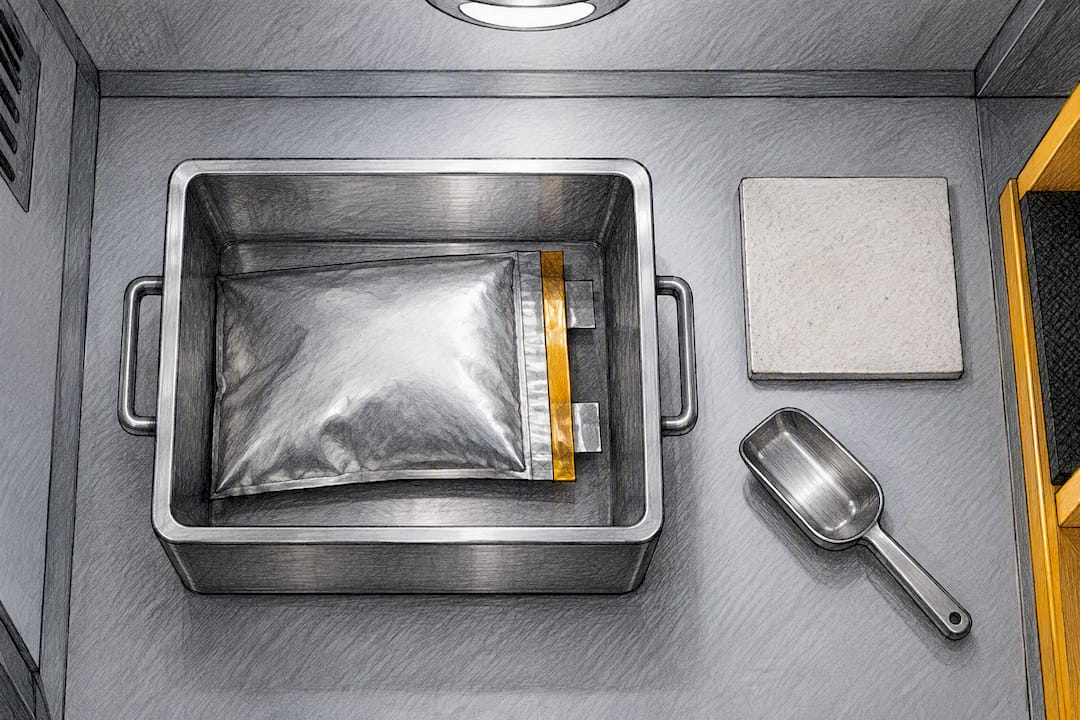
Start with the terminals. Tape both battery terminals with non-conductive tape, whether it’s a standard alkaline cell or a lithium pack, to prevent accidental short-circuiting against metal shelving, tools, or other batteries. Then package the battery individually in plastic, never in a metal tin or can, and surround it with a non-flammable absorbent material.
- Use plastic bags or plastic bins as inner packaging, never metal containers that can conduct current or spark.
- Surround the packaged battery with sand, vermiculite, or cat litter to absorb any leaking electrolyte and insulate against heat.
- Store one damaged battery per inner package whenever the volume allows it, rather than grouping several damaged cells together.
- Keep lithium chemistries separated from alkaline, nickel-cadmium, and other battery types in storage.
- Label the outer container clearly as “Damaged/defective lithium ion battery,” matching the EPA’s recommended wording.
- Choose a storage location that’s cool, ventilated, away from foot traffic, and away from anything flammable.
The location matters as much as the packaging. A back corner of a warehouse near stacked cardboard is a bad choice. A dedicated, restricted-access holding area with a concrete floor, decent airflow, and a few feet of clearance from other stock is the better call. Some facilities set a standoff distance of several feet from occupied workstations for larger battery holding areas, though your fire marshal or insurance carrier may specify guidance for your building.
One detail that trips up a lot of safety teams: a swollen battery is not something you can “fix” by repackaging it tighter or venting it yourself. Swelling signals internal gas generation from chemical breakdown, and guidance on swollen lithium-ion batteries is blunt about it: don’t puncture, compress, or rewrap a swollen cell. Isolate it exactly as it is and route it to a certified handler.
Documentation closes the loop. Log the date and time the battery was found, its condition, who handled it, and where it’s stored. That chain-of-custody record becomes essential later, both for your own incident tracking and for the transporter or recycler who eventually takes custody of the battery.
What PPE and Tools Do You Need to Handle Damaged Batteries?
Minimum PPE for handling a stable, non-venting damaged battery is safety glasses, nitrile gloves, and a protective outer layer like a lab coat or coveralls. That covers routine inspection and packaging work. It does not cover a battery that’s actively venting, smoking, or showing signs of thermal runaway, and treating those two scenarios the same way is where most in-house teams get into trouble.
For anything hot, swollen with visible bulging, or emitting gas, the job shifts to your fire brigade or a hazmat team, who may use self-contained breathing apparatus and full chemical-resistant suits. That’s not overcaution. Off-gassing from a venting lithium cell can include hydrogen fluoride and other irritant compounds, and standard nitrile gloves and safety glasses offer no real protection against that.
A few handling rules apply regardless of PPE level:
- Never use metal tools, tweezers, or jewelry near a damaged cell. Non-conductive, insulated tools reduce short-circuit risk.
- Move batteries on non-conductive trays, not bare metal carts or shelving.
- Inspect visually and check for heat with a non-contact thermometer or thermal camera. Skip disassembly entirely.
- Never attempt to puncture, crush, or manually discharge a leaking or compromised cell. MIT’s EHS guidance notes that controlled discharge through a resistive load is sometimes appropriate for intact-but-damaged batteries, but never for anything punctured or actively leaking.
Access to your battery holding area should be restricted to staff who’ve completed lithium battery safety training, and that training needs a refresh schedule, not a one-time sign-off. Annual refreshers are common, though facilities running high battery volumes often train quarterly.
Pro Tip: If your team handles battery inspections more than once a week, invest in a $30 infrared thermometer. It pays for itself the first time it catches a cell running warm before anyone smells or sees a problem.
What Are the DOT and RCRA Rules for Shipping Damaged Batteries?
Most discarded lithium-ion batteries qualify as hazardous waste under RCRA codes D001 and D003, meaning ignitable and reactive, and that classification alone rules out curbside trash and most standard recycling bins. Once a battery is damaged, defective, or subject to a recall, it moves into an even more tightly regulated category for shipping.
PHMSA’s guidance for lithium batteries is unambiguous on one point: damaged, defective, or recalled batteries cannot travel by air, full stop. They move by highway, rail, or vessel instead, under specific packaging and marking requirements. Depending on the battery’s condition and quantity, that can mean a special permit issued through DOT’s Check the Box program, which offers streamlined packaging authorizations for damaged, defective, or recalled cells.
Getting the classification and paperwork right involves a few concrete steps:
- Confirm hazardous waste status under RCRA and assign the correct D001/D003 codes on any manifest.
- Package according to UN specifications, marking the outer container with the applicable number (UN3480, UN3481, UN3090, or UN3091 depending on chemistry and configuration).
- Verify the transporter holds the correct DOT hazmat certification and, if needed, special-permit authority for damaged cells.
- Complete a hazardous waste manifest documenting quantity, condition, origin, and destination.
- Retain copies of all shipping and manifest paperwork for your own compliance records.
A few practical notes worth keeping in front of your team:
- Never attempt to ship damaged batteries through standard parcel carriers or air freight, even for small quantities.
- State and local rules sometimes add requirements on top of federal ones, so check with your state environmental agency before finalizing a disposal plan.
- Manufacturer take-back programs sometimes offer a faster, cheaper path than a general hazardous-waste transporter, particularly for warranty-covered recalls.
Facilities that ship batteries regularly usually build a relationship with a transporter experienced in DOT hazmat battery shipping rather than sourcing one from scratch every time an incident happens. The universal waste rules for batteries also matter here, since some jurisdictions allow certain battery types to move under a simplified universal waste standard instead of full RCRA hazardous waste procedures, and knowing which category your batteries fall into changes your paperwork burden substantially.
Where Can You Recycle or Dispose of a Damaged Battery?
The right endpoint for a damaged battery depends on volume and condition, but the short list of acceptable options is the same for nearly every organization: a certified hazardous-waste recycler, an RCRA-authorized facility, a household hazardous waste program for small quantities, or a manufacturer take-back program when one exists.
What’s not acceptable is just as important. Curbside trash and standard recycling bins are out, because a damaged cell that shorts or vents inside a garbage truck or sorting facility can start a fire that spreads to everything around it. Uncertified scrap collectors are a gamble, since they often lack the packaging, insurance, and manifest process a hazardous-waste job actually requires. Shipping by air is prohibited for damaged cells under DOT rules, and home remedies like soaking a punctured cell in saltwater do more harm than good. Industry guidance on LiPo battery safety points out that saltwater can corrode terminals and leave a cell that looks discharged while still holding real energy inside.
Consumer programs like Call2Recycle handle plenty of intact, end-of-life batteries, but damaged or defective units are frequently excluded from those consumer drop-off channels. Before assuming a local collection point will take a damaged pack, confirm acceptance directly, since EPA guidance on lithium-ion battery recycling recommends verifying with the transporter or facility before drop-off rather than showing up and hoping.
When vetting a recycling or disposal vendor, look for:
- EPA and DOT compliance documentation, not just a general recycling license.
- Special-permit capability for damaged, defective, or recalled shipments when your volume requires it.
- Liability insurance and a documented emergency response procedure for battery incidents.
- Certificates of recycling or destruction provided after the job, not just a pickup receipt.
Prepare batteries for handoff exactly the way the transporter instructs: individually packaged, terminals taped, absorbent material in place, and a written condition note attached to each unit or shipment. For laptop-format packs specifically, step-by-step prep guidance for laptop battery recycling covers the packaging details that most generic battery guides skip.
How Should You Handle a Lithium Battery Fire and Its Aftermath?
Lithium battery fires don’t behave like ordinary fires, and the biggest mistake responders make is treating “flames out” as “problem solved.” Thermal runaway can reignite hours after the initial fire appears extinguished, because individual cells inside a pack can still hold enough residual energy and heat to flare back up once conditions shift.
Water remains the primary tool for cooling lithium-ion cells, and ATF guidance on fire suppression and post-suppression stabilization recommends using large volumes rather than a quick knockdown spray. Thermal imaging cameras help responders confirm a pack has actually cooled rather than guessing based on visible flame.
A few operational points matter for anyone coordinating with fire or hazmat teams:
- Contain and manage runoff water, since it can carry electrolyte residue and needs proper handling rather than an open drain.
- Decontaminate responders and equipment before re-entry to normal operations.
- Avoid metal tools near cooling or cooled cells, since a short circuit can restart the reaction.
- Plan for extended monitoring, sometimes hours, before declaring the scene fully stable.
After suppression, treat the scene like evidence handling. Bag individual cells separately and store them in non-combustible containers that can vent pressure if a cell still off-gasses, since a fully sealed container around a warm cell can build pressure on its own. Coordinate with your environmental compliance team and, where applicable, local fire investigators before moving anything off-site.
Pro Tip: Assign one person as the “cooling clock” owner during any battery fire response. Someone needs to track elapsed time since the last flame or smoke, because re-ignition risk fades gradually, not on a fixed schedule anyone can guess.
When Should You Bring in a Certified E-Waste and Hazardous-Waste Service?
Some situations genuinely call for outside expertise, and pretending otherwise wastes time your team doesn’t have. A leaking, venting, or swollen battery, a large volume of damaged units, or a facility without in-house hazmat training are all clear signals to bring in a certified vendor rather than muscle through it internally.
A compliant vendor brings a few things most facilities can’t easily replicate on their own: DOT-compliant packaging built for damaged and defective cells, hazardous-waste manifesting handled correctly the first time, certified recycling with a documented chain of custody, and audit-ready paperwork your compliance team can produce on demand.
Some vendors work with organizations facing exactly this kind of situation, offering:
- Compliant electronics and battery recycling built around regulatory requirements rather than shortcuts.
- IT asset disposition and recovery services for equipment that includes damaged or aging battery packs.
- Documentation and certificates that support your internal compliance and audit needs.
- Flexible scheduling for pickups when a damaged battery situation needs prompt resolution.
For a facilities manager staring at a swollen laptop battery or a pallet of recalled packs, the calculation is straightforward: in-house handling covers triage and containment, but the transport, manifesting, and certified disposal is where professional support earns its keep.
The Real Gap in Most Battery Safety Advice
Most battery safety content online treats damaged lithium batteries like a first-aid problem: here’s what to do, here’s what not to do, done. That framing misses the part that actually determines outcomes, which is the handoff between “we’ve contained it” and “it’s off our property and someone qualified has custody of it.”
The conventional advice gets the immediate triage right. Evacuate on smoke or heat, tape terminals, use sand or vermiculite, don’t puncture or soak anything. Where it falls short is treating disposal as an afterthought, a quick “take it to a recycler” line at the end of an article. In practice, that step is where the regulatory exposure actually lives. A facility that nails containment but ships a damaged pack through the wrong carrier, or hands it to an uncertified collector, has traded a fire risk for a compliance risk.
If you take one thing from this guide, prioritize building the relationship with a certified transporter or recycler before you need it, not during an active incident. Waiting until a swollen battery is sitting in a bucket to start researching DOT-compliant shipping options is how minor incidents turn into weeks of scrambling.
— Keith
Get Compliant Battery Disposal Without the Guesswork
Most safety teams can handle the first thirty minutes of a damaged battery incident on their own. What trips people up is everything after that: packaging that meets DOT specifications, manifesting that satisfies RCRA requirements, and a certified endpoint that hands back real documentation instead of a vague pickup receipt.

Usedcartridge exists for exactly that gap. Rather than piecing together a transporter, a recycler, and a paperwork process on your own, you get one point of contact for recycling services, IT asset recovery, and battery collection handled to regulatory standard, with certificates provided for your compliance files. For organizations dealing with a higher volume of damaged or end-of-life battery packs, local electronics recycling pickups can be scheduled around your timeline rather than forcing you to hold hazardous material longer than you’d like. If your damaged batteries came out of retired laptops or other equipment, that same pickup can fold in hard drive destruction for the data security side of the job at the same time. Request a quote and get a pickup scheduled before your next damaged battery becomes a storage problem instead of a solved one.
Sources
Bookmark the EPA’s used lithium-ion battery guidance for RCRA classification questions, and keep the EPA tip sheet on damaged and defective batteries handy for packaging and labeling specifics. For shipping marks, special permits, and the “no air transport” rule, PHMSA’s lithium battery page and the Check the Box program cover the operational detail.
For fire response and post-suppression stabilization, the ATF’s guidance document walks through cooling and re-ignition monitoring in more depth than most internal safety manuals attempt. Consult your state environmental agency for any local rules layered on top of these federal standards.
- End-of-Life Household Small Format Damaged and Defective Batteries (EPA tip sheet)
- Lithium batteries | PHMSA (U.S. DOT)
- Fire Suppression Considerations and Post‑Suppression Stabilization (ATF guidance)
FAQ
What Is the 80/20 Rule for Lithium Batteries?
The 80/20 rule refers to a charging practice, not a disposal rule: keeping a lithium battery’s charge between roughly 20% and 80% is commonly recommended to reduce stress on the cells and slow long-term degradation. It has no bearing on how you handle a battery that’s already damaged, swollen, or leaking, since those batteries need isolation and certified disposal regardless of their charge level.
What Are the Current TSA and DOT Rules for Lithium Batteries?
Damaged, defective, or recalled lithium batteries are prohibited from air transport under PHMSA/DOT guidance, and that applies whether you’re a traveler or a business shipping freight. Intact consumer batteries in personal devices generally travel fine in carry-on bags, but anything showing damage should never go through TSA screening or air cargo at all.
Does Home Depot Accept Damaged Lithium Batteries?
Retail take-back programs and Call2Recycle drop points typically accept intact, end-of-life consumer batteries, but damaged or defective units are frequently excluded from those consumer channels according to EPA guidance. Confirm acceptance directly with the retailer before bringing in anything visibly swollen, leaking, or damaged, and expect to be redirected to a certified hazardous-waste handler instead.
Where Can You Dispose of a Damaged Lithium-Ion Battery?
Certified recyclers, RCRA-authorized hazardous-waste facilities, and manufacturer take-back programs are the correct endpoints for a damaged lithium-ion battery, never curbside trash or standard recycling bins. Organizations handling higher volumes or ongoing IT asset turnover often work with a service like Usedcartridge’s recycling and asset recovery programs to keep packaging, manifesting, and disposal documentation consistent across every pickup.
How Much Does Damaged Battery Disposal Cost?
Pricing depends on battery volume, chemistry, and whether special DOT permits are required for the shipment, so costs vary by job rather than following a flat rate. Current pricing details for Usedcartridge’s recycling and disposal services are available by requesting a quote directly through Usedcartridge.