
Retiring a fleet of corporate laptops sounds straightforward until you realize you’re juggling data privacy law, environmental regulation, chain-of-custody documentation, and the pressure to show measurable sustainability progress all at once. Most organizations treat IT asset recovery as a one-time disposal event rather than a strategic program, and that gap costs them financially and reputationally. This article gives corporate sustainability officers a clear, actionable framework for balancing security, compliance, and genuine eco-impact, covering everything from vendor vetting to value recovery, so your next equipment retirement cycle becomes a competitive advantage rather than a liability.
Table of Contents
- Define clear criteria for eco-friendly IT asset recovery
- Choose certified data sanitization over physical destruction
- Select environmentally responsible logistics and recycling partners
- Maximize value recovery and environmental impact
- Why most IT asset recovery misses the mark on eco-friendliness
- Advance your sustainable IT asset recovery strategy
- Frequently asked questions
Key Takeaways
| Point | Details |
|---|---|
| Certify before disposing | Use certified data wiping standards for maximum security and sustainability. |
| Partner with proven recyclers | Vetted vendors guarantee compliance and transparent environmental impact. |
| Maximize asset value | Refurbishment and resale strategies boost ROI and cut electronic waste. |
| Demand clear reporting | Track all devices and ensure proper chain of custody to meet regulations. |
Define clear criteria for eco-friendly IT asset recovery
Before you touch a single device, you need a written set of criteria that every stakeholder agrees on. Without it, decisions get made inconsistently, compliance gaps appear, and your sustainability reporting loses credibility. Think of this criteria document as your program’s constitution.
Start by setting measurable goals across four dimensions:
- Zero landfill commitment: Every device must have a documented end-of-life path that avoids landfill disposal entirely.
- Data risk threshold: Define acceptable risk levels for each asset class, from executive laptops to shared printers.
- Regulatory compliance scope: Identify which frameworks apply to your organization, such as GDPR for European data subjects or HIPAA for healthcare-related information.
- Lifecycle ROI target: Set a minimum recovery value per device to ensure the program pays for itself.
Environmental certifications matter here too. Require that any partner you work with holds recognized credentials and can demonstrate sustainable e-waste practices that align with your corporate sustainability goals. Insist on computer recycling compliance documentation for every batch processed.
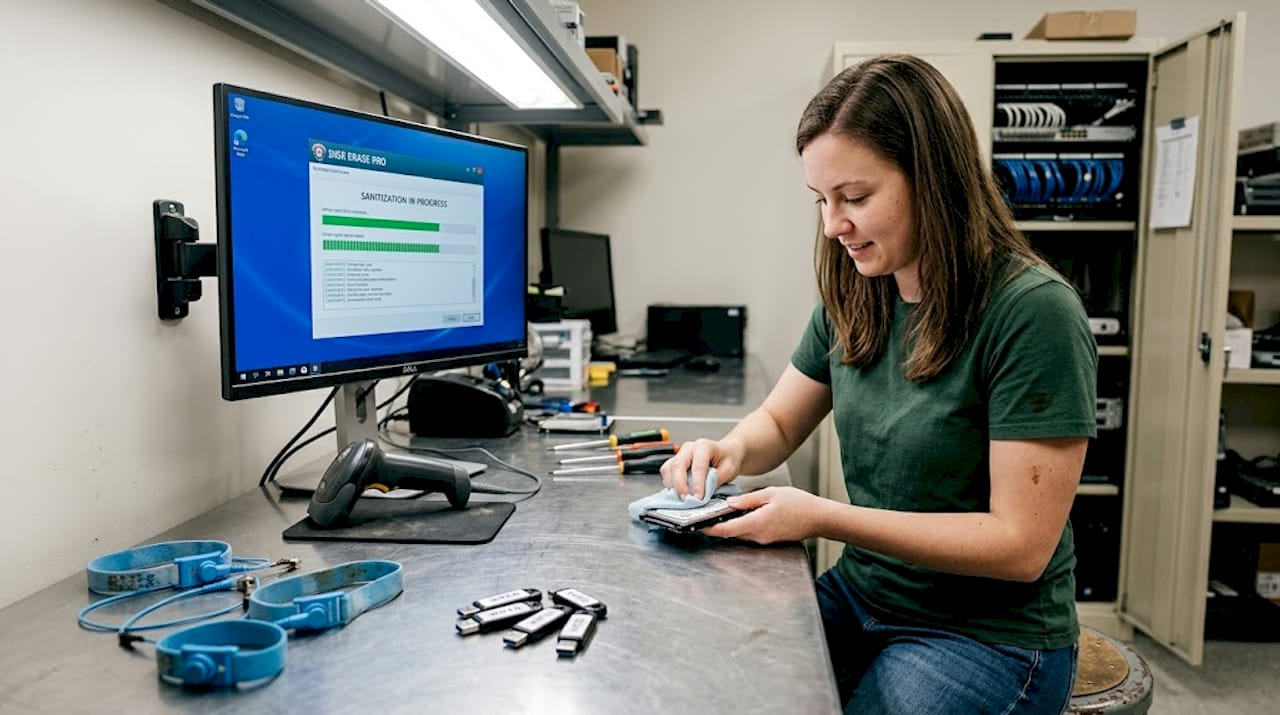
On the data side, NIST SP 800-88 recommends prioritizing certified software wiping over physical destruction for reusable assets, enabling refurbishment and resale while maintaining full compliance with GDPR, HIPAA, and similar frameworks. Physical destruction remains appropriate for highly sensitive or non-functional devices. Following this tiered approach, certified processes can enable up to 98% reuse or resale of recovered assets, a figure that dramatically changes the economics of your program.
When evaluating partners, review their environmental partnership criteria carefully. Ask for sample reports, not just brochures.
Pro Tip: Always request a detailed chain-of-custody document from your recovery provider. This single document protects you during audits and proves your program’s integrity to regulators and board members alike.
Choose certified data sanitization over physical destruction
With your criteria established, the next decision is how to process retired equipment securely and sustainably. Many organizations default to physical destruction because it feels definitive. In practice, it destroys recoverable value and generates more waste than necessary.
Here is a practical sequence for implementing certified sanitization:
- Inventory and classify assets by sensitivity level before any processing begins.
- Apply software-based wiping using tools like Blancco that meet NIST SP 800-88 standards, which confirm that certified sanitization unlocks resale potential while maintaining full security and compliance.
- Generate a sanitization certificate for each device, tied to its serial number.
- Audit the results using device tracking tools that flag any assets that failed the wipe process.
- Route failed devices to physical destruction only when the drive cannot be successfully sanitized or when regulations explicitly require it.
The comparison below shows why sanitization wins in most scenarios:
| Factor | Software sanitization | Physical destruction |
|---|---|---|
| Cost per device | Lower | Higher |
| Compliance coverage | GDPR, HIPAA, NIST | Varies by method |
| Resale potential | High | None |
| Carbon impact | Minimal | Significant |
| Audit trail | Digital certificate | Certificate of destruction |
Physical destruction still has a place. Use it for equipment that cannot be sanitized, such as failed hard drives or devices classified at the highest sensitivity tier. For everything else, sanitization is the smarter path.
For devices that need to move between facilities before processing, follow secure transport procedures to maintain chain-of-custody integrity during transit.
Pro Tip: Pair your sanitization workflow with an asset auditing tool that logs each device’s status in real time. This gives you instant compliance evidence without manual spreadsheet work.
Select environmentally responsible logistics and recycling partners
Choosing the right partner is where many programs quietly fail. A vendor can look excellent on paper and still export e-waste illegally or mishandle data. Due diligence is not optional.
Here is what to verify before signing any contract:
- R2 or e-Stewards certification: These are the two gold-standard credentials for responsible electronics recycling. Neither can be self-reported.
- Zero-export policy: Confirm in writing that the vendor does not ship untested or non-working devices to developing countries.
- Downstream transparency: Ask for documentation showing where materials go after initial processing, not just what happens at the first facility.
- Clear reporting cadence: Monthly or quarterly reports should include device counts, data destruction certificates, and environmental metrics.
The table below outlines what strong vendor sustainability reporting looks like:
| Reporting element | Why it matters |
|---|---|
| Device-level disposition records | Proves compliance per asset |
| Weight-based recycling totals | Supports sustainability reporting |
| Downstream facility names | Prevents illegal export |
| Emissions offset data | Feeds ESG disclosures |
When you vet sustainable recyclers thoroughly, the payoff goes beyond compliance. A circular supply chain case study shows that proactive policy combined with certified partners can yield cost savings, compliance risk avoidance, significant revenue recovery, and measurable emissions cuts. Dell’s asset recovery services, for example, have generated over $500 million in recovered value through structured circular programs.
Don’t overlook component-level recycling either. Battery and parts recycling from retired laptops and mobile devices can contribute meaningfully to both your environmental metrics and your recovered materials revenue.
Pro Tip: Insist on end-to-end tracking that includes downstream facility data. If a vendor cannot provide it, that is a red flag worth acting on before you sign.
Maximize value recovery and environmental impact
The final piece of the loop is extracting maximum value from each device before it leaves your control. This is where sustainability and financial performance genuinely converge.
Start with a structured device health assessment:
- Run diagnostics on battery, screen, storage, and processor for each unit.
- Classify by condition: Grade A devices go to resale, Grade B to refurbishment, Grade C to parts harvesting, and Grade D to certified recycling.
- Sanitize all data before any device changes hands, regardless of its destination.
- Document the outcome for each device with a disposition record linked to its serial number.
Your options for each grade are broader than most teams realize:
- Redeployment internally for lower-tier staff or training environments
- Donation to nonprofits or schools with full sanitization and documentation
- Secure resale through certified remarketing channels to generate direct revenue
- Material recycling for precious metals, rare earth elements, and plastics
The best programs treat every device as having residual value until proven otherwise. NIST SP 800-88 confirms that certified processes enable refurbishment and resale, extending device life and boosting revenue simultaneously. And according to circular supply chain research, sustainable IT recovery can generate millions in cost savings and emissions reductions for organizations that commit to the full lifecycle approach.
“Top-performing programs generate seven-figure savings and measurable emissions cuts by treating every retired device as a resource, not a liability.”
Use a structured tool to calculate asset ROI before each recovery cycle. Knowing your expected return helps you prioritize which assets to fast-track and which require more processing time. Aligning this with your sustainable IT infrastructure strategy ensures your technology lifecycle decisions support broader organizational goals.
Why most IT asset recovery misses the mark on eco-friendliness
Here is an uncomfortable observation: most organizations that believe they are running a responsible IT asset recovery program are actually running a disposal program with better paperwork. The difference matters.
Conventional wisdom treats physical destruction as the gold standard for security. It feels decisive. But modern certified sanitization, when done correctly, is equally secure and far more sustainable. Defaulting to shredding every drive because it is simpler is not a security decision. It is a convenience decision dressed up as one.
What we consistently see is that companies leave both money and sustainability wins on the table by skipping the refurbishment and resale stages. They focus on safe disposal and call the program complete. True eco-impact requires a closed-loop mindset where reuse, resale, and full transparency are the default, not the exception.
Rethinking e-waste as a resource stream rather than a liability changes how your team approaches every retirement decision. That shift in perspective is what separates programs that check a compliance box from programs that genuinely move the needle on sustainability.
Advance your sustainable IT asset recovery strategy
Implementing these strategies is significantly easier with a partner who handles audit support, logistics coordination, compliance documentation, and environmental reporting under one roof.

At UsedCartridge.com, we specialize in e-waste recovery solutions that meet the security and compliance standards your organization requires. From certified computer hardware recycling to full chain-of-custody documentation, our team supports sustainability officers at every stage of the asset recovery lifecycle. Ready to see what your retired IT assets are actually worth? Recover asset value with a free quote and discover how much your next retirement cycle can return to your bottom line and your sustainability report.
Frequently asked questions
What is the safest way to ensure data security during IT asset recovery?
Certified data sanitization using software solutions like Blancco and following NIST SP 800-88 minimizes risk while enabling reuse. This approach is recommended over destruction for most reusable assets because it produces a verifiable audit trail.
How do I verify an IT asset recycler’s sustainability claims?
Ask for R2 or e-Stewards certification, downstream tracking documentation, and transparent reports on final device disposition. Self-reported sustainability claims without third-party certification are not sufficient for compliance purposes.
Does IT asset recovery offer a real ROI?
Yes, organizations report millions in recovered value and environmental savings when following a circular IT recovery strategy. Proactive asset recovery consistently yields both financial and environmental gains for companies that commit to the full lifecycle approach.
When is equipment destruction necessary?
Physical destruction is best for failed storage devices or when regulations prevent resale or reuse. For all other assets, certified sanitization is the more secure, more sustainable, and more financially sound option.