
Free e-waste pickup sounds like a catch. For IT managers juggling data security obligations, compliance audits, and shrinking budgets, “free” often triggers skepticism. But the economics behind these programs are real, and the regulatory frameworks supporting them are solid. Extended Producer Responsibility laws, material recovery revenue, and state-level mandates have created a legitimate ecosystem where businesses can retire old electronics at no direct cost without sacrificing security or compliance. This guide breaks down exactly how free e-waste pickup works, what makes it trustworthy, and how your organization can use it as a strategic asset rather than just a disposal shortcut.
Table of Contents
- The evolving e-waste landscape: Why free services exist
- How do free e-waste pickup companies operate sustainably?
- Benefits for businesses: Security, compliance, and sustainability
- What to check when choosing a free e-waste pickup provider
- The real value of ‘free’: What most overlook about e-waste pickup
- Secure and sustainable e-waste pickup for your organization
- Frequently asked questions
Key Takeaways
| Point | Details |
|---|---|
| Regulations enable free pickup | EPR laws and material value make secure, compliant service possible without hidden costs. |
| Security and compliance included | Certified providers handle data destruction and documentation as a standard part of the service. |
| Business and IT benefits | Free pickup reduces costs, IT burden, and enhances environmental and ESG credentials. |
| Choose providers carefully | Always confirm certifications and data security practices before scheduling a free pickup. |
The evolving e-waste landscape: Why free services exist
The foundation of free e-waste pickup is not charity. It is policy and economics working together. Extended Producer Responsibility (EPR) programs require manufacturers to fund the end-of-life management of the products they sell. California’s SB50 law is one of the most cited examples: electronic waste regulations like this shift the financial burden of disposal from consumers and businesses to the producers themselves.
Under EPR frameworks, manufacturers pay fees into state-administered funds. Those funds then subsidize collection events, certified recyclers, and pickup logistics. The result is a system where your organization hands off old servers, monitors, and networking gear without writing a check.
But fees alone do not cover everything. Recovered materials add significant economic value. A single ton of circuit boards can yield more gold than 17 tons of gold ore, according to the EPA. Copper, aluminum, steel, and rare earth elements extracted from recycled electronics all carry resale value on commodity markets. That revenue stream allows certified recyclers to operate profitably while offering proper recycling practices at no charge to clients.
“Regulations like CA SB50 EPR require manufacturers to help manage e-waste, enabling free services through fees and recovered material value.”
Here is a quick look at how different states approach e-waste funding:
| State | Program type | Who pays | Client cost |
|---|---|---|---|
| California | Advance Recovery Fee | Consumer at purchase | Free at collection |
| Texas | Manufacturer take-back | Manufacturer funded | Free for qualifying items |
| New York | EPR manufacturer program | Manufacturer funded | Free for covered devices |
| Florida | Voluntary + county programs | Mixed funding | Varies by county |
State programs also protect organizations from liability. When you use a certified provider for secure equipment recycling, you receive documentation proving proper disposal. That paper trail matters enormously during audits or regulatory reviews. The free service is not a shortcut. It is the system working as designed.
How do free e-waste pickup companies operate sustainably?
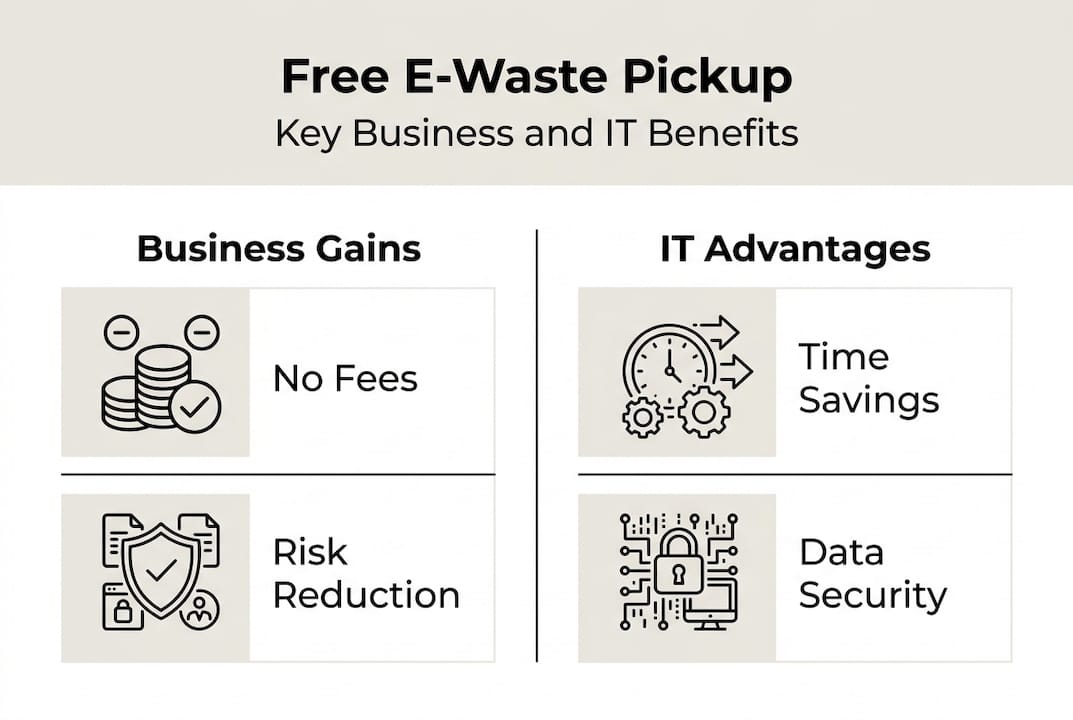
Understanding the business model removes any lingering doubt about quality. Free pickup companies generate revenue through three primary channels: producer program reimbursements, commodity material sales, and value recovery from functional IT assets. None of these require charging your organization directly.
Here is how the two models compare:
| Feature | Traditional paid disposal | Free certified pickup |
|---|---|---|
| Client cost | Per-pound or per-unit fees | No direct charge |
| Revenue source | Client billing | Producer fees + materials |
| Compliance documentation | Often extra cost | Included |
| Data destruction | Add-on service | Integrated into process |
| Audit trail | Basic | Detailed chain of custody |
Producer fees and revenue from materials allow certified providers to absorb logistics costs, maintain certified facilities, and still meet strict environmental and security standards. Volume is also a factor. Large-scale operations reduce per-unit costs significantly, making free pickup economically viable even for smaller client loads.
When evaluating providers, look for these operational hallmarks:
- Certified processing facilities with R2 or e-Stewards accreditation
- Documented chain of custody from pickup to final disposition
- Integrated data destruction with certificate of destruction issued per device
- Compliance reporting aligned with state EPR program requirements
- Transparent downstream partners so you know where materials go
Pro Tip: Before scheduling any pickup, ask your provider for a sample certificate of destruction and a sample chain-of-custody report. If they cannot produce these quickly, keep looking.
The free e-waste quote process at reputable providers is straightforward. You describe your asset inventory, they assess volume and device types, and a pickup is scheduled. No hidden fees emerge later. The types of e-waste accepted typically span computers, laptops, servers, printers, and more. Many providers also include computer recycling programs specifically designed for bulk IT retirements.
Benefits for businesses: Security, compliance, and sustainability
For IT departments, the advantages of free e-waste pickup go well beyond cost savings. Here is what you actually gain:
-
Data security assurance. Certified providers follow NIST 800-88 data sanitization standards. Hard drives are wiped, degaussed, or physically shredded depending on sensitivity level. You receive a certificate of destruction for each device, which is essential for HIPAA, GDPR, and SOC 2 compliance.
-
Regulatory compliance documentation. State regulations like California’s require responsible handling enforced by compliance checks. A certified provider gives you the paperwork to prove you met those requirements without any additional legal exposure.
-
Faster technology refresh cycles. When disposal costs nothing, IT teams can retire aging equipment on schedule rather than delaying refreshes to avoid fees. That reduces security vulnerabilities tied to outdated hardware and software.
-
ESG reporting support. Environmental, Social, and Governance (ESG) disclosures are increasingly required by investors and regulators. Documented e-waste recycling contributes directly to your environmental metrics.
-
Reduced IT resource drain. Coordinating disposal internally is time-consuming. A certified pickup provider handles logistics, documentation, and compliance reporting, freeing your team for higher-value work.
Pro Tip: Request a summary environmental impact report from your provider after each pickup. Many certified recyclers provide data on pounds of materials diverted from landfill and CO2 equivalents saved. That data feeds directly into your annual ESG or sustainability report.
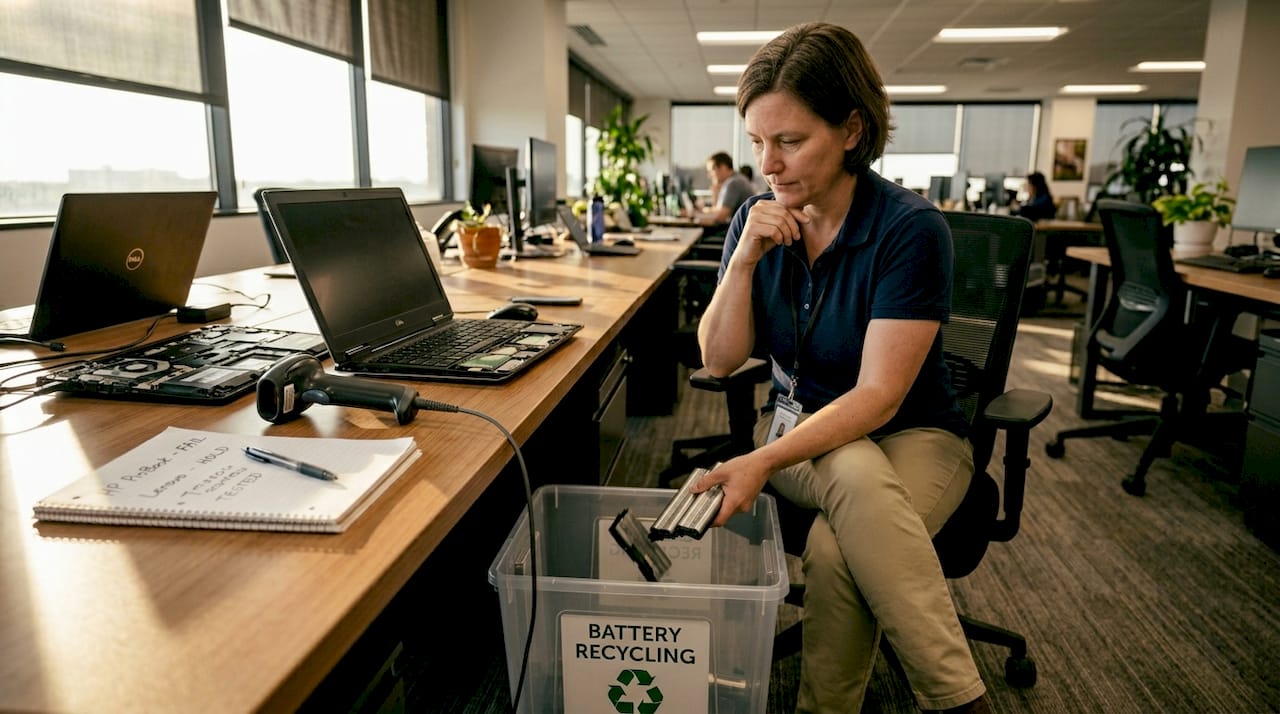
The eco-friendly IT asset recovery approach also extends to components like laptop battery recycling, which involves hazardous materials requiring careful handling. And when you recycle used electronics devices through a certified program, you keep toxic materials like lead, mercury, and cadmium out of landfills and groundwater.
What to check when choosing a free e-waste pickup provider
Not every company offering free pickup meets the same standard. Choosing the wrong provider can expose your organization to data breaches, regulatory penalties, or downstream liability if materials are illegally exported or dumped.
Here is what to verify before committing:
- R2 or e-Stewards certification: These are the gold standards for responsible recycling. Both require annual third-party audits of facilities, downstream partners, and data handling practices.
- NAID AAA certification: If data destruction is part of the service, NAID certification confirms the provider meets rigorous security standards for media sanitization.
- Certificate of destruction: Ask for a sample before you sign anything. It should identify each device by serial number and describe the destruction method used.
- Chain-of-custody documentation: This tracks your equipment from the moment it leaves your facility to final disposition. Gaps in this chain are red flags.
- References from similar organizations: A provider serving healthcare, finance, or government clients is accustomed to strict compliance environments.
- Local regulatory knowledge: Providers familiar with your state’s EPR laws can navigate compliance requirements without putting that burden on your team.
Pro Tip: Run a quick check on your prospective provider’s certification status directly through the R2 Solutions or e-Stewards certification databases online. Certifications should be current, not expired.
Warning signs include vague answers about downstream partners, no written compliance documentation, pressure to sign quickly, and inability to provide references. Regulations enable free services but providers must still demonstrate transparent chain of custody and compliance. If a provider cannot show you both, walk away.
Knowing how to recycle electronic waste properly means understanding that certification is not optional. It is the baseline.
The real value of ‘free’: What most overlook about e-waste pickup
Most IT leaders evaluate free e-waste pickup purely as a cost-avoidance measure. That framing undersells it significantly. The organizations getting the most out of these programs treat them as a component of IT strategy, not just a disposal solution.
When you integrate certified free pickup into your asset lifecycle management process, you gain something more valuable than saved disposal fees. You gain a documented, auditable record of responsible data stewardship. That record protects you during regulatory audits, strengthens your vendor due diligence posture, and supports ESG disclosures that increasingly influence investor and partner decisions.
There is also a workforce dimension. IT teams that are not buried in disposal logistics have more capacity for security hardening, infrastructure upgrades, and strategic projects. Free pickup is not just environmentally responsible. It is operationally smart.
Forward-thinking organizations are already using more on e-waste impacts data to inform procurement decisions, choosing vendors whose products are easier to recycle at end of life. That is digital transformation thinking applied to physical assets. The ‘free’ label is not a discount signal. It is a signal that the system is working, and your organization can benefit from it without compromise.
Secure and sustainable e-waste pickup for your organization
At UsedCartridge.com, we provide fully certified, compliant e-waste pickup and recycling services designed specifically for businesses and IT departments managing asset retirement at scale. Our process includes secure data destruction, chain-of-custody documentation, and compliance reporting aligned with state EPR requirements and federal data security standards.

Qualifying organizations can access free pickup options with integrated data destruction and receive a certificate of destruction for every device. Whether you are retiring a dozen laptops or clearing an entire data center, we make it simple. Start by learning how to recycle electronic waste properly, explore our full range of electronic waste solutions, or request your quote today to get a custom plan for your organization.
Frequently asked questions
Is free e-waste pickup really secure and compliant?
Yes, leading providers follow strict regulations for data destruction and provide compliance documentation at no cost. Regulations require both data security and audited processes as conditions of program participation.
Do any fees apply to businesses using free e-waste pickup?
In most states, there are no direct fees for pickups as costs are covered by producer programs and material recovery. No direct fees for pickup apply because producers cover costs through mandated program contributions.
What types of electronics qualify for free pickup?
Commonly accepted items include computers, monitors, servers, printers, and networking gear. Check with your provider for a full list, as accepted categories vary by state program and provider certification.
How do I verify a provider is legitimate and certified?
Ask for copies of their environmental, security, and data destruction certifications before scheduling a pickup. You can also verify R2 and e-Stewards status directly through their respective certification databases.
How does free pickup benefit IT departments specifically?
It saves IT teams time and budget while ensuring secure and efficient retirement of old electronics, freeing staff to focus on higher-priority infrastructure and security work.