
Most IT managers assume that deleting files or running a basic disk wipe before disposing of old equipment is enough to protect their organization. It is not. Improperly handled IT hardware creates a web of overlapping risks: data breaches from residual storage, regulatory penalties under privacy laws, toxic environmental damage from irresponsible e-waste handling, and the silent loss of real asset value sitting in your decommissioned equipment. With the electronics recycling market projected to reach USD 167.33 billion by 2036, the business case for getting this right has never been more urgent.
Table of Contents
- The core risks of improper IT hardware disposal
- Regulations and standards: What IT managers must know
- Reuse vs. recycling: Preserving value and sustainability
- Choosing the right IT hardware recycling partner
- Our take: What most recycling guides miss (and why it matters)
- Connect with certified, eco-friendly IT hardware recycling solutions
- Frequently asked questions
Key Takeaways
| Point | Details |
|---|---|
| Data protection is critical | Secure hardware recycling prevents data breaches and protects sensitive information. |
| Compliance requires certified partners | Regulatory standards like R2v3 and NAID AAA demand certified ITAD solutions for safe disposal. |
| Reuse maximizes asset value | Refurbishing and reusing IT hardware provide higher sustainability and financial returns than recycling alone. |
| Choose integrated solutions | Integrated, certified ITAD providers simplify compliance and documentation for secure recycling. |
| Environmental impact matters | Proper e-waste management reduces pollution and preserves resources for future generations. |
The core risks of improper IT hardware disposal
Most organizations treat hardware disposal as a facilities problem, not a compliance problem. That misclassification is expensive. When an IT asset leaves your building without going through a certified disposition process, you lose control of what happens to the data, the device, and your legal standing.
Data exposure is the most immediate threat. Standard deletion does not erase data. Even formatting a drive leaves recoverable information for anyone with basic forensic tools. Laptops, servers, smartphones, and even printers with internal storage can all harbor sensitive employee records, customer databases, financial documents, and proprietary business logic. One recovered device, resold through informal channels, can trigger a breach disclosure that costs far more than any hardware refresh budget.
The regulatory exposure is equally serious. Depending on your industry and location, mishandled IT disposal can violate HIPAA, GDPR, SOX, GLBA, and state-level privacy statutes. These are not theoretical risks. Regulators actively investigate breach disclosures that trace back to hardware disposal. The NIST SP 800-88 framework (Guidelines for Media Sanitization) defines three tiers of data elimination: Clear, Purge, and Destroy. Each applies to different media types and risk profiles. Businesses that cannot demonstrate they followed one of these methodologies have no defensible position in a compliance audit.
“Businesses without documented media sanitization protocols cannot demonstrate due diligence during a regulatory investigation, regardless of their intent.”
The environmental dimension is also a compliance matter, not just a PR concern. Electronics contain lead, mercury, cadmium, and brominated flame retardants. When devices reach landfills, these materials leach into soil and groundwater. Many jurisdictions have enacted extended producer responsibility laws and e-waste regulations that assign legal liability to the last holder of a device, meaning your business, not the reseller or scrap dealer you handed it to.
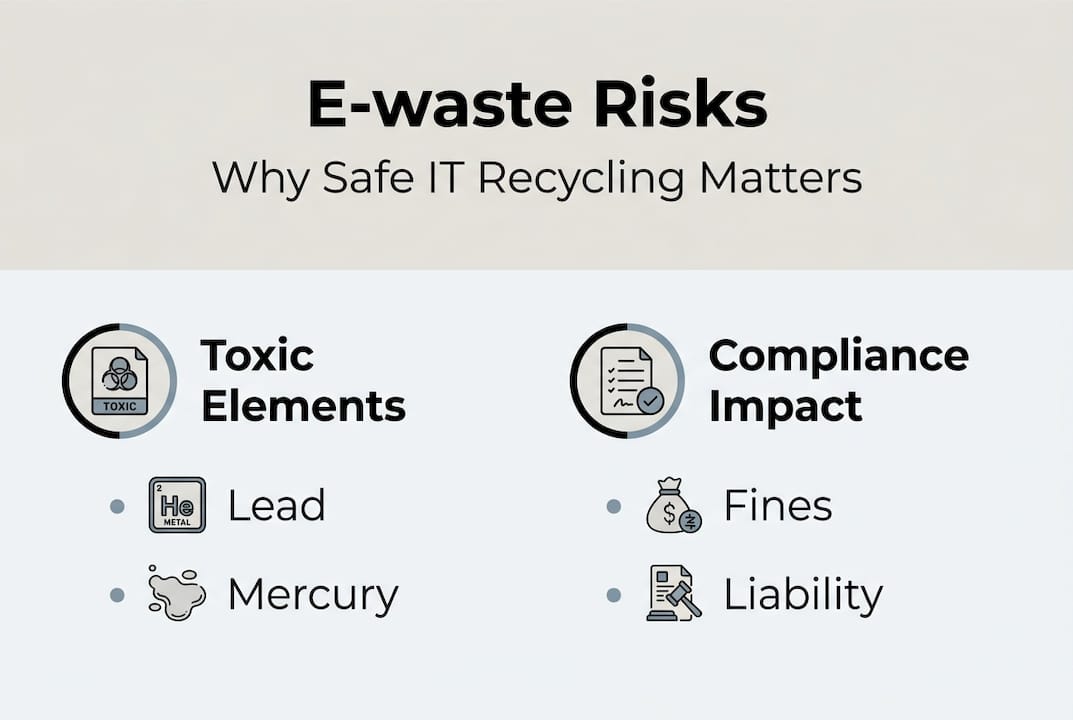
Then there is the financial angle most organizations completely overlook. Your retired IT equipment still has market value. Working components, refurbishable systems, and recoverable precious metals all represent real dollars. Using a proper data destruction guide to securely wipe and certify devices before remarketing them means you recover that value instead of paying someone to haul it away. Companies that skip this step are essentially throwing money out the door while also creating liability.
Key risks of improper IT hardware disposal:
- Residual data accessible via forensic recovery on “wiped” drives
- Fines and sanctions under HIPAA, SOX, GLBA, or state privacy laws
- Environmental liability under e-waste regulations for toxic material mismanagement
- Loss of refurbishment and resale value on functional hardware
- Reputational damage following a breach traced to improper disposition
- Audit exposure when chain-of-custody documentation does not exist
Understanding proper e-waste recycling processes is the first step toward eliminating these risks systematically.
Regulations and standards: What IT managers must know
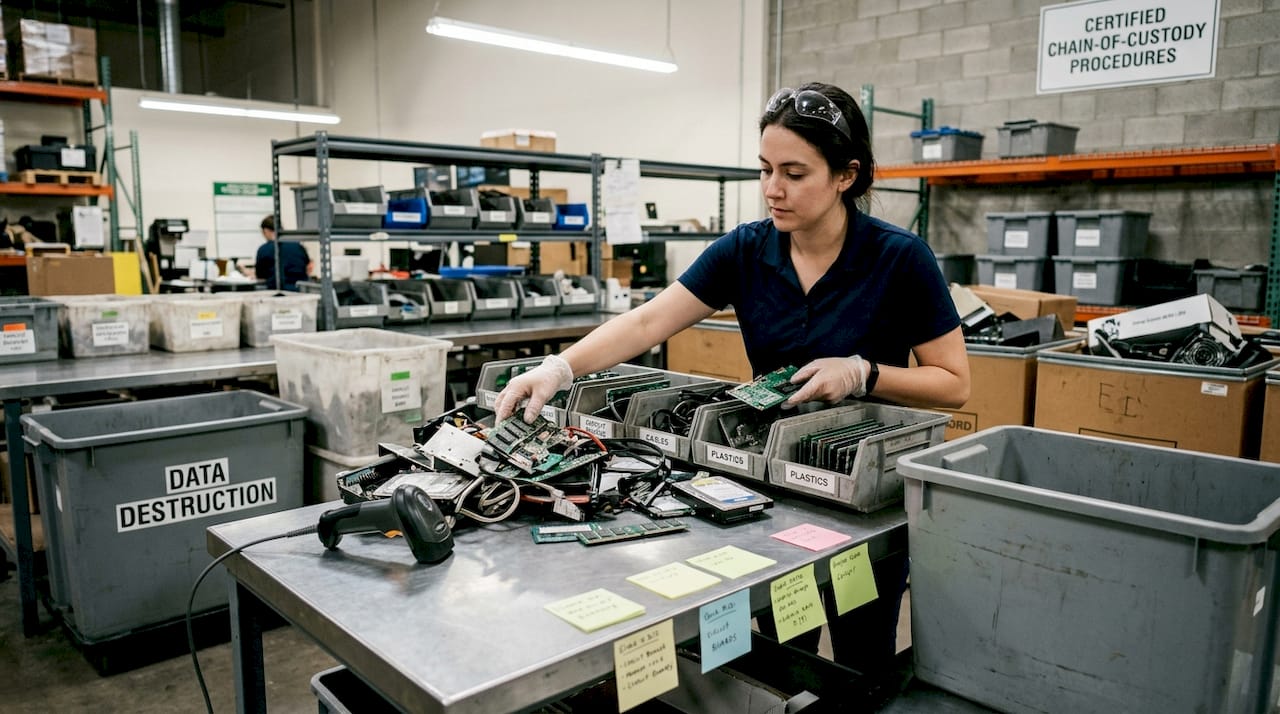
The compliance landscape for IT hardware recycling is defined by three primary frameworks. Every IT manager and compliance officer responsible for asset disposition should understand these standards, what they require, and what certified compliance actually means for your internal processes.
| Standard | Governing body | Scope | Primary requirement |
|---|---|---|---|
| NIST SP 800-88 | NIST (U.S. federal) | Media sanitization | Clear, Purge, or Destroy based on media type and risk |
| R2v3 | SERI (Sustainable Electronics Recycling International) | Responsible recycling | Environmental, data security, and worker safety compliance |
| NAID AAA | i-SIGMA | Data destruction services | Operational security, personnel screening, and audit readiness |
NIST SP 800-88 is the foundational document for secure data sanitization in the United States. It provides specific technical guidance on sanitization methods for HDDs, SSDs, flash storage, and optical media. The NIST SP 800-88 standard distinguishes between Clear (overwriting accessible user-addressable storage), Purge (more intensive methods that defeat laboratory attacks), and Destroy (physical destruction rendering media unusable). For regulated industries, Purge or Destroy is usually the required threshold.
R2v3 governs the environmental and data security practices of recycling facilities themselves. An R2v3-certified recycler has undergone independent auditing of their downstream material management, data handling procedures, and environmental controls. When you hand off equipment to an R2v3-certified provider, you have documented evidence that responsible handling continued after it left your hands.
NAID AAA certification applies specifically to companies providing data destruction services. NAID-certified vendors undergo unannounced audits, background checks on employees, and operational security reviews. For businesses that require on-site destruction or witnessed shredding, a NAID AAA vendor is the appropriate standard.
Steps for building a compliant recycling workflow:
- Conduct a full inventory of all assets scheduled for decommission, including serial numbers and storage specifications
- Classify each asset by data sensitivity to determine the correct sanitization level per NIST SP 800-88
- Select a certified ITAD (IT Asset Disposition) vendor with R2v3 and NAID AAA credentials
- Request a certificate of data destruction and a downstream material manifest for every batch
- Retain all documentation for a minimum of three years, or longer if industry regulations require it
- Review your IT hardware recycling regulations annually as standards and laws evolve
Pro Tip: Choose an ITAD provider that handles both data destruction and remarketing under one contract. Splitting these functions between two vendors creates documentation gaps that are difficult to defend in an audit. A single secure equipment recycling partner generates a unified chain-of-custody record that covers everything from pickup to final disposition.
Meeting IT hardware recycling regulations is not a one-time project. It is a repeatable process that should be embedded in your IT refresh cycle.
Reuse vs. recycling: Preserving value and sustainability
Here is a fact that most corporate sustainability teams have not yet fully absorbed: recycling hardware is almost always the least sustainable option available. It is also the least financially productive. The reason comes down to what economists and environmental scientists call embodied carbon, the total carbon cost of manufacturing a product from raw material extraction through assembly and shipping.
A typical business laptop carries approximately 300 kg of CO2 embedded in its production. When you recycle that laptop, you recover some raw materials but destroy all the manufacturing value locked in it. When you refurbish it and extend its life by even two to three years, you defer the carbon cost of manufacturing a replacement unit. That deferral is worth more, environmentally speaking, than any recycling stream can deliver.
The financial case is even more striking. Reuse and refurbishment yield returns up to 10,000% higher than raw material recycling. A laptop worth $800 new may still command $200 to $350 refurbished. The same unit, shredded for metals recovery, might yield $4 to $8 in commodity value. The math is not subtle.
| Disposition method | Environmental outcome | Financial return | Compliance benefit |
|---|---|---|---|
| Direct reuse (internal redeployment) | Highest carbon savings | No revenue but zero replacement cost | Keeps assets within audited control |
| Refurbishment and resale | High carbon savings | Strong revenue recovery | Documented chain-of-custody supports audit |
| Certified recycling | Moderate, depends on downstream | Low commodity value | Compliant when certified |
| Informal disposal / landfill | Worst, toxic leaching likely | Zero or negative | High legal liability |
Key advantages of integrating reuse into your asset policy:
- Extends useful device life and defers new purchase costs
- Reduces scope 3 carbon emissions in your supply chain reporting
- Generates revenue or cost offsets that fund hardware refresh cycles
- Keeps assets within documented control chains instead of informal markets
- Supports ESG reporting metrics with concrete, measurable data
The electronics recycling market data reinforces this direction. Growth in asset recovery services is outpacing simple recycling because businesses are recognizing the returns. When you explore used device recycling options, the first question to ask is not “how do we dispose of this?” but “what is this asset still worth?”
Building reuse into your IT asset policy means creating a tiered disposition decision tree. Assets in good working condition go to refurbishment. Non-functional units with valuable components go to certified component harvesting. Only end-of-life, non-recoverable equipment goes to material recycling. This hierarchy maximizes both your financial return and your sustainability outcomes. An eco-friendly asset recovery approach integrates these tiers into a single managed workflow.
Choosing the right IT hardware recycling partner
Selecting a vendor to manage your IT asset disposition is a procurement decision with compliance and reputational consequences that outlast the contract. The wrong partner creates liability. The right one becomes a strategic asset in your compliance and sustainability programs.
Here is what to evaluate before signing any agreement:
-
Verify certifications independently. R2v3 and NAID AAA certifications are publicly searchable through SERI and i-SIGMA. Do not accept a vendor’s word. Check the certification database, confirm the scope of their certification, and verify the expiration date.
-
Require integrated services. A vendor that handles data destruction, remarketing, and recycling under one roof provides a single chain-of-custody document from pickup to final disposition. Vendors that subcontract data destruction to a third party introduce documentation breaks that regulators and auditors will question.
-
Insist on serialized certificates. Every hard drive, every device, every batch should generate a certificate of data destruction that includes the serial number, sanitization method applied, technician ID, and date. Batch-level certificates without serial numbers are not sufficient for most regulated industries.
-
Evaluate logistics and pickup capabilities. On-site destruction capability matters for highly sensitive environments like financial services, healthcare, and government contracting. Ask whether the vendor can bring a mobile shredding or degaussing unit to your location and provide a witnessed destruction certificate.
-
Review downstream material handling. Ask for the vendor’s downstream material manifest. Where do recovered components and scrap materials go after your equipment is processed? Responsible vendors can name their downstream partners and confirm those partners are also certified. This matters for your own environmental compliance documentation.
-
Assess reporting and audit support. Your provider should be able to generate asset-level reports on demand and support you during a regulatory inquiry. If they cannot produce itemized records within 24 hours, they are not the right partner for a compliance-conscious organization.
According to asset recovery strategies research, IT managers who consolidate disposition services with certified integrated providers consistently report fewer documentation gaps and stronger audit outcomes than those who split services across separate vendors.
Pro Tip: Before your next hardware refresh, request a device recycling steps consultation from your ITAD provider. Walking through preparation requirements in advance eliminates last-minute scrambles and ensures every asset is properly labeled, logged, and ready for certified processing on pickup day.
Common mistakes to avoid: accepting verbal assurances without written certificates, using free e-waste drop-off events for business assets that contain sensitive data, and failing to include IT asset disposition in your annual compliance review. These shortcuts create exactly the documentation gaps that regulators find in breach investigations.
Your IT asset recovery providers should be held to the same vendor risk management standards you apply to any data processor. Request their SOC 2 report if available, review their insurance coverage, and include disposition compliance in your vendor audit schedule.
Our take: What most recycling guides miss (and why it matters)
Most articles about IT hardware recycling focus on logistics: how to wipe a drive, where to drop off old equipment, which bin it goes in. That framing misses the point entirely.
The real opportunity is not in disposal. It is in reclassifying your retired hardware as a managed financial and environmental asset rather than a problem to be removed. Every organization running a three to five year hardware refresh cycle is sitting on a portfolio of depreciating but still valuable equipment. The difference between treating that portfolio as waste versus treating it as an eco-friendly recovery opportunity can be measured in both dollars and carbon output.
We also think the documentation conversation is underweighted. The businesses that get into compliance trouble are rarely the ones that made malicious choices. They are the ones that made informal choices and could not produce records afterward. A 300 kg CO2 embodied cost per laptop is a real number, and so is the fine for an undocumented data breach traced to a scrapped device.
Integrated, certified ITAD is not a premium add-on. For any organization subject to data privacy regulation, it is the baseline.
Connect with certified, eco-friendly IT hardware recycling solutions
Responsible IT hardware recycling does not have to be complicated. The right partner handles secure e-waste handling, certified data destruction, and asset recovery under one coordinated program, so your team gets compliance documentation and financial returns without managing multiple vendors or tracking down certificates after the fact.

UsedCartridge.com provides certified, end-to-end IT asset disposition services for businesses that need secure, auditable, and environmentally responsible solutions. Whether you are processing a single office refresh or a full enterprise decommission, you can request an asset recovery quote and schedule a secure pickup at your convenience. Compliance and sustainability, handled together, without the paperwork headaches.
Frequently asked questions
What certifications should an IT hardware recycler have?
Look for R2v3, NAID AAA, and NIST SP 800-88 compliant providers to ensure your data is securely sanitized and your disposal process meets regulatory standards across both environmental and data security requirements.
Is it better to reuse or recycle old hardware?
Reuse and refurbishment provide greater carbon savings and up to 10,000% higher asset value returns compared to material recycling, which destroys the embodied carbon and manufacturing value locked in the device.
How does secure IT hardware recycling protect my business?
Certified recycling with documented chain-of-custody records prevents data breaches, supports regulatory compliance, and recovers asset value. For regulated industries, certified ITAD providers with R2v3 and NAID AAA credentials provide the documentation needed to withstand audit scrutiny.
What happens if IT hardware is improperly disposed?
Improper disposal can result in data exposure from forensically recoverable storage, regulatory fines under NIST SP 800-88 and privacy statutes, environmental liability from toxic material mismanagement, and lost revenue from missed asset recovery opportunities.