
Retired devices carry more risk than most organizations realize. 86% of enterprises reported data breaches, and unsanitized redeployed assets accounted for 17% of those incidents. That number is alarming because most organizations focus their security budgets on firewalls and ransomware protection while ignoring the hard drives, phones, and printers quietly leaving the building. Proper security in e-waste management is not a back-office afterthought. It is a compliance requirement, a reputational safeguard, and an operational necessity. This guide walks through the real risks, what secure disposal actually means, current industry standards, and the steps your organization should take right now.
Table of Contents
- Why e-waste poses a unique security risk
- What does security mean in e-waste management?
- How industry standards safeguard sensitive data
- Best practices for secure and compliant e-waste disposition
- Why most organizations underestimate e-waste security risk
- Secure your organization’s e-waste management with expert solutions
- Frequently asked questions
Key Takeaways
| Point | Details |
|---|---|
| E-waste risks data breaches | Discarded electronics often still contain sensitive data, exposing organizations to losses and fines. |
| Follow NIST/industry standards | Best practice is to use current, rigorous protocols like NIST SP 800-88 for data sanitization and destruction. |
| Demand certified, documented processes | Work only with vendors who provide certifications, chain-of-custody, and destruction certificates. |
| Integrate ITAD with ESG and compliance | Merge secure data disposal with environmental responsibility and regulatory requirements for best results. |
Why e-waste poses a unique security risk
When a device leaves your organization, the data on it does not automatically leave with it. Hard drives, solid-state drives (SSDs), USB sticks, smartphones, and even networked printers store enormous volumes of sensitive information, including customer records, financial data, employee files, and proprietary business intelligence. Without deliberate sanitization, that data remains accessible to anyone who knows where to look.
“Security in e-waste involves protecting data stored on devices during disposal and recycling to prevent breaches and regulatory penalties.”
The threat is more common than most IT leaders expect. Stolen or lost devices have emerged as a larger source of breaches than ransomware or stolen credentials. That means the risk is physical, not just digital. When your retired laptops sit on a loading dock waiting for pickup, or when a third-party vendor carries them away without proper chain-of-custody documentation, your organization is exposed.
The consequences of improper data disposal are significant and span several categories:
- Regulatory penalties: HIPAA, GDPR, and state-level data privacy laws impose heavy fines on organizations that fail to sanitize data on retired devices.
- Reputational harm: A single publicized breach tied to discarded equipment can erode customer trust in ways that take years to rebuild.
- Legal liability: Depending on the nature of the data involved, organizations can face class-action lawsuits from affected individuals.
- Operational disruption: Breach investigations and remediation efforts consume significant IT and legal resources.
What makes e-waste uniquely dangerous is that it sits at the intersection of legal, operational, and environmental concerns. Most organizations have mature security policies covering active systems, but those policies often fail at the endpoint of a device’s life. You can learn more about the full scope of e-waste security standards that responsible vendors and regulators now expect organizations to meet.
The gap between active device security and disposal security is where breaches happen. Bridging that gap starts with understanding what security in e-waste actually means in practice, and how protecting data during recycling requires deliberate, documented processes rather than assumptions.
What does security mean in e-waste management?
Security in e-waste management is not about locking a storage room. It refers to the entire process of controlling, sanitizing, and documenting what happens to data-bearing devices from the moment they are retired until they are confirmed destroyed or repurposed. Three core pillars support this process.

1. Media sanitization
Media sanitization is the process of removing data from a storage device so it cannot be recovered. The term, formalized in NIST SP 800-88r2 (National Institute of Standards and Technology Special Publication 800-88, Revision 2), covers software-based overwriting, cryptographic erasure, degaussing, and physical destruction. NIST SP 800-88r2 defines media sanitization to include chain-of-custody, documentation, and compliant destruction protocols, not just running a delete command.
2. Chain-of-custody documentation
A chain-of-custody log tracks every person, location, and action that touches a device from decommissioning through final disposition. Without it, you cannot prove to an auditor, regulator, or attorney that your retired devices were handled securely. Chain-of-custody records also deter insider threats. When employees know every device movement is logged, the incentive to pocket a drive or bypass disposal procedures drops significantly.
3. Vendor certifications
Not every recycler is a secure recycler. Certifications like NAID AAA (from the National Association for Information Destruction) and R2v3 (Responsible Recycling version 3) signal that a vendor has been independently audited for data security and environmental practices. These credentials are not marketing badges. They represent enforceable standards with regular audits.
Pro Tip: Before signing any vendor contract, request their most recent NAID or R2v3 audit report. A legitimate certified vendor will provide it without hesitation.
A critical misconception is that physical destruction always guarantees data elimination. It does not. Crushed or shredded drives can still yield recoverable data fragments if particle sizes are not within certified specifications. Secure proper device recycling goes far beyond simply breaking hardware. Review device preparation steps to understand what your team should do before any device leaves your control.
How industry standards safeguard sensitive data
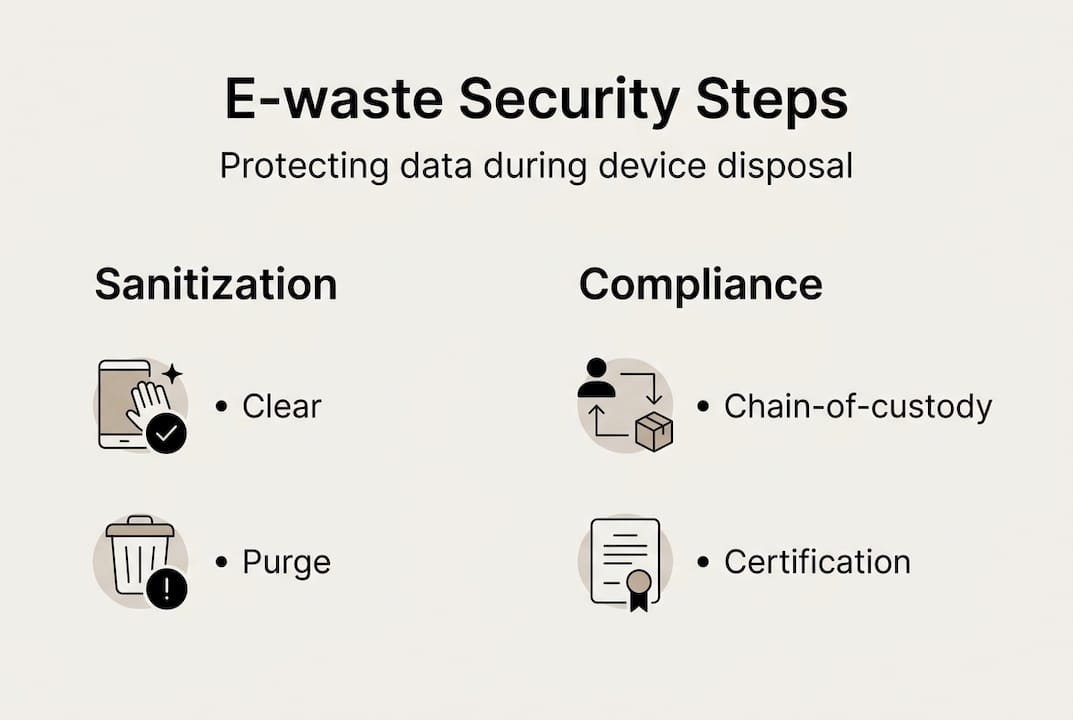
NIST SP 800-88r2 is the current benchmark for data sanitization in the United States and is widely referenced internationally. It defines three levels of sanitization, each offering a different balance of security and device reusability.
| Sanitization level | Method | Device reuse possible? | Best for |
|---|---|---|---|
| Clear | Software overwrite | Yes | Low-sensitivity internal redeployment |
| Purge | Degauss or cryptographic erase | Sometimes | Moderate-to-high sensitivity data |
| Destroy | Shred or pulverize to spec | No | Classified or highly sensitive data |
NIST defines these three levels with specific technical requirements for each: Clear uses verified overwrite passes, Purge includes degaussing magnetic media or cryptographic erasure on self-encrypting drives, and Destroy requires physical shredding or pulverization to particle sizes that prevent any data recovery. Reviewing the full NIST media sanitization guidelines gives your team the technical detail needed to match methods to your data sensitivity levels.
Many organizations still rely on the old DoD 5220.22-M overwrite standard, which was technically retired years ago. NIST has formally replaced it with methods better suited to modern SSDs, flash storage, and self-encrypting drives, which do not respond to traditional magnetic overwriting the same way spinning hard drives do.
Why does the right level matter? Using Clear on a device that held protected health information (PHI) is insufficient under HIPAA. Using Destroy on a device that could have been Purged and resold throws away recoverable asset value. Selecting the right level is both a security decision and a financial one.
Explore detailed guidance on hard drive destruction methods and review the basics of data destruction to build your organization’s protocol baseline.
Best practices for secure and compliant e-waste disposition
Knowing the standards is one thing. Building an organization-wide process that consistently meets them is another. Here is a practical framework you can implement immediately.
| Step | Action | Why it matters |
|---|---|---|
| Inventory | Classify devices and data sensitivity before decommission | Determines which NIST level applies |
| Vendor vetting | Confirm NAID AAA or R2v3 certification | Ensures auditable, enforceable security |
| Chain-of-custody | Require serial-level tracking from pickup to destruction | Proves compliance and deters insider threats |
| Documentation | Retain certificates of destruction and audit logs | Essential for regulatory audits and legal defense |
| Asset recovery | Request value recovery where sanitization allows reuse | Offsets disposal costs and supports ESG goals |
Classifying data and matching NIST protocols to device type is the single most important step organizations can take to reduce both breach risk and unnecessary destruction costs.
Your vendor selection process should be non-negotiable. Ask for proof of insurance, audit reports, and sample certificates of destruction before committing. Price should never be the primary selection criteria when data security is at stake.
Pro Tip: Build asset disposition into your procurement cycle, not just your IT decommission cycle. Knowing a device’s eventual disposal path from day one makes compliance far easier and recovery value far higher.
Asset recovery is often overlooked as a benefit of a well-managed e-waste process. When devices are properly sanitized and still functional, they retain resale or refurbishment value. That recovered value can partially offset your disposal costs while supporting environmental, social, and governance (ESG) reporting goals. Explore eco-friendly asset recovery strategies and connect with IT asset disposition services to get a customized estimate for your organization’s portfolio.
Why most organizations underestimate e-waste security risk
Here is an uncomfortable reality: most organizations believe their e-waste is secure because a vendor picked it up and issued a receipt. That is not security. That is paperwork.
The “just shred it” mindset is pervasive and genuinely dangerous. Organizations assume that physical destruction equals total data elimination. But as recent reporting confirms, physical destruction remnants can still yield recoverable data without verified smelting at certified particle sizes, particularly from SSDs and flash-based storage.
The deeper problem is structural. Security teams own active infrastructure, legal teams own compliance, and facilities teams often own asset disposal. Nobody owns the intersection. That gap is exactly where breaches occur. Understand the full range of types of e-waste your organization generates so you can assign clear ownership over each category.
True e-waste security is a process involving policy, people, and technology working together across the full device lifecycle. One-time destruction events without ongoing vendor verification, documented chain-of-custody, and regular policy review are not enough. Demand transparency from every vendor. Stay educated as storage technologies and threat landscapes evolve. Your organization’s liability does not end when a device leaves the building.
Secure your organization’s e-waste management with expert solutions
Organizations that handle sensitive data cannot afford to treat device disposal as a logistics task. The regulatory and reputational stakes are too high. Certified, documented, auditable disposal is the only defensible standard.

UsedCartridge.com provides secure e-waste logistics built around verified data destruction, chain-of-custody documentation, and environmentally responsible recycling. Whether you are managing a one-time IT refresh or building an ongoing disposition program, we work with your team to match the right sanitization method to your data sensitivity and compliance requirements. From certified hard drive destruction to recoverable asset remarketing, every step is documented and auditable. Get a disposition quote today and find out how your organization can move forward with confidence.
Frequently asked questions
What are the legal consequences of not sanitizing data on e-waste?
Failure to sanitize data on retired devices can result in regulatory fines and lawsuits under HIPAA, GDPR, and state privacy laws, along with severe reputational damage. The financial and operational costs of a breach far exceed the cost of proper disposal.
Which is more secure: physical destruction or cryptographic erasure?
Both can meet high security standards when executed correctly. NIST SP 800-88r2 guidance specifies exact requirements for each method, and verification through documentation is essential regardless of which approach you choose.
How can organizations ensure their e-waste vendor is truly secure?
Require NAID AAA or R2v3 certification, demand serial-level chain-of-custody logs, and request a sample certificate of destruction. Verify vendor certifications directly with the issuing body rather than relying solely on vendor-provided documents.
What standards are recommended for secure e-waste data destruction?
NIST SP 800-88r2 and IEEE 2883 are the current preferred standards, having replaced the legacy DoD 5220.22-M protocol. NIST 800-88 and IEEE 2883 provide specific technical requirements for Clear, Purge, and Destroy methods across all modern storage media types.