
Most IT managers assume that when a device reaches the end of its useful life inside your organization, the choice comes down to recycling or disposal. That assumption leaves real money on the table. Electronics remarketing is a third path, one that recovers financial value, reduces environmental impact, and keeps your organization compliant with data security requirements. This guide walks you through exactly what remarketing is, how it compares to recycling, what the process looks like step by step, and how to build a program that delivers results on all three fronts.
Table of Contents
- What is electronics remarketing?
- Electronics remarketing vs recycling: Key differences
- How the electronics remarketing process works
- Sustainability and compliance: Why businesses choose remarketing
- Best practices for secure and effective electronics remarketing
- Why most organizations overlook the true value of electronics remarketing
- Need a secure and sustainable remarketing solution?
- Frequently asked questions
Key Takeaways
| Point | Details |
|---|---|
| Remarketing definition | Electronics remarketing refurbishes used devices for resale, benefiting both ROI and sustainability. |
| Remarketing vs recycling | Unlike recycling, remarketing extends device life and offers greater financial and environmental returns. |
| Data security | Certified data destruction and chain of custody are critical at every step. |
| Sustainability benefits | Choosing remarketing reduces e-waste and supports compliance with green policies. |
| Proven best practices | Work with certified partners, maintain thorough records, and monitor outcomes for improvement. |
What is electronics remarketing?
Electronics remarketing is the practice of extending the useful life of your organization’s retired devices by refurbishing them and returning them to the market through resale or redeployment. The goal is not destruction or material recovery. It is value recovery, and it works across a much wider range of equipment than most people realize.
As recycling used electronics specialists explain, electronics remarketing enables organizations to extend the lifecycle of their used devices by refurbishing and reselling them, offering financial returns and supporting sustainability. That definition is important because it separates remarketing from two common alternatives: outright disposal, which generates no return and maximum waste, and recycling, which recovers raw materials but destroys the device itself.
Devices commonly eligible for remarketing include:
- Desktop and laptop computers
- Servers and storage arrays
- Smartphones and tablets
- Network switches, routers, and access points
- Monitors and display equipment
- Point-of-sale terminals
The key qualifier is functionality. If a device still powers on, performs its core tasks, and can be wiped securely, it is a remarketing candidate. Understanding electronic waste basics helps your team identify which retiring assets belong in a remarketing stream versus a recycling stream, and that distinction directly affects your financial recovery rate.
“A device that ends up in a shredder instead of a secondary market represents both an environmental failure and a financial one. Remarketing changes that calculus entirely.”
Pro Tip: Maintain a running IT asset register that tracks purchase date, current condition, and estimated residual value for every device. When refresh cycles arrive, you will already know which assets are remarketing candidates before they leave active service.
Electronics remarketing vs recycling: Key differences
Understanding what remarketing is, it’s useful to see how it truly stacks up against other end-of-life strategies. The table below compares the three main options side by side.
| Factor | Remarketing | Recycling | Disposal |
|---|---|---|---|
| Device outcome | Refurbished and resold | Materials recovered | Landfill or incineration |
| Financial return | Yes, resale value | Sometimes, scrap credit | None |
| Environmental impact | Low, lifecycle extended | Moderate, energy intensive | High, waste generated |
| Data security | Certified wiping or destruction | Usually shredding | Often unsecured |
| Compliance support | Full audit trail possible | Partial | Minimal |
| Best for | Functional devices | Non-functional equipment | Last resort only |
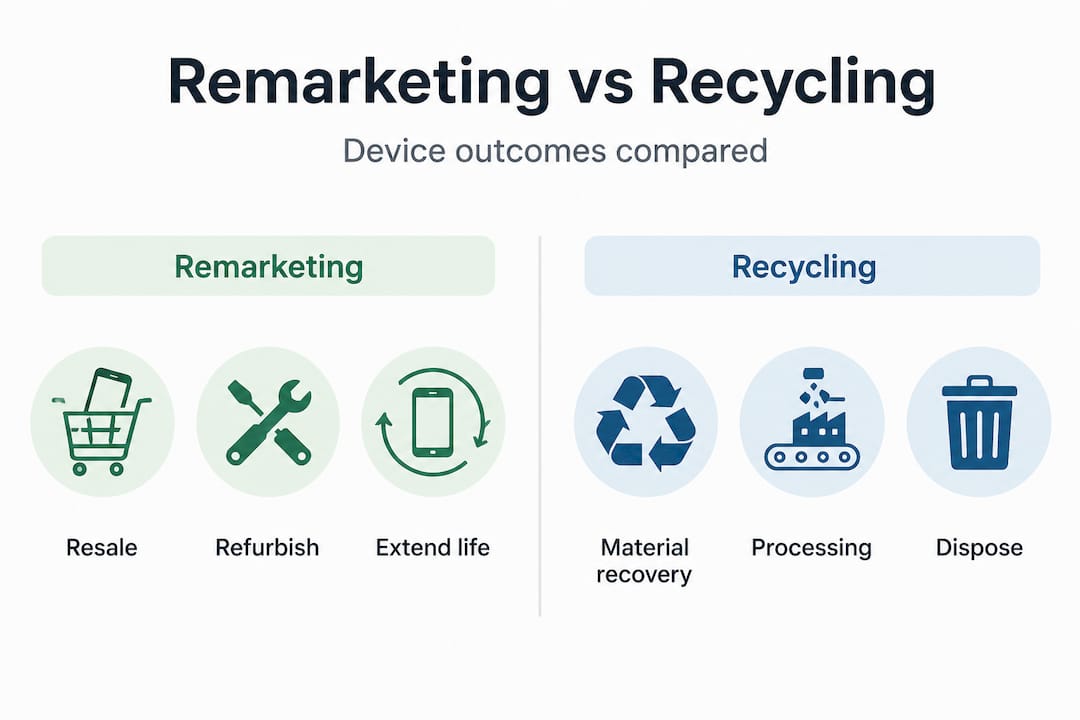
As computer recycling processes illustrate, remarketing extends device lifecycles and supports sustainability, while recycling focuses on material recovery, often involving destruction. That distinction matters for your compliance reporting and your budget.
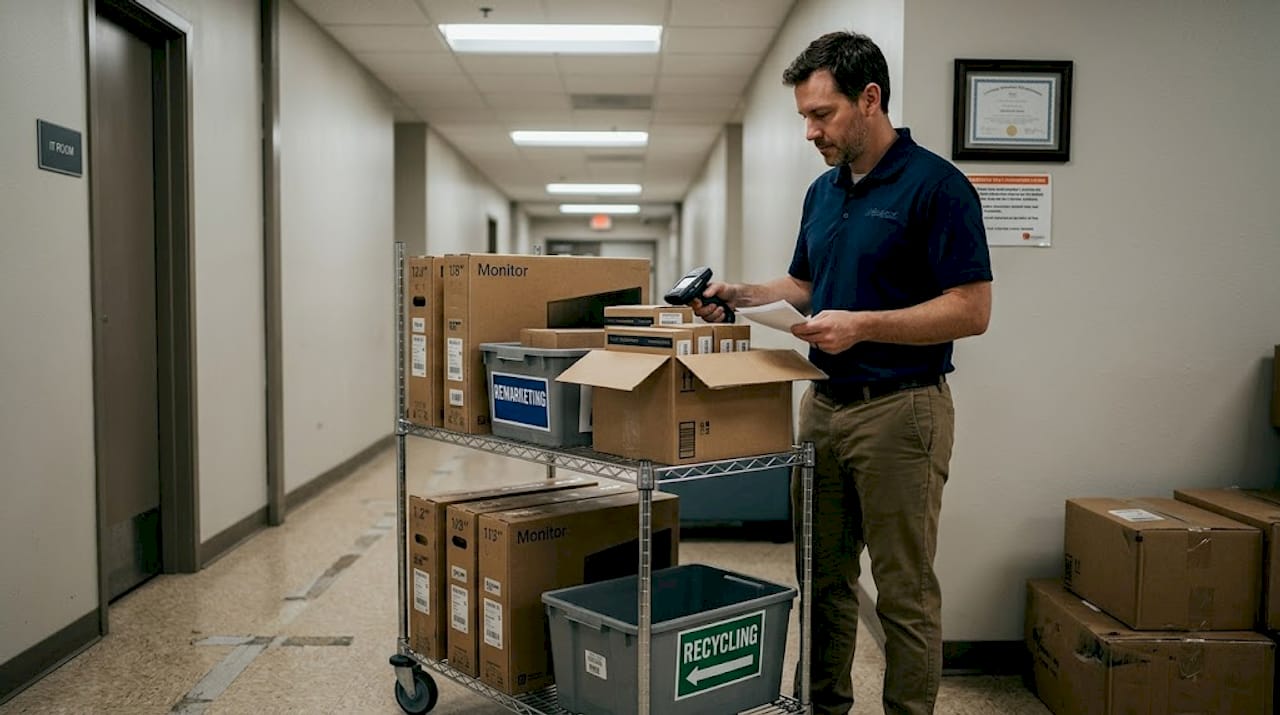
From a data security standpoint, remarketing requires a more structured approach than recycling. When a device gets shredded, the data problem is solved physically. When a device gets remarketed, you need certified data destruction to happen before the device leaves your control. That is a critical control point many organizations underestimate.
Key advantages remarketing holds over recycling:
- Financial recovery: A three-year-old laptop may still fetch $150 to $400 on the secondary market. That same laptop shredded returns almost nothing.
- Resource conservation: Refurbishment consumes far less energy than smelting and reprocessing raw materials.
- Carbon footprint reduction: Manufacturing a new device generates significantly more greenhouse gas than refurbishing an existing one.
- Compliance documentation: Remarketing programs typically produce more detailed chain-of-custody records than standard recycling drop-off programs.
The bottom line is that remarketing maximizes ROI when devices are functional and securely processed. Recycling remains the right choice for broken or end-of-life-beyond-repair equipment, but it should not be your default simply because it feels more familiar.
How the electronics remarketing process works
Once you know why to consider remarketing, you will want to understand exactly how the process unfolds. A well-run remarketing program follows a clear sequence, and every step has compliance and financial implications.
-
Inventory and assessment. Every retiring device is cataloged with its make, model, serial number, and physical condition. This inventory becomes the foundation of your audit trail.
-
Certified data destruction. Before anything else happens to the device physically, all data must be wiped to a recognized standard such as NIST 800-88 or DoD 5220.22-M, or physically destroyed if the storage media cannot be reliably wiped. You receive a certificate of data destruction for each asset.
-
Functional testing and grading. Technicians assess each device for hardware integrity, screen quality, battery health (for laptops and phones), and overall cosmetic condition. Devices receive a grade: A (like new), B (minor wear), C (visible wear), or F (parts only).
-
Refurbishment. Graded devices undergo cleaning, hardware repair, OS reinstallation, and quality control testing. The goal is to return the device to a fully operational state appropriate to its grade.
-
Compliance verification. Before resale, the remarketing partner verifies that all regulatory requirements are met, including environmental compliance and data destruction documentation. Asset recovery for compliance confirms that effective remarketing involves secure data destruction, functional assessment, refurbishment, and compliance checks before resale.
-
Resale or redeployment. Finished devices are sold through secondary markets, donated to qualifying nonprofits, or redeployed internally to lower-demand roles within your organization.
The data below reflects realistic recovery rates across common device categories based on industry benchmarks:
| Device type | Average age at retirement | Typical resale recovery |
|---|---|---|
| Business laptop | 3 to 4 years | 20% to 45% of original cost |
| Desktop workstation | 4 to 5 years | 10% to 25% of original cost |
| Enterprise server | 3 to 5 years | 15% to 35% of original cost |
| Smartphone | 2 to 3 years | 25% to 55% of original cost |
| Network switch | 5 to 7 years | 5% to 20% of original cost |
Knowing these ranges lets you build remarketing value into your IT refresh budget projections, rather than treating retired assets as a pure cost.
Pro Tip: Document every step in the remarketing process with timestamps, technician signatures, and serial number verification. If a compliance audit ever targets your data disposal practices, this paperwork is your defense. Prepare devices with a standardized workflow, and review how to prepare devices securely before your first batch goes out the door.
Sustainability and compliance: Why businesses choose remarketing
With a clear process in mind, let us explore why businesses increasingly choose remarketing from both a compliance and sustainability perspective.
The environmental case starts with a simple fact: manufacturing a new electronic device generates more waste, energy consumption, and carbon emissions than refurbishing an existing one. Every device that gets remarketed instead of shredded or landfilled is a device whose embedded resources, the rare earth metals, the plastics, the circuit board components, stay in productive use longer. Green e-waste practices confirm that remarketing supports green initiatives and regulatory compliance by reducing e-waste generation and maximizing resource efficiency.
For compliance officers, the regulatory landscape is increasingly demanding. Laws such as the Resource Conservation and Recovery Act (RCRA) in the US govern how organizations handle hazardous materials in electronics. Many state-level e-waste laws add additional requirements. A documented remarketing program, complete with certificates of data destruction and chain-of-custody records, satisfies these requirements far more cleanly than informal disposal.
Benefits your sustainability and compliance teams will recognize immediately:
- Reduced e-waste volume flowing to landfills and incinerators, directly lowering your organization’s reported waste footprint.
- Extended device lifespans that push back the manufacturing demand for new equipment and reduce your supply chain carbon impact.
- ESG reporting support through verifiable metrics: how many devices were remarketed, how much waste was diverted, how much financial value was recovered.
- Data security compliance through certified destruction documentation that satisfies HIPAA, GLBA, FACTA, and other regulations governing sensitive data disposal.
- Vendor due diligence records that demonstrate your organization selected qualified, certified partners for IT asset disposition.
Understanding types of e-waste is also important here because not every device qualifies for remarketing, and compliance officers need to ensure that non-remarketed items follow the correct regulated disposal pathway.
“Organizations that treat remarketing as a compliance tool, not just a financial one, consistently outperform peers in audit readiness and sustainability reporting.”
Best practices for secure and effective electronics remarketing
To truly benefit from remarketing, you need a program that is both secure and value-driven. A poorly run program can expose your organization to data breach liability, regulatory penalties, or reputational damage that far outweighs any financial recovery.
Here is a structured approach to building or auditing your remarketing program:
-
Establish a written policy. Define which devices are eligible for remarketing, minimum data destruction standards, approved vendors, and documentation requirements. A policy puts everyone on the same page and survives staff turnover.
-
Vet your remarketing partners carefully. Look for certifications such as R2 (Responsible Recycling), e-Stewards, or ISO 14001. Ask for sample certificates of data destruction and references from organizations in regulated industries.
-
Enforce chain of custody. Track every device from the moment it leaves active service to the moment it is resold or recycled. This means manifests, signed handoff records, and serial number verification at each stage.
-
Require certificates of data destruction. Every remarketed device must generate a certificate tied to its serial number before it leaves your custody. No certificate, no release.
-
Conduct periodic audits. At least annually, review a sample of completed remarketing transactions. Verify that certificates match inventory records and that resale proceeds were accurately reported and credited.
-
Track financial and environmental outcomes. Measure recovered revenue, number of devices diverted from waste streams, and weight of e-waste avoided. These metrics feed your ESG reports and justify program investment.
Following a structured approach with certified partners maximizes value and ensures secure remarketing, which is why the electronics remarketing guide consistently emphasizes partner selection as the single highest-leverage decision in your program design.
Pro Tip: Run a pilot with one device category before scaling your remarketing program. Start with laptops, collect data on recovery rates and processing times, then use that experience to refine your workflow before extending to servers and phones.
Why most organizations overlook the true value of electronics remarketing
Most discussions of e-waste management frame the decision as a binary: recycle or dispose. Remarketing appears as an afterthought, if it appears at all. That framing costs organizations real money and real sustainability progress every single year.
The deeper problem is institutional inertia. IT teams are measured on uptime and security. Finance teams are measured on cost control. Neither team has a natural incentive to optimize residual asset value unless someone builds that accountability into the program explicitly. Remarketing requires cross-functional ownership, and most organizations have not assigned it to anyone.
There is also a risk-perception gap. Many IT managers worry that remarketing a device creates data breach exposure. The truth is the opposite: a poorly documented recycling program, where devices disappear into a vendor’s facility with no paper trail, is far riskier than a certified remarketing program with serial-number-level documentation at every step. The fear of remarketing is often based on a misunderstanding of what certified data destruction actually guarantees.
We have seen organizations shred functional three-year-old laptops because “it’s safer.” That decision costs them $300 per unit in lost resale value, generates unnecessary waste, and provides no more security protection than a certified wipe would have. It simply feels safer because destruction is visible and final.
The organizations that get this right treat remarketing as a program, not a transaction. They assign ownership, set performance targets, select vetted partners, and report outcomes. They also recognize that the combination of financial recovery, compliance documentation, and sustainability metrics makes remarketing one of the highest-return investments an IT asset management team can make, with essentially zero capital outlay.
Do not let conventional wisdom about e-waste push you toward a strategy that leaves value on the table. Remarketing done correctly is not a risk. It is the most responsible, financially sound, and audit-ready option available for functional retired equipment.
Need a secure and sustainable remarketing solution?
If you are ready to capture all the advantages of electronics remarketing, partnering with experts can make all the difference between a program that delivers and one that stalls.

UsedCartridge.com provides end-to-end support for electronics remarketing and e-waste services, from certified data destruction and device grading through compliant resale and full documentation. Whether you are managing a large corporate refresh cycle or need to recycle electronics properly for devices that do not qualify for remarketing, our team handles every step with transparency and regulatory rigor. Take the first step toward recovering value from your retired assets and request a remarketing quote today to see what your organization’s retired equipment is worth.
Frequently asked questions
What types of devices can be remarketed?
Computers, servers, phones, tablets, and networking equipment are commonly eligible for remarketing if still functional and capable of certified data destruction.
Is data destruction included in electronics remarketing?
Certified data destruction is an essential part of IT asset remarketing and must occur before any device changes hands to protect your organization from breach liability.
How is remarketing different from recycling?
Remarketing refurbishes and resells working equipment for financial and environmental gain, while recycling processes devices for materials recovery after the device itself is destroyed.
Can electronics remarketing help with sustainability goals?
Yes, remarketing extends device lifespans and reduces landfill e-waste, generating verifiable metrics that support ESG reporting and regulatory compliance.
What should organizations look for in a remarketing partner?
Seek partners with R2 or e-Stewards certifications, transparent chain-of-custody processes, and a demonstrated compliance track record in regulated industries.