
Recycling networking gear is defined as the process of securely disposing of routers, switches, firewalls, and related hardware through certified channels that recover materials and destroy sensitive data. IT professionals managing equipment refreshes face two simultaneous obligations: protecting data stored on decommissioned devices and keeping hazardous materials out of landfills. Effective recycling programs help businesses meet sustainability goals and regulatory mandates. Cisco’s Customer Recycling Solutions program demonstrates what responsible disposal looks like at scale, recovering over 99% of materials including steel, copper, aluminum, plastics, and circuit boards. That benchmark sets the standard every IT team should measure their own recycling program against.
How to recycle networking gear: what to do before you start
Preparation determines whether your recycling effort succeeds or creates liability. Skipping this phase is the single most common reason organizations end up with compliance gaps or data breach exposure.
Build a complete equipment inventory
Start by cataloging every device scheduled for disposal. Record the make, model, serial number, and data classification for each unit. Switches and routers often hold configuration files, VPN credentials, and network topology data that qualify as sensitive under frameworks like HIPAA, SOC 2, and GDPR. A network equipment disposal guide built around asset tracking prevents devices from slipping through without proper data handling.

Confirm your data destruction policy
Your organization’s data retention policy dictates which destruction method applies to each device. Physical destruction is required for devices that held classified or regulated data. Overwriting or degaussing may suffice for lower-risk hardware. Certified data destruction includes documentation and certification of secure disposal, which you will need for audits. Confirm the policy in writing before a single device leaves the building.
Assess your recycling options
Three main pathways exist for recycling old networking equipment: manufacturer takeback programs, certified third-party recyclers, and municipal e-waste collection events. Each has different documentation standards and security controls. Certified recyclers operating under R2 (Responsible Recycling) or e-Stewards standards provide the strongest compliance paper trail. Municipal collection events rarely offer data destruction certificates, making them unsuitable for business-grade hardware.
Pro Tip: Request a sample certificate of recycling or destruction from any recycler before signing a contract. A legitimate vendor provides this without hesitation.
| Preparation step | Why it matters |
|---|---|
| Asset inventory | Prevents devices from being disposed of without data review |
| Data policy review | Determines the correct destruction method per device class |
| Recycler vetting | Confirms R2 or e-Stewards certification before engagement |
| Regulatory check | Identifies state and federal rules governing your equipment type |
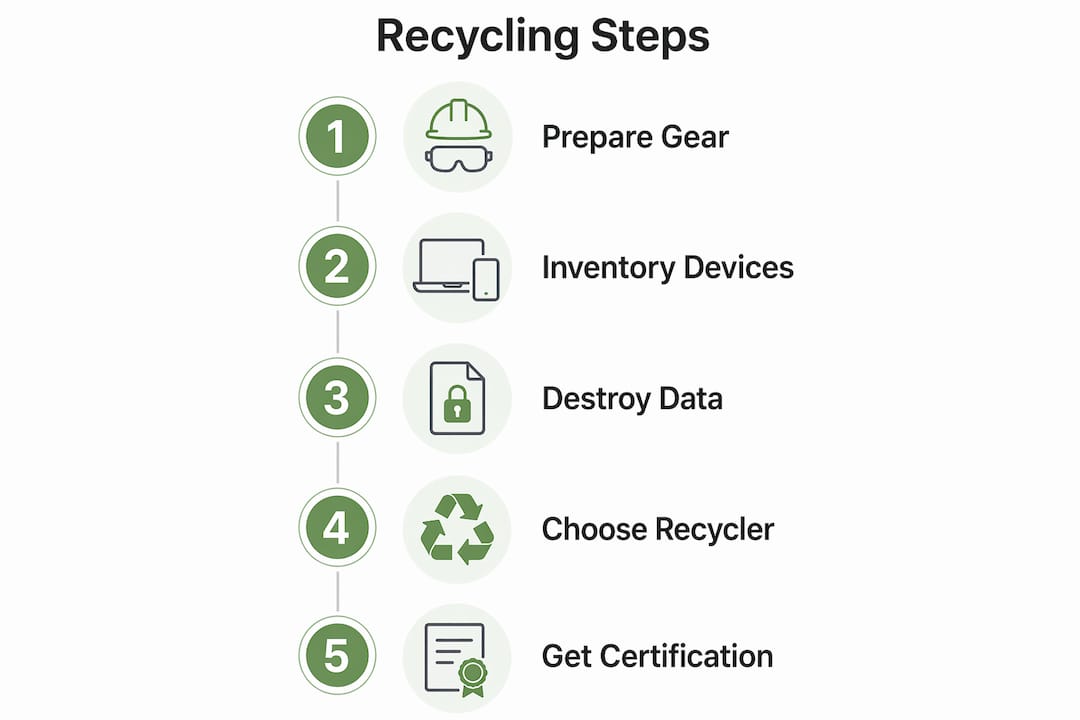
What is the step-by-step process for secure, sustainable disposal?
Sustainable networking equipment disposal follows a fixed sequence. Skipping steps, especially data destruction, creates legal exposure that no recycling certificate can undo.
-
Wipe or destroy data first. Use NIST 800-88 compliant overwriting software for flash and hard drive storage embedded in networking gear. For devices that cannot be reliably wiped, physical destruction is the correct choice. Degaussing works for magnetic media but does not apply to solid-state components common in modern switches and routers.
-
Document the destruction. Record which method was used, who performed it, the date, and the device serial number. Proper documentation and certificates from recyclers are critical for compliance with environmental regulations and corporate governance policies. Maintain these records for a minimum of three years or as required by your industry.
-
Prepare equipment for transport. Remove all power cables and label each device with its asset tag. Package units to prevent physical damage during transit. Damaged hardware can release hazardous materials like lead solder or cadmium from batteries during handling.
-
Select and schedule your recycling vendor. Contact your chosen manufacturer takeback program or certified recycler. Cisco’s program, for example, accepts Cisco-branded gear and offers pickup or drop-off options with documented recycling confirmation. Third-party certified recyclers typically provide scheduled pickups for larger volumes.
-
Handle cables, batteries, and accessories separately. Many electronics recyclers accept cables and adapters, but special handling is required due to materials like PVC insulation and lithium batteries. Sort these items before pickup. Proper sorting increases material recovery rates and reduces safety risks during processing.
-
Obtain and file your certificate. Request a Certificate of Recycling or Certificate of Destruction from your vendor upon completion. File it with your asset disposal records. This document is your proof of compliance if regulators or auditors ask.
Pro Tip: Schedule data destruction and recycling pickup on the same day. Devices sitting in a staging area after wiping are still a physical security risk.
What are the common challenges when recycling networking gear?
Even well-prepared IT teams run into problems. Knowing where the process typically breaks down lets you build controls before the failure happens.
The biggest risk is a data breach from improper disposal. Devices that leave your facility without verified data destruction are a liability, regardless of what the recycler promises verbally. Common challenges include data breach risks, lacking recycler verification, and improper documentation of recycling or destruction. Businesses must carefully vet recyclers and maintain audit trails for compliance.
Verifying recycler certifications is harder than it sounds. R2 and e-Stewards certifications require annual audits, but certificates can be outdated or falsified. Always verify directly with the certifying body rather than accepting a PDF from the vendor.
Compliance missteps are also common when teams treat all networking gear as identical. A decommissioned firewall that processed financial transactions carries different regulatory weight than an unmanaged switch from a conference room. Classify devices by data sensitivity before assigning a disposal method.
Damaged or end-of-life gear that cannot be recycled through standard channels requires special handling. Contact your state’s environmental agency for guidance on disposing of gear containing hazardous materials like lead or mercury.
Cost is a real consideration. Certified recycling with on-site destruction costs more than dropping equipment at a municipal collection site. That cost difference is the price of compliance and liability protection. For most organizations managing regulated data, it is not optional.
What are the main options for recycling networking gear?
IT professionals have four primary pathways for disposing of networking gear responsibly. The right choice depends on data sensitivity, volume, and budget.
Manufacturer takeback programs
Manufacturer programs are the most straightforward option for branded equipment. Cisco’s program recovers over 99% of collected materials and provides Certificates of Recycling on request. Other major networking vendors operate similar programs. The limitation is that these programs typically cover only their own branded hardware, leaving mixed-vendor environments with a gap.
Certified third-party recyclers
Certified recyclers operating under R2 or e-Stewards standards handle mixed-vendor equipment and provide full documentation. They are the best fit for organizations with large, diverse inventories. Managed IT recycling examples show that certified channels consistently outperform ad hoc disposal in both compliance outcomes and material recovery rates.
Donation and reuse programs
Donation extends the life of functional equipment and reduces e-waste volume. However, donation programs require that all data is securely wiped before transfer. Not all old gear is suitable for reuse, and donation programs require proper vetting of recipient organizations. Never donate a device that held regulated data unless you have a destruction certificate for its storage components.
On-site destruction and recycling services
On-site services bring the destruction process to your facility. A certified technician destroys storage media on location, provides a witnessed certificate, and then transports the hardware for recycling. This option eliminates the chain-of-custody risk that comes with transporting data-bearing devices off-site. It costs more, but for organizations handling sensitive data, it is the most defensible approach.
Pro Tip: For high-volume refreshes, negotiate a blanket service agreement with a certified recycler. Per-unit costs drop significantly at scale, and you get consistent documentation across every disposal event.
| Pathway | Best for | Documentation provided |
|---|---|---|
| Manufacturer takeback | Single-vendor environments | Certificate of Recycling |
| Certified third-party recycler | Mixed-vendor, large volumes | Certificate of Destruction or Recycling |
| Donation and reuse | Functional gear, low data risk | Wipe certificate required before transfer |
| On-site destruction service | High-sensitivity data environments | Witnessed destruction certificate |
Key Takeaways
Responsible recycling of networking gear requires data destruction before disposal, certified vendor selection, and documented proof of both for every device.
| Point | Details |
|---|---|
| Data destruction comes first | Wipe or physically destroy storage before any device leaves your facility. |
| Certifications matter | Only use recyclers certified under R2 or e-Stewards standards for business-grade hardware. |
| Documentation is compliance | Obtain a Certificate of Recycling or Destruction for every disposal event and retain it for audits. |
| Accessories need separate handling | Cables, batteries, and adapters require special sorting due to PVC and lithium content. |
| Match method to data sensitivity | Firewalls and core switches warrant stricter destruction methods than low-risk access layer gear. |
What I’ve learned from years of watching IT teams get this wrong
Most IT teams treat equipment recycling as a logistics problem. It is actually a risk management problem with a logistics component. The teams that get into trouble are the ones that hand off decommissioned gear to a recycler without confirming data destruction first, then discover months later that the recycler had no real certification.
The detail that surprises most IT professionals is how often recycler credentials are not verified at all. A vendor with a professional website and a PDF certificate is not the same as a vendor whose R2 certification you confirmed directly with the certifying body. I have seen organizations fail audits not because they skipped recycling, but because they could not produce a valid destruction certificate for a device that left the building two years earlier.
Integrating recycling into your IT asset lifecycle from the start changes the economics entirely. When disposal is planned at procurement, you know the data classification, the expected end-of-life date, and the correct destruction method before the device ever goes into service. That planning eliminates the scramble that leads to shortcuts. The safe disposal of IT assets is not a one-time event. It is a repeatable process that gets cheaper and more reliable every time you run it correctly.
— Keith
Usedcartridge makes secure networking gear recycling straightforward
IT teams managing equipment refreshes need a partner that handles both sides of the problem: data security and environmental compliance. Usedcartridge provides certified e-waste recycling, on-site data destruction, and documented chain-of-custody reporting for networking hardware of all types.

Whether you are disposing of a single firewall or clearing out an entire data center, Usedcartridge offers secure equipment destruction and e-waste recycling logistics built around compliance requirements. Every disposal event includes documentation you can present to auditors. Request a free quote and find out how straightforward responsible disposal can be.
FAQ
What data destruction method is required for networking gear?
NIST 800-88 compliant overwriting works for most flash-based networking hardware. Physical destruction is required for devices that held classified or regulated data and cannot be reliably wiped.
How do I verify a recycler’s certification?
Confirm R2 or e-Stewards certification directly with the certifying body, not from a document the vendor provides. Certifications require annual audits and can lapse or be misrepresented.
Can I donate old networking equipment instead of recycling it?
Donation is an option for functional gear with low data risk, but all storage must be securely wiped and certified before transfer. Devices that held regulated data are generally not suitable for donation programs.
What documentation do I need after recycling networking gear?
A Certificate of Recycling or Certificate of Destruction from your vendor is the minimum requirement. Retain it alongside your asset disposal records for at least three years or as your industry regulations specify.
Are cables and accessories recycled the same way as hardware?
No. Cables, adapters, and batteries require separate handling due to materials like PVC and lithium. Many certified recyclers accept them but sort them independently to increase material recovery and reduce safety risks during processing.