
The safest way to move sensitive drives is to ship only hardware-encrypted media through a dedicated, bonded courier, transfer decryption keys through a separate channel, and require a signed chain-of-custody at both ends. Follow the checklist below for routine shipments. For high-volume, regulated, or high-risk transfers, request a specialist like Usedcartridge to coordinate on-site destruction or bonded transport and handle the documentation for you.
TL;DR:
- Proper secure drive transport requires encrypting the device, verifying the security measures before shipping, and maintaining a backup to prevent data loss.
- Packaging must include a lockable, tamper-evident case with serialized seals, photographed and logged at both pickup and delivery to ensure integrity.
- Choose dedicated or bonded couriers for high-security or regulated data shipments, avoiding hub-and-spoke networks that increase tampering risks.
- Chain-of-custody records should include detailed device info, timestamps, and photographs, with retention periods aligned to organizational data policies.
- Outsourcing secure transport and destruction is advisable for high-volume, sensitive, or regulatory-critical data, supported by proof of encryption, security, and proper documentation.
Table of Contents
- What Does Secure Drive Transport Actually Require?
- Prepare Drives Before Transit: Encryption, Malware Checks, Backup
- Packaging and Tamper-Evident Controls: What to Use and How to Document It
- Courier and Logistics Options: Weighing Dedicated, Bonded, and Standard Service
- Chain of Custody and Documentation: What Makes It Audit-Ready
- How Do You Verify a Drive Arrived Intact?
- When to Hire a Specialist for Secure Drive Transport
- Practitioner Take: Where Secure Drive Transport Usually Breaks
- Ready for Audit-Ready Transport and Destruction, Handled for You?
- Sources
- FAQ
What Does Secure Drive Transport Actually Require?
Secure drive transport means the drive, the courier, and the paperwork all have to hold up under scrutiny. That last part gets skipped constantly. Teams lock down encryption, then hand the box to a standard parcel carrier and call it done. The real standard blends three things: cryptographic assurance on the device itself, physical custody controls during the move, and a paper trail that proves both.
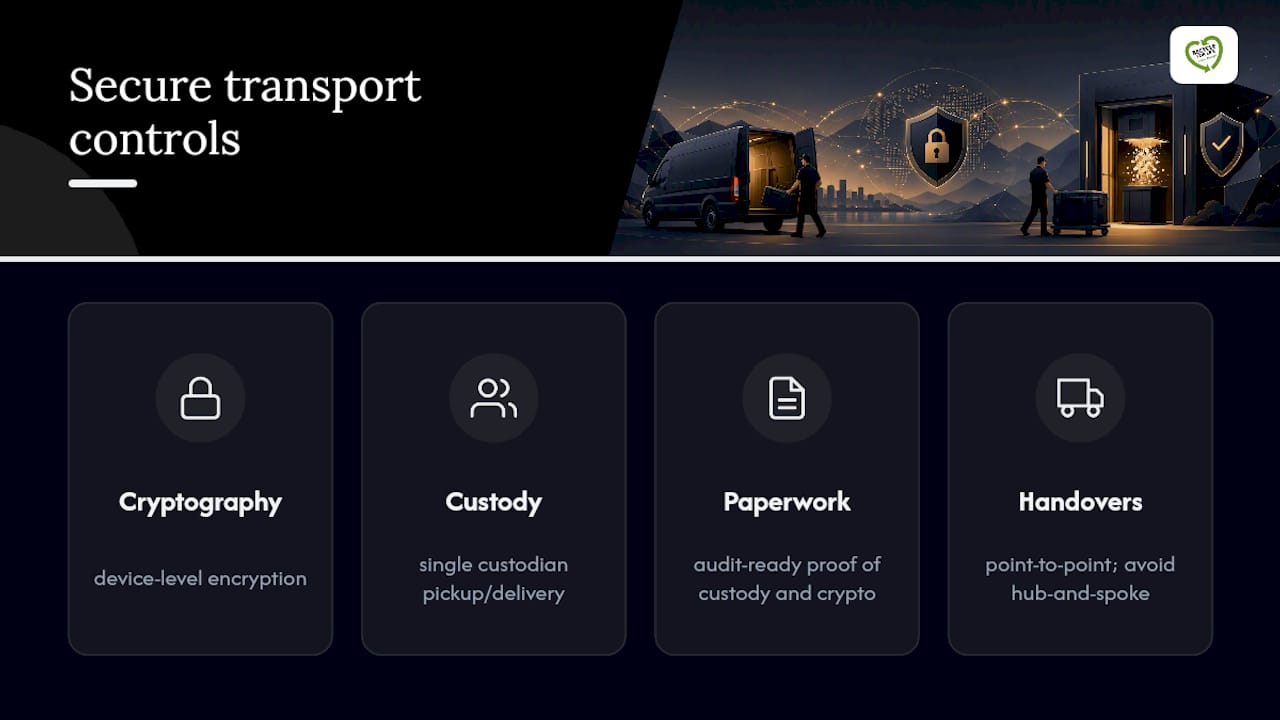
A single custodian at pickup and a single custodian at delivery is the simplest control that actually works. Every extra handler in between raises the odds of loss, tampering, or a broken seal nobody can explain later. That’s the logic behind avoiding hub-and-spoke shipping networks for anything containing regulated data, and it’s why point-to-point courier handovers keep showing up in formal transport guidance for protected material, including RCMP transport and storage standards.
Prepare Drives Before Transit: Encryption, Malware Checks, Backup
No packaging or courier fixes a drive that wasn’t secured before it left the building. Before anything ships, confirm the following:
- Verify hardware-based or full-disk encryption is active, and record the device model and serial number against the encryption method used
- Prefer FIPS-validated hardware encryption modules when regulatory exposure demands it, following key management guidance from CMS
- Maintain an independent backup elsewhere; never treat the drive in transit as the only surviving copy
- Run current malware scans and firmware integrity checks, and log the results with timestamps
- Wipe cached credentials, saved sessions, and any locally stored secrets before the drive leaves the facility
- Plan the out-of-band key transfer, including which channel and when it goes out relative to pickup
Devices that self-wipe after repeated failed PIN attempts add a real layer of protection if a shipment is intercepted or stolen in transit.
Pro Tip: Schedule the key transfer to land after the courier confirms pickup, not before. A key sent too early sits exposed for hours with no drive attached to it yet.
Packaging and Tamper-Evident Controls: What to Use and How to Document It
Packaging is where a lot of otherwise solid security plans fall apart, usually because someone reaches for a padded envelope instead of a locking case. Use a rigid, lockable transport case with serialized tamper-evident seals, and photograph both the seal number and its placement before the case leaves your custody.
For drives sensitive to shock or humidity, add foam inserts and, where the device type calls for it, a moisture barrier bag. Skip anything on the outside of the case that hints at contents. Labels should carry an internal reference ID only, never a description like “hard drives” or “financial records.”
On receipt, someone needs to check the case against a short list before signing for it:
- Does the seal number match the one recorded at pickup?
- Is the seal physically intact, with no cuts, re-adhesion, or discoloration?
- Does the case show any signs of forced entry, moisture intrusion, or impact damage?
- Does the internal ID on the label match the manifest?
Any mismatch stops the handoff and triggers the incident process before the case gets signed for.
Courier and Logistics Options: Weighing Dedicated, Bonded, and Standard Service
Not every courier option carries the same risk profile, and procurement teams often don’t realize how much that choice matters until something goes wrong.
- Dedicated or direct couriers move a shipment from pickup to delivery with no intermediate sorting facility, which is the single biggest reduction in exposure you can buy. DAGO Express notes that direct courier delivery of encrypted drives, paired with sealed packaging and separate key transmission, is standard practice for time-critical, high-security transfers.
- Bonded couriers carry insurance and liability coverage specific to the shipment’s value, which matters when the drives themselves aren’t the real cost. It’s the data exposure and breach notification liability that make insurance worth the line item.
- Standard parcel carriers route packages through multiple hubs by design. That’s efficient for retail shipping and a bad fit for anything with regulatory teeth behind it.
- Air transport adds security screening, customs handling, and extra handlers outside your control, so reserve it for cases where ground transit time is the bigger risk.
Whatever option you choose, put acceptance criteria directly into the procurement contract: ID verification at both ends, no unattended drop-offs, and documented GPS tracking for the full route.
Chain of Custody and Documentation: What Makes It Audit-Ready
A chain-of-custody record is only as good as the fields it captures. At minimum, the manifest needs device IDs, serial numbers, seal numbers, and a condition note at pickup. Time-stamped photos at both ends, plus retained courier GPS logs, close most of the gaps auditors ask about.
- Manifest fields: device ID, serial number, seal number, condition notes, custodian names
- Time-stamped photos at pickup and at delivery, filed against the manifest
- Face-to-face handover: government ID check, signature, recorded timestamp on both sides
- Written incident escalation procedure for a broken seal, missing item, or unexplained delay
- Retention period for transport records aligned to your compliance framework, often several years
Emerging tools are pushing this further. Digital product passport frameworks and blockchain-based traceability systems are being tested as a supplement to physical custody logs, giving organizations end-to-end provenance data that a paper manifest alone can’t provide. Some prototype supply chain systems combining blockchain and smart contracts show promising traceability results, though this is still early for most IT transport programs.
Pro Tip: Retain transport records at least as long as your data retention policy for the underlying information itself, not the shorter default your shipping vendor offers.
How Do You Verify a Drive Arrived Intact?
Inspect the case the moment it arrives, before signing anything. Photograph the seal, the case exterior, and any visible damage, then compare seal numbers against the pickup record.
- Power the device on and run a cryptographic health check without exposing the decryption key
- Verify a sample of files against a known hash or checksum from before shipment
- Confirm the device serial number matches the manifest exactly
- Log the inspection results with a timestamp and the receiving custodian’s name
Only after physical acceptance is confirmed should decryption keys move through the pre-agreed out-of-band channel. Sending keys before acceptance defeats the entire point of separating them from the drive in the first place.
From there, final disposition depends on the drive’s purpose: ingest it into a secure environment, place it in evidence-grade locked storage pending further use, or schedule witnessed destruction if the transport was one-way. Usedcartridge’s certified hard drive destruction process documents exactly this kind of witnessed, audit-ready endpoint. Update your audit log and notify stakeholders once disposition is set.
When to Hire a Specialist for Secure Drive Transport
Handling this internally works fine for occasional, low-volume moves. It stops working once you’re dealing with regulated data classes, high shipment volume, or a schedule tight enough that a missed pickup becomes a compliance problem.
Vendor due diligence should cover:
- Encryption verification procedures and documented key handling practices
- Bonded courier arrangements with insurance coverage matched to shipment value
- Tamper-evident containers with serialized seals as a standard part of service
- Acceptance testing on delivery, not just a signature on a clipboard
- A certificate of destruction or transport certificate issued after the job
Ask for proof, not promises: insurance documentation, facility credentials, and any third-party audit reports the vendor can share. Procurement teams should also weigh responsible sourcing practices, since circular economy frameworks increasingly expect downstream traceability for IT asset disposition, not just security at the point of transport.
Organizations moving more than a handful of drives at a time, or facing regulatory audit exposure, generally see a faster payoff from outsourcing transport and destruction together rather than splitting the two across separate vendors.
Practitioner Take: Where Secure Drive Transport Usually Breaks
The failure point almost never has anything to do with the courier truck. It’s key management, nearly every time. Someone emails the decryption key alongside the tracking number, or worse, tapes a password to the inside of the case “just in case.” The second most common mistake is defaulting to whatever parcel service is already set up for office supplies.
Fix both with a checklist you actually enforce and one named custodian per leg of the trip. Photograph seals before they leave your hands, not after something looks wrong. If a seal arrives broken or a number doesn’t match, stop the handover, isolate the shipment, and escalate immediately rather than assuming it’s nothing.
— Keith
Ready for Audit-Ready Transport and Destruction, Handled for You?
Specialized services replace the DIY approach to secure drive transport with a coordinated on-site destruction and pickup process built for compliance, not guesswork. Instead of stitching together your own courier contract, packaging vendor, and manifest template, you get one service that handles encryption verification, secure pickup coordination, and a documented certificate at the end.

Getting a quote takes almost no setup. Have your device count, device types, and any pickup or delivery constraints ready to scope the job accurately the first time. For sensitive drives that need a witnessed, auditable endpoint rather than shipping alone, onsite data destruction removes the transport risk entirely by handling destruction where the drives already sit. If transport to a facility fits your process better, the hard drive destruction service page covers both options side by side. Request your IT asset recovery and disposition quote today and get a specific plan back, not a generic price list.
Sources
For deeper technical or regulatory detail beyond this checklist:
- USB drive by courier: secure transport for time-critical data | DAGO Express
- Digital Product Passport case study (PMC)
- CMS key management handbook
FAQ
What Is the Safest Method for Secure Drive Transport?
Ship only hardware-encrypted drives through a dedicated or bonded courier, send decryption keys through a separate out-of-band channel, and require signed chain-of-custody documentation at pickup and delivery.
Should Decryption Keys Ever Travel With the Drive?
No. Keys should move through a different channel and at a different time than the physical drive, and only after the receiving party confirms physical acceptance of the shipment.
What Counts as Tamper-Evident Packaging?
A rigid, lockable case with a serialized seal that shows visible damage if opened, photographed and logged at both pickup and delivery so any mismatch is caught immediately.
When Should an Organization Outsource Secure Drive Transport?
Outsourcing makes sense once shipment volume, regulatory exposure, or data classification pushes past what an internal team can document reliably; Usedcartridge’s certified hard drive destruction guide outlines what an audit-ready process looks like.
How Long Should Transport Records Be Retained?
Retention should match your organization’s broader data retention policy, often several years, rather than defaulting to a courier’s standard record-keeping window.