
Improperly retired IT equipment is one of the most underestimated liability sources in modern organizations. A single hard drive leaving your facility without verified data destruction can trigger regulatory fines, customer lawsuits, and reputational damage that far outweigh any savings from cutting corners on disposal. Environmental regulators are tightening rules around hazardous material handling in electronic waste, adding another layer of risk for organizations that treat e-waste pickup as a low-priority logistics task. This guide breaks down what secure e-waste pickup actually means, how to evaluate providers, and why both your compliance team and your sustainability commitments depend on getting this right.
Table of Contents
- Defining secure pickup for e-waste
- Why secure pickup matters for IT and compliance teams
- Key features of a secure e-waste pickup provider
- How secure pickup supports sustainability and compliance
- The hidden pitfalls of e-waste pickup: What most organizations overlook
- Take the next step: Secure your e-waste disposal
- Frequently asked questions
Key Takeaways
| Point | Details |
|---|---|
| Secure pickup essentials | It requires verified chain-of-custody, certified destruction, and compliance with regulations. |
| Compliance and sustainability | Secure e-waste pickup protects sensitive data and supports environmental goals. |
| Provider evaluation | Always check certifications, workflow transparency, and guarantees before choosing a service. |
| Common pitfalls | Avoid providers lacking clear credentials or proven chain-of-custody processes. |
Defining secure pickup for e-waste
Not every service that collects old computers and servers qualifies as secure e-waste pickup. The word “secure” carries specific operational and legal weight that separates certified providers from generic removal companies.
At its core, secure pickup combines three pillars: physical security during transport, procedural controls throughout the chain of custody, and regulatory compliance at every stage. Physical security means equipment is placed in locked, tamper-evident bins or containers before it leaves your facility. Vehicles are tracked, and access to collected assets is restricted to authorized personnel only. No stops at unmarked warehouses, no unsupervised handoffs.
Procedural controls are equally important. A legitimate secure provider will supply transfer receipts at pickup, signed confidentiality agreements before the engagement begins, and a documented chain of custody that tracks every device from your loading dock to its final disposition. This paperwork is not bureaucratic noise. It is your legal protection during an audit.
Regulatory compliance is where many organizations get tripped up. Secure pickup includes data destruction processes aligned with regulatory requirements such as NIST 800-88 for media sanitization and state-level e-waste statutes. A provider that skips certified destruction in favor of resale without disclosure is not offering a secure service, regardless of what their marketing says.
Here is what a legitimate secure pickup process includes:
- Signed chain-of-custody documentation before any equipment moves
- Tamper-evident packaging and GPS-tracked transport
- Certified data destruction using DoD-level or NIST-compliant methods
- Environmental handling that meets state and federal e-waste regulations
- Certificates of destruction delivered after the process is complete
“The difference between secure and non-secure pickup is not the truck. It is the documentation, the certification, and the accountability built into every step of the process.”
Understanding the full scope of electronic waste is essential before engaging any provider, because the risk profile differs between a box of old monitors and a rack of decommissioned servers with live data. Reviewing device preparation steps before pickup reduces gaps in the chain of custody before a provider ever arrives.
Why secure pickup matters for IT and compliance teams
IT managers and compliance officers often face a familiar tension: the pressure to move fast on equipment refresh cycles while maintaining airtight records of what happened to every retired asset. Secure pickup is where those two priorities either align or collide.
Proper management of used electronics is critical for safety and data security, and regulators across industries have codified that responsibility into enforceable law. HIPAA, GLBA, FACTA, and state privacy statutes all carry provisions that extend to hardware disposal. A data breach traced to an improperly destroyed hard drive is not treated as an accident. It is treated as a compliance failure with financial and reputational consequences.
Here is a practical sequence to understand the stakes:
- A device leaves your facility without certified data destruction.
- Residual data is accessed by a third party.
- A breach notification is triggered, requiring disclosure to affected individuals.
- Regulators open an investigation into your disposal practices.
- Fines, remediation costs, and legal fees accumulate.
- Your organization’s vendor management practices come under audit scrutiny.
The financial exposure is significant. Data breach costs in the healthcare sector alone average over $10 million per incident, a figure that makes certified disposal look like a bargain by comparison.
Environmental compliance adds a parallel track of risk. Many states prohibit landfill disposal of electronics containing lead, mercury, and cadmium. Organizations that rely on unverified pickup services may unknowingly become liable for improper disposal, especially when those providers operate without environmental permits.
Beyond avoiding penalties, secure pickup creates a positive audit trail. When regulators or internal auditors request proof of data destruction, a certificate from a certified provider closes the inquiry quickly. Without that documentation, your team is left reconstructing events from memory and spreadsheets, which is a losing position in any formal review. Exploring eco-friendly asset recovery strategies shows how compliance and return on investment can work together rather than against each other.
Key features of a secure e-waste pickup provider
Choosing the right provider requires more than checking a box on a procurement form. The criteria that matter are verifiable, not just claimed.

Certifications are the first filter. Look for R2 (Responsible Recycling), e-Stewards, and NAID AAA certifications. These are third-party audited programs that verify a provider’s practices for data destruction, environmental handling, and worker safety. A provider that lists certifications on their website but cannot produce current certificates on request is a red flag.
Chain-of-custody documentation should be non-negotiable in your vendor agreement. This means serialized asset tracking from pickup through final destruction or recycling, with timestamps and personnel records at each handoff. If a provider cannot show you how they track individual devices, they cannot prove what happened to your data.
Process transparency is increasingly available through real-time tracking portals and digital reporting. The best providers offer dashboards where your team can verify the status of a pickup in real time, rather than waiting for a monthly report.
Evaluating the security and reliability of e-waste pickup providers comes down to verifiable credentials and documented guarantees, not marketing language.
| Feature | Secure provider | Non-secure provider |
|---|---|---|
| Certifications | R2, e-Stewards, NAID AAA | None or unverified |
| Chain of custody | Serialized, documented | Verbal only |
| Data destruction proof | Certificate issued | Not provided |
| Environmental compliance | Permitted, audited | Unknown |
| Tracking | Real-time, GPS-enabled | Not available |
Pro Tip: Before signing any vendor agreement, request a sample certificate of data destruction and a sample chain-of-custody report. A provider that hesitates to share these samples is telling you something important about their actual practices.
Organizations evaluating secure alternatives for e-waste pickup will find that the gap between certified and uncertified providers is wider than most procurement teams initially expect.
How secure pickup supports sustainability and compliance
Secure pickup is not just a data protection strategy. It is also a sustainability and compliance mechanism that affects your organization’s environmental standing and stakeholder relationships.
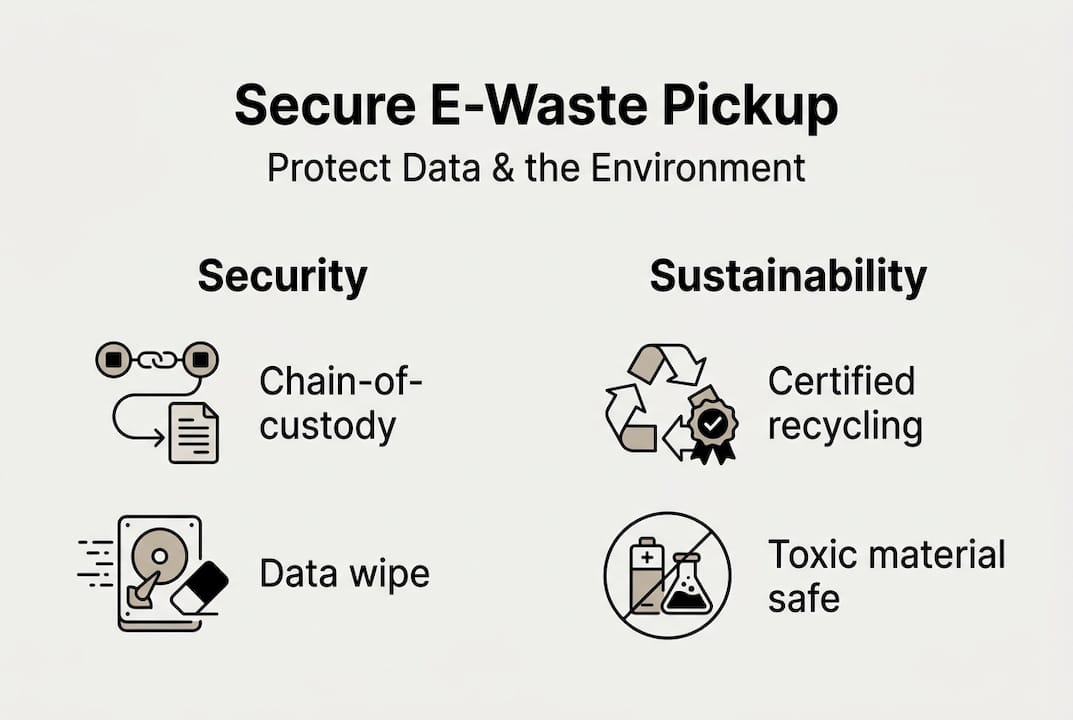
Properly managed e-waste supports both sustainability and regulatory compliance by keeping hazardous materials out of landfills and ensuring valuable materials are recovered responsibly. Electronics contain recoverable metals including copper, gold, and rare earth elements. Certified recyclers extract these through processes that do not release toxins into soil or groundwater, unlike informal or unregulated recyclers.
From a compliance standpoint, secure pickup supports adherence to the following frameworks:
- HIPAA: Requires covered entities to protect patient information through end of life of any hardware that stored it
- GDPR: Mandates verifiable destruction of personal data for EU residents regardless of where your organization operates
- FACTA Disposal Rule: Requires proper disposal of consumer report information derived from credit reporting agencies
- State e-waste laws: Vary by jurisdiction but increasingly require documented recycling through registered handlers
The table below shows how secure pickup maps to common compliance requirements:
| Regulation | Secure pickup requirement | Documentation needed |
|---|---|---|
| HIPAA | Certified data destruction | Certificate of destruction |
| GDPR | Verified deletion or destruction | Destruction record |
| FACTA | Proper disposal of consumer data | Audit trail |
| State e-waste laws | Licensed recycler used | Environmental compliance record |
Corporate stakeholders, including investors, clients, and employees, increasingly evaluate organizations on environmental, social, and governance (ESG) criteria. A documented secure recycling program contributes directly to ESG reporting and demonstrates that responsible disposal is built into your IT lifecycle management, not treated as an afterthought. Choosing to recycle used electronics through verified channels also reinforces a public commitment that resonates with clients and procurement partners.
The hidden pitfalls of e-waste pickup: What most organizations overlook
Here is something most vendor selection guides will not tell you: the biggest risk in e-waste pickup is not choosing a bad provider. It is assuming a provider is good without verifying the specific steps that matter.
We see organizations sign contracts with certified vendors and then never request the certificates of destruction afterward. The certification is only useful if you actually collect and archive the documentation for each disposal event. An auditor does not care that your vendor is R2-certified. They want to see the certificate tied to the specific device serial numbers from the last refresh cycle.
The allure of free pickup creates another blind spot. Free is not inherently insecure, but it does require due diligence. Some providers offset the cost of free pickup through data resale or materials arbitrage that bypasses certified destruction. The question is not whether the pickup is free. The question is whether destruction is certified and documented regardless of cost.
Single-point-of-failure in logistics is an underappreciated risk. If your provider subcontracts transportation to a third party without extending chain-of-custody controls to that subcontractor, you have a gap that auditors and regulators will find before you do. Always ask whether subcontractors are bound by the same security standards as the primary provider.
Take the next step: Secure your e-waste disposal
With a clear picture of what secure e-waste pickup requires, the next step is finding a provider that delivers on every element: certified destruction, documented chain of custody, and environmentally responsible handling.

UsedCartridge.com provides secure e-waste logistics built for IT and compliance teams that cannot afford gaps in their disposal records. From free pickup scheduling to certified data destruction with documentation, every step is designed to protect your organization and support your sustainability commitments. Explore our equipment destruction services to get a quote and learn how a certified process protects your data, your compliance standing, and the environment at the same time.
Frequently asked questions
What makes an e-waste pickup service secure?
A secure e-waste pickup service provides chain-of-custody documentation and guarantees of certified data destruction at every step, not just at the collection point.
How can organizations verify the security of their e-waste provider?
Request current certification documents, sample destruction certificates, and chain-of-custody reports before signing a contract. Evaluating providers based on certifications and process transparency is the most reliable verification method.
Does secure e-waste pickup also help with environmental compliance?
Yes. Secure pickup uses permitted recyclers and responsible hazardous material handling, meaning proper management of e-waste directly aids environmental compliance under state and federal regulations.
Are ‘free’ e-waste pickup services always secure?
No. Not all free pickup services guarantee certified data destruction. Always verify credentials and chain-of-custody controls regardless of the price.
What documentation should a secure e-waste pickup provide?
You should receive serialized transfer receipts at pickup, a certificate of destruction tied to specific device serial numbers, and environmental disposal records confirming compliant recycling.