
When a server room gets cleared out or a fleet of laptops is retired, most organizations assume the job is done once the equipment leaves the building. It is not. Understanding what are the stages of IT recycling is what separates businesses that face data breach liabilities and regulatory fines from those that operate with confidence. The IT recycling process is a structured, multi-phase lifecycle that covers everything from asset inventory to certified destruction and final material recovery. Get it right, and you protect your data, recover asset value, and stay compliant.
Table of Contents
- Key takeaways
- What are the stages of IT recycling: an overview
- Stage 1: Initial assessment and inventory
- Stage 2: Secure data sanitization and destruction
- Stage 3: Reuse and refurbishment before recycling
- Stage 4: Material separation and processing
- Stage 5: Documentation, certification, and final reporting
- My perspective on where most businesses go wrong
- How Usedcartridge can handle every stage for you
- FAQ
Key takeaways
| Point | Details |
|---|---|
| Start with a full inventory | Every device must be assessed for condition, data sensitivity, and disposition options before anything else happens. |
| Data destruction is non-negotiable | Certified sanitization using standards like NIST SP 800-88 must occur before any device leaves your control. |
| Reuse comes before recycling | Refurbishing and redeploying assets extends device life, recovers value, and supports circular economy goals. |
| Material recovery requires certified facilities | Dismantling IT hardware for metal, plastic, and battery recovery must happen at compliant, audited facilities. |
| Documentation is your legal protection | Certificates of destruction and chain of custody records reduce compliance risk for regulated industries. |
What are the stages of IT recycling: an overview
The IT recycling process is not a single event. It is a sequence of deliberate steps, each with its own compliance requirements, security considerations, and environmental obligations. Most businesses mistakenly treat IT recycling as waste disposal rather than as an asset management opportunity, which means they skip stages that protect them legally and financially.
The stages of electronic recycling, in order, are: initial assessment and inventory, secure data sanitization and destruction, reuse and refurbishment evaluation, physical material separation and processing, and final documentation with certification. Each stage feeds into the next. Skipping or rushing any one of them creates risk at every level, from a data breach to an environmental violation.
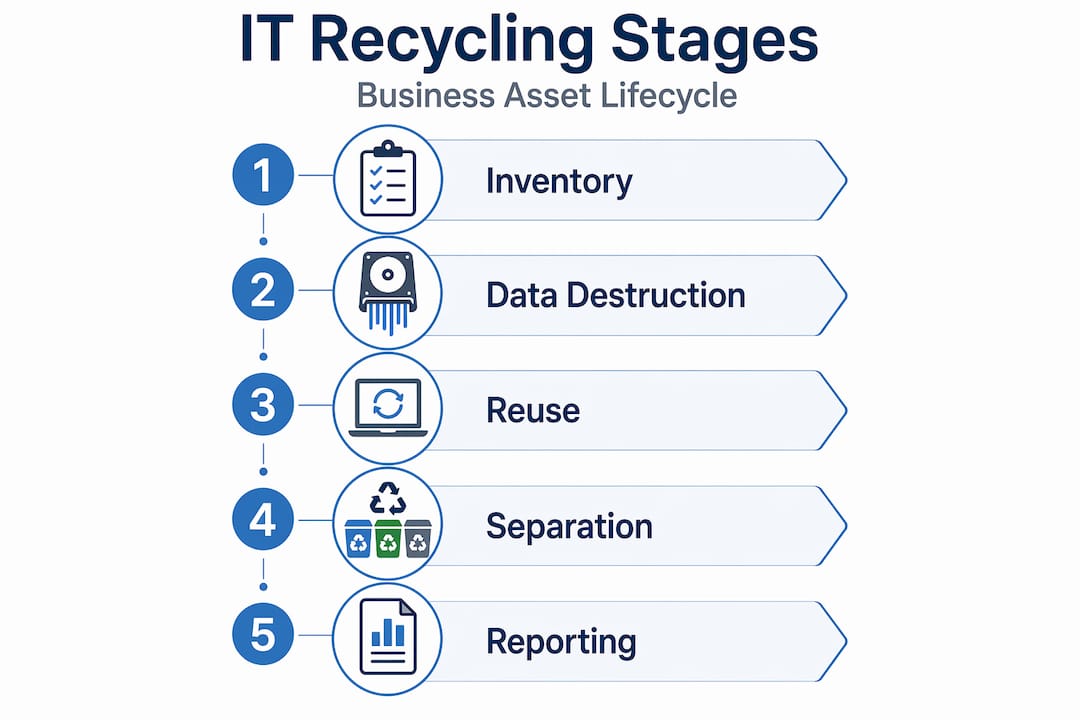
The phases of electronics recycling apply whether you are retiring ten workstations or ten thousand. Scale changes the logistics. The stages do not change.
Stage 1: Initial assessment and inventory
Before a single device is touched, your organization needs a complete picture of what it owns. The IT recycling process begins with a thorough inventory and assessment to determine asset disposition options, including reuse, refurbishment, or recycling.
What this looks like in practice:
- Asset tagging and cataloging: Every device gets logged with make, model, serial number, age, and current condition. Without this, you cannot make informed decisions about disposition.
- Data classification review: Devices that stored sensitive data, such as HR records, financial data, or patient information, require a higher level of destruction verification than general-use machines.
- Condition grading: Devices are graded on a scale from fully functional to non-repairable. This determines whether a device moves toward reuse, refurbishment, or direct recycling.
- Compliance flagging: Any equipment subject to industry regulations, such as HIPAA, SOX, or GDPR, gets flagged for priority data destruction documentation.
- Logistics planning: High-volume disposals require scheduled pickups, chain of custody forms, and secure transport arrangements before anything moves.
The inventory stage is where most organizations underinvest. A sloppy asset list creates gaps in your audit trail that will be difficult to explain to a regulator or an auditor.
Pro Tip: Do not rely on self-reported asset lists from department managers. Cross-reference against your IT asset management system and physically verify devices before finalizing the inventory. Discrepancies are common, and each one is a potential liability.
Stage 2: Secure data sanitization and destruction
This is the most legally consequential stage in the entire IT asset disposal process. It is also the stage where shortcuts cause the most damage.
Data destruction falls into two categories: logical sanitization and physical destruction. Logical sanitization involves software-based overwriting of data to standards like NIST SP 800-88, which specifies methods for clearing, purging, and destroying data based on media type and sensitivity classification. Physical destruction covers shredding, crushing, or degaussing storage media so that recovery is impossible by any means.
The right method depends on the device type and the sensitivity of the data it held. A general-use workstation may qualify for certified software wiping. A server that processed financial transactions may require physical shredding with a witnessed destruction event and serial number documentation.
Here is how the two primary certification frameworks compare on data destruction requirements:
| Certification | Data destruction standard | Export restrictions | Downstream tracking |
|---|---|---|---|
| R2v3 | Risk-based approach, allows certified wiping | Permits export under controlled conditions | Requires vendor audit trails |
| e-Stewards | Mandatory NAID AAA certification required | Zero functional equipment export | Quarterly reporting, deeper audits |
e-Stewards certification enforces quarterly reporting and deeper downstream tracking than R2v3’s risk-based approach. Organizations in healthcare, finance, and government typically prefer e-Stewards for this reason. The mandatory NAID AAA requirement provides the strongest available assurance of physical destruction integrity.
Pro Tip: Always request a certificate of data destruction that includes the serial number of each device, the destruction method used, the date, and the technician’s signature. A generic certificate with no device-level detail is not sufficient for a compliance audit.
Stage 3: Reuse and refurbishment before recycling
Recycling should not be the first destination for a retired device. It should be the last resort after reuse and refurbishment options are exhausted. Reuse and refurbishment significantly reduce electronic waste and maximize asset value recovery before recycling or disposal.
The hierarchy works like this:
- Direct reuse: A device that is still functional and meets current performance requirements can be redeployed internally to another department or donated to a qualified nonprofit. This requires data wiping but minimal physical intervention.
- Refurbishment: Devices that are functional but degraded get cleaned, repaired, tested, and certified for resale or redeployment. This often recovers real monetary value, especially for laptops and servers that are only two to four years old.
- Component harvesting: Devices that cannot function as a whole may still have valuable components, such as RAM, SSDs, or power supplies, that can be harvested and reused separately.
- Recycling: Only after the above options are exhausted does a device move to material separation and processing.
Treating IT recycling as asset management rather than waste disposal unlocks financial recovery and promotes better sustainability practices. A business that retires 200 laptops and sends them straight to shredding without evaluating refurbishment potential is leaving money on the table and generating unnecessary waste. Businesses focused on eco-friendly IT asset recovery know that reuse is where the real environmental and financial gains live.
Stage 4: Material separation and processing
Once a device reaches the end of its useful life, it enters the physical recycling stage. This is where IT waste recycling methods diverge significantly from general recycling. IT hardware contains a mix of materials that require specialized handling.
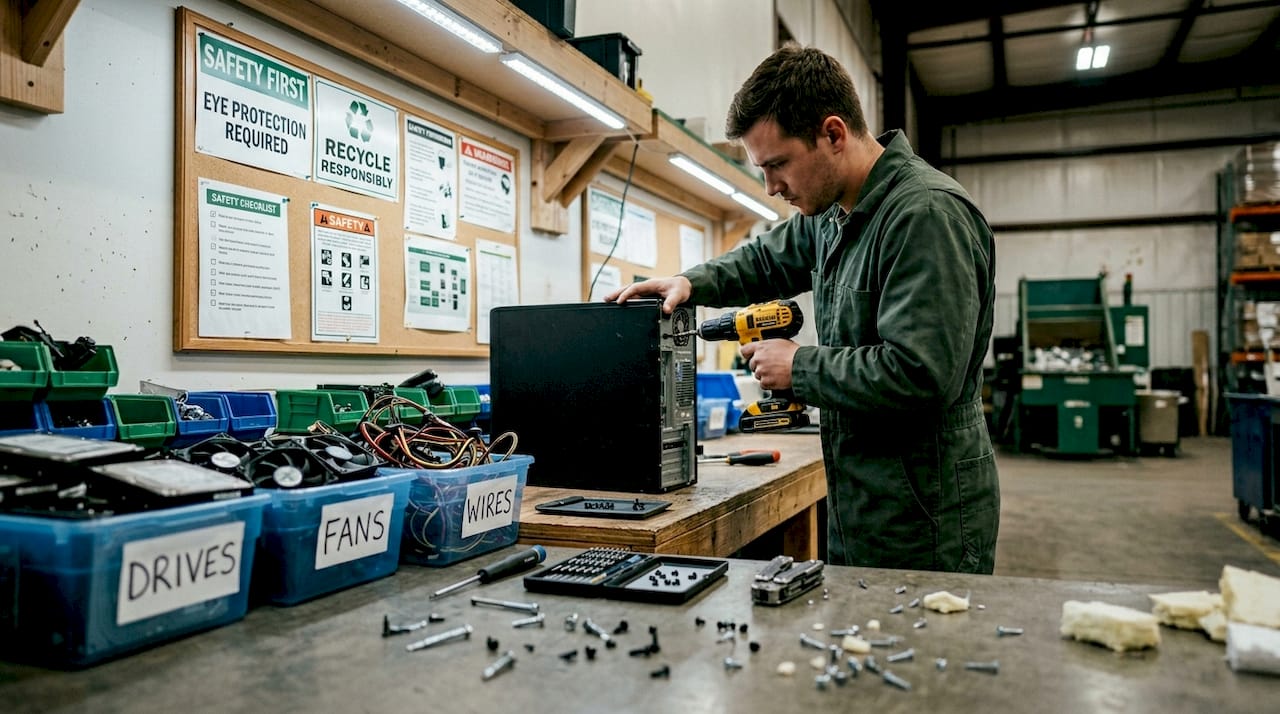
The table below outlines the key material categories and their handling requirements:
| Material type | Found in | Handling requirement |
|---|---|---|
| Ferrous and non-ferrous metals | Chassis, heat sinks, connectors | Sorted and smelted at certified facilities |
| Plastics | Casings, keyboards, cables | Separated by polymer type for processing |
| Circuit boards | Motherboards, GPUs, NICs | Processed for precious metal recovery (gold, silver, palladium) |
| Batteries | Laptops, UPS units, mobile devices | Treated as hazardous, managed under separate regulations |
| LCD screens | Monitors, laptops | Contain mercury; require specialized dismantling |
Material recovery in IT recycling involves safe dismantling, management of hazardous substances, and certified processing for environmental compliance. Metals, plastics, circuit boards, and batteries each require specialized recovery and disposal to prevent pollution.
The recycling facility itself matters enormously. You need a vendor who holds R2v3 or e-Stewards certification, operates under documented environmental management practices, and can provide downstream tracking showing where each material category ends up. Handing equipment to an uncertified vendor creates liability for your organization even after the devices leave your facility. Proper electronic waste recycling means knowing exactly where every component goes.
Stage 5: Documentation, certification, and final reporting
The recycling is done. The data is destroyed. Now you need the paperwork that proves it. This final stage of the IT recycling process is what regulators, auditors, and insurers will ask for.
Here is what a complete documentation package should include:
- Certificate of data destruction for every storage device, with device-level serial number detail, destruction method, date, and technician identification.
- Chain of custody records that trace each asset from initial collection through each processing stage to final disposition.
- Weight-based recycling reports showing the total volume of material recovered and how it was processed.
- Downstream vendor documentation confirming that materials were processed at certified facilities that meet applicable environmental standards.
- Environmental compliance certificates if your organization participates in sustainability reporting frameworks or has carbon footprint disclosure obligations.
Robust certification programs demand detailed chain of custody documentation and audit trails to ensure accountability throughout the recycling process. Documentation helps regulated industries comply with legal and sustainability mandates and provides traceability for audits. Well-maintained records create compliance assurance and demonstrate circular economy participation.
Integrate this documentation into your IT asset lifecycle management system from day one. Trying to reconstruct an audit trail six months after the fact is a stressful, expensive exercise that rarely produces the detail a regulator expects.
My perspective on where most businesses go wrong
I have spent years working alongside organizations going through IT asset disposition, and the pattern I see repeatedly is the same. Businesses focus almost entirely on getting the equipment out the door. Speed becomes the priority. The reuse evaluation gets skipped. The vendor selection happens based on whoever offers free pickup. And the documentation comes back as a single-page generic certificate that would not survive five minutes of scrutiny in a compliance audit.
What I have learned is that the certification your vendor holds is not a checkbox. It dictates how they handle your data, where your equipment goes, and whether you have any legal protection if something goes wrong downstream. The certification approach directly impacts how vendors handle data destruction, export, and downstream audits, affecting your compliance risk and operational costs in ways most IT managers do not anticipate until there is a problem.
The other thing I would push back on is the assumption that sustainability is a bonus feature. For publicly traded companies, companies with ESG reporting obligations, and companies in regulated industries, the documentation trail from a certified IT recycler is no longer optional. It is a business requirement. Organizations that treat the steps in IT recycling as a strategic process rather than a logistical nuisance are the ones that come out of audits clean and build vendor relationships that actually scale.
— Keith
How Usedcartridge can handle every stage for you
If walking through these stages has made it clear that your current IT disposal process has gaps, you are not alone. Most organizations discover the same thing when they map their actual practices against what a compliant process requires.

Usedcartridge provides end-to-end e-waste recycling services built around the exact stages covered in this article. From secure data destruction with device-level certification to certified material processing and final disposition reporting, every step is documented and compliant. For businesses that need on-site destruction, Usedcartridge offers witnessed shredding with serialized certificates. For organizations with large asset volumes, computer recycling programs include scheduled pickup, full chain of custody tracking, and downstream audit documentation. Contact Usedcartridge for a free quote and find out how a properly managed IT recycling process protects your organization at every stage.
FAQ
What are the main stages of the IT recycling process?
The main stages are initial asset inventory and assessment, secure data sanitization or destruction, reuse and refurbishment evaluation, physical material separation and processing, and final documentation with certification. Each stage has distinct compliance and security requirements.
How does data destruction fit into IT recycling?
Data destruction occurs before any device leaves your control and before physical recycling begins. Methods range from certified software wiping under NIST SP 800-88 to physical shredding, depending on the sensitivity of the data and the device type.
What is the difference between R2v3 and e-Stewards certification?
R2v3 uses a risk-based approach that permits certified device export under controlled conditions, while e-Stewards requires NAID AAA physical destruction certification and bans functional equipment export entirely. Regulated industries typically favor e-Stewards for stronger security assurances.
Why is reuse considered a stage in IT recycling?
Reuse and refurbishment are prioritized before physical recycling because they recover more value, generate less waste, and extend device lifecycle. Sending functional equipment directly to shredding wastes recoverable assets and undermines sustainability goals.
What documentation should businesses expect from an IT recycler?
Businesses should receive device-level certificates of data destruction, chain of custody records, downstream processing reports, and environmental compliance certificates. Generic or summary-level certificates without serial number detail are not sufficient for most compliance audits.