
Most organizations assume that handing off old laptops and servers to a recycling vendor closes the loop. It doesn’t. Untracked electronic waste leaves your organization exposed to data breaches, regulatory fines, and environmental liability that can surface months after the devices leave your building. E-waste tracking is the process of maintaining verified, documented control over retired devices from the moment they’re decommissioned to the moment they’re certified as destroyed or recycled. This guide breaks down what effective e-waste tracking looks like, which risks it eliminates, and how your team can implement it without overhauling existing workflows.
Table of Contents
- What is e-waste tracking and why does it matter?
- Key elements of a robust e-waste tracking system
- How e-waste tracking ensures security and compliance
- Implementing e-waste tracking: Steps and best practices
- A smarter approach: What most organizations miss about e-waste tracking
- Partnering for secure and compliant e-waste solutions
- Frequently asked questions
Key Takeaways
| Point | Details |
|---|---|
| Tracking is essential | Proper e-waste tracking reduces legal, security, and environmental risks for organizations. |
| Robust systems add value | Digital platforms, chain-of-custody logs, and certified partners give IT teams confidence and audit readiness. |
| Effective tracking protects data | Verified destruction and real-time monitoring ensure no data leaks from obsolete devices. |
| Compliance is achievable | With best practices and expert support, organizations can meet regulatory and sustainability goals. |
What is e-waste tracking and why does it matter?
E-waste tracking is the systematic monitoring of the movement, handling, and final disposition of every retired or obsolete electronic device your organization retires. This goes far beyond dropping equipment in a bin. It means knowing who touched each device, where it went, and what happened to the data stored on it. Think of it as a documented chain of custody for technology, similar to evidence handling in a legal investigation.
The drivers behind e-waste tracking fall into three clear categories:
- Regulatory compliance: Standards such as R2 (Responsible Recycling), e-Stewards, and the EPA’s overview of e-waste define how electronics must be handled and documented. State and local laws add another layer of obligation.
- Data security: Decommissioned devices almost always contain residual data. Without verified destruction, that data doesn’t disappear.
- Environmental accountability: Proper tracking confirms devices don’t end up in landfills or unauthorized export streams, which carry their own legal consequences.
The e-waste categories covered under these regulations span everything from desktop computers and smartphones to networking hardware and medical devices. Each category may carry different handling requirements, making item-level documentation essential.
Organizations that skip tracking often discover compliance gaps only during audits, when remediation options are limited and penalties are already accruing.
The stakes are real. Improper e-waste disposal can result in legal fines and data breaches that damage both your organization’s finances and its reputation. Tracking transforms disposal from a one-time transaction into a verifiable, auditable record that protects you before, during, and after any regulatory review.
Tracking also supports internal audits. When your IT team can pull a complete history for any asset, from purchase to certified disposal, you have the evidence needed to demonstrate e-waste compliance to regulators, insurers, and clients without scrambling to reconstruct records after the fact.
Key elements of a robust e-waste tracking system
A reliable tracking program is built from several interconnected components. Miss one, and the chain of custody has a gap that auditors will find.
- Item-level inventory: Every device gets a unique identifier, typically a barcode or RFID tag, before it leaves the IT department. This ties the physical asset to a digital record.
- Chain of custody documentation: Each transfer between internal teams, vendors, or facilities is logged with timestamps and responsible party names.
- Vendor qualification: Your tracking is only as strong as your weakest partner. Require certified vendors whose processes align with recognized standards.
- Integrated reporting: Automated alerts for overdue transfers, missing items, or failed destruction confirmations keep compliance officers in the loop without manual follow-up.
- Centralized digital platform: A single dashboard where all logs, certificates, and transfer records live gives auditors and compliance teams a clean, searchable record.
A comprehensive tracking system improves transparency, security, and compliance across the entire asset lifecycle. The Basel Convention on international e-waste movements also mandates documentation for cross-border transfers, so if your vendor ships equipment internationally, those records must be airtight.
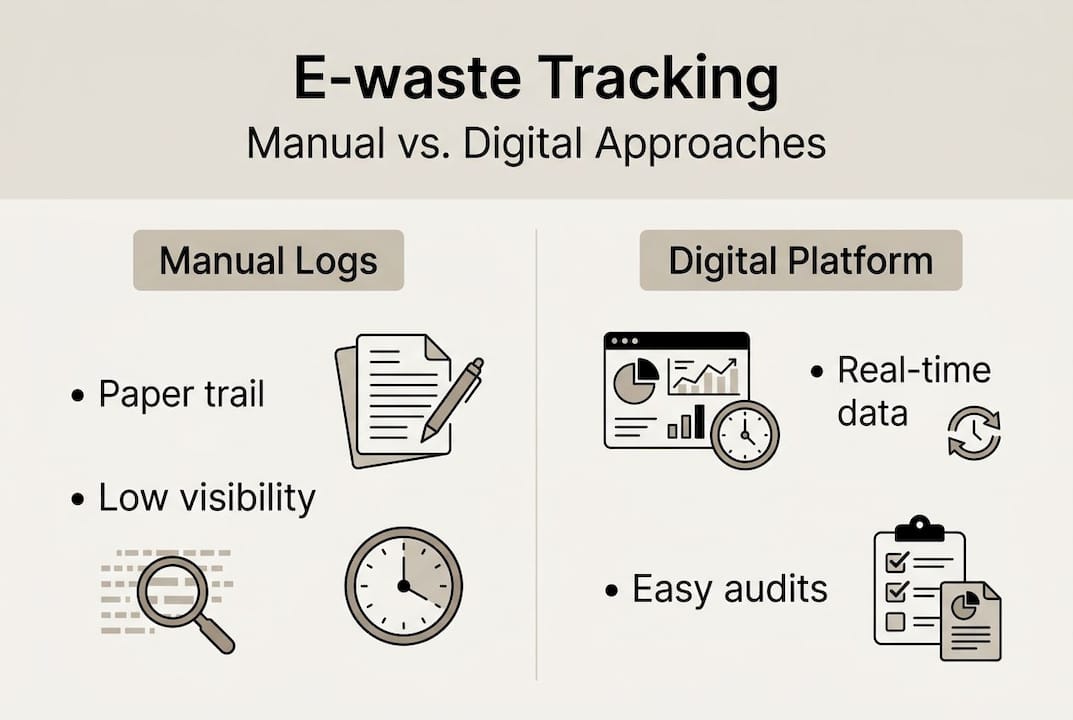
Here’s how manual and digital approaches compare:
| Feature | Manual logs | Digital tracking platform |
|---|---|---|
| Real-time visibility | No | Yes |
| Audit readiness | Low | High |
| Error rate | High | Low |
| Scalability | Poor | Strong |
| Certificate storage | Paper-based | Cloud-based, searchable |
Pro Tip: Before you prepare devices securely for handoff, photograph the device label and serial number and attach them to the digital record. This takes thirty seconds and eliminates disputes about what was actually transferred.
For organizations managing eco-friendly asset recovery, digital platforms also support value recovery reporting, showing leadership exactly how much was recovered, recycled, or responsibly disposed of during each cycle.
How e-waste tracking ensures security and compliance
Data destruction is where tracking pays its biggest dividend. Without documentation, you can’t prove that a hard drive containing patient records, financial data, or employee information was wiped or destroyed. That gap is precisely what regulators look for during HIPAA, GDPR, and CCPA audits.

Here’s how specific security risks map to tracking-based solutions:
| Security risk | Tracking solution |
|---|---|
| Data leak from unwiped drives | Verified destruction certificate tied to asset ID |
| Chain-of-custody gap | Timestamped transfer logs at every handoff |
| Unauthorized vendor resale | Vendor qualification requirements and audit rights |
| Missing devices | Real-time inventory reconciliation |
| Regulatory audit failure | Centralized, exportable compliance records |
Improper disposal increases the risk of data breaches that can expose your organization to significant legal and financial consequences. The media sanitization guidelines published by NIST (National Institute of Standards and Technology) outline the specific methods, overwriting, degaussing, and physical destruction, that count as verified sanitization under federal standards.
End-to-end traceability means you can produce a verified record for any device, at any point, without reconstruction or estimation.
Pro Tip: Always require a certificate of destruction from your vendor. This document, tied to a specific device serial number, is your legal proof that data was destroyed according to recognized standards. It’s the single most important piece of documentation in a compliance audit related to secure data destruction.
For organizations managing sensitive categories of equipment, secure recycling practices that incorporate both physical and data security controls provide a defensible compliance posture that satisfies auditors across multiple regulatory frameworks simultaneously.
Implementing e-waste tracking: Steps and best practices
Putting a tracking program in place doesn’t require a massive infrastructure project. Most organizations can establish a workable system in four to six weeks by following a structured sequence.
- Conduct a full asset inventory. List every device in active use and identify retirement candidates. Include serial numbers, asset tags, and assigned users.
- Define a decommissioning workflow. Specify who initiates the process, which forms are required, and how devices are physically staged for transfer.
- Select certified vendors. Evaluate partners based on certifications such as R2 or e-Stewards, audit rights, and reporting capabilities.
- Implement a digital tracking platform. Even a well-configured spreadsheet system beats paper logs, but purpose-built software provides real-time visibility and automated reporting.
- Train staff and establish accountability. Every team member who handles retired devices should know the protocol. Standardized procedures ensure compliance and reduce environmental impact across the organization.
- Archive and review records. Keep disposal records for a minimum of three years, or longer if required by your industry’s data retention rules.
Common pitfalls to avoid:
- Letting IT teams dispose of devices informally without triggering the tracking workflow
- Accepting vendor certificates of recycling without verifying destruction of data-bearing components
- Failing to update the tracking system after device transfers to remote or branch locations
- Using a single catch-all record for bulk disposal rather than item-level documentation
Pro Tip: Schedule a quarterly review of your tracking logs and cross-reference them against your proper e-waste recycling vendor invoices. Discrepancies often surface missing devices or undocumented transfers before they become compliance problems.
The Global E-waste Monitor data shows that global e-waste generation continues to climb each year, which means the regulatory pressure on organizations to document their disposal practices will only increase. Getting your tracking program right now positions your organization ahead of tightening requirements rather than scrambling to catch up.
For computer recycling best practices, item-level documentation applies to every component, not just the chassis. Drives, memory modules, and expansion cards all carry data risk and need their own disposition records.
A smarter approach: What most organizations miss about e-waste tracking
Here’s the uncomfortable truth: most e-waste tracking programs are designed to satisfy auditors, not to reduce actual risk. Organizations treat tracking as a checkbox exercise, collecting certificates and filing them in a folder that nobody opens until a regulator asks. That’s a minimum-viable compliance posture, not a risk management strategy.
The organizations that get the most value from tracking use it as operational intelligence. When you know the average lifespan of each device category, which vendors generate the most discrepancies, and how much value is recovered versus destroyed, you can make IT procurement and refresh cycle decisions with real data behind them.
Tracking also connects directly to sustainability reporting. Frameworks like GRI (Global Reporting Initiative) and ESG disclosures increasingly require verified environmental metrics. Disposal records with verified recycling outcomes are exactly the kind of evidence those reports need. Organizations relying on eco-friendly recovery perspective not only meet current reporting standards but build a foundation for future requirements that are almost certainly becoming stricter.
The shift from reactive to proactive e-waste management is where the real competitive and compliance advantage lives. Tracking isn’t overhead. It’s a strategic asset.
Partnering for secure and compliant e-waste solutions
Managing e-waste tracking in-house is achievable, but partnering with specialists eliminates the gaps that create the most risk. Certified e-waste logistics experts bring the systems, certifications, and audit-ready documentation that compliance officers need without requiring your team to become e-waste specialists overnight.

UsedCartridge.com provides tailored solutions that address both regulatory compliance and sustainability goals, from secure data destruction with certified documentation to full asset recovery programs. Whether you need a single pickup or an enterprise-wide disposition program, you can request an IT asset recovery quote to get started. For organizations ready to establish proper electronics recycling workflows backed by verifiable chain-of-custody records, the next step is straightforward: connect with a certified partner and put the right infrastructure in place.
Frequently asked questions
What does e-waste tracking involve for organizations?
E-waste tracking means documenting each device’s journey from decommission through secure, certified disposal, meeting legal and environmental requirements. Tracking requires proof of proper handling at every stage to satisfy regulatory and audit demands.
How does e-waste tracking reduce security risks?
By ensuring chain-of-custody and data destruction are verified at every step, e-waste tracking prevents information leaks and audit failures. Chain-of-custody prevents data breaches by closing the gap between device decommissioning and confirmed destruction.
Are there specific laws requiring e-waste tracking?
Yes, many states and countries mandate e-waste tracking for compliance with environmental and data protection laws such as R2, e-Stewards, GDPR, and NIST standards. Tracking aligns with multiple regulatory frameworks simultaneously, reducing the burden of managing separate compliance programs.
What are best practices for starting an e-waste tracking program?
Start with a complete asset inventory, set clear vendor criteria, and use digital tracking platforms for documentation and audits. Best practices include inventory and defined disposal processes that create defensible records from day one.