
Global e-waste exceeded 62 million tons in 2024, yet less than 40% of it was responsibly collected or processed. For most businesses, “eco-friendly equipment disposal” sounds like dropping old laptops in a recycling bin and calling it a day. That assumption is costly, sometimes legally catastrophic, and increasingly hard to defend to regulators, auditors, and customers. True eco-friendly disposal is a structured process that weaves together data security, regulatory compliance, certified recycling, and trackable environmental outcomes. This guide cuts through the confusion and gives you a clear, actionable path forward.
Table of Contents
- What does eco-friendly equipment disposal really mean?
- Why secure, compliant disposal matters for your business
- Key steps in an eco-friendly equipment disposal process
- Choosing the right partners: Certifications, recovery rates, and risks
- How to measure eco-friendly outcomes: ESG and reporting best practices
- Our take: What most organizations miss about eco-friendly disposal
- Partnering for secure, eco-friendly IT disposal
- Frequently asked questions
Key Takeaways
| Point | Details |
|---|---|
| Certified process required | Using certified ITAD and recycling partners is key for compliant, eco-friendly equipment disposal. |
| Track data destruction | Secure and auditable data destruction should come before recycling any device. |
| ESG reporting value | Integrating disposal metrics into ESG reports can boost ROI and reputation. |
| Avoid informal channels | Unregulated recycling risks compliance, data security, and environmental harm. |
| Continuous improvement | Document and refine disposal practices to keep up with regulation and maximize sustainability impact. |
What does eco-friendly equipment disposal really mean?
With a growing volume of electronic waste globally, understanding what eco-friendly disposal truly entails is crucial for any organization managing outdated IT assets.
Eco-friendly equipment disposal is not simply dropping old hardware into a collection bin. It is the secure, responsible, and compliant management of obsolete electronics across their entire end-of-life journey. That journey covers data sanitization, physical disassembly, material recovery, and verified environmental accountability. For business and IT leaders, this definition carries legal weight, not just ethical weight.
The electronic waste overview is broader than most realize. It includes computers, servers, networking gear, mobile devices, printers, solar panels, and even industrial control systems. Each category carries specific handling requirements. Some contain hazardous materials like lead, mercury, and cadmium that require specialized processing to prevent soil and water contamination. Others store sensitive data on internal memory chips that survive physical damage and can be retrieved by bad actors if not properly destroyed.
What true eco-friendly disposal includes:
- Secure data destruction verified by certification before any device leaves your facility
- Material recovery through certified dismantling to reclaim metals, plastics, and components
- Regulatory compliance with GDPR, HIPAA, FACTA, and state-level e-waste laws
- Avoidance of informal channels that export waste to unregulated overseas markets
- Documentation and audit trails to prove compliant handling at every stage
“Just 37.5% of electronic waste was collected in the EU as of 2023, far short of the 65% target set by regulators. Businesses operating in any market need to understand that the gap between policy and practice creates real legal and reputational exposure.”
Understanding the types of e-waste your organization generates is the essential first step before selecting any disposal approach. A server rack has different compliance requirements than a fleet of employee laptops, and treating them identically is a common mistake that creates downstream problems.
Why secure, compliant disposal matters for your business
After clarifying the definition, it is essential to understand why secure, compliant approaches matter to business outcomes, not just environmental ones.
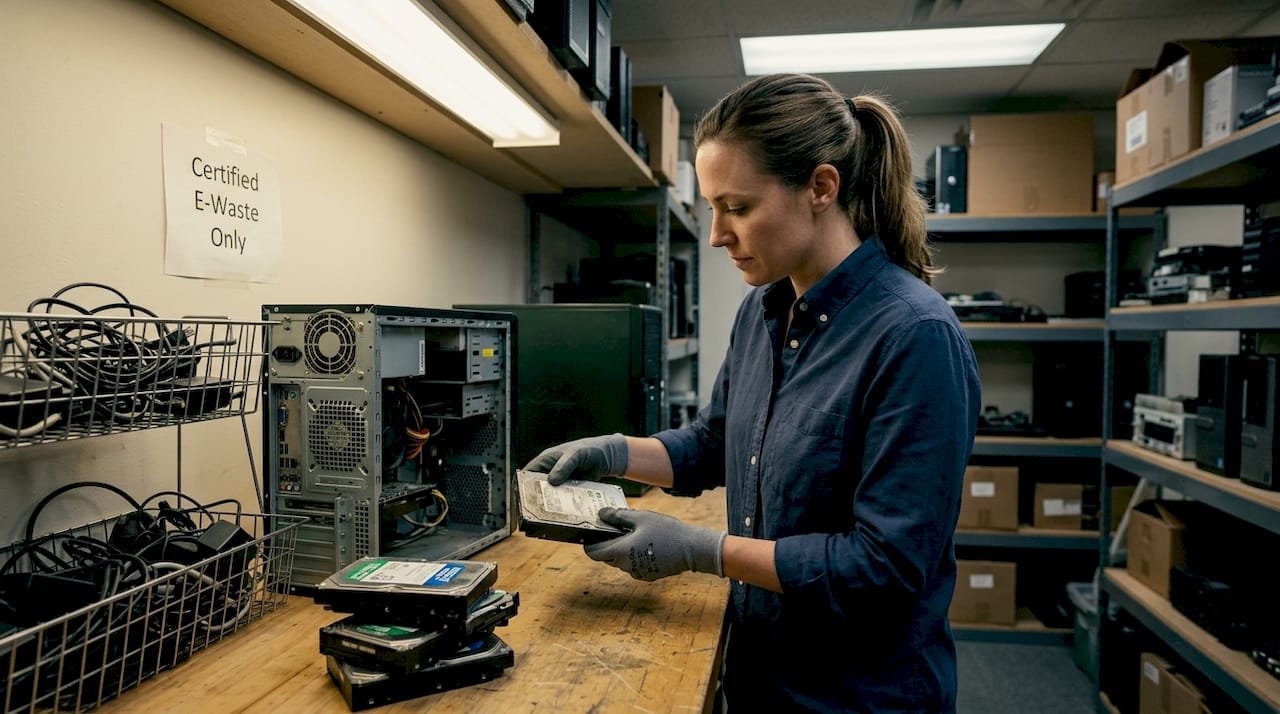
Regulatory frameworks are tightening fast. GDPR in Europe, HIPAA in healthcare, FACTA for financial records, and a growing list of U.S. state privacy laws all impose specific requirements on how businesses handle data before disposing of the hardware that stores it. A single improperly discarded hard drive can trigger a reportable data breach. Fines can reach millions of dollars, and the reputational damage often outlasts the legal penalty.
Here is a numbered walkthrough of the compliance and business case for certified disposal:
- Data breach prevention. Hard drives, SSDs, and even USB ports retain recoverable data long after standard deletion. Only certified wiping or physical destruction closes this gap.
- Regulatory compliance. GDPR Article 17, HIPAA Security Rule, and FACTA each require demonstrable proof of proper data destruction. A certificate of destruction from a certified provider satisfies audit requirements.
- ESG reporting. Environmental, Social, and Governance reporting now influences investor decisions, procurement awards, and insurance premiums. Documented responsible disposal feeds directly into these reports.
- Brand protection. A single news story about improperly discarded medical records or customer data can erase years of brand equity. The cost of compliance is almost always lower than the cost of a public incident.
- Certification as proof. R2v3 (Responsible Recycling version 3) and e-Stewards are the two leading certifications for IT asset disposition (ITAD) providers. These certifications require third-party audits, chain-of-custody documentation, and strict downstream vendor controls.
Certified recyclers can recover between 85% and 97% of materials from electronic devices, safeguarding both data and the environment simultaneously. That recovery rate is dramatically better than informal channels and translates directly into reduced environmental liability for your organization.
Before any hardware moves, your hard drive destruction steps should be documented and repeatable. Ad-hoc approaches break down under audit scrutiny.
Pro Tip: Build a disposal tracking spreadsheet that logs every device by serial number, destruction method, date, and certifying vendor. This takes minutes per device and can save you days during a compliance audit.
Key steps in an eco-friendly equipment disposal process
Now that we have established the importance, let us walk through what the actual eco-friendly disposal process looks like in practice.
Start with inventory and policy before you ever schedule a pickup. Organizations that skip this step routinely discover devices they forgot existed, which creates gaps in data destruction records and compliance documentation. A complete asset inventory tells you exactly what you have, where it is, what data it holds, and who is responsible for clearing it.
The five-step eco-friendly disposal process:
- Inventory and policy setup. Catalog all equipment by type, location, data classification, and assigned user. Establish a written disposal policy that specifies approved methods and authorized vendors.
- Data wiping or physical destruction. For devices that will be refurbished or resold, certified data wiping to NIST 800-88 standards is appropriate. For devices at end of physical life, shredding or degaussing is required. Never skip this step.
- Reuse and refurbishment. Enterprise IT asset refurbishment rates range from 30% to 75% depending on equipment age and condition. Refurbished devices can be donated, resold, or redeployed, which generates recoverable value and reduces raw material demand.
- Certified recycling. Devices that cannot be refurbished go to certified recyclers who dismantle them properly, recover materials, and handle hazardous components according to environmental regulations.
- ESG and compliance tracking. Document recovery rates, destruction certificates, and vendor certifications. Feed this data into your sustainability and ESG reporting cycles.
Explore asset recovery tips to understand how structured programs routinely recover value that offsets disposal costs. And if you are managing a large fleet refresh, IT hardware recycling programs offer scalable solutions with full chain-of-custody documentation.
| Disposal stage | Compliance checkpoint | Sustainability outcome |
|---|---|---|
| Inventory and policy | Asset register verified | Prevents orphaned devices |
| Data destruction | Certificate of destruction issued | Zero data breach risk |
| Refurbishment | Device condition graded | Extends product life cycle |
| Certified recycling | R2v3 or e-Stewards vendor confirmed | 85-97% material recovery |
| ESG reporting | Recovery rate documented | Feeds sustainability metrics |
Pro Tip: Ask every ITAD vendor for their downstream vendor list before signing a contract. Certified providers will share this without hesitation. If a vendor is reluctant, that is a red flag worth acting on.
Choosing the right partners: Certifications, recovery rates, and risks
Every process is only as strong as its weakest link, so selecting trustworthy partners is essential to true eco-friendly disposal.
The certification landscape for ITAD providers breaks down into two main standards. R2v3 is widely adopted globally and covers data destruction, environmental responsibility, and worker health and safety. e-Stewards carries stricter requirements around ethical export practices and prohibits sending e-waste to developing countries that lack the infrastructure to process it safely. Both certifications require annual third-party audits, which gives you a meaningful baseline of trust.
Informal recycling achieves only 15% to 50% recovery rates, compared to up to 97% for certified providers. That gap is not just an environmental statistic. It represents materials that end up in landfills, data that may be exposed, and legal liability that lands on your organization, not the recycler.
Comparison: Certified vs. informal disposal
| Factor | Certified ITAD | Informal recycler |
|---|---|---|
| Material recovery rate | 85-97% | 15-50% |
| Data destruction proof | Certificate issued | Rarely provided |
| Regulatory compliance | Fully documented | Not guaranteed |
| Environmental risk | Minimized | Significant |
| Cost | Transparent, often offset by recovery | Low upfront, high hidden risk |
| Audit readiness | Complete chain of custody | No documentation trail |
“The price difference between certified and informal recycling looks attractive in the short term. The difference in liability exposure makes certified disposal the clear financial choice once you factor in regulatory risk.”
Quick checklist for vetting ITAD service partners:
- Confirm active R2v3 or e-Stewards certification with the certifying body directly
- Request sample certificates of destruction and data wiping reports
- Ask for downstream vendor transparency and review it
- Verify liability insurance coverage that protects your organization
- Confirm pickup, on-site destruction, and chain-of-custody options
For IT asset recovery guidance tailored to your organization’s size and equipment type, getting a quote from a certified provider is the fastest way to understand your options. And if computer recycling services are part of your scope, ensure the provider covers the full workflow from collection through material recovery certification.
How to measure eco-friendly outcomes: ESG and reporting best practices
Effective partners will ask you for metrics. Here is how you can use these numbers to drive real business value.
The ITAD market is forecasted to reach $40 billion by 2035, driven by growing enterprise demand for compliance and ESG transparency. That growth signals something important: disposal is becoming a strategic function, not a line-item expense. Organizations that treat it that way gain measurable advantages in investor relations, procurement eligibility, and regulatory standing.
Key performance indicators (KPIs) to track for disposal and ESG reporting:
- Material recovery rate: The percentage of device weight reclaimed as usable materials, ideally 85% or higher with a certified partner
- Data destruction compliance rate: 100% of retired devices must have documented destruction before leaving your control
- Certificate coverage: Every device should have an associated certificate of destruction or data wipe report linked to its asset record
- Carbon footprint offset: Certified recycling reduces the energy and carbon cost of raw material extraction, which can be quantified for sustainability reports
- Asset recovery value: Revenue or cost savings generated from refurbished or resold equipment, which often offsets vendor fees
How to integrate disposal data into ESG reporting: Start by tagging disposal events in your IT asset management (ITAM) system with the outcome type, vendor name, and certification status. Export this data quarterly and map it to your ESG framework categories, whether that is GRI, SASB, or an internal sustainability scorecard. Investors and procurement teams increasingly expect this level of specificity.
The reputational benefit is equally real. Companies that publish documented disposal outcomes demonstrate they take data privacy and environmental responsibility seriously. That signal builds trust with customers, partners, and regulators faster than any marketing campaign can.
Our take: What most organizations miss about eco-friendly disposal
Having mapped the landscape, here is the practical wisdom that helps you avoid the costly mistakes others have made before you.
Most organizations treat equipment disposal as an afterthought. It shows up on the to-do list only when a storage room fills up or an IT refresh forces the issue. By that point, the options narrow, the documentation is incomplete, and the risk exposure is already baked in. We have seen companies spend more recovering from a compliance audit or a data incident than they would have spent on five years of certified disposal services.
The deeper issue is cultural. Disposal is almost never owned by a single function. IT manages the hardware. Legal manages the compliance. Finance manages the vendor relationships. Sustainability manages the ESG reports. When nobody owns the complete picture, gaps form at every handoff. Building a responsible asset management culture means assigning clear ownership, writing a formal disposal policy, and reviewing it at least annually.
Here is the part that surprises most IT leaders: disposal is a strategic initiative. Structured programs consistently deliver measurable ROI through material recovery, risk reduction, and ESG credibility. The organizations that recognize this shift their disposal programs from cost center to competitive advantage. They negotiate better insurance rates, win procurement bids that require ESG documentation, and avoid the regulatory penalties that quietly erode margins elsewhere.
Our recommendation is simple. Start with your eco-friendly asset recovery advice baseline, document your current process end to end, identify where chain of custody breaks down, and then build forward from there. Measure your outcomes every quarter. The data will tell you where to improve, and it will also give you something valuable to report.
Partnering for secure, eco-friendly IT disposal
To truly put eco-friendly equipment disposal into action, you need the right partners backing your program. Educational clarity is the starting point, but operational results come from working with certified providers who can handle your organization’s specific mix of equipment, data sensitivity, and compliance requirements.

At UsedCartridge.com, we provide certified, secure, and environmentally responsible disposal solutions designed for businesses that cannot afford compliance gaps or data exposure. From electronic waste solutions to certified secure equipment destruction, our services cover the full chain of custody with documentation at every step. Whether you are managing a one-time refresh or an ongoing disposal program, explore our business e-waste recycling options and request a free quote to get started.
Frequently asked questions
What equipment can be disposed of eco-friendly?
Most IT equipment, including computers, servers, hard drives, and networking devices, can be eco-friendly disposed of by certified recyclers and ITAD providers. Global e-waste included enterprise IT assets with recovery rates ranging from 30% to 75% depending on equipment type and condition.
How do I ensure data is destroyed before recycling?
Work with certified ITAD partners who use secure data wiping or physical destruction methods for all devices. Partner with certified ITAD providers who issue verifiable certificates of destruction for every device processed.
What certifications should an eco-friendly recycler have?
Look for R2v3 or e-Stewards certifications to ensure both environmental and data protection standards are met. R2v3 and e-Stewards are leading certifications in electronics recycling and require annual third-party audits.
What happens if my business uses informal e-waste recyclers?
Using informal recyclers risks legal issues, data leaks, and low material recovery, all of which can damage your company’s standing with regulators and clients. Informal recycling achieves only 15% to 50% recovery and carries significant compliance risks that transfer directly to your organization.
How can I report on eco-friendly disposal for ESG purposes?
Track recovery rates, data destruction compliance, and audit trails to integrate disposal metrics into ESG reports. Tracking ESG metrics like recovery rate supports enterprise reporting and demonstrates verifiable environmental responsibility to investors and regulators.