
Most people have no idea that 80% of global e-waste ends up improperly discarded, mostly in landfills or informal dump sites, despite carrying toxic materials that contaminate soil, groundwater, and the air we breathe. Understanding why avoid landfill e-waste is not an abstract environmental concern. It is a direct public health issue, a legal liability, and an economic problem that affects communities globally. Whether you manage IT assets for a company or simply have a drawer full of old phones, the decisions you make about disposal have consequences that last for decades.
Table of Contents
- Key takeaways
- Why avoid landfill e-waste: the environmental hazards
- Public health consequences of improper e-waste disposal
- Legal regulations and economic costs
- Practical alternatives to landfill disposal
- My perspective on the e-waste landfill problem
- Responsible e-waste disposal starts here
- FAQ
Key takeaways
| Point | Details |
|---|---|
| Landfills leach toxic chemicals | Lead, mercury, and cadmium from e-waste contaminate groundwater and soil for generations. |
| Public health is directly at risk | E-waste toxins cause cancers, neurological damage, and developmental harm in children. |
| Illegal dumping has real consequences | The Basel Convention and U.S. state laws criminalize improper e-waste disposal. |
| Recycling recovers real economic value | Certified recycling recovers precious metals and reduces carbon emissions significantly. |
| Better options are widely available | Certified recyclers, refurbishers, and IT asset recovery services offer safe, legal alternatives. |
Why avoid landfill e-waste: the environmental hazards
When a laptop or old television ends up in a landfill, it does not just sit there harmlessly. The toxic materials packed into modern electronics begin leaching into the surrounding environment almost immediately. Toxic substances like lead, mercury, cadmium, and brominated flame retardants migrate from e-waste into soil and groundwater, often reaching drinking water supplies and agricultural land within years.
Here is what that actually looks like in practice. A single cathode ray tube monitor contains up to four pounds of lead. A batch of smartphones contains mercury in their LCD backlights. Circuit boards are treated with brominated flame retardants that resist breakdown in the environment and accumulate in plant and animal tissue over time. Once these compounds enter the water table, there is no practical way to fully remove them.
The environmental effects of e-waste extend beyond individual contamination events. Toxic metals bioaccumulate in food chains, meaning fish, livestock, and crops absorb them and pass them on to humans. Soil contamination degrades farmland productivity for decades after the original dumping event. Air pollution compounds the problem when waste is burned, either at informal recycling sites or during landfill fires.
The scale of this problem is genuinely alarming. Global e-waste reached 62 million tonnes in 2022 and is projected to hit 82 million tonnes by 2030. With only a fraction properly recycled, the volume of toxins entering landfills worldwide grows every year.
Pro Tip: Check whether your municipality classifies electronics as hazardous household waste. Many jurisdictions prohibit curbside disposal of electronics entirely, and a quick call to your local waste authority can point you toward a free drop-off program.
Public health consequences of improper e-waste disposal
The risks of landfill e-waste are not limited to ecosystems. They run directly through human bodies, especially in communities located near landfills or informal recycling operations.
Exposure pathways are multiple and difficult to avoid in affected areas:
- Contaminated drinking water from landfill leachate reaching aquifers
- Airborne particulates released during open burning of electronics
- Contaminated food grown in soil with elevated heavy metal concentrations
- Direct skin contact for workers at informal recycling sites who handle raw components without protective equipment
E-waste contaminants are linked to prenatal harm, reproductive damage, reduced IQ, and lasting intergenerational effects. Lead and mercury cross the placental barrier, meaning fetal development is directly compromised when a pregnant woman is exposed to contaminated water or food. The consequences do not end at birth. Children raised in areas with high e-waste exposure consistently show measurable cognitive deficits compared to those in unaffected areas.
“E-waste is as much a public health crisis as an environmental one, with toxicants causing multi-system damage and persistent community exposure.” — Nature Human Behaviour
The impact on vulnerable populations is disproportionate and well documented. Communities near landfills, particularly in lower-income areas, face the worst exposure with the fewest resources to address it. Informal recycling sites cause intense pollution and health risks, particularly in low-income countries where workers strip electronics by hand, burn circuit boards to recover metals, and use acid baths with no protective gear.
The dangers of e-waste are not theoretical. They are being measured in blood lead levels, cancer rates, and infant birth weights in affected communities right now.

Pro Tip: If your organization generates significant IT waste, track the full chain of custody for every device. Knowing exactly where your old equipment ends up is the only way to verify it is not contributing to informal dumping overseas.
Legal regulations and economic costs
Ignorance of e-waste law is not a defense, especially for businesses. Regulatory pressure on landfill disposal of electronics has increased significantly at both the international and domestic level.
At the international level, the Basel Convention classifies e-waste as hazardous waste and criminalizes illegal dumping across borders. This means companies that export old electronics to developing countries without proper documentation and consent are breaking international law, not just bending environmental guidelines.
Within the United States, the legal picture varies by state but trends strongly toward prohibition:
- 25 or more U.S. states have enacted specific e-waste recycling laws that ban landfill disposal of electronics.
- Retailers and manufacturers in many states carry legal obligations to accept returned electronics for proper recycling.
- Penalties for non-compliance range from fines to criminal prosecution, depending on the volume and nature of the illegal disposal.
- Extended Producer Responsibility (EPR) programs are expanding, shifting more legal responsibility onto manufacturers and distributors.
The economic argument for proper recycling is just as compelling as the legal one. A single ton of circuit boards can contain more gold than 17 tons of mined ore. Professional recycling can reduce carbon emissions by up to 80% per unit of gold recovered compared to mining virgin ore. Valuable materials recovered from e-waste include gold, silver, palladium, copper, and rare earth elements that would otherwise require destructive and expensive extraction from natural deposits.
| Disposal method | Economic outcome | Environmental outcome |
|---|---|---|
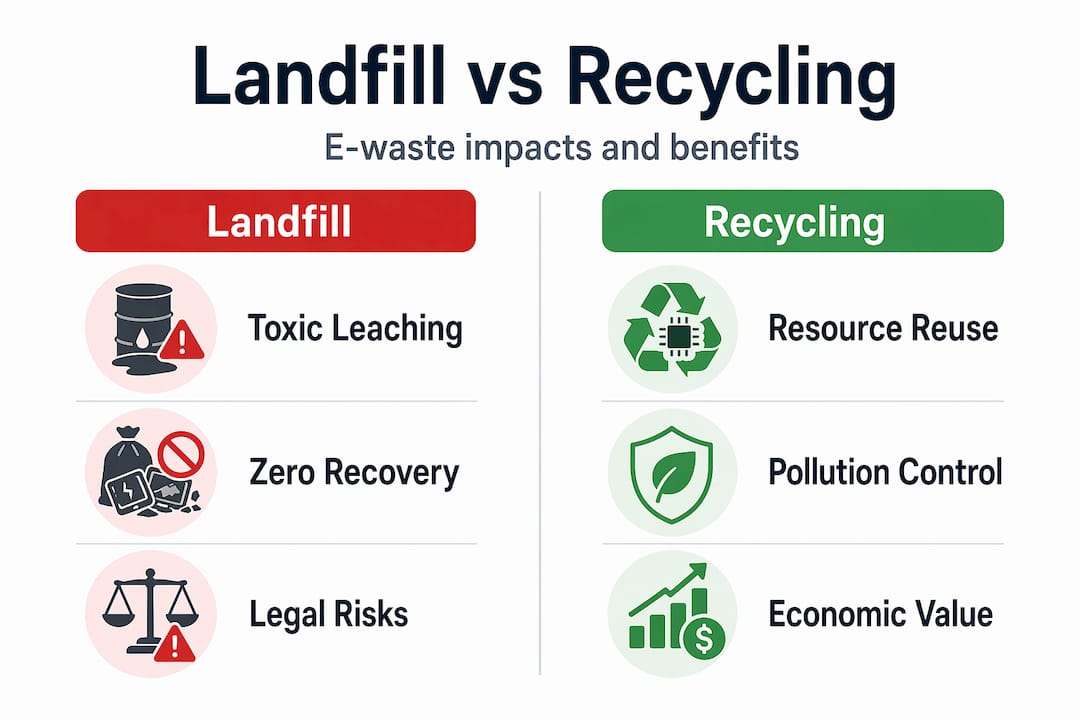
| Landfill disposal | Zero material recovery, potential fines | Long-term contamination, toxic leachate |
| Certified recycling | Precious metal recovery, compliance | Reduced emissions, no soil/water damage |
| IT asset recovery | Equipment resale value, data security | Extended device lifespan, fewer new units needed |
Pro Tip: Request a material recovery report from your certified recycler. Most reputable programs can quantify the exact weight of metals recovered and the carbon savings generated. That data is useful for sustainability reporting and compliance documentation.
Practical alternatives to landfill disposal
Knowing why this matters only takes you halfway. The more useful question is: how do you dispose e-waste properly, and what options actually work for individuals and organizations of different sizes?
The good news is that the alternatives to landfills are more accessible than most people realize.
- Certified e-waste recyclers process electronics safely, recovering materials without releasing toxins. Look for certifications like R2 (Responsible Recycling) or e-Stewards, which verify that recyclers meet environmental and worker safety standards.
- Manufacturer take-back programs exist at Apple, Dell, HP, and many other major brands. Most will accept old devices by mail or at retail locations, often at no cost.
- Donation and refurbishment extends device life and keeps electronics out of the waste stream entirely. Organizations like nonprofits, schools, and community centers often accept functional older equipment.
- IT asset recovery services are particularly relevant for businesses. These services assess residual value in old equipment, wipe data securely, and either resell or recycle devices based on condition.
- Municipal collection events operate in most major U.S. cities and offer free drop-off points for individuals who only have occasional devices to dispose of.
Despite all these options, 22% of U.S. adults still dispose of old electronics in the trash, and 29% simply store devices at home indefinitely, creating a stockpile that is statistically likely to end up in a landfill eventually. The barrier is rarely cost or access. It is usually awareness and friction.
For organizations, the path to responsible IT disposal involves more than just dropping boxes at a collection site. Data destruction must be certified, chain of custody must be documented, and materials must go to recyclers whose downstream processes are verified. Usedcartridge provides all of these services under one program, including on-site destruction and official certification.
The transition from a linear “buy, use, discard” model to a circular one starts with a single decision: treating old electronics as a resource rather than trash. Usedcartridge’s approach to recycling electronic waste properly reflects exactly that mindset, recovering value while keeping toxins out of the ground.
My perspective on the e-waste landfill problem
Working in this space, I’ve seen the same pattern repeat itself: organizations and individuals know, at some level, that throwing electronics in the trash is wrong. But the gap between knowing and acting is wider than it should be.
What I’ve found is that most people significantly underestimate how long the consequences last. Cadmium deposited in soil today will still be measurable in that soil fifty years from now. That is not a metaphor for environmental damage. It is a documented chemical reality. When I talk to facilities managers about their IT disposal habits, the most common response I get is “we’ve always done it this way.” That logic does not hold up when “the way it’s always been done” means paying a hauler to take old servers to a municipal dump.
I’ve also noticed that the economic case for recycling is the argument that actually moves organizations. Environmental impact matters to people, but it often feels abstract. Telling a CFO that their old server racks contain recoverable copper, gold, and silver, and that a certified recycler can document the value recovered, changes the conversation immediately.
The deeper challenge I see is the informal recycling sector. Integrating informal recyclers into regulated, safe systems is genuinely difficult, but it is the only approach that addresses both the health risks and the livelihoods that depend on e-waste processing. Ignoring informal markets while promoting formal ones does not solve the problem. It just moves it.
My honest view: the regulatory framework is mostly in the right place. What’s missing is consistent enforcement and better consumer education at the point of purchase. The moment someone buys a phone, they should already know what to do with it at end of life.
— Keith
Responsible e-waste disposal starts here
Understanding the e-waste problem is one thing. Having a professional partner to handle it correctly is another.

Usedcartridge offers certified e-waste recycling solutions for both individuals and organizations, covering everything from single device drop-offs to enterprise-scale IT asset recovery. Every service includes secure data destruction, documented chain of custody, and official recycling certification so you can demonstrate environmental compliance without guesswork. For businesses navigating state e-waste regulations or sustainability reporting requirements, Usedcartridge’s business sustainability recycling program provides the documentation and processes your compliance team needs. Free pickup options and quotes are available for qualifying volumes. Stop letting old equipment sit in a storage room or end up in a landfill. Get a free quote and start disposing of your e-waste the right way.
FAQ
What makes e-waste dangerous in landfills?
E-waste contains lead, mercury, cadmium, and brominated flame retardants that leach into soil and groundwater when buried. These toxins cause cancers, neurological damage, and contaminate drinking water sources for decades.
Is it illegal to throw electronics in the trash?
In more than 25 U.S. states, disposing of electronics in regular trash or landfills is prohibited by law. Violations can result in fines or criminal penalties, particularly for businesses generating significant volumes of e-waste.
How can individuals dispose of e-waste properly?
Individuals can use certified e-waste recyclers, manufacturer take-back programs, municipal collection events, or donate functional devices to schools and nonprofits. Usedcartridge also offers drop-off and pickup options for convenient, certified disposal.
What percentage of e-waste is actually recycled?
Only about 20% of global e-waste is properly collected and recycled. The remaining 80% is improperly discarded in landfills or informal dump sites, releasing toxic materials into the environment.
Why is e-waste a public health issue?
E-waste pollution consequences extend directly into human health through contaminated water, food, and air. Exposure is linked to cancers, reproductive harm, reduced IQ in children, and prenatal damage, with communities near landfills facing the greatest risk.