
Recycling is defined as a core operational mechanism within ESG frameworks, directly advancing environmental performance, social accountability, and governance transparency for organizations. The role of recycling in ESG extends well beyond waste diversion. It generates quantifiable climate metrics, satisfies emerging disclosure requirements under standards like ESRS E5, and reduces regulatory exposure under laws such as California’s SB 343. Companies like Winning Group have demonstrated that a structured take-back and recycling program can quantify 8.2 kilotons of CO2e avoided, turning circular economy principles into audit-ready ESG evidence. For business leaders and sustainability professionals, recycling is not a peripheral initiative. It is a measurable pillar of credible corporate sustainability.
How does recycling align with environmental goals in ESG?
Recycling advances the environmental dimension of ESG by reducing waste sent to landfill, conserving virgin natural resources, and lowering greenhouse gas emissions across Scope 1, 2, and 3 boundaries. These outcomes map directly onto the material topics that ESG frameworks prioritize, making recycling one of the most tractable levers available to sustainability teams.
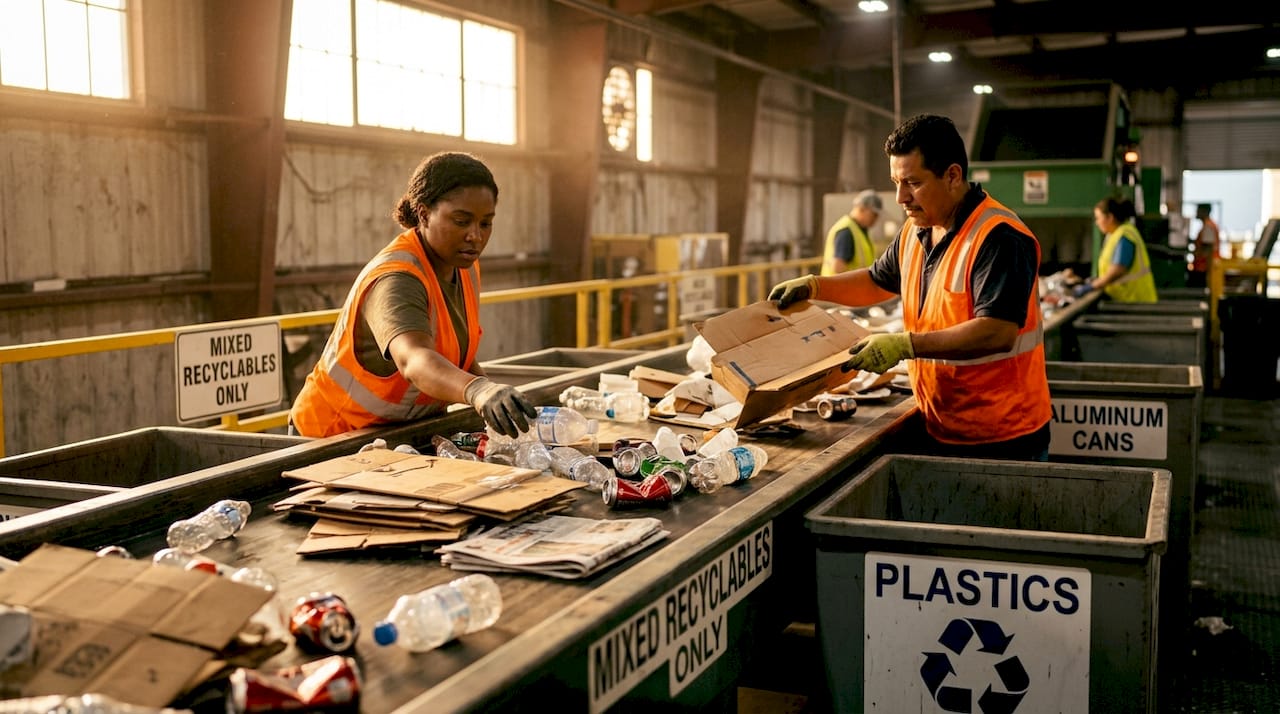
The climate impact is concrete and measurable. Winning Group’s circular take-back program tracked Scope 1 to 3 emissions over FY21 to FY25, including avoided emissions from refrigerant recovery and material reuse. That 8.2 kilotons figure is not a projection. It is a verified outcome from a structured recycling initiative, which is exactly the kind of evidence ESG auditors and investors now expect.
Resource conservation is the second major environmental benefit. When recycled materials replace virgin inputs in manufacturing, companies reduce extraction pressure on finite resources, cut energy consumption in production, and lower pollution from primary processing. This aligns directly with circular economy objectives embedded in ESG reporting.
“Recycling within ESG is more than an environmental action; it operationalizes measurable ESG reporting indicators, driving accountability and transparency across circular business models.” — ESG and Circular Business Models Framework
Key environmental ESG outcomes that recycling supports include:
- Diversion of waste from landfill and incineration, reducing methane and particulate emissions
- Substitution of secondary materials for virgin inputs, lowering upstream extraction impacts
- Avoided emissions from material reuse, quantifiable under Scope 3 accounting
- Reduced water and energy consumption in production through recycled feedstock use
- Contribution to circular economy targets required in sustainability disclosures
The UK’s Simpler Recycling scheme illustrates what policy-driven recycling systems can achieve at scale. The program documents environmental savings valued at £11.8 billion, providing a benchmark for what organized recycling infrastructure delivers in greenhouse gas savings and circular economy performance.
What governance and compliance considerations shape recycling in ESG?
Governance is where recycling claims either hold up under scrutiny or collapse. The credibility of any ESG recycling narrative depends on traceability, third-party verification, and regulatory compliance. Without these, recycling claims become a liability rather than an asset.
ISO 59014 sets the current global standard for traceability and responsible recovery of secondary materials. Eastman’s Kingsport methanolysis facility achieved ISO 59014 certification, demonstrating that independent audits, supply chain traceability, and safe working conditions are all verifiable under this framework. That certification signals to investors and regulators that recycled-content claims are not self-reported assertions. They are externally validated facts.
California’s SB 343 raises the compliance stakes significantly. Effective October 4, 2026, the law restricts recyclability claims unless organizations can substantiate collection coverage, sorting infrastructure, reclaimer capacity, and product design compliance. Companies that use recycling symbols or language in consumer communications without meeting these criteria face deceptive marketing exposure. That risk flows directly into ESG governance scores.
Governance teams must prepare substantiation files before any recyclability claim appears in public communications. These files should document:
- Collection coverage data for the relevant geography
- Sorting and reclaimer infrastructure confirmation
- Product or packaging design compliance with SB 343 criteria
- Third-party audit reports or ISO 59014 certification records
- Internal review sign-off linking claims to verified data
Pro Tip: Build your substantiation file before drafting ESG disclosures, not after. Retroactive documentation is harder to defend under regulatory scrutiny and creates audit gaps that undermine governance scores.
Third-party verification is not optional for organizations seeking credibility. Independent audits reinforce traceability and reduce greenwashing risk under ESG governance expectations. Investors and regulators increasingly treat unverified recycling claims the same way they treat unverified financial disclosures: as a red flag.
How do ESG reporting frameworks incorporate recycling metrics?
ESRS E5 is the most demanding recycling-related disclosure standard currently in force for organizations subject to the Corporate Sustainability Reporting Directive. It requires quantitative reporting across the full material cycle, not just waste collected at the point of disposal.
Specifically, ESRS E5 requires disclosure of waste generation volumes, diversion rates, treatment methods, and recycled content shares, all with verified data that meets audit-readiness standards. The critical distinction is between waste collected and waste actually recycled. Many organizations report collection figures and assume they represent recycling rates. ESRS E5 closes that gap by requiring linkage between input data, treatment confirmation, and output verification.
| Reporting Element | What ESRS E5 Requires |
|---|---|
| Waste generation | Total volumes by waste type and hazard classification |
| Diversion and treatment | Split by disposal method: recycling, recovery, landfill, incineration |
| Recycled content | Share of secondary materials in production inputs, with verified sourcing |
| Material cycle tracing | Linkage of procurement data to waste outflows for full cycle accounting |
| Circularity targets | Time-bound goals with baseline metrics and progress tracking |
The materials accounting challenge is where most organizations struggle. Connecting verified data across procurement, production, and waste streams is required for effective ESG reporting of recycling and circular economy efforts. A company that buys recycled aluminum but cannot trace that input through its production system to a verified waste output cannot satisfy ESRS E5 requirements, regardless of how much recycled material it actually uses.
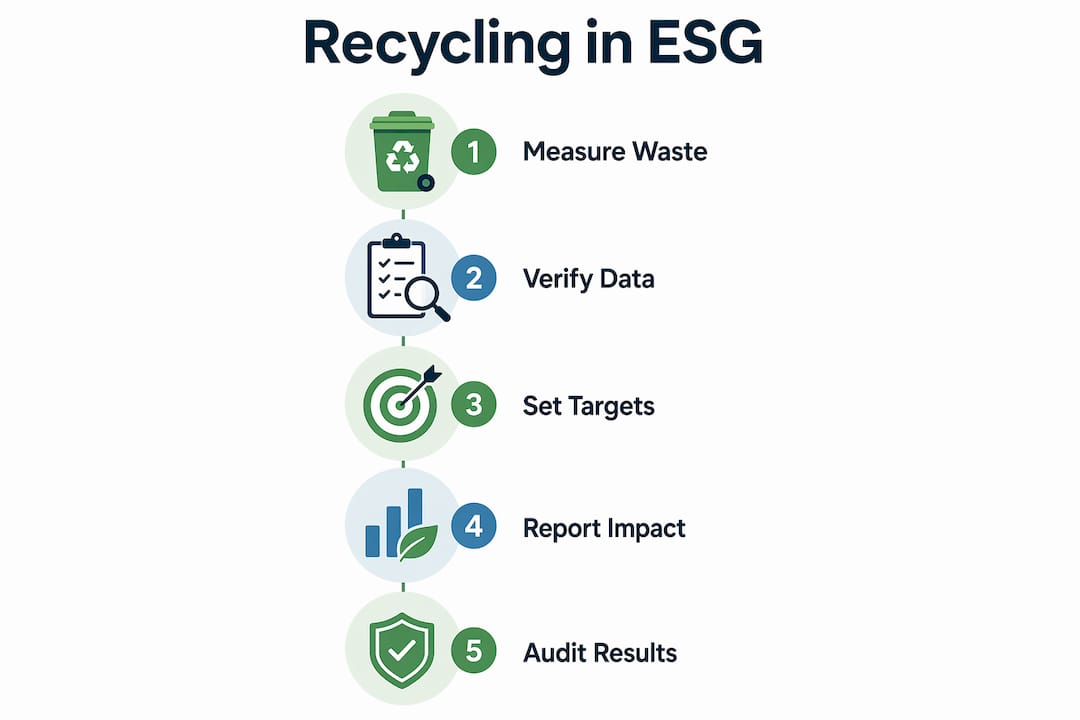
Setting measurable, time-bound circularity goals is the second major reporting requirement. Vague commitments to “increase recycling” do not satisfy disclosure standards. Organizations need baseline metrics, annual progress data, and a documented methodology for calculating recycling rates that auditors can independently verify. The e-waste recycling and ESG compliance connection is particularly relevant here, as electronic waste carries both environmental and data governance dimensions that compound reporting complexity.
What practical strategies maximize the ESG benefits of recycling?
Embedding recycling into an ESG program requires more than contracting a waste hauler. The organizations that generate the strongest ESG outcomes from recycling treat it as a data-driven business process with defined inputs, outputs, and accountability structures.
Here is a practical framework for business leaders:
- Conduct a baseline waste audit. Map all waste streams by type, volume, and current treatment method. Identify the gap between what is collected for recycling and what is actually recycled, since ESRS E5 requires you to report both.
- Implement take-back and recycling programs aligned to your sector. Recycling initiatives in consumer cyclical and technology sectors are the most common ESG responses to e-waste and reputational risk. Winning Group’s take-back model is a replicable template for product-based businesses.
- Establish traceability documentation from day one. Use certified recycling vendors who provide chain-of-custody documentation. The role of documentation in e-waste management is foundational to any audit-ready ESG claim.
- Pursue ISO 59014 certification or require it from suppliers. This standard is becoming the baseline expectation for recycled-content claims in investor-grade ESG disclosures.
- Coordinate with supply chain partners on recycled input sourcing. Recycling performance is not just about what leaves your facility. It includes what enters it. Procurement teams need to track secondary material shares with the same rigor applied to waste outputs.
- Set circular business model targets that match your industry archetype. A manufacturer has different circularity levers than a technology services firm. Targets should reflect the specific material flows relevant to your operations.
- Monitor regulatory changes continuously. California’s SB 343 is effective in late 2026, and similar regulations are advancing in the EU. The role of recycling vendors in e-waste compliance includes staying current on these changes so your ESG claims remain defensible.
Pro Tip: Treat avoided emissions as a separate line item in your ESG reporting. Emissions from recycling operations and avoided emissions from material reuse require distinct scope boundaries. Conflating them is a common audit finding that damages credibility.
The organizations that communicate recycling impact most credibly are those that report avoided emissions alongside direct emissions, use third-party verified data, and connect recycling performance to specific ESG targets rather than general sustainability commitments.
Key takeaways
Recycling supports ESG goals most effectively when it is treated as a materials accounting discipline with verified data, certified vendors, and time-bound targets rather than a compliance checkbox.
| Point | Details |
|---|---|
| Environmental impact is quantifiable | Programs like Winning Group’s documented 8.2 kilotons of CO2e avoided, setting the standard for credible climate metrics. |
| Governance requires verification | ISO 59014 certification and SB 343 compliance are now baseline expectations for defensible recycling claims. |
| ESRS E5 demands full cycle data | Reporting must link procurement inputs to waste outputs, not just collection volumes, to satisfy audit requirements. |
| Avoided emissions need separate accounting | Direct recycling emissions and avoided emissions from material reuse require distinct scope boundaries in ESG disclosures. |
| Documentation is the foundation | Chain-of-custody records and substantiation files are required before any recyclability claim enters public communications. |
Why recycling’s role in ESG is more demanding than most leaders expect
Most sustainability teams I work with underestimate how much governance infrastructure recycling actually requires. The environmental case is intuitive. The reporting and compliance case is where organizations consistently fall short.
The shift from “we recycle” to “we can prove we recycle at this rate, with these verified outcomes, under these certified conditions” is not incremental. It requires connecting procurement data, production records, waste treatment confirmations, and third-party audits into a single coherent disclosure. Very few organizations have that infrastructure in place when they first commit to ESG recycling targets.
What I find most revealing is how ISO 59014 is reshaping expectations. Eastman’s certification of its Kingsport facility is not just a PR milestone. It signals that institutional investors and regulators are moving toward requiring this level of verification as standard practice. Organizations that wait for the mandate will spend the next two years in reactive compliance mode rather than building genuine circular economy value.
The SB 343 situation in California is the clearest warning signal. Governance teams that have been using recycling symbols on packaging without substantiation files are now facing material legal exposure. That is a governance failure, not an environmental one. It illustrates exactly why recycling cannot be managed by the sustainability team alone. Legal, procurement, and communications all need to be part of the process.
My honest recommendation: treat your first ESRS E5 recycling disclosure as a diagnostic. The gaps it reveals will tell you more about your actual ESG maturity than any materiality assessment.
— Keith
How Usedcartridge supports your ESG recycling goals
For organizations managing electronic equipment, recycling is both an environmental obligation and a governance requirement. Usedcartridge provides certified electronic waste recycling services designed specifically for businesses that need audit-ready documentation, chain-of-custody records, and compliance with data security standards alongside environmental reporting.

Whether you are building your first ESRS E5 disclosure or tightening an existing ESG program, Usedcartridge offers IT asset recovery and disposition solutions that generate the verified recycling data your sustainability reports require. Every service includes certification documentation that supports both environmental claims and data privacy compliance, giving your governance team the substantiation files that regulators and investors now expect.
FAQ
What is the role of recycling in ESG frameworks?
Recycling advances all three ESG dimensions: it reduces environmental impact through waste diversion and emissions avoidance, supports social responsibility through safe material recovery, and strengthens governance through traceable, verifiable reporting. ESRS E5 formalizes these requirements for organizations subject to the Corporate Sustainability Reporting Directive.
How does recycling support ESG reporting requirements?
ESRS E5 requires quantitative disclosure of waste generation, diversion rates, treatment methods, and recycled content shares with verified data. Organizations must link procurement inputs to waste outputs to confirm true recycling rates rather than reporting collection volumes alone.
What certifications strengthen recycling claims in ESG disclosures?
ISO 59014 is the current global standard for traceability and responsible recovery of secondary materials. Eastman’s certification of its Kingsport methanolysis facility demonstrates that independent audits and supply chain traceability under this standard satisfy investor and regulatory expectations for recycled-content claims.
How does California’s SB 343 affect corporate ESG recycling claims?
Effective October 4, 2026, SB 343 restricts recyclability claims and symbols unless organizations can substantiate collection coverage, sorting infrastructure, reclaimer capacity, and product design compliance. Companies that cannot meet these criteria face deceptive marketing exposure that directly impacts ESG governance scores.
What is the difference between recycling emissions and avoided emissions in ESG reporting?
Direct emissions from recycling operations, such as energy use at processing facilities, are reported within Scope 1 and 2 boundaries. Avoided emissions represent the climate benefit of substituting recycled materials for virgin inputs and are reported separately. Winning Group’s program quantified both categories across FY21 to FY25, providing a replicable model for accurate ESG climate accounting.