
Hard drive shredding is the physical destruction of storage media by cutting, grinding, and pulverizing it into fragments too small to reconstruct, making data recovery permanently infeasible. Unlike deleting files or formatting a drive, shredding renders data completely unrecoverable because the physical medium itself no longer exists in any usable form. NIST classifies shredding under its “Destroy” sanitization category, the highest level of data elimination available. Services from providers like Shred-it and Iron Mountain have made certified physical destruction accessible to businesses of every size, while frameworks like NIST SP 800-88 Rev.2 define exactly what “secure” means in practice.
What is hard drive shredding and why does it matter?
Hard drive shredding is the process of feeding storage devices into an industrial shredder that slices, crushes, and reduces them to metal fragments. The goal is not simply to damage a drive but to make data access infeasible regardless of the tools or expertise an attacker might bring. A formatted drive still holds recoverable data. A shredded drive does not.
This distinction matters because delete or format commands do not remove data at the physical level. They only remove the file system’s pointer to that data. Forensic software can reconstruct files from a “wiped” drive in minutes. Physical destruction eliminates that risk entirely.

For businesses handling medical records, financial data, or personally identifiable information, shredding is not optional. Regulations like HIPAA, GDPR, and CCPA each impose obligations around secure disposal, and shredding is widely recognized as a compliant method under all three frameworks. For individuals, shredding a retired laptop drive before recycling it is the only way to guarantee that old tax returns, passwords, and personal photos cannot be recovered.
How does hard drive shredding work?
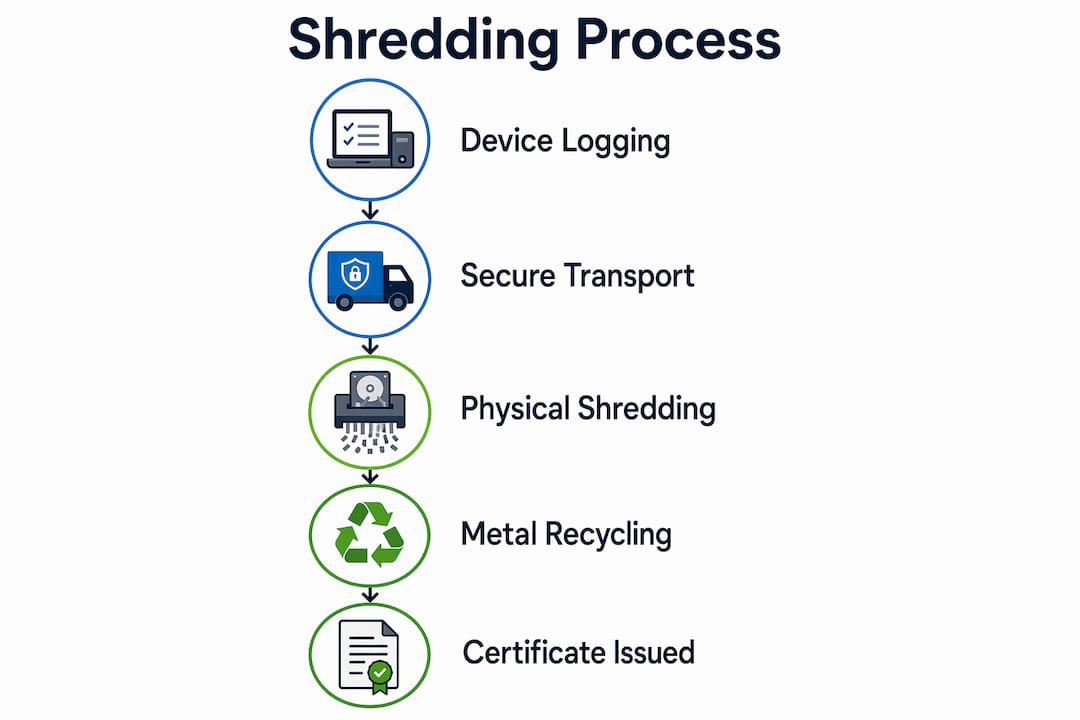
The process begins before the drive ever enters a shredder. Technicians log each device by serial number, creating a chain-of-custody record that documents every step from collection to final destruction. This audit trail is what separates a certified service from someone smashing drives in a parking lot.
Once logged, drives enter an industrial shredder that applies cutting, slicing, and pulverizing force through sharp rotating blades or discs. The machine strips away the outer casing, then shreds the internal platters, read/write heads, and circuit boards into fragments. High-capacity shredders apply thousands of pounds of force per cycle, processing dozens of drives per hour.
The key variables in this process are:
- Fragment size. Smaller fragments mean lower recovery risk. NSA/CSS EPL-listed shredders produce particles of 2mm or less for classified media.
- Drive type. HDDs contain magnetic platters that shredding physically destroys. SSDs store data on flash chips, which require finer shredding or disintegration to fully neutralize.
- Shredder vs. disintegrator. Standard shredders cut drives into strips or chunks. Disintegrators produce finer particles, meeting stricter government and defense requirements.
Pro Tip: Ask any shredding provider for their particle size specification before signing a contract. If they cannot provide it, their process may not meet NIST or NSA standards for your data sensitivity level.
After shredding, the metal fragments are typically sent to a certified recycler, closing the loop on responsible e-waste disposal. No usable component leaves the facility.
What standards define secure data destruction?
NIST SP 800-88 Rev.2 is the authoritative framework for media sanitization in the United States. It defines three sanitization outcomes: Clear, Purge, and Destroy. Shredding falls under Destroy, the outcome applied when data sensitivity is highest or when the media will not be reused. The standard does not mandate a specific method but requires that the chosen technique make recovery infeasible for the defined threat level.
“The goal of media sanitization is to render data access infeasible for a given level of effort.” — NIST SP 800-88 Rev.2
The table below maps the major regulatory frameworks to their shredding requirements:
| Regulation | Requirement | Shredding status |
|---|---|---|
| NIST SP 800-88 Rev.2 | “Destroy” outcome for highest sensitivity media | Fully compliant method |
| HIPAA | Physical destruction of PHI-containing media | Accepted and recommended |
| GDPR | Irreversible destruction of personal data | Compliant when certified |
| CCPA | Secure disposal of consumer personal information | Compliant with documentation |
Certification programs like NAID AAA (now i-SIGMA) add a third-party audit layer on top of these regulatory requirements. Providers like Shred-it and Iron Mountain carry NAID AAA certification, meaning their processes, facilities, and employee screening have been independently verified. A certificate of destruction issued after each job serves as your documented proof of compliance, which is exactly what auditors and regulators ask for.
NIST also makes a point that many organizations miss: shredding alone does not guarantee security unless the procedures surrounding it are verified and documented. The physical act of destruction is only as reliable as the chain-of-custody controls that support it.
How does shredding compare with other destruction methods?
Physical destruction takes several forms, and shredding is not always the only answer. Understanding the alternatives helps you choose the right method for your situation.
| Method | Data security level | Best use case | Limitation |
|---|---|---|---|
| Shredding | Very high | All drive types, compliance-driven disposal | Drive cannot be reused |
| Degaussing | High (HDDs only) | Bulk HDD destruction | Ineffective on SSDs or flash media |
| Crushing/punching | High | Quick on-site destruction | Fragments remain large; less thorough |
| Software wiping | Moderate | Drives intended for reuse or resale | Ineffective if drive is failing |
| Melting/smelting | Very high | Government/defense classified media | Expensive, not widely available |
Degaussing uses a powerful magnetic field to scramble data on HDDs, but it has no effect on SSDs because flash memory does not rely on magnetic storage. Crushing deforms the drive physically but leaves larger fragments that a determined attacker with specialized equipment could potentially analyze. Software wiping is the only method that allows a drive to be reused, but it requires a functioning drive and multiple verified passes to meet NIST’s “Clear” or “Purge” standards.
Shredding wins on two counts: it works on every media type, and it produces the most thorough physical destruction available outside of a smelting furnace. For organizations retiring large volumes of mixed media, including HDDs, SSDs, USB drives, and mobile devices, shredding is the most practical path to secure data destruction across the board.
The environmental angle also favors certified shredding services over informal destruction. Reputable providers send shredded metal to certified recyclers, keeping hazardous materials out of landfills and satisfying e-waste regulations in states like California, New York, and Texas.
What should you look for in hard drive shredding services?
Selecting a shredding provider is a compliance decision as much as a logistics one. The wrong choice can leave you exposed to regulatory penalties even if the drives are physically destroyed. Here is how to evaluate your options:
- Verify certification. Look for NAID AAA certification from i-SIGMA or equivalent third-party audit credentials. This confirms the provider’s processes meet documented security standards.
- Request a certificate of destruction. Every reputable provider issues one. It should include drive serial numbers, destruction date, method used, and the technician’s signature.
- Clarify on-site vs. off-site options. On-site shredding eliminates transport risk because the shredder comes to your location. Off-site shredding can be more cost-effective for large volumes but requires a verified chain-of-custody from pickup to destruction.
- Ask about fragment size. For standard business data, 2mm particles are sufficient. For healthcare or government data, request NSA-compliant particle sizes.
- Confirm recycling practices. A responsible provider recycles shredded material through certified e-waste channels rather than sending it to a general landfill.
Pro Tip: For high-volume IT asset retirement, combine on-site shredding with an IT asset disposition (ITAD) audit. This gives you a complete inventory of what was destroyed and its estimated residual value, which matters for both compliance and accounting.
Providers like Shred-it and Iron Mountain offer scheduled pickup programs for businesses with ongoing destruction needs. For smaller volumes, local certified providers can often match their pricing while offering faster turnaround. The hard drive shredding services market includes dozens of regional and national options, so comparing certifications and service terms before committing is worth the time.
Key takeaways
Hard drive shredding is the only destruction method that renders all media types permanently unrecoverable while satisfying NIST, HIPAA, GDPR, and CCPA compliance requirements simultaneously.
| Point | Details |
|---|---|
| Shredding defined | Physical destruction of storage media into fragments too small to reconstruct, making data recovery infeasible. |
| NIST framework | NIST SP 800-88 Rev.2 classifies shredding as a “Destroy” outcome, the highest sanitization level available. |
| Fragment size matters | Smaller particles mean lower recovery risk; NSA-compliant shredders produce fragments of 2mm or less. |
| Certification is required | NAID AAA certification and a certificate of destruction are the minimum proof of compliant destruction. |
| On-site vs. off-site | On-site shredding eliminates transport risk; off-site requires verified chain-of-custody controls to be equally secure. |
Why I think most organizations underestimate what shredding actually protects
I have reviewed a lot of data disposal policies over the years, and the same mistake appears repeatedly. Organizations treat shredding as a final checkbox rather than as a security control with its own requirements. They hand drives to a vendor, receive a certificate, and file it away without ever verifying the vendor’s certification status or fragment size specification.
The uncomfortable reality is that a certificate of destruction from an uncertified provider is worth nothing in a regulatory audit. HIPAA enforcement actions have cited improper disposal as a contributing factor in breach investigations, and “we used a shredding service” is not a defense if that service cannot demonstrate NAID AAA compliance or equivalent documentation.
What I find more concerning is the SSD blind spot. Many IT teams still default to degaussing for bulk destruction because it is fast and familiar. Degaussing does nothing to an SSD. As flash-based storage now accounts for the majority of new enterprise deployments, the gap between assumed security and actual security is growing. Shredding, specifically with verified particle sizes, is the only method that closes that gap across your entire media inventory.
The organizations that get this right treat shredding as part of a documented data lifecycle policy, not a one-time event. They schedule destruction cycles, maintain serial number logs, and cross-reference certificates against their asset inventory. That level of rigor is what separates a defensible compliance posture from one that collapses under scrutiny. You can explore IT compliance best practices to build that kind of policy from the ground up.
— Keith
Secure, certified hard drive destruction with Usedcartridge

Usedcartridge offers certified hard drive shredding and physical destruction services designed for both businesses and individuals who need documented, compliant disposal. Every destruction job includes a certificate of destruction with serial number tracking, giving you the audit trail that HIPAA, GDPR, and CCPA auditors require. Usedcartridge integrates shredding with its broader e-waste recycling services, so shredded material is processed responsibly rather than sent to a landfill. Whether you need a one-time purge of retired IT assets or a recurring destruction program, Usedcartridge provides on-site options that eliminate transport risk entirely. Request a free quote and get your data destroyed the right way.
FAQ
What is hard drive shredding in simple terms?
Hard drive shredding is the physical destruction of a storage drive using an industrial shredder that cuts and grinds it into fragments too small to read or reconstruct. It is the most thorough method of permanent data destruction available for both HDDs and SSDs.
Is shredding better than wiping a hard drive?
Shredding is more secure than software wiping because it destroys the physical medium rather than overwriting data. Software wiping meets NIST “Clear” or “Purge” standards for drives intended for reuse, but shredding is required when drives will not be reused or when data sensitivity demands the highest sanitization level.
Does shredding work on SSDs as well as HDDs?
Yes. Shredding is one of the few destruction methods effective on both SSDs and HDDs. Degaussing does not work on SSDs because flash memory is not magnetic, making shredding the preferred method for organizations with mixed media inventories.
What proof do I get that my drives were shredded?
A certified shredding provider issues a certificate of destruction that includes drive serial numbers, the destruction date, the method used, and the technician’s credentials. This document is your compliance evidence for HIPAA, GDPR, and CCPA audits.
How do I choose between on-site and off-site shredding?
On-site shredding is the more secure option because drives never leave your premises before destruction, eliminating transport risk. Off-site shredding works well for large volumes when the provider maintains a verified, documented chain of custody from pickup through final destruction.