
Responsible device repurposing is defined as the practice of extending the functional life of electronic devices through secure data sanitization, physical refurbishment, and ethical redeployment, rather than sending assets to landfill or recycling streams prematurely. The industry term for this practice within IT asset management is IT Asset Disposition (ITAD), and responsible repurposing sits at the highest tier of the waste hierarchy: reuse before recycling, recycling before disposal. For organizations managing fleets of laptops, servers, or mobile devices, this approach directly addresses two converging pressures: the legal obligation to protect sensitive data and the growing regulatory expectation to minimize electronic waste. The UK alone discards 1.45 million tons of e-waste annually, a figure that reflects how far most organizations still are from treating retired devices as assets rather than liabilities.
What is responsible device repurposing, and what does it require?
Responsible device repurposing means keeping a device functional and in use rather than breaking it down for raw material recovery. Repurposing prioritizes functionality over material extraction, which reduces demand for virgin materials and cuts the pollution generated by manufacturing new hardware. This distinction matters because recycling, while better than landfill, still destroys the embodied energy and labor already invested in a working device.
The core components of a credible repurposing program are:
- Data sanitization: All storage media must be wiped using NIST 800-88 compliant methods, whether software overwriting, cryptographic erasure, or physical degaussing. NIST-compliant data sanitization with verifiable audit trails is the non-negotiable foundation of ethical repurposing. Without it, sustainability claims are undermined by real data breach exposure.
- Physical refurbishment and testing: Devices must pass functional testing covering battery health, display integrity, port functionality, and operating system performance before redeployment. A laptop that fails within 90 days of redeployment creates more waste, not less.
- Ethical supply chain standards: Ethical repurposing requires data security, worker safety, and environmental protection to operate together. Vendors handling refurbishment must provide fair wages, proper protective equipment, and documented environmental controls.
- Extended producer responsibility (EPR): EPR policies hold manufacturers accountable for product lifecycle impacts and incentivize design for repairability. Organizations that select vendors aligned with EPR principles reinforce circular economy demand signals.
Pro Tip: Request a Certificate of Data Destruction from every vendor handling your retired devices. This document is your legal protection and your audit trail. If a vendor cannot produce one, that is a disqualifying condition.
How does repurposing differ from recycling and disposal?
Sustainability experts define the difference between repurposing and recycling by whether a device retains its function. Recycling breaks down materials to recover metals and plastics, while repurposing keeps the device whole and operational. Disposal, the lowest tier, sends devices to landfill or incineration with no resource recovery at all.

The practical implications for your organization are significant. A repurposed laptop avoids the carbon cost of manufacturing a replacement. A recycled laptop recovers perhaps 30% of its material value while destroying the rest. A disposed device contributes toxic materials including lead, mercury, and cadmium to soil and groundwater.
| Method | Environmental impact | Data security | Best use case |
|---|---|---|---|
| Repurposing | Lowest. Extends device life, delays disposal, reduces new manufacturing demand. | Requires certified data wipe before redeployment. | Devices with 2 or more years of functional life remaining. |
| Recycling | Medium. Recovers materials but destroys embodied energy and labor. | Requires physical destruction of storage media. | Devices beyond repair or with no redeployment market. |
| Disposal | Highest. Landfill or incineration with toxic leaching risk. | Uncontrolled unless media is destroyed first. | No responsible use case. Avoid entirely. |
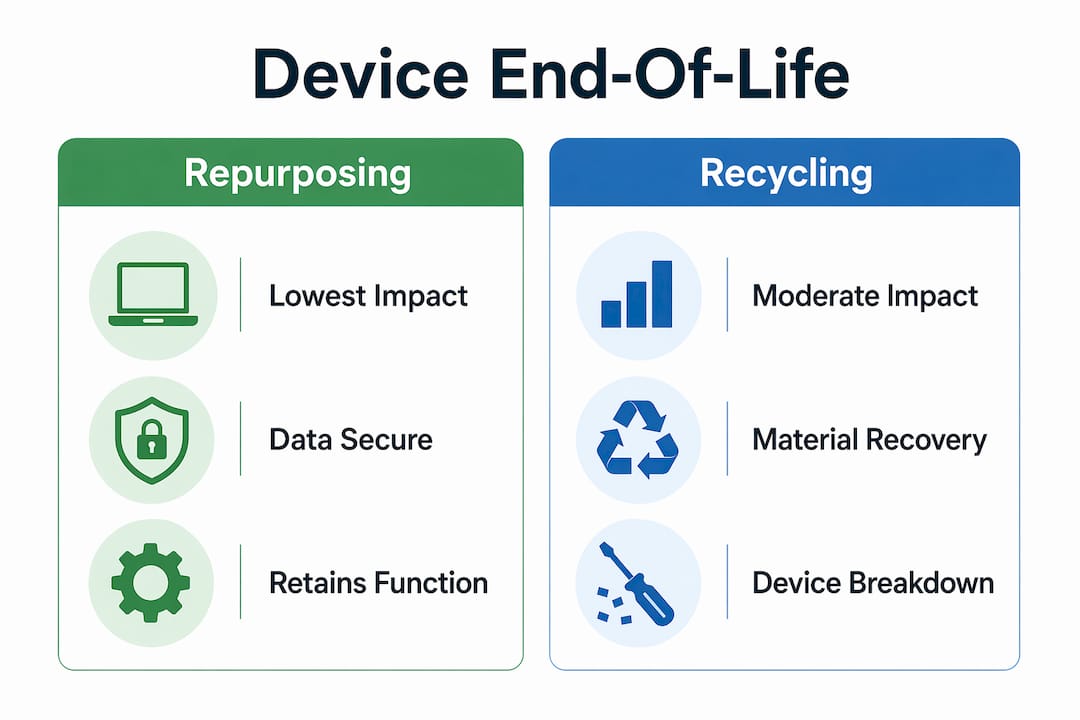
Responsible device recycling transforms e-waste from a pollution source into a secondary resource, but repurposing goes further by preserving the device’s full value. The waste hierarchy is clear: reuse first, recycle second, dispose only as a last resort.
Pro Tip: Before routing any device to recycling, run a quick functional test. If the device powers on and passes basic diagnostics, it belongs in a repurposing stream, not a shredder.
What practical steps can organizations take to implement repurposing programs?
Building a repurposing program requires a sequential process that connects IT asset management, data security, and sustainability reporting. Successful repurposing depends on vendors with transparent supply chains, certified processes, and documented adherence to circular economy principles. Here is the implementation sequence that works in practice:
- Conduct a device audit. Catalog every asset by model, age, condition, and remaining functional life. Use asset management platforms like ServiceNow or Lansweeper to generate accurate inventories. Devices with more than two years of useful life are repurposing candidates.
- Classify devices by data sensitivity. Separate devices that held regulated data (HIPAA, PCI-DSS, GDPR-adjacent) from general use hardware. Higher sensitivity devices require more rigorous sanitization protocols and independent verification.
- Execute certified data sanitization. Apply NIST 800-88 compliant wiping using tools like Blancco or Ontrack Eraser. Obtain a Certificate of Data Destruction for every device. Store certificates for a minimum of three years for compliance audits. Review secure preparation protocols to align your internal process with industry standards.
- Refurbish and test. Replace batteries, clean hardware, update firmware, and run diagnostic suites. Document pass/fail results for every device. Failed devices move to certified recycling, not repurposing.
- Select a redeployment channel. Options include internal redeployment to lower-intensity roles (reception desks, training labs), donation to verified nonprofit partners, or resale through certified refurbishers. UK charity programs demonstrate that secure wiping followed by professional refurbishment and donation is both operationally viable and socially impactful.
- Choose vendors with verified credentials. Require R2 (Responsible Recycling) or e-Stewards certification from any third-party handler. These certifications verify environmental controls, worker protections, and data security practices. Explore IT hardware recycling partners that combine asset recovery with documented sustainability outcomes.
- Document and report. Track every device from retirement to final disposition. Generate sustainability reports showing tons of e-waste diverted, CO2 equivalent avoided, and devices donated or redeployed. This data feeds ESG disclosures and regulatory compliance filings.
Organizations that skip steps two or three expose themselves to data breach liability even when their environmental intentions are sound. The two objectives, security and sustainability, are not in tension. They require the same disciplined process.
What are the measurable benefits and challenges of responsible repurposing?
The business case for responsible tech reuse is concrete. Repurposing a fleet of 500 laptops instead of replacing them avoids the manufacturing emissions of 500 new units, reduces procurement costs, and generates either resale revenue or tax-deductible donation value. The circular economy impact of extending device life cycles includes delayed disposal, reduced resource extraction, and lower total cost of IT asset ownership over time.
The social benefits are equally measurable. The UK’s IT Reuse for Good charter was created specifically because 1.5 million adults lack digital devices, and corporate device donation programs directly address that gap. Organizations that donate refurbished devices to schools, nonprofits, or workforce development programs create documented community impact that strengthens ESG reporting.
The challenges are real and should not be minimized:
- Data security gaps: The most common failure in repurposing programs is incomplete data sanitization. Organizations often fail to implement verifiable audit trails, which creates compliance exposure even when devices are donated with good intent.
- Logistical complexity: Managing device collection, testing, sanitization, and redeployment across multiple locations requires dedicated process ownership. Without a named program manager and clear vendor contracts, repurposing initiatives stall after the first pilot.
- Vendor quality variance: Not all refurbishers operate to the same standard. A vendor without R2 or e-Stewards certification may export devices to developing countries where illegal e-waste processing exposes workers to toxic materials without protection.
- Device condition thresholds: Organizations sometimes push devices into repurposing that are genuinely beyond useful life, creating downstream costs for recipients and damaging the credibility of donation programs.
The organizations that navigate these challenges successfully treat repurposing as a formal program with governance, not an ad hoc activity triggered by office cleanouts. Reviewing responsible computer recycling frameworks gives IT and sustainability teams a structured starting point for building that governance.
Key takeaways
Responsible device repurposing is the highest-value option in sustainable electronics disposal because it preserves device functionality, protects data, and reduces e-waste simultaneously.
| Point | Details |
|---|---|
| Repurposing beats recycling | Keeping devices functional avoids manufacturing emissions and preserves embodied value that recycling destroys. |
| Data sanitization is non-negotiable | NIST 800-88 compliant wiping with a Certificate of Data Destruction is required before any device changes hands. |
| Vendor certification matters | Only work with R2 or e-Stewards certified partners to prevent illegal exports and protect worker safety. |
| Social impact is quantifiable | Donation programs address digital exclusion directly, with 1.5 million UK adults currently lacking access to devices. |
| Governance drives results | Repurposing programs without a named owner, documented process, and compliance reporting consistently fail at scale. |
Why most organizations are still getting this wrong
I have reviewed IT asset disposition programs at organizations that genuinely believe they are doing the right thing. They are collecting old laptops, handing them to a vendor, and filing it under “sustainability initiative.” What they are not doing is verifying that data was wiped to NIST standards, checking whether their vendor holds active R2 certification, or tracking where those devices actually ended up.
The uncomfortable truth is that responsible device repurposing is not a disposal activity. It is an asset management discipline. The moment you treat a retired device as waste, you have already made the wrong decision. The device has value, the data on it has risk, and the vendor you choose has either earned your trust through certification or has not.
I am also skeptical of organizations that lead with environmental messaging but cannot produce a single Certificate of Data Destruction. Sustainability without security is not responsible repurposing. It is a liability dressed up as a values statement.
The organizations doing this well share one characteristic: they have a named person accountable for the full lifecycle of every device, from procurement to final disposition. That accountability is what separates a credible program from a feel-good exercise. If your organization cannot answer “where is device serial number X right now,” your repurposing program has a governance problem, not a technology problem.
— Keith
How Usedcartridge supports responsible device repurposing
Usedcartridge operates as a certified environmental services provider built specifically for organizations that need both data security and sustainability outcomes from their retired IT assets.

Usedcartridge offers certified data destruction, device refurbishment, and e-waste management services designed to meet NIST compliance standards while keeping functional devices in circulation. For organizations building or scaling a repurposing program, Usedcartridge provides on-site destruction, official certification documentation, and asset recovery reporting that feeds directly into ESG disclosures. Explore the full range of business sustainability services to see how your organization can turn retired devices into documented environmental and social impact rather than liability.
FAQ
What is responsible device repurposing in simple terms?
Responsible device repurposing is the practice of securely wiping, refurbishing, and redeploying electronic devices rather than recycling or discarding them. It keeps devices functional and in use, reducing e-waste and protecting sensitive data.
How does repurposing differ from ethical device recycling?
Repurposing keeps a device whole and operational, while ethical device recycling breaks it down to recover raw materials. Repurposing sits higher on the waste hierarchy and preserves more environmental and economic value.
What data security standards apply to device repurposing?
NIST Special Publication 800-88 defines the accepted methods for data sanitization before device redeployment, including software overwriting, cryptographic erasure, and degaussing. Every repurposed device requires a Certificate of Data Destruction as proof of compliance.
Can small organizations implement a repurposing program?
Yes. Small organizations can start with a device audit, partner with an R2-certified vendor for sanitization and refurbishment, and donate functional devices to verified nonprofits. The process scales down without losing its core security and documentation requirements.
What certifications should a repurposing vendor hold?
Vendors should hold R2 (Responsible Recycling) or e-Stewards certification, both of which verify environmental controls, worker protections, and data security practices. These certifications are the minimum standard for any organization serious about sustainable electronics disposal.