
Value recovery from electronics is defined as the process of extracting financial return and reusable materials from retired or end-of-life electronic assets through resale, refurbishment, component harvesting, and material recycling. The industry term for this practice is IT asset disposition, or ITAD. Businesses that treat outdated equipment as a cost center rather than a recoverable asset leave real money on the table. This guide explains what value recovery from electronics involves, which materials and methods deliver the highest returns, and how your organization can build a strategy that balances financial gain, data security, and environmental responsibility.
What is value recovery from electronics?
Value recovery from electronics covers four primary methods: resale of functional devices, refurbishment for secondary markets, component harvesting, and material recycling. Each method targets a different point in the asset lifecycle, and the right choice depends on device age, condition, and your organization’s compliance requirements.
Resale applies to devices that still function and hold market demand. Laptops, servers, and networking equipment under five years old typically qualify. Resale generates the highest per-unit return but requires data sanitization before any device leaves your facility.

Refurbishment extends the life of devices that need repair or cosmetic work before resale. Refurbished devices produce 85% lower carbon emissions than newly manufactured equivalents. That figure makes refurbishment one of the strongest arguments for recovery programs from both a financial and sustainability standpoint.
Component harvesting targets assets too old or damaged for whole-unit resale. Enterprise CPUs, RAM, and hard drives can carry more resale value than the complete aged unit. Knowing when to disassemble rather than remarket is one of the most financially significant decisions in any ITAD program.
Material recycling applies to assets with no resale or component value. Mechanical shredding followed by hydrometallurgical or pyrometallurgical processes isolates precious metals from circuit boards and batteries. Each method carries trade-offs in cost, yield, and environmental impact.
- Resale: Highest return per unit; requires certified data wiping
- Refurbishment: Strong sustainability profile; adds labor cost
- Component harvesting: Best for obsolete assets with valuable parts
- Material recycling: Lowest per-unit return; handles assets with no resale path
Pro Tip: Before committing to a single recovery method, audit your asset inventory by age and condition. A three-tier classification of resalable, harvestable, and recyclable assets will guide vendor selection and maximize net recovery across the full portfolio.
Which materials hold the highest recovery value?
Printed circuit boards, hard drives, and lithium-ion batteries contain the most economically significant materials in any electronics recovery program. Gold, palladium, cobalt, lithium, and nickel all appear in concentrations that exceed typical ore grades, making e-waste a genuinely competitive source of raw materials.
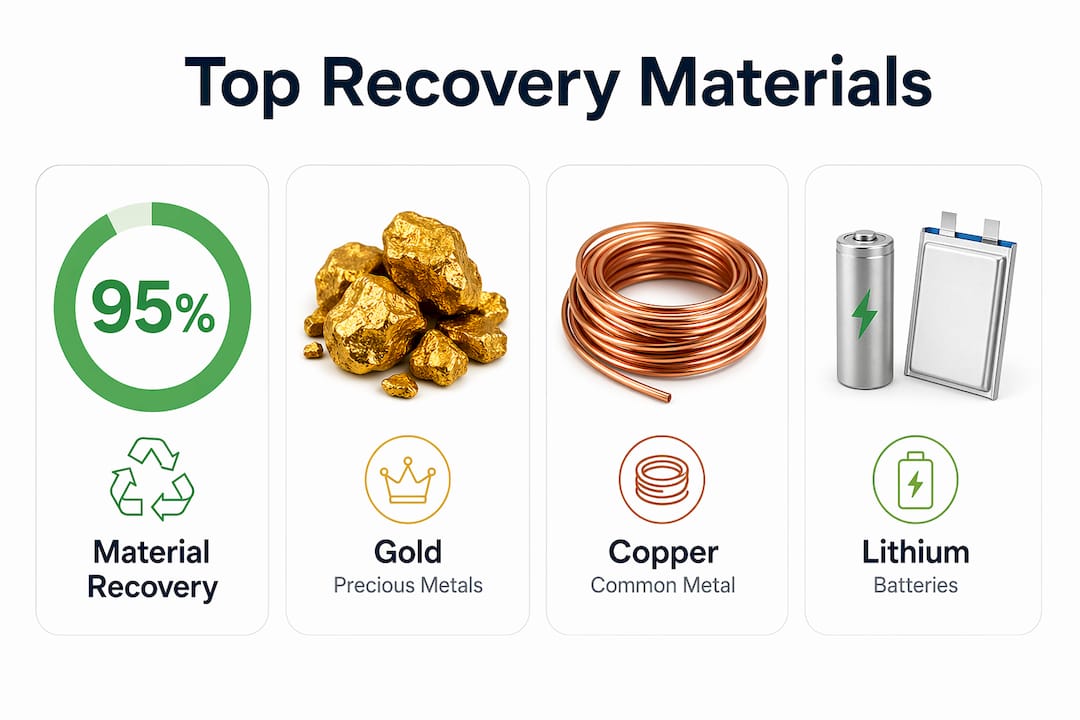
The table below compares key materials by economic value and recovery difficulty.
| Material | Primary source in electronics | Relative economic value | Recovery difficulty |
|---|---|---|---|
| Gold | Printed circuit boards, connectors | Very high | Moderate |
| Palladium | Multilayer ceramic capacitors | Very high | High |
| Copper | Wiring, heat sinks, PCBs | High | Low |
| Cobalt | Lithium-ion batteries | High | Moderate |
| Lithium | Lithium-ion batteries | Moderate | High |
| Nickel | Battery electrodes, plating | Moderate | Moderate |
Processing one ton of e-waste yields gold equivalent to processing 29 tons of raw ore, with significant savings in energy and water. That ratio explains why urban mining, the practice of recovering metals from manufactured goods, is growing faster than traditional mining investment in many regions.
Accurate chemical analysis determines whether a recovery batch is profitable before processing begins. Fire Assay and Loss on Drying are the accredited lab methods used to measure metal content precisely. Skipping this step risks undervaluing a batch or paying for processing that does not cover its costs.
Beyond precious metals, copper is the workhorse of electronics recycling. Its relatively low recovery difficulty and consistent market demand make it a reliable revenue contributor even in batches with minimal gold content. Organizations managing large server fleets or data center decommissions should account for copper yield in their recovery projections.
For a deeper look at the specific materials extracted during recovery and their role in resource conservation, Usedcartridge covers the topic in detail on its electronic waste materials page.
What are the financial and environmental benefits?
Value recovery from electronics delivers measurable returns across three categories: direct revenue, avoided costs, and supply chain resilience. Most organizations focus on the first and underestimate the other two.
Direct revenue comes from resale, component sales, and refining payments for precious metals. Avoided costs include reduced procurement spending on new raw materials and lower waste disposal fees. Supply chain resilience is the least visible benefit but increasingly the most strategic.
“The circular electronics model turns retired IT assets into a private secondary supply chain, reducing supply chain vulnerability and geopolitical risks.” Circular Economy in Electronics
That framing matters for procurement and finance teams. A structured ITAD program does not just offset hardware refresh costs. It reduces dependence on commodity markets for critical materials like cobalt and lithium, both of which face supply concentration risks.
The environmental case is equally concrete. Only 17% of global e-waste is formally recycled, representing an economic loss exceeding £45 billion annually. The gap between current practice and potential recovery is enormous, and businesses that close that gap internally gain both financial and reputational advantages.
Modern processing facilities achieve 80–95% material recovery rates when handling e-waste correctly. Compared to virgin mining, those rates translate directly into lower energy consumption, reduced water use, and fewer emissions per unit of material produced.
Compliance is the third pillar. Regulations including the Resource Conservation and Recovery Act in the United States and the European WEEE Directive impose legal obligations on organizations disposing of electronics. A documented recovery program with certified vendors satisfies auditors, protects against liability, and supports ESG reporting requirements that investors and procurement partners increasingly demand. Usedcartridge provides compliance-focused IT asset recovery guidance for organizations navigating these requirements.
How can businesses implement effective value recovery strategies?
A structured approach to ITAD starts with asset classification and ends with documented reporting. The steps below reflect best practice for organizations managing regular hardware refresh cycles.
-
Classify your asset inventory. Sort devices by age, condition, and data sensitivity. Assets under five years old with functional hardware belong in the resale or refurbishment track. Older or damaged assets move to component harvesting or material recycling.
-
Prioritize data security before disposition. Every device containing storage media requires certified data destruction before leaving your control. This applies to resale candidates as much as recycling candidates. Aligning recovery goals with data security and regulatory compliance is not optional. It is the foundation of any defensible ITAD program.
-
Select vendors with verifiable credentials. Look for ITAD partners certified under R2 (Responsible Recycling) or e-Stewards standards. Request certificates of destruction for every batch. Verify that downstream processors are also certified, not just the primary vendor.
-
Negotiate recovery economics transparently. Understand whether your vendor offers revenue sharing, flat-rate processing, or a net-zero model for low-value assets. Value recovery balances revenue against security and logistics costs, and not every asset will generate a positive return. That is acceptable when the program delivers net value across the full portfolio.
-
Document and report outcomes. Require weight receipts, material recovery reports, and destruction certificates from every vendor. This documentation supports ESG disclosures, regulatory audits, and internal cost justification for the program.
Pro Tip: Request a chemical assay report from your recycling vendor for any batch containing significant quantities of printed circuit boards or lithium-ion batteries. Accurate metal content analysis prevents undervaluation and gives you a basis for comparing vendor pricing.
Vendor relationships improve over time when you provide consistent volumes and predictable asset types. Organizations that manage redundant electronics proactively rather than reactively tend to negotiate better recovery rates and faster processing timelines.
Key Takeaways
Effective value recovery from electronics requires combining the right disposition method with certified data security, accurate material assessment, and documented compliance reporting.
| Point | Details |
|---|---|
| Choose the right recovery method | Classify assets by age and condition to select resale, harvesting, or recycling. |
| Precious metals drive material value | Gold, palladium, and cobalt in circuit boards and batteries offer the highest per-unit returns. |
| Environmental benefits are measurable | Certified facilities recover 80–95% of materials, far outperforming virgin mining yields. |
| Security and compliance are non-negotiable | Every asset requires certified data destruction before disposition, regardless of recovery path. |
| Net portfolio value matters more than per-unit return | Accept small costs on low-value assets when the overall program delivers financial and compliance gains. |
The recovery metric most businesses get wrong
Most organizations measure their ITAD program by the check they receive at the end of the quarter. That is the wrong metric. I have seen companies walk away from vendor relationships that were actually performing well because a single batch of aging desktops returned almost nothing. They missed the point entirely.
The real measure of a value recovery program is net outcome across the full asset portfolio, including avoided disposal costs, compliance risk reduction, and supply chain benefits. A laptop that returns $80 at resale looks very different when you factor in the $40 it would have cost to dispose of it through a non-compliant channel, plus the potential regulatory exposure that channel carried.
The other misconception I encounter regularly is the idea that maximizing recovery revenue and maintaining rigorous data security are competing goals. They are not. Certified data destruction adds a modest cost but protects against liability that can dwarf any recovery revenue. The organizations that treat security as a cost to minimize rather than a standard to maintain are the ones that end up in breach notification situations.
The trend I find most significant right now is the shift toward circular buy-use-remarket models. Businesses that build recovery into their procurement cycle from day one, rather than treating it as an afterthought at refresh time, consistently recover more value and face fewer compliance surprises. The circular electronics model is not a sustainability talking point. It is a supply chain strategy with real financial consequences.
— Keith
How Usedcartridge supports your value recovery program
Usedcartridge operates as a specialized provider of e-waste recycling, data destruction, and IT asset recovery for businesses and organizations. Whether you are decommissioning a data center, refreshing a fleet of laptops, or managing end-of-life solar panels, Usedcartridge provides certified, compliant processes from collection through final disposition.

Services cover secure hard drive data destruction, component recovery, and full electronic waste recycling with official certification at every step. Free quotes and pickup options make it straightforward to start a program without upfront logistics complexity. If your organization is ready to turn retired assets into documented, compliant recovery outcomes, request an IT asset recovery quote from Usedcartridge today.
FAQ
What does value recovery from electronics mean?
Value recovery from electronics is the process of extracting financial return and reusable materials from retired electronic assets through resale, refurbishment, component harvesting, and material recycling. The formal industry term for this practice is IT asset disposition, or ITAD.
Which electronics contain the most recoverable value?
Printed circuit boards, enterprise servers, and lithium-ion batteries hold the highest material value. Gold, palladium, cobalt, and copper are the primary metals recovered, with one ton of e-waste yielding gold equivalent to processing 29 tons of raw ore.
How does data security fit into value recovery?
Every device containing storage media requires certified data destruction before disposition, regardless of whether it is destined for resale or recycling. Skipping this step creates regulatory and liability exposure that outweighs any recovery revenue.
What certifications should I look for in an ITAD vendor?
Look for vendors certified under R2 (Responsible Recycling) or e-Stewards standards. Both programs require audited downstream accountability, meaning your vendor must verify that processors further down the chain also meet environmental and security standards.
Is value recovery worth it for low-value or older assets?
Yes, when measured at the portfolio level. Individual older assets may return little or nothing, but a structured program reduces disposal costs, satisfies compliance requirements, and recovers material value that offsets processing fees across the full asset mix.