
The circular economy in technology is defined as a systemic model that keeps electronic products and materials in use as long as possible through repair, refurbishment, remanufacturing, and responsible recycling. It replaces the traditional linear “take-make-dispose” approach with closed loops that eliminate waste by design. Pioneered by thinkers like Dr. Walter Stahel and formalized through frameworks from the Ellen MacArthur Foundation, this model now shapes how IT managers, sustainability advocates, and business decision-makers approach technology procurement and end-of-life planning. Extending device life spreads the production carbon footprint over more years, cutting Scope 3 emissions and total ownership costs at the same time.
What is circular economy in technology, and how does it apply to electronics?
The circular economy in electronics starts with a design decision, not a disposal decision. Products built for longevity, modularity, and repairability stay in service far longer than devices engineered for a single ownership cycle. That design philosophy is the foundation of what the Circular Economy Alliance calls “tightening the loop,” where manufacturing and recovery decisions work together to minimize waste at every stage.
Repair and refurbishment sit at the top of the value hierarchy. Keeping a device functional through component-level repair preserves far more embedded value than shredding it for raw materials. Industry standards like IPC-7711/21 govern the repair and rework of electronic assemblies, giving technicians a consistent benchmark for restoring hardware to a serviceable state. Refurbishment goes further, restoring devices to near-original condition for resale or redeployment.

Reverse logistics is the operational backbone of circular electronics. When an organization retires a fleet of laptops or servers, a well-designed reverse logistics program routes each unit toward its highest-value recovery option: redeployment, refurbishment, parts harvesting, or certified recycling. Product-as-a-service models take this further by keeping ownership with the manufacturer, who has a direct financial incentive to design for durability and reclaim assets at end of life.
Core circular practices in technology include:
- Design for modularity: Components can be replaced or upgraded without replacing the whole device.
- Repair and refurbishment: Certified technicians restore hardware to extend its usable life.
- Remanufacturing: Devices are disassembled, cleaned, and rebuilt to original specifications.
- Reverse logistics: Structured return programs route retired assets to the best recovery option.
- Secondary markets: Refurbished equipment is remarketed to new users at lower price points.
- Responsible recycling: Material recovery is the last resort, not the first response.
Pro Tip: When evaluating a supplier or service provider, ask specifically whether they follow IPC-7711/21 repair standards. Compliance signals a genuine commitment to quality refurbishment, not just cosmetic cleaning.
What are the benefits of circular economy strategies for technology organizations?
Circularity delivers measurable financial returns, not just environmental goodwill. Circular strategies help organizations manage electronics supply shortages by keeping older equipment operational when new devices are constrained. That operational buffer translates directly into procurement savings and supply chain resilience.
Risk management is a second major driver. Raw material shortages for rare earth elements, semiconductors, and lithium affect every organization that buys new hardware. A circular IT program treats your existing device fleet as a strategic inventory pool. Devices that would otherwise be retired become a reserve of functional components and recoverable materials, reducing dependence on volatile commodity markets.
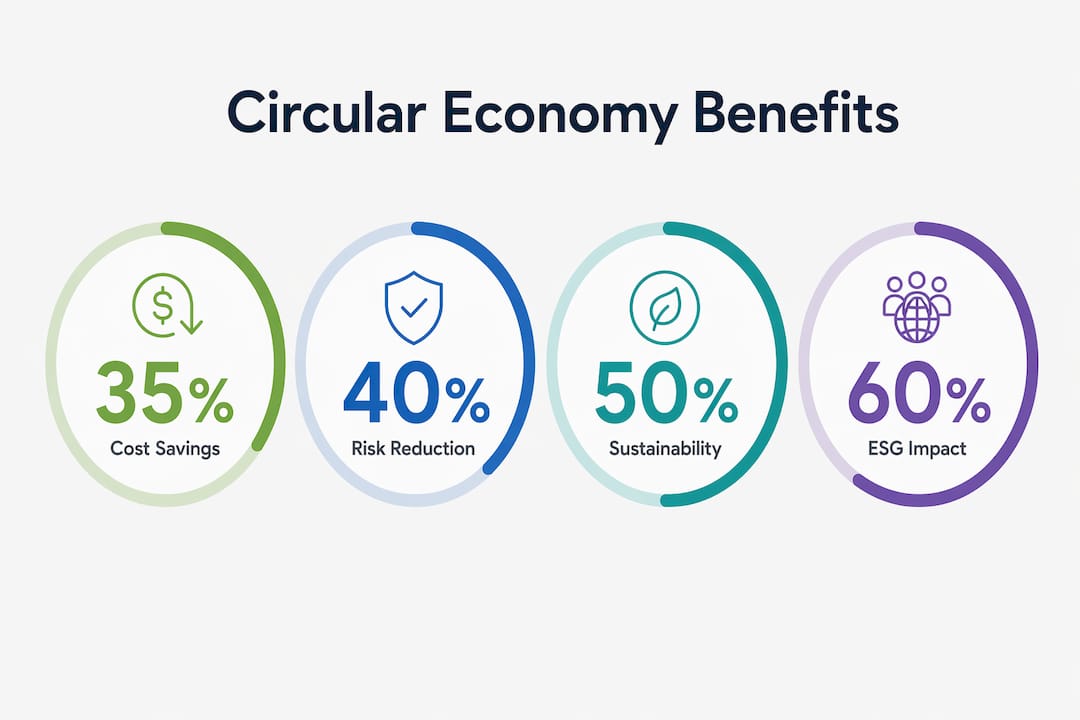
Environmental sustainability gains are concrete and measurable. Extended use of electronic equipment spreads embedded environmental impact across more years of service, lowering carbon emissions per year of use. For organizations tracking Scope 3 emissions under GHG Protocol frameworks, this directly improves reported figures without requiring new capital investment.
ESG reporting has become a competitive differentiator. Investors, regulators, and enterprise customers increasingly require documented sustainability metrics. A circular IT program generates the data points that feed ESG disclosures, from tonnes of e-waste diverted to percentage of assets refurbished versus landfilled.
| Benefit | Practical impact |
|---|---|
| Reduced procurement costs | Extended device lifecycles lower annual hardware spend |
| Supply chain resilience | Existing fleets buffer against component shortages |
| Lower Scope 3 emissions | Longer asset life spreads embedded carbon over more years |
| ESG compliance data | Circular programs generate auditable sustainability metrics |
| Secondary market revenue | Refurbished assets recover value instead of generating disposal costs |
Pro Tip: Track your “Circularity Delta,” the gap between what you spend on hardware and the value you recover at end of life. Closing that gap is the clearest indicator of circular program maturity.
Common misconceptions about implementing circular economy in technology
The most persistent misconception is that circularity adds cost. The World Economic Forum and OECD research both confirm that operational resilience benefits outweigh implementation expenses. Reverse logistics and secondary markets transform end-of-life equipment from a disposal liability into a revenue source. The cost framing collapses once organizations account for avoided procurement, reduced disposal fees, and recovered asset value.
A second misconception treats recycling as the primary circular strategy. Recycling is the last resort in a well-designed circular program. True circularity begins with designing electronics for modularity, accessibility, and repairability. Breaking a device down for raw materials recovers only a fraction of its embedded value compared to refurbishment or redeployment.
Data security is the overlooked prerequisite. Secure data destruction must happen early in the asset lifecycle to enable safe refurbishment or resale. Organizations that skip certified data wiping before remarketing devices expose themselves to serious compliance and reputational risk. Circular IT and data security are not competing priorities. They are sequential steps in the same process.
Common implementation pitfalls include:
- Attempting a full supply chain overhaul instead of starting with a manageable pilot program.
- Treating circularity as an IT department initiative rather than a procurement and finance decision.
- Failing to document asset recovery outcomes, which leaves ESG reporting unsupported.
- Choosing recycling vendors based on price alone without verifying certifications or data destruction protocols.
The IT lifecycle management process works best when circularity is embedded at the procurement stage, not bolted on at disposal. Buying decisions that favor modular, repairable hardware create the conditions for circular recovery years later.
How does digital technology support the circular economy in tech?
Digitalization is the engine that makes circular electronics scalable. Without data, circular programs rely on manual tracking, which introduces errors and missed recovery opportunities. Digital asset management systems log device condition, location, and lifecycle stage in real time, giving organizations the visibility they need to route assets toward their highest-value recovery option.
The Circular Circuits project demonstrates this directly. By treating e-waste as a starting point for value creation rather than an endpoint, the project uses digitalized recovery and routing to identify which components can be refurbished, which can be harvested for parts, and which require material recycling. That decision-making layer is what separates a circular program from a simple recycling contract.
Emerging technologies are expanding what is possible. Extended reality (XR) tools support remote diagnostics and repair guidance, reducing the need to physically ship devices to centralized repair centers. Blockchain-based tracking creates tamper-proof records of device provenance and refurbishment history, which builds buyer confidence in secondary markets. AI-driven triage systems can assess device condition at intake and recommend the optimal recovery pathway within seconds.
Key digital capabilities that support circular electronics:
- Asset lifecycle tracking: Real-time visibility into device condition and location across the fleet.
- Data-driven triage: Automated systems recommend repair, refurbishment, or recycling at intake.
- Digital product passports: Standardized records of materials, components, and repair history travel with the device.
- Remote diagnostics: XR and remote access tools reduce shipping costs and repair turnaround time.
- Circular supply chain platforms: End-to-end platforms connect asset recovery, remarketing, and procurement in one system.
For professionals managing large device fleets, IT asset tracking is the practical starting point. You cannot recover value from assets you cannot see.
Key Takeaways
The circular economy in technology creates measurable financial and environmental returns when organizations embed circularity into procurement, design, and end-of-life planning from the start.
| Point | Details |
|---|---|
| Design drives circularity | Products built for modularity and repairability recover far more value than those designed for single use. |
| Recycling is the last resort | Refurbishment and redeployment preserve more embedded value than material recovery. |
| Data security is a prerequisite | Certified data destruction must precede any refurbishment or resale activity. |
| Pilot before scaling | Starting with a manageable circular IT pilot reduces failure risk and builds internal capability. |
| Digital tools enable scale | Asset tracking and data-driven triage are the operational foundation of any mature circular program. |
Why circularity is a resilience strategy, not just a compliance checkbox
I have watched organizations approach circular economy programs in two very different ways. The first group treats it as an ESG reporting exercise, something to document and present to stakeholders once a year. The second group treats it as an operational strategy, embedding circular thinking into every hardware procurement decision and every vendor contract. The second group consistently outperforms the first, and not just on sustainability metrics.
The insight that most articles miss is this: your retired device fleet is a prepaid resource pool. Every laptop, server, or monitor you have already purchased contains materials and functional components that have real market value. Neglecting end-of-life management means losing visibility into that value entirely. Organizations that track their Circularity Delta, the ratio of value recovered to hardware expenditure, consistently find that they have been leaving significant money on the table.
My strongest recommendation is to start with a pilot, not a policy. Pick one device category, one department, or one refresh cycle. Map where those assets go today. Measure what you recover. Then use that data to make the case for broader change. Successful circular IT programs follow three phases: Pilot, Integrate, and Optimize. Organizations that skip the pilot phase and attempt immediate supply chain overhauls fail at a much higher rate.
The other oversight I see repeatedly is treating data destruction as a barrier to circularity. It is not. Certified data wiping or physical destruction is what makes refurbishment and resale legally and ethically viable. Build it into the process from day one, and it becomes a feature, not a friction point.
— Keith
Practical e-waste and IT asset recovery services from Usedcartridge
Circular economy principles require practical infrastructure to work. Understanding the framework is the first step. Acting on it requires a partner with the certifications, logistics, and data security protocols to handle your retired IT assets responsibly.

Usedcartridge provides e-waste recycling and recovery services built around the circular economy model, covering secure data destruction, IT asset recovery, and certified hardware recycling for businesses of all sizes. Every service includes documented chain-of-custody records, which directly support your ESG reporting and compliance requirements. For organizations ready to move from policy to practice, Usedcartridge offers free quotes and pickup options, making it straightforward to close the loop on your next device refresh cycle. You can also explore IT asset recovery options to understand what your retired hardware is worth before it leaves your facility.
FAQ
What is the circular economy in technology?
The circular economy in technology is a systemic model that keeps IT products and materials in use as long as possible through repair, refurbishment, remanufacturing, and recycling. It replaces the linear take-make-dispose model with closed loops that eliminate waste by design.
How does circular economy differ from standard recycling?
Standard recycling recovers raw materials at end of life, which is the lowest-value recovery option. The circular economy prioritizes repair, refurbishment, and redeployment first, treating recycling as a last resort when no higher-value recovery path exists.
Why is data destruction part of circular IT?
Certified data destruction is a prerequisite for safe refurbishment and resale. Without it, organizations risk data leaks during the reuse phase, which creates compliance and reputational exposure that outweighs any recovery value.
What is the Circularity Delta?
The Circularity Delta measures the gap between what an organization spends on hardware and the value it recovers at end of life. Tracking it helps organizations identify how much value they are losing through poor end-of-life management.
How should an organization start implementing circular economy practices?
The most effective starting point is a pilot program focused on one device category or department. Phased implementation reduces failure risk and generates the data needed to build the case for broader adoption across procurement and supply chain functions.