
Transparency in asset disposal is defined as the obligation to conduct every step of the retirement process, from initial valuation through final disposition, in a manner that is open, documented, and auditable by regulators, auditors, and stakeholders. The role of transparency in asset disposal has grown more critical as regulatory bodies tighten requirements and organizations face greater scrutiny over e-waste handling and IT asset retirement. Compliance officers who treat transparency as a procedural checkbox rather than a structural discipline expose their organizations to audit failures, data breach liability, and reputational damage. The frameworks, technologies, and practices covered here give business leaders a concrete foundation for building disposal programs that hold up under examination.
How do current regulatory frameworks enforce transparency in asset disposal?
Regulatory frameworks now treat transparency as a legal obligation, not a best practice. The proposed 2025 Public Assets Disposal Regulations require mandatory advertisement of any asset disposal valued above Rs 5 million, with a minimum 10-day response window for national bidders and 20 days for international bidders. That requirement directly eliminates the closed-door disposal deals that historically allowed undervaluation and favoritism.
The same draft regulations mandate that asset disposal information remain publicly accessible until bid deadlines close. This creates a continuous audit trail that regulators can examine at any point. Public disposal processes also require complete bidder eligibility verification and integration with electronic procurement systems to prevent market manipulation.
Local government bodies in the United States and United Kingdom operate under parallel obligations. Under the 1972 Local Government Act, local authorities must obtain “best consideration” through a balanced, defensible commercial judgment that weighs price, risk, and deliverability. That standard requires documented reasoning, not just a record of the highest bid received.
Key procedural requirements compliance officers should track include:
- Mandatory public advertisement of disposals above defined thresholds, with documented response periods
- Bidder eligibility verification to confirm qualifications before award
- Electronic system integration to create tamper-resistant records
- Documented commercial judgment explaining award decisions beyond price alone
- Retention of disposal records through the full bid cycle and post-award audit period
These requirements reduce discretionary decision-making and increase competition. Organizations that build these steps into their standard operating procedures are better positioned when auditors request documentation.
What are best practices for ensuring transparency throughout the asset disposal process?
Meticulous record-keeping is the foundation of any transparent disposal program. Government asset disposal compliance surveys consistently reveal that the most common failure points are missing asset information and inadequate condition ratings, not intentional misconduct. Closing those gaps requires structured intake processes that capture asset identity, condition, appraised value, and custody history before any disposal action begins.
The following steps define a transparent disposal workflow:
- Create a complete asset register with serial numbers, acquisition dates, current condition ratings, and estimated residual values before initiating any disposal.
- Conduct independent appraisals for high-value assets to establish a defensible market baseline that supports audit-ready financial reporting.
- Document chain of custody at every transfer point, from internal collection through transport to final disposition or resale.
- Issue serialized certificates for data destruction or physical disposal, with photographic evidence where applicable.
- Retain all records in a centralized system accessible to auditors, with version control to prevent post-hoc modification.
- Conduct periodic internal audits against the asset register to identify discrepancies before external review.
Technology strengthens each of these steps. Blockchain and AI now enable immutable, shared records that verify recycling rates, confirm ethical sourcing, and provide circular economy compliance evidence. Blockchain creates a shared, unalterable record of each asset’s disposal history, which regulators and auditors can verify independently without relying on the organization’s own reporting.
Pro Tip: Implement real-time asset tracking through a cloud-based portal that logs every custody transfer automatically. This eliminates manual entry errors and produces an audit-ready timeline without additional administrative effort.
The role of documentation in e-waste management extends beyond compliance. Organizations that maintain complete records also recover more value from retired assets because buyers and resellers trust the condition history and are willing to pay accordingly.

How does transparency impact ethical and financial decision-making in asset disposal?
“Best consideration” is a structured commercial judgment, not a mechanical exercise in selecting the highest price. Legal interpretations under the Local Government Act confirm that decision-makers have legitimate discretion to weigh risk, deliverability, and bidder credibility alongside price. That discretion must be documented to be defensible.
Ethical accounting practices reinforce this point. Transparent financial reporting during disposal requires that accounting entries accurately remove asset cost, accumulated depreciation, and any recognized gain or loss from the balance sheet. Proper asset disposal accounting directly affects audit readiness and the integrity of financial statements.
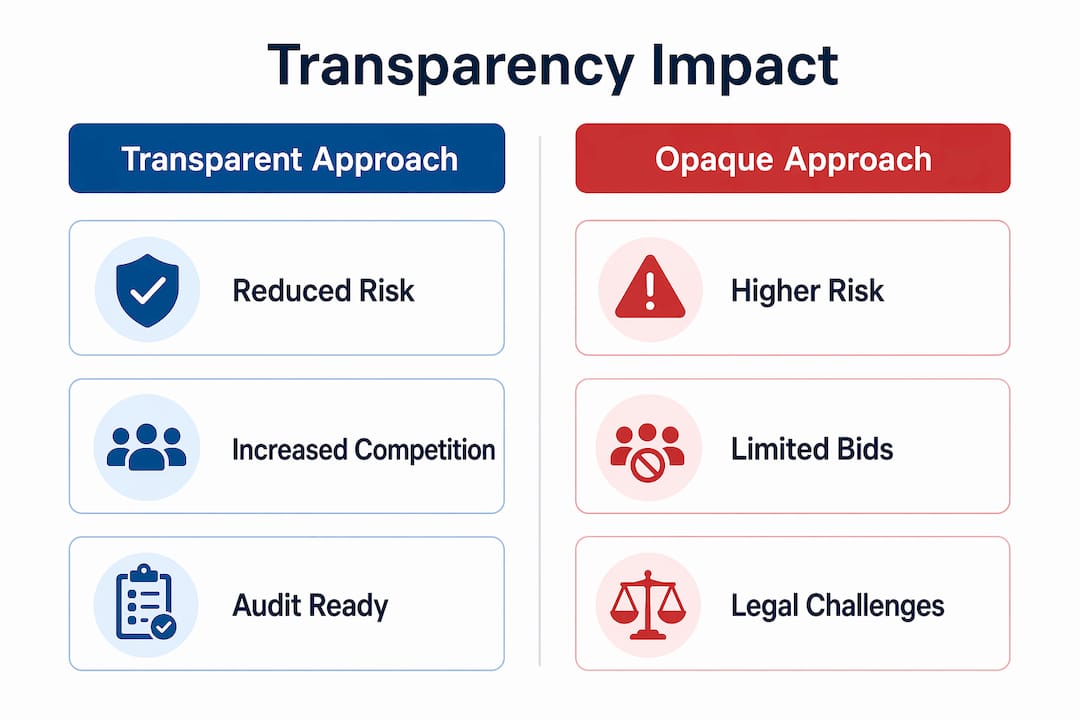
The contrast between transparent and opaque decision-making is significant:
| Decision factor | Transparent approach | Opaque approach |
|---|---|---|
| Award criteria | Documented, weighted, pre-published | Informal, undisclosed |
| Bid evaluation | Scored against defined risk and price criteria | Based on undocumented judgment |
| Financial reporting | Entries reconciled with disposal records | Entries made without supporting documentation |
| Audit outcome | Defensible with full evidence trail | Vulnerable to challenge or reversal |
| Stakeholder trust | High, due to open process | Low, due to perceived favoritism |
Organizations that operate transparently produce disposal decisions that hold up under legal challenge. Those that rely on informal processes create liability even when the underlying decision was commercially sound.
What role do technology and secure handling play in maintaining transparency in e-waste and IT asset disposal?
Secure sanitization is a technical requirement, not just a policy preference. Applying outdated wiping methods to SSDs risks data remanence because wear leveling prevents traditional tools from overwriting all storage cells. Cryptographic erasure or physical destruction are the compliant methods for modern solid-state drives.
Technology and process controls that support transparent IT asset disposition include:
- Cryptographic erasure or physical destruction for SSDs, with certificates issued for each device
- Serialized destruction certificates and photographic proof as standard documentation for every retired asset
- Chain of custody manifests that track physical movement from collection through final processing
- Cloud portals that provide real-time status updates to compliance officers and auditors
- Automated compliance reports generated at each disposal milestone, reducing manual reporting burden
Documented chain of custody in IT asset disposition reduces data breach incidents by 60% and provides critical audit evidence proving regulatory compliance. That figure reflects the direct, measurable value of process discipline over informal handling.
Compliance officers frequently overlook virtual assets. Cloud storage and software licenses require separately approved disposal workflows to avoid audit gaps. A physical device retirement program that ignores associated cloud accounts and license deactivations leaves an incomplete audit trail.
Pro Tip: When selecting an IT asset disposition partner, request a sample chain of custody report and a sample destruction certificate before signing any agreement. A provider that cannot produce these documents immediately does not have the process discipline your compliance program requires.
Usedcartridge provides compliant IT disposal with documented chain of custody and certified data destruction, giving compliance officers the audit evidence they need without building internal processes from scratch.
Key Takeaways
Transparent asset disposal is the single most effective control for reducing audit risk, preventing data breaches, and maintaining defensible financial records across the full retirement lifecycle.
| Point | Details |
|---|---|
| Regulatory compliance requires documentation | Proposed 2025 regulations mandate advertisement, bidder verification, and retained records for all major disposals. |
| Best consideration goes beyond price | Award decisions must document risk, deliverability, and credibility to withstand legal and audit scrutiny. |
| Chain of custody reduces breach risk | Documented custody trails reduce data breach incidents by 60% and satisfy regulatory audit requirements. |
| Technology creates immutable records | Blockchain and AI produce tamper-resistant disposal histories that regulators can verify independently. |
| Virtual assets need separate workflows | Cloud storage and software licenses require distinct, approved disposal processes to close audit gaps. |
Transparency as a strategic discipline, not a compliance checkbox
After working with organizations across multiple sectors on IT asset retirement, the pattern I see most often is this: compliance officers treat transparency as something they produce for auditors rather than something they build into operations. That distinction matters more than most leaders realize.
The organizations with the cleanest audit outcomes are not the ones that scramble to assemble documentation after a disposal event. They are the ones that generate records automatically as a byproduct of their standard process. Chain of custody logs, destruction certificates, and bid evaluation summaries exist because the workflow produces them, not because someone compiled them in response to a request.
The technology argument is real but often oversold. Blockchain and AI do create better records. They do not fix a process that lacks discipline at the intake stage. I have seen organizations invest in tracking platforms while still failing to capture basic condition ratings at asset retirement. The platform cannot record what the process never collected.
The most practical step any compliance officer can take right now is to audit one recent disposal cycle end to end. Pull the asset register entry, the custody log, the destruction certificate, and the financial entry. If any of those four elements is missing or inconsistent, that gap is your priority. Fix the process before adding technology on top of it.
— Keith
Usedcartridge: transparent, certified disposal for compliance officers
Business leaders and compliance officers who need audit-ready disposal records without building internal infrastructure have a direct option.

Usedcartridge delivers e-waste recycling and IT asset recovery with documented chain of custody, certified data destruction, and compliance-grade reporting at every step. Every retirement handled through Usedcartridge produces the serialized certificates, custody manifests, and destruction records that auditors require. For organizations managing large-scale IT retirements or sensitive data destruction, Usedcartridge offers secure data destruction services with on-site options and official certification. Request a quote and get the documentation your compliance program demands.
FAQ
What is the role of transparency in asset disposal?
Transparency in asset disposal means every step from valuation through final disposition is documented, open to audit, and conducted according to defined criteria. It protects organizations from legal challenge, supports accurate financial reporting, and reduces data breach risk.
What documentation is required for compliant IT asset disposal?
Compliant IT asset disposal requires a chain of custody manifest, serialized destruction certificates, photographic proof of destruction, and financial entries reconciling asset cost and accumulated depreciation. These records must be retained and accessible for audit review.
How does “best consideration” apply to asset disposal decisions?
Best consideration requires decision-makers to document a balanced commercial judgment that weighs price, risk, and bidder credibility, not just the highest offer. Legal interpretations under the 1972 Local Government Act confirm that undocumented discretion is not defensible under audit.
Why do SSDs require different sanitization methods than traditional hard drives?
Traditional overwrite methods do not work reliably on SSDs because wear leveling prevents complete coverage of all storage cells. Cryptographic erasure or physical destruction are the only compliant sanitization methods for modern solid-state drives.
What are the biggest transparency gaps in organizational asset disposal?
Survey data from disposal committee reviews identifies missing asset information and inadequate condition ratings as the most common failures. These gaps undermine financial reporting accuracy and leave organizations exposed during regulatory audits.