
IT asset disposition (ITAD) is the structured process of recovering value from retired technology while ensuring secure, compliant disposal. The question of why recycle vs resell old it gear matters more than most finance and IT teams realize. Reselling functional equipment under four years old can recover 20%–40% of original investment, while recycling converts obsolete or damaged assets into recovered raw materials. Both paths serve a purpose. The mistake is treating them as interchangeable. This guide explains when each path wins, what the financial and compliance stakes are, and how to build a disposal strategy that serves your organization’s bottom line and sustainability goals.
Why recycle vs resell old IT gear: understanding the core difference
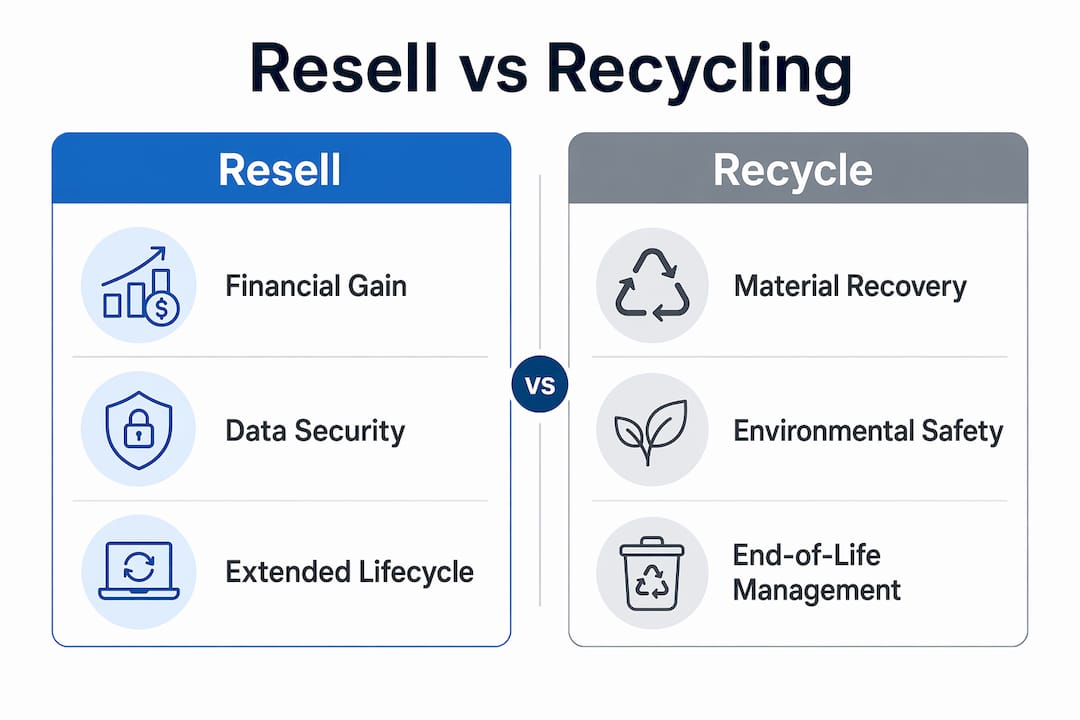
Reselling and recycling are not competing options. They are sequential steps in a responsible IT asset lifecycle. Resale captures financial value from equipment that still has a working market. Recycling handles what resale cannot.
The financial case for resale is concrete. Business laptops 2–4 years old often retain $300–$600 in resale value. Sending those devices directly to a recycler means absorbing a 100% loss on that residual value. That loss compounds fast across a fleet of 500 or 1,000 devices.

Recycling, by contrast, recovers value through raw material extraction: copper, aluminum, lithium, and rare earth metals. That recovery is real but modest compared to functional resale. Recycling is the right answer for broken, obsolete, or end-of-life equipment with no viable secondary market.
The industry term for managing this full lifecycle is ITAD. A well-run ITAD program evaluates each asset, wipes data, remarketes what it can, and routes the rest to certified recyclers. Organizations that skip the evaluation step and default to recycling leave significant money on the table.
What financial benefits does reselling old IT equipment offer?
Resale is the highest-value exit for functional IT equipment. Functional enterprise equipment under 3–4 years old recovers 20%–40% of its original purchase price through resale, versus near-zero recovery through standard recycling. That gap is the financial argument for building a resale-first disposition policy.
The resale model you choose also shapes your return. Two primary structures exist:
- Upfront buyout: A vendor purchases your retired fleet at a fixed price. Payment is immediate, but the offer typically discounts 20%–40% below market value to account for the vendor’s remarketing risk and effort.
- Revenue-share (consignment): Your assets are remarketed through secondary channels, and you receive a percentage of the final sale price. Revenue-share models yield 20%–40% higher returns than buyouts, but cash arrives weeks or months later depending on how quickly devices sell.
Condition grading directly affects which model makes sense. Devices in Grade A condition (minimal cosmetic wear, fully functional) perform well in consignment. Heavily worn or partially functional units often make more sense as a buyout, since remarketing costs can erode the consignment advantage.
Timing matters too. A laptop that commands $450 today may command $280 in 18 months as newer models enter the market. Holding retired assets in storage while debating disposition strategy is itself a financial decision, and usually the wrong one.
Pro Tip: Track device age at the fleet level, not just individually. When a cohort of laptops crosses the 36-month mark, trigger a disposition review immediately. Waiting another quarter can cost hundreds of dollars per device in depreciated resale value.
How does responsible recycling fit into the IT asset lifecycle?
Recycling is not a fallback for organizations that failed to plan. It is the correct and necessary endpoint for equipment that has exhausted its resale potential. The distinction matters because treating recycling as a last resort after all resale options are evaluated is the industry best practice, not recycling by default.
Certified recycling processes recover materials that would otherwise end up in landfills as hazardous waste. A single laptop contains copper wiring, aluminum chassis components, lithium battery cells, and trace rare earth metals used in displays and circuit boards. Responsible recovery of these materials reduces the need for virgin mining and supports circular supply chains.
The environmental benefits of recycling extend beyond material recovery. US recycling supports 757,000 jobs and $36.6 billion in wages, reflecting the scale of the infrastructure built around responsible end-of-life processing. Every ton of electronics diverted from landfill contributes to that system.
Certification separates responsible recyclers from those that simply move e-waste offshore. The two leading standards are:
- R2 (Responsible Recycling): Covers data security, environmental controls, and downstream vendor accountability. R2-certified facilities track materials from intake to final processing.
- e-Stewards: A stricter standard that prohibits export of hazardous e-waste to developing countries and requires verified data destruction.
Organizations that send equipment to non-certified recyclers risk regulatory exposure and reputational damage if materials are mishandled downstream. Certification is not a marketing label. It is a legal and operational safeguard.
Recycling should follow a clear sequence: evaluate for resale, evaluate for internal redeployment, evaluate for donation, then recycle. Skipping the earlier steps wastes value. Skipping recycling for end-of-life assets creates environmental and compliance risk.
What data security and compliance considerations separate resale from recycling?
Data security is the single most consequential variable in IT disposition decisions. Both resale and recycling require verified data destruction before any device leaves your control. The difference is in how rigorously each path enforces it.
Professional ITAD providers perform NIST 800-88 compliant data erasure or physical destruction, then issue certificates of data destruction linked to individual asset serial numbers. That documentation creates an audit trail that satisfies HIPAA, GDPR, and SOC 2 requirements. Standard recycling facilities rarely provide this level of documentation. Sending devices to a general recycler without verified destruction is a compliance gap, not a disposal solution.
Pro Tip: Request a sample certificate of data destruction before signing any ITAD or recycling contract. If a vendor cannot produce one, or produces a generic batch-level document rather than serial-level records, find a different vendor.
Resale introduces an additional layer of accountability. Every device that enters the secondary market must have a verified wipe or destruction record tied to its serial number. Improper DIY wiping creates non-compliance risk even when the intent is responsible. A factory reset does not meet NIST 800-88 standards. Overwrite-based erasure software certified to DoD 5220.22-M or equivalent does.
Certified recyclers with R2 or e-Stewards credentials provide data sanitization alongside material recovery. That combination is what separates a compliant recycling partner from a logistics vendor. Selecting vendors based on price alone, without verifying certification status and chain-of-custody documentation, exposes your organization to breach liability that far exceeds any disposal cost savings.
How should businesses decide whether to resell or recycle old IT gear?
The decision framework is straightforward when you apply it consistently. Work through these steps for every device cohort:
- Assess device age and condition. Equipment under 3–4 years old with functional status and no major physical damage belongs in the resale evaluation. Equipment older than 5 years or with significant damage goes directly to certified recycling.
- Check residual market value. Use secondary market pricing data to estimate per-unit resale value. If the logistics cost of remarketing exceeds the expected return, recycling is the better economic choice.
- Evaluate data sensitivity. Devices that held sensitive data require certified erasure or destruction regardless of disposition path. Factor the cost of certified wiping into your resale margin calculation.
- Consider redeployment. Before external resale, check whether devices can serve internal needs: field teams, temporary staff, or training environments. Internal redeployment captures full value with minimal logistics cost.
- Evaluate donation. Devices with low resale value but functional capability can go to nonprofits or educational institutions. Donations generate goodwill, potential tax benefits, and keep working devices in use longer. Pair them with secure preparation steps to protect data before transfer.
- Route non-viable assets to certified recycling. Everything that fails the resale, redeployment, and donation filters goes to an R2 or e-Stewards certified recycler with full chain-of-custody documentation.
The business laptop repair landscape also affects this calculus. A device with a failed keyboard or cracked screen may have repair costs that are lower than its resale value uplift. A quick repair assessment before disposition can shift a recycling candidate into a resale candidate.
Destroying functional devices unnecessarily wastes both financial and social value. Recovery-first approaches consistently outperform recycle-first defaults on both profitability and sustainability metrics. The goal is a coordinated ITAD program that evaluates, wipes, remarketes, redeploys, and then recycles, in that order.
Key Takeaways
Resale-first ITAD programs recover 20%–40% of original hardware investment while certified recycling handles end-of-life assets responsibly, making both paths necessary and neither optional.
| Point | Details |
|---|---|
| Resale beats recycling financially | Functional devices under 4 years old recover $300–$600 each; recycling recovers near-zero cash value. |
| Revenue-share outperforms buyouts | Consignment models yield 20%–40% more than upfront buyouts if your organization can wait for the sale. |
| Recycling requires certification | R2 and e-Stewards certified recyclers provide data destruction records and downstream accountability. |
| Data security applies to both paths | NIST 800-88 compliant erasure and serial-level certificates of destruction are required before resale or recycling. |
| Sequence determines outcomes | Evaluate for resale, redeployment, and donation before routing any asset to recycling. |
The real cost of defaulting to recycling
Organizations default to recycling for one reason: it feels safe. No resale transaction, no secondary market exposure, no worry about data on a device that left the building. That logic is understandable. It is also expensive.
I have seen IT teams shred entire cohorts of 3-year-old laptops because the compliance team was nervous about resale. The devices were worth $400 each on the secondary market. The shredding cost $15 per unit. The net loss per device was over $400, multiplied across hundreds of units. The compliance concern was real, but the solution was certified erasure, not destruction.
The misconception is that recycling eliminates risk. It does not. A non-certified recycler with poor downstream controls creates data and environmental liability that is harder to document and defend than a resale transaction with proper chain-of-custody records. Certified resale with NIST 800-88 erasure is often more defensible in an audit than a recycling receipt from an uncertified vendor.
Patience with revenue-share models also pays off more than most organizations expect. The instinct is to take the buyout and close the books. But a 30% higher return on a 500-device fleet is a material budget line, not a rounding error. The organizations that build disposition timelines into their refresh cycles, rather than treating disposition as an afterthought, consistently capture more value.
Sustainability is best served by maximizing reuse before recycling. Every device that sells into the secondary market displaces demand for a new manufactured device. That displacement has a larger environmental benefit than the material recovery from shredding the same device. Recycling is necessary and valuable. It is just not the most sustainable first choice for a functional asset.
— Keith
Usedcartridge: IT asset recovery built for compliance and value
Businesses that want to stop leaving money on the table with retired IT equipment need a partner that handles the full lifecycle, not just the final step.

Usedcartridge provides IT asset recovery and recycling services built around certified data destruction, chain-of-custody documentation, and both buyout and revenue-share disposition models. Every asset is evaluated for resale potential before recycling is considered. Devices that cannot be remarketed go to certified electronic waste processing that meets R2 and e-Stewards standards. Organizations get a free recovery quote, flexible pickup options, and the compliance documentation their auditors require. Responsible disposal does not have to mean sacrificing financial recovery.
FAQ
What is ITAD and how does it differ from recycling?
ITAD (IT asset disposition) is the full lifecycle management of retired technology, including resale, redeployment, donation, and certified recycling. Standard recycling handles only end-of-life material recovery without the asset tracking or data destruction documentation that ITAD provides.
How much can a business recover by reselling old IT equipment?
Functional enterprise equipment under 3–4 years old typically recovers 20%–40% of its original purchase price through resale, compared to near-zero cash recovery through standard recycling.
Is recycling IT equipment always the safest option for data security?
Recycling is only as safe as the recycler’s certification and data destruction practices. R2 or e-Stewards certified recyclers provide verified data sanitization; uncertified recyclers often do not, creating compliance gaps under HIPAA and GDPR.
What is the difference between a buyout and a revenue-share ITAD model?
A buyout pays immediately but discounts 20%–40% below market value. A revenue-share model remarketes devices through secondary channels and returns a higher percentage of the final sale price, though payment takes longer.
When should a business choose recycling over resale for old IT gear?
Recycling is the right choice for equipment that is older than 4–5 years, physically damaged, or has no viable secondary market. Any device with residual resale value should go through a certified ITAD resale process first.