
LCD screen recycling is the controlled process of dismantling liquid crystal displays to recover valuable raw materials while safely containing toxic substances. At its core, it means separating components like indium, copper, aluminum, glass, and plastics for reuse, while preventing hazardous mercury from escaping into the environment. The process matters because LCD screens contain both critical metals worth recovering and dangerous chemicals that can cause serious harm if mishandled.
Key materials and hazards inside a typical LCD screen:
- Indium-tin oxide (ITO) glass — contains indium, a critical metal used in new displays
- CCFL backlights — contain mercury, a volatile neurotoxin
- Aluminum and steel frames — recoverable structural metals
- Plastic casings and optical films — recyclable polymers
- Printed circuit boards (PCBs) — contain copper and other metals
- Liquid crystals — recoverable organic compounds with high unit value
What are the environmental hazards inside LCD screens?
The biggest threat inside an LCD screen is mercury. Cold-cathode fluorescent lamps (CCFLs), which serve as the backlight in most older LCD monitors and televisions, contain mercury vapor. When a CCFL breaks, mercury vapors release immediately into the air, posing serious risks to anyone nearby and contaminating surrounding materials.
Tossing an LCD screen in the trash compounds the problem. E-waste in landfills accounts for 70% of toxic metal effluent, according to the European Chemical Society, threatening soil and groundwater wherever those landfills sit. LCD monitors are classified as electronic waste precisely because of this hazardous content, and most U.S. states prohibit throwing them in regular trash.
Key hazards to know:
- Mercury vapor from broken CCFLs
- Toxic metal leachate from landfill disposal
- Lead and other heavy metals in PCBs
- Liquid crystals that require controlled handling
Stat to know: E-waste accounts for 70% of toxic metal effluent in landfills globally, making proper LCD disposal one of the highest-impact actions you can take.
How does the LCD recycling process work?
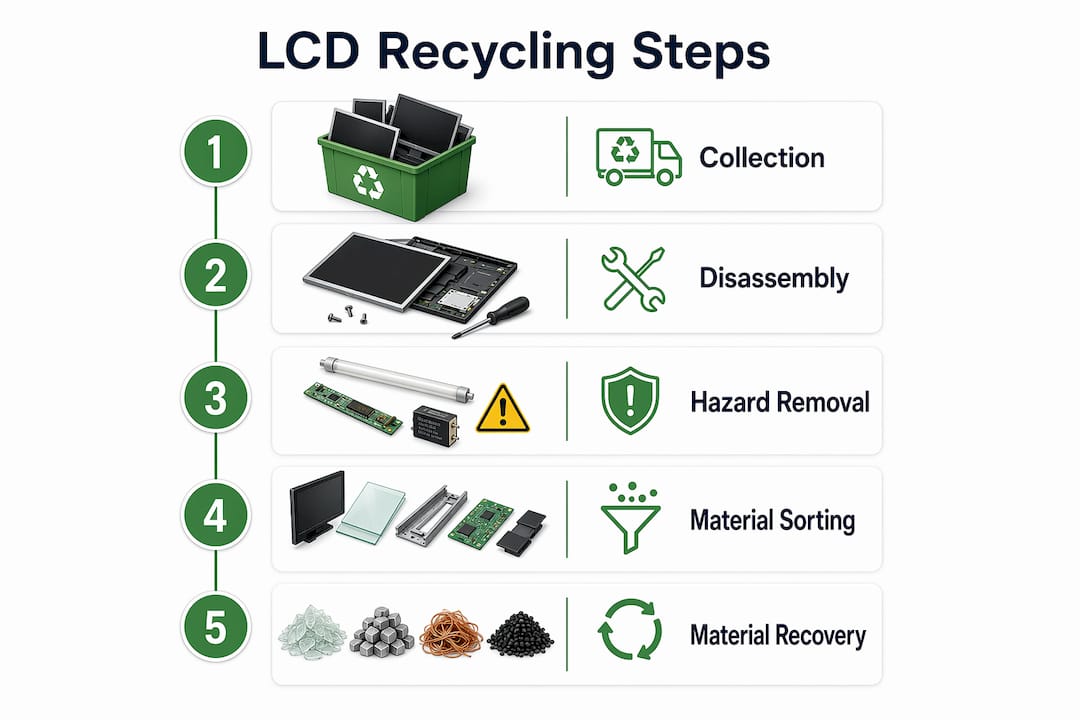
The LCD recycling process follows a structured sequence designed to isolate hazardous parts before anything gets shredded or chemically treated. Skipping steps, especially the manual removal of CCFLs, creates mercury contamination that can render an entire batch of materials unrecyclable.
Typical process stages:
- Collection and transport — devices shipped intact to certified facilities
- Data wiping — storage components cleared before disassembly begins
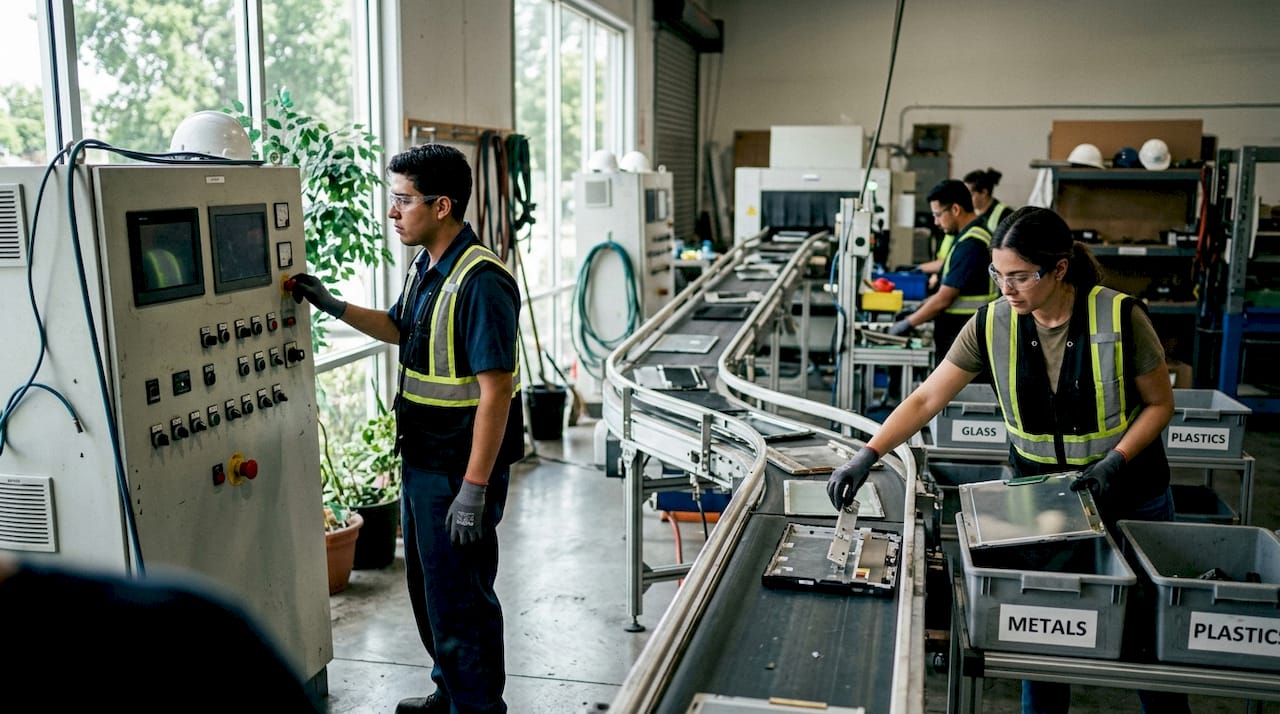
- Manual disassembly — trained technicians remove CCFLs and PCBs by hand
- Material separation — glass, plastics, metals, and optical films sorted into streams
- Hydrometallurgical or biometallurgical recovery — acids or microorganisms extract indium and other metals from ITO glass
- Polymer and liquid crystal recovery — solvents reclaim optical films and liquid crystals
Advanced facilities now use mechanical, chemical, and biological methods to recover virtually all bulk materials from LCD waste, including indium at yields up to 84% purity in pilot-scale processes. Recovering indium still requires pretreatment to concentrate it in the feedstock, since its content varies widely across different screen generations and sizes.
Pro Tip: Never attempt to disassemble an LCD screen yourself. DIY disassembly releases mercury vapors and generates regulated hazardous waste that most municipal drop-off centers will not accept.
What U.S. regulations govern LCD screen disposal?
LCD monitors fall under electronic waste regulations at both the federal and state level, though the specifics vary by location. California’s Department of Toxic Substances Control (DTSC) classifies LCD screens with CCFLs as universal waste lamps when recycled, or as hazardous waste when disposed of, each carrying different labeling and accumulation time requirements.
For businesses, the stakes are higher. Large Quantity Generators face a 90-day accumulation limit for mercury-containing lamps, while Small Quantity Generators get 180 days. Sending universal waste lamps to a facility not authorized to recycle them is a serious regulatory violation for both the sender and the recipient.
Key legal requirements and options:
- Households in most states can recycle LCD screens for free through state programs
- Businesses may pay fees depending on volume and location
- California Electronic Waste Recycling Program covers LCD monitors as Covered Electronic Waste (CEW)
- E-Cycle Washington offers free recycling for monitors and TVs statewide
- CCFLs destined for disposal must travel on a hazardous waste manifest to a Class I landfill
For a detailed look at monitor disposal compliance requirements by business size, Usedcartridge covers the regulatory landscape in depth.
What makes LCD screen recycling so challenging?
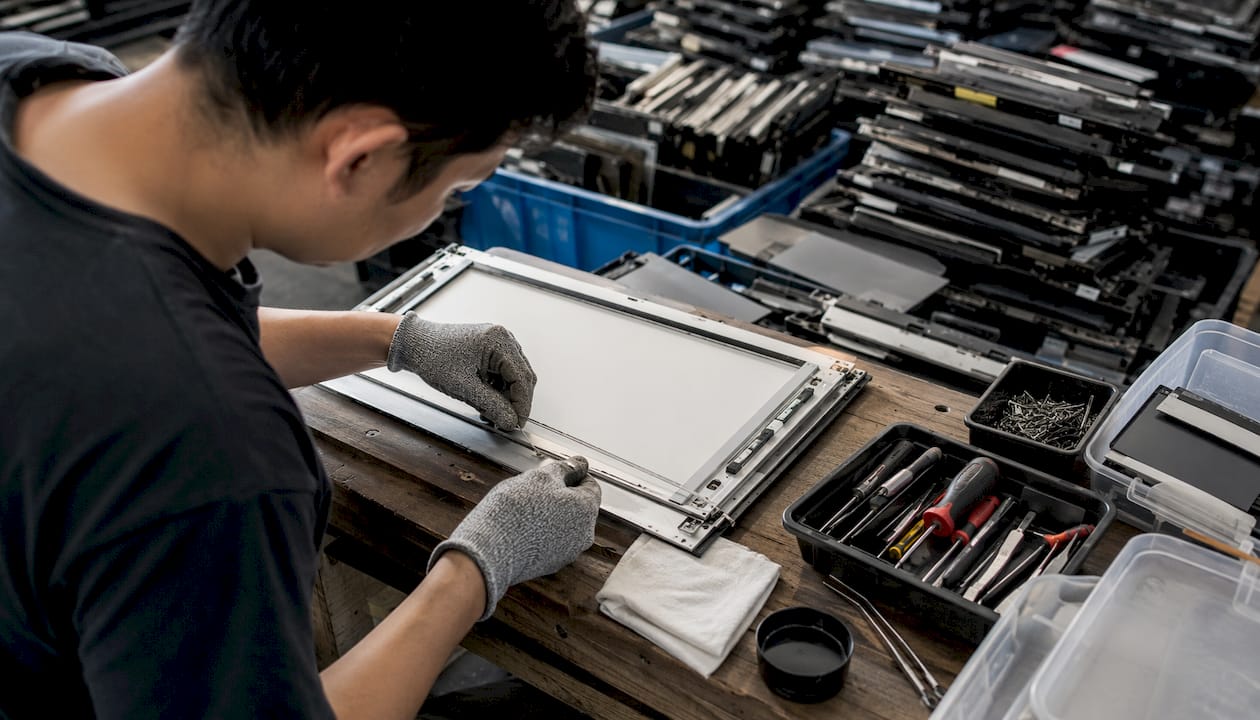
The fragility of CCFLs is the central problem. Removing them without breaking the lamp requires slow, careful manual work, and even trained technicians occasionally cause breakage. Once a lamp breaks, mercury vapor contaminates the workspace and the surrounding materials, triggering a hazardous waste response.
Beyond mercury, material heterogeneity across LCD generations creates real complications. Indium content varies widely depending on screen size, manufacturer, and production year, making it difficult to predict recovery yields or build cost-effective processing lines. Most indium recovery research has only reached lab or pilot scale, and a fully commercial recycling technology is still lacking.
Common challenges and best practices:
- Challenge: Fragile CCFLs break during removal, releasing mercury
Best practice: Use only trained personnel at certified facilities - Challenge: Low and variable indium concentration in ITO glass
Best practice: Pretreat feedstock to concentrate indium before leaching - Challenge: Mixed plastics and optical films complicate sorting
Best practice: Manual pre-sort before mechanical processing - Challenge: Limited certified recyclers in some U.S. regions
Best practice: Ship devices intact to the nearest certified handler
Pro Tip: When selecting a recycling service, look for facilities that handle hazardous e-waste removal with documented mercury containment protocols and certified hazardous waste handling credentials.
How do pre-2009 and post-2009 LCD screens differ for recycling?
The year 2009 marks a meaningful dividing line in LCD recycling. Screens manufactured before roughly 2009 almost universally used CCFL backlights, meaning every one of them contains mercury and must be treated as hazardous material during disassembly.
Post-2009 screens increasingly shifted to LED backlights, which contain no mercury. An LED-backlit LCD monitor still requires proper recycling for its indium, glass, and PCBs, but it does not carry the same mercury hazard. The practical difference: older screens demand more careful handling, higher processing costs, and stricter regulatory compliance than newer ones. If you are recycling a monitor from before 2009, assume it has a CCFL and treat it accordingly.
What are the real benefits of recycling LCD screens?
Recycling LCD screens keeps toxic metals out of landfills, where they would otherwise leach into soil and groundwater for decades. That alone justifies the effort. But the resource recovery side is equally compelling: indium is listed as a critical raw material by the European Commission, and recovering it from waste screens reduces dependence on primary mining.
Aluminum, copper, glass, and plastics recovered from LCD waste all re-enter manufacturing supply chains, cutting the energy and emissions tied to extracting virgin materials. Liquid crystals, when recovered at sufficient purity, can be reused directly in new display panels. For organizations managing large monitor fleets, recycling electronic waste responsibly also satisfies corporate sustainability reporting requirements and reduces liability under state e-waste laws.
Usedcartridge provides certified e-waste recycling services for individuals and organizations across the United States, handling LCD screens, monitors, and other electronics with full hazardous waste compliance and documented chain of custody.

Key Takeaways
LCD screen recycling recovers critical metals like indium and copper while safely containing mercury from CCFL backlights, preventing toxic contamination of soil and groundwater.
| Point | Details |
|---|---|
| Mercury is the primary hazard | CCFL backlights in pre-2009 screens contain mercury; breakage releases toxic vapors immediately. |
| E-waste drives landfill pollution | E-waste accounts for about 70% of toxic metal effluent in landfills, making proper disposal high-impact. |
| Indium recovery is complex | Indium content varies widely across screen generations, requiring pretreatment before chemical extraction. |
| Pre-2009 screens need extra care | Screens made before 2009 almost always use CCFL backlights and must be handled as hazardous waste. |
| Free programs exist for households | State programs like E-Cycle Washington offer free LCD monitor recycling to keep hazardous electronics out of landfills. |