
Only 22.3% of global e-waste is formally collected and recycled each year. For IT professionals and environmental managers, that number should feel uncomfortable. The role of recycling in IT lifecycle management extends far beyond what happens when a laptop gets retired. It touches product design, procurement decisions, asset deployment, and the moment a device finally leaves your building. Most organizations focus narrowly on end-of-life disposal and miss enormous opportunities for cost recovery, regulatory compliance, and environmental impact reduction along the way. This article covers where recycling fits at every stage and why that changes how you should manage IT assets.
Table of Contents
- Key takeaways
- The role of recycling in IT lifecycle stages
- Design-for-recycling and the circular economy in IT
- Advanced ITAD and secure recycling workflows
- Building an effective IT recycling program
- My perspective: recycling as lifecycle architecture
- How Usedcartridge can support your IT recycling goals
- FAQ
Key takeaways
| Point | Details |
|---|---|
| Recycling starts at design | Design-for-recycling principles can reduce environmental impact by up to 90% before a product is ever deployed. |
| Circular economy is a strategy | Treating IT assets as circulating resources rather than disposable equipment reduces costs and raw material dependency. |
| ITAD is evolving fast | IT asset disposition programs now rely on digital platforms and certified vendors to secure data and maximize recovery. |
| Compliance requires carbon data | ISO/IEC TS 19770-13 requires actual Product Carbon Footprint data for accurate Scope 3 emissions reporting. |
| Cross-functional teams win | Sustainable IT recycling programs succeed when IT, procurement, and sustainability leaders collaborate on shared goals. |
The role of recycling in IT lifecycle stages
The IT lifecycle runs through five phases: design, procurement, deployment, active use, and end-of-life. Recycling touches all five, though most organizations only notice it at the last one. That gap is where significant value gets lost.
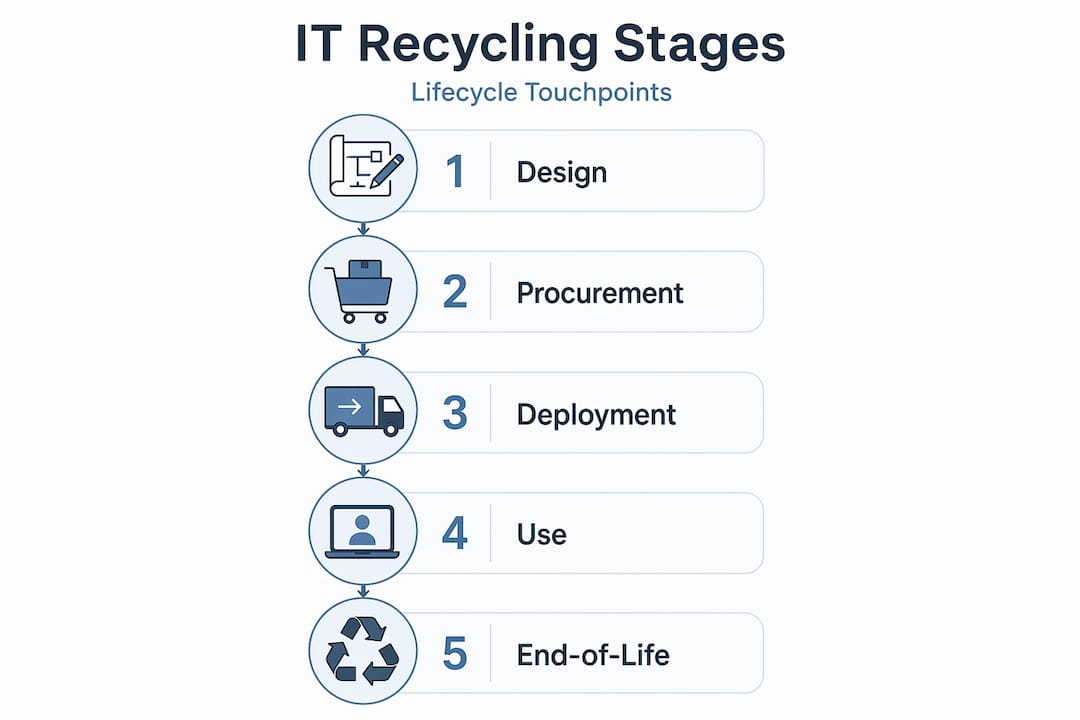
Design and procurement are where recycling impact is highest and most overlooked. Design-for-recycling principles applied during manufacturing can reduce a product’s environmental footprint by up to 90%. When procurement teams prioritize vendors using modular architecture and recyclable materials, they set the entire lifecycle up for better outcomes. Asking vendors for recyclability data at the purchasing stage is not common practice yet. It should be.
Deployment and active use create opportunities for repair, refurbishment, and component reuse that extend asset life and delay the resource cost of replacement. A device repaired and redeployed internally consumes no new raw materials. Organizations that track IT hardware through its lifecycle can identify which assets are candidates for refurbishment versus retirement, converting what would have been waste into working inventory.
End-of-life is the phase most people associate with recycling, and it carries real weight. It involves:
- Formal collection through certified recyclers
- Secure data destruction before any device leaves the premises
- Materials recovery, where metals, plastics, and rare earth elements re-enter the supply chain
- Compliance documentation for regulatory and ESG reporting
Pro Tip: Build your end-of-life process backward from compliance requirements. Know which certifications your recycler holds and which data destruction standards apply to your industry before a single device is retired.
The economic case for recycling is not abstract. The EPA reports that recycling generates approximately 1.57 jobs and over $76,000 in wages per 1,000 tons processed, alongside measurable tax revenue. When IT recycling is treated as infrastructure rather than a cost center, it becomes a contributor to both sustainability goals and organizational economics.
Design-for-recycling and the circular economy in IT
The circular economy applied to IT assets works on three principles: eliminate waste at the source, keep materials circulating at their highest value, and avoid degrading natural resources. This is not theoretical. It is changing how products are designed and how organizations manage their IT portfolios.
Modular design is one of the clearest applications. Devices built so that components can be swapped, upgraded, or removed without destroying other parts dramatically improve recyclability. It also extends usable life by making repair economically viable. Compare that to a device bonded with adhesive, housing a soldered battery and non-removable memory. One is built for a circular model. The other is designed for landfill.
Several innovations are accelerating these changes:
- Digital product passports attach material and component data to a device throughout its life, enabling recyclers to process it accurately at end-of-life.
- Molecular marking allows recycled content verification at the material level, transforming recovered plastic into a verified, tradable asset rather than generic waste.
- Sustainable material substitution replaces hard-to-recover compounds with materials that retain value through the recycling process.
- Lifecycle intelligence platforms aggregate data across the asset fleet to inform procurement, refurbishment, and retirement decisions in real time.
Regulatory frameworks are pushing this further. Standards like ISO/IEC TS 19770-13 now require IT organizations to use actual Product Carbon Footprint data for Scope 3 emissions reporting, which directly pressures supply chains to document recyclability and material composition.
“The circular economy approach requires integrating design, material choices, and lifecycle intelligence strategically.” This means the decisions your procurement team makes today about which IT equipment to buy will determine what your recycling outcomes look like three to five years from now.
State-level regulations also create compliance pressure. Understanding Massachusetts disposal regulations as one example shows how regional rules increasingly shape acceptable IT disposal practices for organizations operating across multiple locations.
Advanced ITAD and secure recycling workflows
IT asset disposition, commonly called ITAD, has matured considerably. What once meant arranging a pickup and hoping for the best now involves certified downstream vendors, digital tracking platforms, and documented chain-of-custody processes.

Enterprise ITAD programs are shifting toward platform-based models that integrate multi-site organizations with certified recyclers. This matters because visibility and consistency are the two things most enterprise recycling programs lack. A platform approach connects your facilities across telecom, healthcare, finance, or any other sector to a standardized disposition workflow where every asset is tracked from collection to final materials processing.
The secure data destruction component is non-negotiable. Any recycling workflow that does not start with verified data destruction creates legal and reputational risk. Certified destruction means documented proof: serial numbers, destruction method, date, and chain of custody. For regulated industries, this documentation is not optional.
Beyond security, advanced recycling workflows support:
- Refurbishment pipelines that capture value from devices still functional enough for secondary markets
- Parts harvesting for components with remaining useful life, reducing demand for newly manufactured parts
- Material recovery reporting that feeds directly into ESG disclosures
- Asset recovery credits that offset the cost of new hardware procurement
Lenovo’s asset recovery program offers a scaled example. The company processed over 94,000 metric tons of IT equipment globally, with 71% reused or refurbished rather than recycled into raw materials. That ratio reflects what a genuinely circular IT model looks like at enterprise scale. Reuse before recycling is the right hierarchy.
Pro Tip: When evaluating ITAD vendors, ask specifically for downstream certification documentation. R2 or e-Stewards certification confirms your equipment does not get laundered through non-certified facilities after pickup.
Digital tracking platforms now give IT managers consistent visibility into disposition status across multiple sites. This directly improves your ability to report on recycling outcomes in sustainability disclosures and respond to audits with hard data.
Building an effective IT recycling program
Moving from awareness to a functioning IT recycling program requires structure. The organizations that do this well share a few common traits: cross-functional ownership, certified partners, and technology that connects the dots between asset data and recycling outcomes.
Here is a practical framework for building or improving your program:
- Audit your current asset fleet. Know what you have, how old it is, and what your retirement schedule looks like over the next 24 months. You cannot plan recycling without knowing volumes and timing.
- Map compliance requirements. Identify which regulations apply to your industry and locations. Data privacy laws, environmental disposal mandates, and ESG reporting standards all shape what your recycling program must deliver.
- Select certified recyclers. R2v3 and e-Stewards certifications are the relevant benchmarks for responsible IT disposal. Verify that certification covers downstream vendors, not just the pickup company.
- Integrate asset tracking. Lifecycle intelligence tools that track devices from purchase to retirement give you the data you need for accurate carbon footprint reporting and ESG disclosures.
- Establish asset recovery credits. Negotiate upfront with your ITAD provider for credits on resalable hardware. This revenue can offset procurement costs and creates a financial incentive to maintain the program.
| Program element | Common mistake | Better approach |
|---|---|---|
| Data destruction | Relying on software wipe only | Require certified physical destruction with documentation |
| Recycler selection | Choosing based on price | Verify downstream certifications and audit rights |
| ESG reporting | Using estimated carbon data | Transition to actual Product Carbon Footprint data per ISO/IEC TS 19770-13 |
| Asset recovery | Treating old hardware as cost | Negotiate recovery credits and refurbishment pipelines |
| Team ownership | IT handles alone | Build cross-functional team with sustainability and procurement |
IT lifecycle sustainability programs that integrate procurement decisions with recycling outcomes consistently outperform programs that treat recycling as a separate, reactive activity. The difference is planning. Build recycling into procurement criteria, refresh cycles, and vendor contracts rather than addressing it only when devices pile up.
My perspective: recycling as lifecycle architecture
I’ve spent years working with organizations that treat IT recycling as something that happens after the real work is done. A device gets retired, someone calls a vendor, and the problem disappears. That thinking is the core of why most e-waste never reaches a certified recycler.
What I’ve learned is that the upstream decisions carry more weight than anyone wants to admit. The materials in a device, the architecture it uses, the vendor who built it. These choices made at procurement determine whether that asset can be economically refurbished three years later or whether it ends up as a disposal liability. By the time a device hits end-of-life, most of the environmental cost is already locked in.
The organizations I’ve seen get this right share one characteristic: they treat recycling as architecture, not cleanup. They build responsible IT disposal into procurement criteria, vendor contracts, and refresh cycles. Their sustainability teams have a seat at the IT table before the purchase order is signed.
The honest barrier is organizational. IT wants uptime. Procurement wants price. Sustainability wants compliance. Getting those three groups aligned around circular lifecycle principles requires shared metrics and executive support. Digital traceability tools help because they make the data visible to all three. Once everyone can see the asset recovery credits, carbon reduction numbers, and compliance status in one place, the conversation changes.
Recycling is infrastructure. Treating it like an afterthought costs more than it saves.
— Keith
How Usedcartridge can support your IT recycling goals

Usedcartridge offers the kind of end-to-end IT recycling support that turns the framework above into real outcomes. From certified IT asset recovery and secure on-site data destruction to full compliance documentation and computer recycling services, Usedcartridge handles the process with verifiable, audit-ready results.
The benefit for IT professionals and environmental managers is straightforward: you get certified documentation, data security compliance, and material recovery value without managing multiple vendors. Usedcartridge provides free quotes and pickup options, making it practical for organizations managing large refresh cycles or single-site cleanouts alike.
If your organization needs to align IT retirement practices with ESG goals and data security requirements, connecting with Usedcartridge is a direct path from planning to execution. Request a quote and start recovering value from assets that are currently sitting idle or headed for non-compliant disposal.
FAQ
What is the role of recycling in IT lifecycle management?
Recycling supports every phase of the IT lifecycle, from design-for-recycling principles that reduce environmental impact at manufacturing through end-of-life material recovery and secure data destruction. It is not just an end-of-life activity but a design and procurement consideration.
How does recycling impact IT sustainability goals?
Recycling reduces raw material extraction, extends asset life through refurbishment, and generates verified carbon reduction data needed for Scope 3 ESG reporting under standards like ISO/IEC TS 19770-13. Organizations with structured recycling programs report measurable improvements in both environmental metrics and asset recovery revenue.
What certifications should I look for in an IT recycler?
R2v3 and e-Stewards are the two leading certifications for responsible IT asset disposition. Both cover downstream vendor accountability, meaning the certification follows your equipment through the entire recycling chain, not just the initial collection step.
Why is secure data destruction part of IT recycling?
Data destruction is a prerequisite for recycling any device that stored sensitive information. Without certified destruction and chain-of-custody documentation, retiring equipment creates legal exposure under data privacy laws regardless of how the hardware itself is processed.
What economic benefits does IT recycling provide?
Beyond environmental impact, recycling IT assets generates asset recovery credits from resalable hardware, reduces procurement costs, and creates documented ESG data that supports regulatory compliance and investor reporting. The EPA estimates recycling generates over $76,000 in wages per 1,000 tons processed, reflecting its broader economic value.