
Effective e-waste employee training combines initial safety instruction, regulatory compliance education, hands-on practice, and ongoing reinforcement. Done right, it protects workers from real chemical and electrical hazards, keeps your organization on the right side of federal and state law, and builds the kind of environmental culture that actually sticks. The core components every program needs are:
- Initial education: Cover what e-waste is, why it matters, and your organization’s specific disposal policies and designated collection points.
- Regulatory compliance: Train staff on applicable rules, including EPA guidelines and state-level requirements such as California’s CalRecycle program.
- Hazard awareness and PPE: Teach workers to recognize toxic dust, heavy metals, and electrical risks, and show them exactly how to use protective equipment.
- Sorting and disposal procedures: Walk employees through the physical steps of identifying, separating, storing, and handing off e-waste for certified recycling.
- Assessment and reinforcement: Use quizzes, practical tests, and scheduled refreshers to verify knowledge and close compliance gaps over time.
- CSR alignment: Connect training to your organization’s broader sustainability goals so employees see the purpose behind the procedures.
The sections below break each component into practical steps you can implement immediately.
1. How to build a strong foundation with initial e-waste education
The first training session sets the tone for everything that follows. Employees who understand why e-waste handling matters, not just what to do, tend to follow procedures more consistently. Start with the environmental and health stakes: discarded electronics contain lead, mercury, cadmium, and flame retardants that leach into soil and groundwater when improperly disposed of. The California Department of Public Health specifically flags toxic dust and chemical exposure as primary occupational hazards in e-waste recycling environments.
Once the “why” lands, move to your organization’s specific policies. Employees need to know where collection containers are located, which devices qualify as e-waste, and who to contact when something falls outside the standard process. Businesses that invest in employee training report smoother e-waste operations and fewer compliance issues, largely because workers stop guessing and start following a clear path.
Practical sorting instruction belongs in this first session too. Show employees how to separate computers, monitors, printers, batteries, and mobile devices from general trash and from each other. Different device categories often go to different certified processors, and mixing them creates downstream problems for your recycling partner.
- Cover the regulatory landscape: Explain that the EPA oversees e-waste at the federal level, and that many states layer additional requirements on top. California’s Electronic Waste Recycling Act, for example, mandates specific handling and fee structures that affect any organization operating in the state.
- Map disposal locations physically: Walk employees through the facility and point out labeled collection stations. A poster on the wall is not a substitute for a live walkthrough.
- Explain data security as part of disposal: Devices containing sensitive data require certified destruction before recycling. Employees who handle IT equipment need to know this step exists and who owns it.
- Use visual reinforcement: Post clear signage at every collection point showing accepted device types and prohibited items. Familiarity with containers and labels directly reduces contamination in recycling streams.
Pro Tip: Run the initial training session in the actual workspace rather than a conference room. Employees retain procedural information better when they learn it in the environment where they will apply it.
2. Techniques for keeping e-waste knowledge current over time
Initial training fades. Research on active learning consistently shows that employees engaged in real-life case studies and interactive simulations retain practical skills far better than those who sit through a one-time lecture. The goal of ongoing education is not to repeat the same content, but to deepen it and adapt it as regulations, equipment, and organizational processes change.
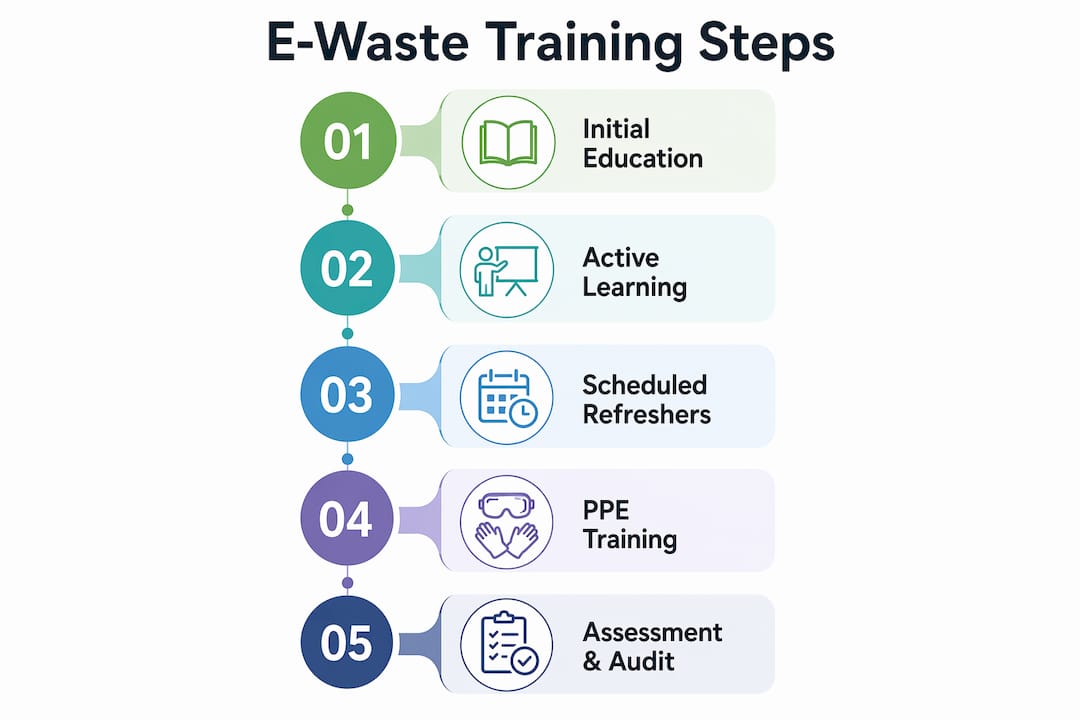
Structured refreshers work best when they are scheduled in advance rather than triggered by incidents. Quarterly webinars, annual in-person updates, and brief monthly communications each serve a different purpose: webinars handle regulatory updates efficiently, annual sessions allow for hands-on practice, and monthly emails or intranet posts keep e-waste top of mind without demanding much time.
Simulations deserve special attention. A tabletop exercise where employees work through a scenario, say, a shipment of mixed devices arrives with no documentation, forces them to apply policy knowledge in real time. That kind of practice surfaces gaps that a quiz never would.
Structured approaches that work:
- Quarterly regulatory briefings: Assign someone to monitor EPA and state agency updates, then summarize changes in a 15-minute team meeting or short video.
- Annual hands-on refreshers: Bring employees back to the collection stations for a live sorting exercise. Rotate the device types to keep it from feeling routine.
- Scenario-based simulations: Present realistic workplace situations where the correct e-waste decision is not obvious. Debrief as a group afterward.
- Recognition programs: Acknowledge employees or teams who consistently follow proper procedures. Public recognition costs nothing and reinforces the behavior you want to see.
- Feedback loops: Create a simple channel, a shared inbox or a monthly five-minute check-in, where employees can flag unclear procedures or suggest improvements. Acting on that feedback signals that management takes the program seriously.
Beyond the schedule, vary the format. Video modules, printed job aids, peer-led discussions, and short e-learning modules each reach different learners. An e-waste management training program that covers device life cycles, collection methods, and disposal best practices gives trainers a ready-made curriculum to adapt rather than build from scratch.
- Use real incident examples: When a compliance issue or near-miss occurs in your industry, share a sanitized version with your team as a learning case.
- Tie refreshers to equipment changes: Every time your organization retires a new category of device, that is a natural trigger for a targeted update session.
- Track completion rates: If only half your team completes the annual refresher, that is a program design problem, not an employee motivation problem.
3. What hazards do employees actually face when handling e-waste?
E-waste is not just old computers. It is a category of materials that can expose workers to lead solder, mercury in fluorescent backlights, cadmium in batteries, beryllium in circuit boards, and brominated flame retardants in plastic casings. The CDPH guidance on electronic waste recycling identifies toxic dust as one of the most consistent hazards, particularly when devices are disassembled or shredded without adequate controls.

Electrical hazards are a separate category. Capacitors in monitors and power supplies can hold a charge long after a device is unplugged. Employees who open equipment without training risk serious shock. Safe disassembly protocols, including discharge procedures and lockout/tagout practices aligned with California’s Title 8 regulations, address this directly.
Ergonomic risks round out the picture. Large servers, UPS battery units, and CRT monitors are heavy and awkward. Improper lifting technique causes musculoskeletal injuries that are entirely preventable with basic training.
“Workers in e-waste recycling facilities face a complex mix of chemical, physical, and ergonomic hazards. Effective training must address all three categories, not just the most visible ones. Toxic dust exposure, in particular, requires engineering controls and respiratory protection working together, since neither alone is sufficient.” — California Department of Public Health, Electronic Waste Recycling: Working Safely
Common hazards and the controls that address them:
- Toxic dust and fumes: Use local exhaust ventilation at disassembly stations. Require N95 respirators or better when ventilation is not available.
- Chemical exposure: Train employees to read Safety Data Sheets (SDS) for materials they handle. California’s Hazard Communication Standard under Title 8 Section 5194 requires SDS access for all hazardous substances.
- Electrical risks: Enforce a no-solo-disassembly rule for high-voltage equipment. Require discharge verification before any internal access.
- Heavy lifting: Set a two-person lift requirement for items over 50 pounds. Provide hand trucks and carts at collection stations.
- Contamination spread: Designate e-waste handling areas separately from general workspaces. Require hand washing after any contact with device components.
The EMEP program at Auburn University offers a publicly available curriculum framework that covers many of these hazard categories, which trainers can reference when building their own safety modules.
4. Which PPE do employees need for safe e-waste handling?
The right personal protective equipment depends on the specific task, not a one-size-fits-all list. An employee logging incoming devices at a collection point faces different exposure risks than one disassembling circuit boards. Train employees to match their PPE to the task before they start, not after something goes wrong.
Core PPE for e-waste handling:
- Nitrile gloves: Protect against chemical residues on device surfaces and sharp edges during disassembly. Replace after each session or immediately if torn.
- Safety goggles: Required whenever there is any risk of dust, debris, or chemical splash. Standard eyeglasses do not provide adequate side protection.
- N95 respirator or half-face respirator: Necessary during any disassembly, shredding, or sorting that generates airborne particles. The CDC’s National Institute for Occupational Safety and Health (NIOSH) certifies respirator ratings.
- Protective coveralls or lab coat: Prevents chemical transfer to personal clothing, which can carry contaminants home.
- Steel-toed boots: Required when handling heavy equipment that could fall during transport or staging.
- Anti-static wrist strap: Protects both the worker and sensitive components from electrostatic discharge during device handling.
| PPE Item | When Required | Replacement Trigger |
|---|---|---|
| Nitrile gloves | All device handling tasks | Visible damage or end of shift |
| Safety goggles | Disassembly, sorting, shredding | Scratched lenses or broken frame |
| N95 respirator | Dust-generating tasks | After 8 hours of use or if damaged |
| Protective coveralls | Disassembly and chemical contact tasks | Visible contamination |
| Steel-toed boots | Moving heavy equipment | Worn sole or structural damage |
| Anti-static wrist strap | Handling circuit boards and components | Broken connection or frayed cord |
PPE compliance requires more than handing out equipment. Employees need to see a demonstration of correct donning and doffing, understand why each item matters, and know where to find replacements. Post a visual PPE guide at every workstation where e-waste is handled. Inspect stored PPE monthly and remove any item that is past its service life.
Pro Tip: Run a brief PPE inspection drill at the start of each shift. Employees who check their own equipment before starting work catch problems before they become injuries.
5. How CSR alignment and employee engagement strengthen e-waste training
Training programs that connect to something larger than compliance tend to produce better outcomes. Training aligned with Corporate Social Responsibility goals can boost employee commitment to circular economy initiatives. That commitment shows up in behavior: employees who understand how their actions connect to the organization’s environmental goals are more likely to follow procedures consistently and flag problems when they see them.
Green HRM practices, meaning HR policies that explicitly incorporate environmental performance, create the structural conditions for this kind of engagement. When e-waste training is framed as part of a broader green e-waste management strategy rather than a compliance checkbox, employees respond differently. The training feels purposeful rather than bureaucratic.
Statistic callout: CSR-aligned training programs strengthen employee commitment to circular economy principles, and employee engagement significantly mediates the impact of Green HRM training practices on organizational performance.
Practical ways to build this connection into your program:
- Share organizational sustainability metrics: Tell employees how much e-waste your organization diverted from landfill last quarter. Concrete numbers make the impact visible.
- Link training to the circular economy: Explain how properly recycled devices recover materials that re-enter manufacturing, reducing the need for virgin resource extraction.
- Involve employees in goal-setting: Ask teams to propose e-waste reduction targets for their department. Ownership of a goal changes how people pursue it.
- Report progress publicly: Post recycling totals in common areas or include them in internal newsletters. Visibility sustains motivation between training sessions.
- Recognize environmental champions: Designate a rotating role for an employee who leads e-waste awareness activities in their team. Peer influence is often more effective than top-down messaging.
Measuring engagement over time matters as much as building it initially. Track participation rates in voluntary training activities, monitor the volume of employee-submitted improvement suggestions, and survey staff annually on their confidence in e-waste procedures. Declining participation is an early signal that the program needs a refresh, not a heavier compliance push.
6. How do you measure whether e-waste training is actually working?
Assessment is where most e-waste training programs fall short. A sign-off sheet proves attendance, not understanding. Effective evaluation uses multiple methods, each designed to surface a different kind of gap.
Quizzes and knowledge checks work best immediately after a training session and again 30 days later. The gap between the two scores tells you how much knowledge is actually retained versus temporarily recalled. Keep questions scenario-based rather than definitional: “An employee finds an unlabeled battery pack near a printer. What are the correct next steps?” tests applied knowledge in a way that “What does e-waste stand for?” never will.
Practical assessments require employees to demonstrate a skill rather than describe it. Have them sort a mixed batch of devices into the correct collection streams, or walk through the PPE donning sequence while a trainer observes. Regular evaluation of this kind identifies knowledge gaps and reinforces compliance in ways that written tests cannot.
Participation tracking catches a different problem: employees who complete assessments but disengage from the program between sessions. Track attendance at refresher sessions, completion rates for e-learning modules, and response rates to compliance communications. A team with 100% quiz scores but 40% refresher attendance has a structural problem worth addressing.
Compliance audits close the loop between training and actual behavior. Conduct unannounced spot checks of collection stations, storage areas, and disposal records. Compare audit findings against training completion data to identify whether specific gaps correlate with specific training deficiencies.
Build a simple tracking dashboard that shows, by team or department, training completion rates, assessment scores, audit findings, and the date of each employee’s last refresher. That view makes it easy to prioritize where to focus next.
7. What training materials and resources actually help?
The quality of your training materials determines how much of the content employees retain. Generic slide decks with stock photos of recycling bins do not move the needle. The resources that work are specific, visual, and tied to the actual devices and procedures in your workplace.
High-impact materials to build or source:
- Facility-specific job aids: One-page laminated cards posted at collection stations showing accepted device types, prohibited items, and the contact number for questions. Generic posters get ignored; location-specific ones get used.
- Video demonstrations: Short videos (under five minutes) showing correct PPE donning, device sorting, and safe disassembly are far more effective than written instructions for procedural tasks. Record them in your actual facility with your actual equipment.
- SDS binders and digital access: Every workstation where employees handle e-waste components needs immediate access to Safety Data Sheets for the materials present. California’s Title 8 Section 5194 requires this; OSHA’s federal Hazard Communication Standard mirrors it.
- The CDPH e-waste safety guide: The California Department of Public Health publishes a detailed guide on working safely with e-waste that covers chemical hazards, engineering controls, and medical surveillance. It is free, authoritative, and directly applicable to training program development.
- EMEP curriculum framework: The E-waste Management Education Program developed through Auburn University provides a structured educational framework that trainers can adapt for their organization’s specific context.
- E-learning platforms with e-waste modules: Instructor-led corporate training courses covering e-waste life cycles, collection methods, and disposal best practices give trainers a ready-made starting point. Look for programs that include assessments and completion tracking.
- Regulatory reference documents: Keep current copies of applicable EPA guidance, your state’s e-waste regulations, and OSHA standards accessible to trainers and safety officers. Regulations change; your training materials need to reflect current requirements.
For organizations managing large volumes of IT equipment, pairing internal training with a certified external partner adds a layer of accountability. Usedcartridge provides secure e-waste disposal and recycling services with documented chain-of-custody records, which can serve as real-world examples in your training program and as evidence of compliance in audits.
The electronics disposal planning resources available through Usedcartridge also give trainers concrete procedural frameworks to reference when building step-by-step disposal instructions for employees.
Circular economy principles are increasingly part of corporate e-waste training curricula. Resources that explain sustainable electronics practices in the context of green IT give employees a broader frame for understanding why proper disposal connects to resource recovery and reduced environmental impact.
Key Takeaways
Effective e-waste employee training requires combining safety instruction, regulatory compliance, hands-on practice, and CSR-aligned reinforcement to produce lasting behavioral change across the organization.
| Point | Details |
|---|---|
| Start with hazard awareness | Employees need to understand chemical, electrical, and ergonomic risks before handling any e-waste. |
| Match PPE to the specific task | Gloves, goggles, respirators, and coveralls each serve a different exposure scenario, not a single universal situation. |
| Use active learning methods | Case studies and simulations produce better skill retention than lecture-only sessions. |
| Align training with CSR goals | A survey of HR managers found that employee engagement significantly mediates the impact of CSR-aligned training on organizational performance in circular economy initiatives, strengthening employee commitment and improving outcomes. |
| Assess with multiple methods | Combine quizzes, practical demonstrations, and compliance audits to get a complete picture of training effectiveness. |