
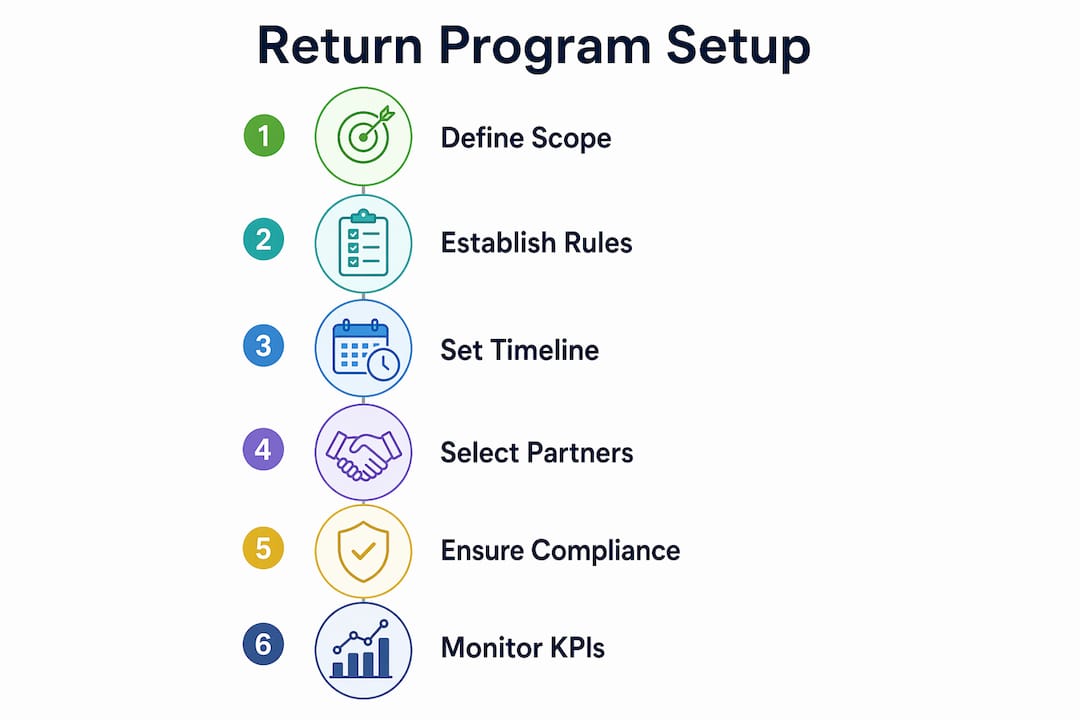
A compliant, value-preserving electronics return program comes down to six operational rules: define scope and policy, build rules-based disposition workflows, design collection logistics, secure data on every storage device, vet partners for certifications and audit-ready documentation, and track recovery KPIs by SKU. Electronics return rates can be significant, and delays in disposition decisions reduce recovery margin.
Six core steps at a glance:
- Scope and policy: Define eligible devices, return windows, and liability allocation.
- Rules-based workflows: Route by SKU, condition grade, and model generation automatically.
- Collection and logistics: Choose mail-back, drop-off, or scheduled on-site pickup based on volume.
- Data security: Require documented sanitization or on-site destruction for all storage-bearing devices.
- Partner vetting: Demand R2 or e-Stewards certification, insurance, and certificates of destruction.
- KPIs and tracking: Measure Net Recovery Rate, triage SLA, and time-to-disposition weekly.
Quick reference targets: triage within 24–72 hours, dock-to-disposition SLA of 48–72 hours, and recovery benchmarks that move from 15–25% at baseline to 55–65% at program maturity.
Table of Contents
- What should your electronics return program actually cover?
- How do you build a rules-based disposition workflow?
- Which collection channels work best for your volume?
- How do you secure data on returned devices?
- What should you require from recycling and logistics partners?
- What tech stack do you need to enforce routing rules?
- What do costs and timelines actually look like?
- How do you stay compliant with U.S. e-waste regulations?
- How do you run a pilot and launch the program?
- Which KPIs tell you if the program is working?
- How Usedcartridge supports businesses launching compliant return programs
- Handling hazardous materials in e-waste
- Key Takeaways
- What most organizations get wrong when launching a return program
- Usedcartridge handles the hard parts for you
- Useful sources and further reading
What should your electronics return program actually cover?
Start with goals, because they drive every downstream decision. A program built for ESG reporting sets different disposition thresholds than one built for maximum asset recovery. Most organizations need both, plus risk mitigation and brand protection.
Device scope to define upfront:
- Laptops, desktops, servers, and workstations
- Printers, copiers, and multifunction devices
- Batteries (including lithium packs) and solar panels
- Peripherals and networking hardware
Geographic coverage matters too. A national program needs carrier agreements for dangerous goods (lithium batteries ship under DOT 49 CFR regulations). A regional program can rely on scheduled pickups. For electronics disposal planning, map where devices are collected versus where they’ll be processed before you write a single SLA.
Return eligibility rules should specify time windows by risk category. High-risk devices (anything with storage) warrant a shorter, tighter window with mandatory data-wipe confirmation before the return is accepted. Policy elements to lock down: who pays return shipping, whether restocking fees apply, exchange-first logic, and how liability transfers during transit.

How do you build a rules-based disposition workflow?
Rules-based routing tied to SKU and condition is the single biggest lever for protecting margin on depreciating electronics. Manual triage is too slow. A laptop loses measurable resale value every week it sits ungraded.
Condition grading tiers and their dispositions:
| Grade | Condition | Disposition |
|---|---|---|
| A | Like new, fully functional | Restock or direct resale |
| B | Minor cosmetic wear, functional | Refurbish and resell |
| C | Functional with defects | Parts harvest |
| D | Non-functional or BER | Certified recycle or destroy |
SERI guidance recommends routing repairable units to refurbishment, non-repairables to parts harvesting, and the remainder to certified recycling. That sequence protects both value and environmental outcomes. Grade D (Beyond Economic Recovery) devices are a liability if sold to unvetted buyers: salvage operations can expose data and dump hazardous waste. Require downstream traceability for every BER unit.
Real-time inventory visibility is what makes the routing engine work. Without SKU-level data flowing from your returns portal into your WMS, operators make disposition calls manually, and manual calls are inconsistent. See the refurbish vs. recycle decision guide for category-level thresholds.
Which collection channels work best for your volume?
Prioritize channels that minimize time to triage. A well-run program targets dock-to-disposition in 48–72 hours; mid-market operations that average 8–14 days lose significant recovery value.
- Mail-back: Low cost per unit, works for small volumes, but requires DG-compliant packaging for lithium batteries and adds 2–5 transit days before triage starts.
- Regional drop-off hubs: Faster triage, better for consumer-facing programs, but requires physical infrastructure or a partner network.
- Scheduled on-site pickup: Best for high-volume B2B returns (server refreshes, fleet retirements). Minimizes handling and keeps chain-of-custody clean from the first touch.
- 3PL-managed returns lanes: Scales well but requires dedicated lanes, not shared inbound, to avoid commingling with forward inventory.
For lithium batteries and other dangerous goods, carriers require UN-certified packaging, proper labeling (UN 3481 or UN 3480), and shipping papers. Certified recycling partners handle this documentation and provide the environmental compliance records needed for audits.
Pro Tip: Contract 3PL SLAs with an explicit 48–72 hour dock-to-disposition commitment and require dedicated returns lanes. Shared inbound docks routinely delay triage by days.
How do you secure data on returned devices?
Require documented, auditable sanitization or approved on-site destruction for every storage-bearing device before it leaves your custody or before a vendor takes possession.
- NIST 800-88 Clear/Overwrite: Acceptable for functional drives being refurbished for resale. Requires verification passes and a logged report per serial number.
- Cryptographic erase: Appropriate for self-encrypting drives (SEDs) and modern SSDs. Fast, but only valid when the device’s encryption was enabled from initial provisioning.
- Physical destruction: Required for Grade D devices, failed drives, and any unit where software methods cannot be verified. On-site destruction keeps chain-of-custody intact and eliminates transit data risk.
Every sanitized or destroyed device needs a certificate tied to its serial number. That certificate is your audit evidence. Without serial-number-level manifesting, you cannot demonstrate compliance to a regulator or an enterprise customer’s security team. Integrate manifesting into your returns portal so certificates generate automatically at disposition, not as a manual afterthought. For a detailed breakdown of methods and documentation, see what you should know about data destruction.
What should you require from recycling and logistics partners?
Partner vetting must treat data security and audit-ready documentation as primary selection criteria, not secondary features. A partner without traceability is a liability, regardless of their price.
Vendor checklist:
- R2 (Responsible Recycling) or e-Stewards certification, current and verifiable
- General liability and cargo insurance certificates naming your organization
- Written EHS (environmental, health, and safety) practices for hazardous materials
- State e-waste compliance documentation for every state where devices are collected
- Sample certificate of destruction and sample chain-of-custody manifest
- Downstream buyer list with their certifications (no bulk liquidation to unvetted buyers)
- On-site destruction capability for high-security or Grade D devices
- SLA commitments in writing: triage time, reporting cadence, and remediation process
Red flags: bulk liquidation without condition testing, no serial-number tracking, and any partner who cannot produce a sample certificate on request. The role of recycling vendors in e-waste compliance covers how to evaluate audit paperwork specifically.
What tech stack do you need to enforce routing rules?
At minimum, connect your returns portal to your WMS and IT asset management (ITAM) system so disposition updates flow into inventory records and finance automatically.
- Returns portal: SKU-level routing rules, condition capture at intake, automated disposition flags, and customer-facing status updates
- WMS integration: Real-time inventory adjustments when a return is graded and dispositioned
- ITAM integration: Serial-number decommissioning, asset status updates, and audit trail for IT compliance
- Finance tags: Disposition outcomes tagged in QuickBooks or Xero so restocking fees and recovery credits hit the right accounts
Operators who skip finance reconciliation obscure their true Net Recovery Rate per SKU. You cannot optimize what you cannot measure. Build daily feeds from your 3PL or WMS into your accounting system from day one. Returns portals that surface exchanges and store credit first also reduce cash refunds and improve retention for customer-facing programs.
What do costs and timelines actually look like?
Include per-unit processing, grading labor, shipping, refurbishment, and downstream fees against expected recovery before you build a business case.
| Stage | Target timeline | Notes |
|---|---|---|
| Triage and grading | 24–72 hours from receipt | Grade A/B to refurb queue same day |
| Refurbishment | 8–14 days | Varies by device complexity |
| Data sanitization | Same day as grading | Certificate issued at completion |
| Resale or recycling | 3–10 days post-disposition | Depends on channel and partner SLA |
Recovery benchmarks from a structured program: baseline programs recover 15–25% of original value. Year 1 with disposition logic and partner SLAs typically reaches 35–45%. By Year 2, mature programs with recommerce channels and finance reconciliation reach 55–65%. The payback on incremental operations spend is usually visible within the first two quarters once grading consistency improves.
How do you stay compliant with U.S. e-waste regulations?
Maintain serial-number-level manifests, certificates of destruction or wiping, and vendor audit reports. Those three document types cover the majority of audit requests from regulators and enterprise customers.
- Chain-of-custody logs: From first touch at intake through final disposition, with timestamps and handler names
- Transport manifests: Required for hazardous materials (batteries, CRTs, mercury-containing devices) under DOT and EPA rules
- Disposal certificates: Issued per device, tied to serial number, signed by the certified processor
- Vendor certifications: Current R2 or e-Stewards certificates on file, renewed annually
State e-waste laws vary significantly. California’s CalRecycle program, for example, imposes different obligations than Texas or New York. Map collection locations to processing locations and confirm your vendor holds the right state authorizations. The electronic disposal regulations list covers state-by-state requirements in detail.
For contaminated or non-compliant returns (devices with unknown substances, damaged batteries, or missing documentation), establish a quarantine lane with a documented escalation path. Assign insurance and liability for transit damage in your vendor contracts before a claim arises, not after.
How do you run a pilot and launch the program?
Run a limited pilot on one product category or one region first. Validate grading rules, SLA compliance, and reporting before scaling.
- Select the pilot: Choose a high-volume, lower-risk category (laptops over servers) and one geographic region.
- Define success metrics: Triage SLA hit rate, grading accuracy, certificate issuance rate, and recovery per unit.
- Train receiving staff: Grading rubric, intake checklist, data-wipe initiation steps, and escalation path for non-compliant returns.
- 30-day checkpoint: Review grading consistency and SLA data; adjust routing rules based on actual condition distribution.
- 60-day checkpoint: Confirm finance reconciliation is working; verify vendor certificates are generating correctly.
- 90-day full rollout: Expand to remaining categories and regions with updated SOPs from pilot learnings.
Launch communications should cover internal handoffs (ops, ITAM, finance), customer-facing messaging in the returns portal, and partner onboarding documentation. Run dry runs for on-site pickup procedures before the first live pickup.
Which KPIs tell you if the program is working?
Track Net Recovery Rate, triage SLA hit rate, time-to-disposition, resale rate, resale yield, and cost per return. Break each down by SKU, category, and collection channel.
- Net Recovery Rate: (Revenue from resale/parts + recycling credits) minus (processing + shipping + refurb costs), divided by original device value. This is the headline metric.
- Triage SLA hit rate: Percentage of returns graded within your 24–72 hour target. Below 80% signals a staffing or intake process problem.
- Time-to-disposition: Days from receipt to final disposition decision. Track by category; servers take longer than laptops.
- Resale rate: Percentage of returns that reach Grade A or B and enter a resale channel.
- Cost per return: Total program cost divided by units processed. Benchmark against recovery to confirm positive unit economics.
Audit vendors annually or when SLA miss rates spike. Internal audits should sample 5–10% of certificates quarterly to verify serial numbers match manifests. A structured program moves recovery from a 15–25% baseline, typically to 35–45% in Year 1, and up to 55–65% at maturity — that gap is the business case for investing in grading consistency and partner quality.
How Usedcartridge supports businesses launching compliant return programs
Usedcartridge provides the operational infrastructure that most organizations need to launch a compliant program without building it from scratch.
Services that map directly to the steps above:
- On-site destruction for Grade D and high-security devices, with certificates issued at the point of destruction
- Certified recycling for laptops, batteries, solar panels, and IT hardware
- IT asset recovery with valuation and direct payout for devices with remaining value
- Audit-ready documentation: chain-of-custody manifests, certificates of destruction, and compliance records
- Pickup and logistics coordination, including free quotes based on device type, volume, and location
To request a quote, prepare a device manifest (types, quantities, approximate age), your location, preferred disposition (reuse vs. recycle vs. destroy), and any certificate requirements your compliance team specifies.
Handling hazardous materials in e-waste
Electronics contain lead, mercury, cadmium, and lithium compounds that trigger federal and state hazardous waste rules. Batteries are the most common compliance gap: lithium cells require UN-certified packaging and DOT shipping papers for transport, and damaged or swollen packs must be isolated in non-conductive containers before any handling.
CRT monitors contain lead-laden glass. Fluorescent backlights in older LCDs contain mercury. Both require separate manifesting under EPA Universal Waste rules (40 CFR Part 273) and cannot be landfilled. Document each hazardous material type on your intake manifest, note condition (intact vs. damaged), and confirm your recycling partner holds the applicable state and federal authorizations for each material class. Gaps in this documentation are the most common finding in state e-waste audits.
Key Takeaways
A compliant electronics return program requires rules-based routing, serial-number-level documentation, certified partners, and finance reconciliation from day one to move recovery from an initial 15–25% baseline to 35–45% in Year 1 and toward 55–65% at program maturity.
| Point | Details |
|---|---|
| Define scope first | Lock down device categories, return windows, and liability allocation before building workflows. |
| Automate disposition routing | Rules-based routing by SKU and condition grade prevents margin erosion on depreciating devices. |
| Require serial-level certificates | Every storage device needs a destruction or wipe certificate tied to its serial number for audit compliance. |
| Reconcile finance from day one | Tag disposition outcomes in QuickBooks or Xero to calculate true Net Recovery Rate per SKU. |
| Usedcartridge as turnkey option | Usedcartridge provides on-site destruction, certified recycling, IT asset recovery, and audit-ready documentation with free pickup quotes. |
What most organizations get wrong when launching a return program
The most common failure is treating triage speed as a logistics problem when it’s actually a rules problem. Teams that wait to build grading rubrics until after launch end up with inconsistent grades, inconsistent dispositions, and recovery data that means nothing. Write the grading rubric before the first device arrives.
The second pitfall is weak vendor traceability. A partner who cannot produce a sample certificate before you sign a contract will not produce reliable certificates after. Test the paperwork during vendor selection, not during an audit.
Finance integration gets skipped most often because it feels like an IT project. It isn’t. Tagging disposition outcomes in your accounting system is a two-hour configuration task that pays back in clear ROI visibility within the first quarter. Without it, your program looks like a cost center even when it’s generating recovery revenue.
Usedcartridge handles the hard parts for you
Skip the vendor search and the compliance paperwork build-out. Usedcartridge gives IT and procurement teams a direct path to certified e-waste recycling, on-site data destruction with serial-level certificates, and IT asset recovery payouts — all with audit-ready documentation included.

The process is straightforward: share your device manifest, volumes, location, and certificate requirements, and Usedcartridge provides a free quote covering pickup logistics and disposition options. Whether you need equipment destruction for a server refresh or a recurring recycling program for end-of-life laptops, the service is built around the compliance controls your operations and legal teams will ask for. Request your IT asset recovery quote to get started.
Useful sources and further reading
Operations, legal, and procurement teams should keep these references in their vendor RFP files and compliance documentation.
- The Journey From Returns to Sustainable Returns (SERI) — Best for operations teams designing disposition workflows and BER handling policies.
- Electronics Returns Strategy: Refurbish, Resell, or Recycle? (Kase) — Practical decision framework for category-level routing; useful for procurement and ITAM leads.
- How to Build a Reverse Logistics Program That Recovers 60% of Return Costs (Ecommerce Times) — Recovery benchmarks, SLA targets, and finance reconciliation guidance; essential for building the business case.
- Consumer Electronics Reverse Logistics (Cubic) — Return rate benchmarks and triage timing data; useful for setting KPI baselines.
- Return & Refund Policy Template (TermsFeed) — Policy drafting reference for legal and compliance teams writing customer-facing return terms.
- Electronic Disposal Regulations List for Business Compliance (Usedcartridge) — State-by-state regulatory reference; keep this in your compliance file and review annually.
- B2B Electronics Recycling: A Clear Guide for Compliance (Usedcartridge) — Vendor vetting and compliance documentation guidance for procurement teams.