
Old TV glass is the cathode ray tube, or CRT, a heavy vacuum-sealed panel formulated with lead, barium, or strontium to shield users from X-rays generated inside the tube. If you have one in your garage, in a shop you’re clearing out, or sitting cracked in a dumpster, the single safest move is simple: don’t break it, don’t open it, and don’t set it out for curbside pickup. Call a certified e-waste recycler or a trained technician instead.
That instruction holds even if the tube looks intact and the TV still turns on. CRTs are vacuum vessels under constant physical stress, and the glass composition that makes them so effective at blocking radiation is exactly what makes them hazardous once they break.
- Don’t break, drill, or pry it open. A cracked CRT can implode and throw glass shards well beyond arm’s length.
- Keep it upright during any move. Tipping the tube stresses the neck and increases fracture risk.
- Skip curbside and regular recycling bins entirely. Standard glass recycling streams reject CRT glass outright.
- If it’s already cracked or shattered, clear the room first. Don’t sweep or vacuum dry powder. See the emergency steps further down for exactly what to do next.
Key Takeaways
Old TV glass is CRT glass, a leaded, vacuum-sealed component that requires certified recycling rather than standard disposal, and shrinking processing capacity makes documentation essential.
| Point | Details |
|---|---|
| Identify before you act | Weight, curved faceplate, and a funnel-shaped rear tube confirm you’re dealing with CRT glass, not modern flat-panel screen. |
| Never break or open it | Vacuum implosion risk and stored electrical charge make DIY disassembly dangerous even on units that look intact. |
| Call a certified recycler | Look for R2 or e-Stewards certification and request a manifest or certificate of recycling before scheduling pickup. |
| Repair is often uneconomical | Replacement picture tubes are scarce, and professional rebuilds can cost several hundred dollars with no guaranteed outcome. |
| Regional capacity is shrinking | California’s last lead-glass recycling facility closed over a decade ago, pushing more CRTs toward Arizona desert landfills; Usedcartridge provides documented, certified pickup and recycling for businesses managing this gap. |
Table of Contents
- What Counts as Old TV Glass, and How Do You Identify It?
- Why Is CRT Glass More Dangerous Than Regular Glass?
- How Do You Safely Move, Store, or Remove a CRT?
- What Should You Do If the Glass Breaks?
- How Do You Dispose of Old TV Glass Responsibly?
- How Do You Vet a Recycler or Removal Service?
- Is It Worth Repairing or Salvaging an Old CRT?
- Why Is Recycling Capacity for CRT Glass Shrinking?
- A Publisher’s Note on Handling This Responsibly
- How Can Usedcartridge Help With Old TV Glass Disposal?
- Frequently Asked Questions
- Sources
What Counts as Old TV Glass, and How Do You Identify It?
“Old TV glass” is shorthand for CRT glass, and once you know the vocabulary, spotting one gets easy. The faceplate (or panel glass) is the flat viewing surface you watched shows on. The funnel is the flared cone-shaped section behind it. The neck is the narrow tube at the very back that housed the electron gun. Inside, a shadow mask (a perforated metal grid) and a phosphor coating on the inner faceplate worked together to produce the picture.
These parts aren’t interchangeable in composition. According to technical documentation on CRT glass, faceplates typically use barium-strontium melts formulated for optical clarity and X-ray absorption, while the funnel and neck are usually made from lead-heavy potash-soda glass. That split matters because it’s part of why CRT glass can’t be tossed into a single recycling stream. The two glass types have to be separated and processed differently, and most facilities that once did that work have shut down.
Here’s a quick way to tell what you’re looking at:
| Feature | CRT (old TV) glass | Modern flat-panel screen |
|---|---|---|
| Weight | Very heavy for its size; a 27-inch tube can weigh 80+ pounds | Light, often significantly less for the same screen size |
| Shape | Deep, curved front, tapering funnel behind it | Flat and thin, usually under 2 inches deep |
| Connectors | Coaxial or RF input, sometimes RCA jacks on the back | HDMI, USB, sometimes VGA |
| Interior | Vacuum-sealed tube visible if the back is removed | No vacuum tube; backlight or LED panel instead |
| Glass feel | Thick, often curved slightly outward at the corners | Thin, uniformly flat |
If you’re staring at an old console TV or a bulky monitor and wondering whether the front panel is bonded protective glass rather than the CRT itself, check for a visible gap or air space between the outer glass and the tube. Many older sets used a separate safety panel glued or clipped in front of the actual CRT faceplate. That distinction matters if you’re trying to figure out what you’re actually removing, since the bonded safety glass is typically ordinary glass, while the tube behind it is the hazardous component.
Why Is CRT Glass More Dangerous Than Regular Glass?
CRT glass isn’t dangerous because it’s old. It’s dangerous because of what’s in it and what it’s holding.
Chemical hazards come first. Cathode ray tubes rely on doped glass, often lead oxide in the funnel and neck, and barium or strontium compounds in the faceplate, specifically to block the X-rays generated when the electron beam strikes the phosphor screen, according to background on how cathode ray tubes are built. A single tube from an older console TV can contain lead oxide locked in the glass, with the quantity depending on screen size. That lead doesn’t go anywhere once the TV stops working. It stays locked in the glass until something breaks it.
Physical hazards come second, and they’re more immediate. A CRT is a sealed vacuum chamber. When the glass fails, air rushes in violently rather than gently, and that pressure differential can send glass fragments flying in every direction, a risk documented in the same overview of CRT construction. This isn’t a theoretical concern reserved for repair technicians. It’s the reason you never hit, drill, or drop a CRT, intact or not.
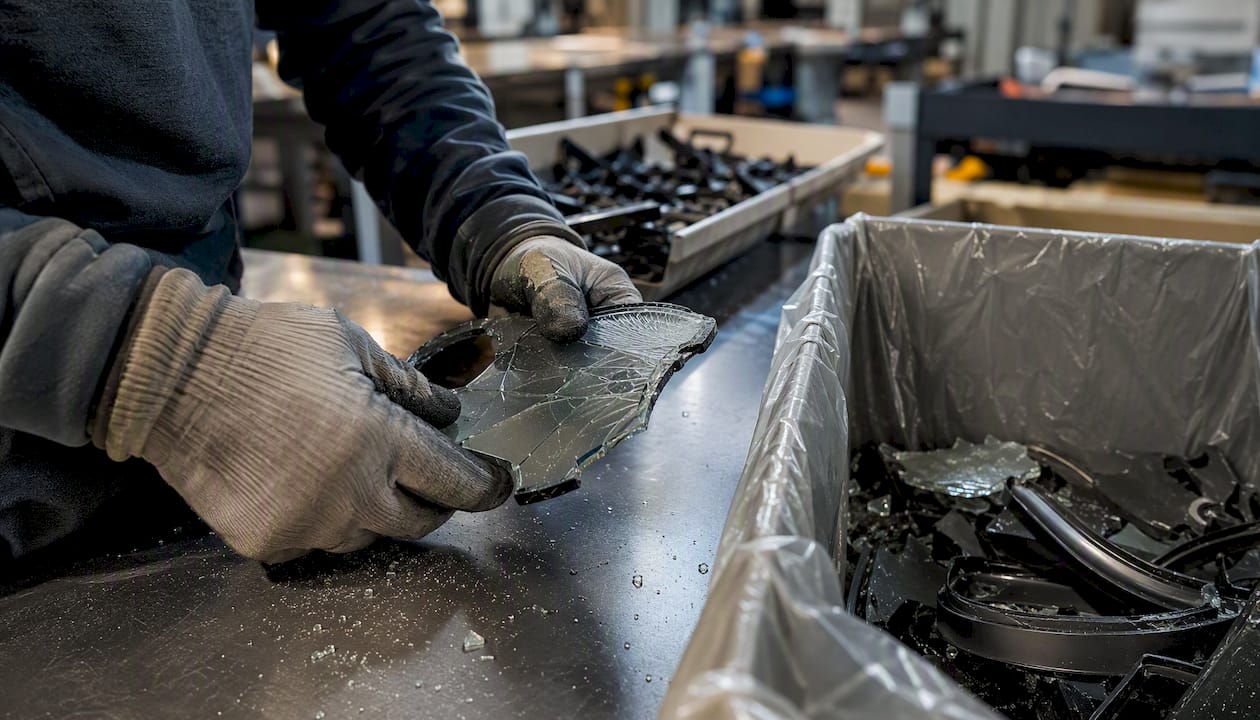
There’s also the phosphor coating lining the inside of the faceplate. Older phosphor formulations sometimes included cadmium or other heavy metals, and while intact glass fully contains that coating, a shattered tube exposes it as fine powder that shouldn’t be inhaled or handled bare-handed.
Put those three hazards together, and you get a straightforward regulatory outcome: municipal single-stream recycling programs almost universally exclude CRT glass, and most curbside haulers will flag or reject anything that’s clearly an old television. Treating a CRT like a broken picture frame or a wine glass is the single most common mistake people make with this material, and it’s the one that gets people (and disposal facilities) into trouble.
How Do You Safely Move, Store, or Remove a CRT?
There’s a hard line between what a homeowner or small shop can reasonably do and what belongs strictly to a trained technician. Knowing which side of that line you’re on protects you and everyone helping you.
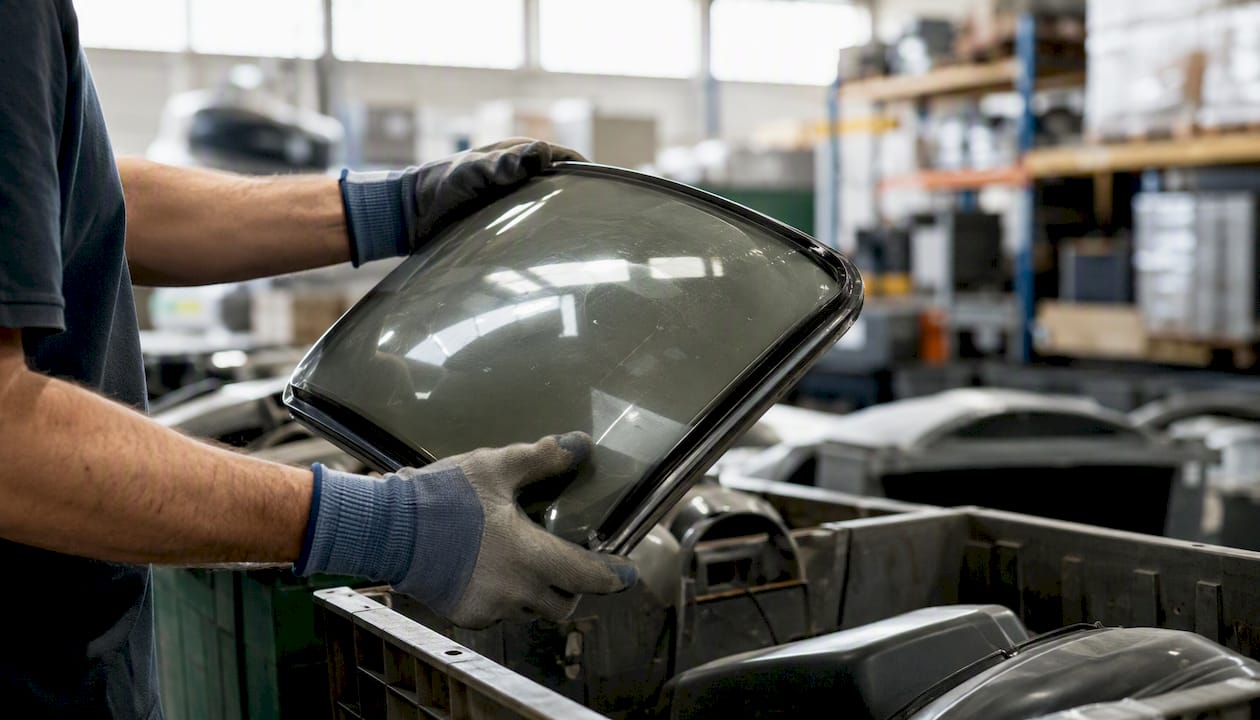
When to stop and call someone: if the tube is already cracked, if you don’t recognize the model or its internal layout, or if you’re tempted to open the back cover to “see what’s inside.” CRTs hold a residual electrical charge on internal capacitors even when unplugged for weeks, and that charge combines with the implosion risk to make amateur disassembly genuinely dangerous.
What trained technicians actually do, at a high level: they discharge the tube’s stored voltage using a grounded probe before touching anything internal, remove the deflection yoke carefully to avoid stressing the neck glass, and support the chassis so the tube’s weight never rests unevenly during the process. This is technician-only work. It’s listed here so you understand what a legitimate service should be doing, not as a how-to.
What you can safely do yourself:
- Keep the TV upright at all times, screen facing forward, never on its back or face down.
- Pad the base with a moving blanket or foam before sliding it into a vehicle.
- Secure it so it can’t shift or tip during transport; a seatbelt or ratchet strap across the cabinet works well.
- Never stack anything on top of a CRT console during storage or transport.
- If you’re prepping for pickup, leave the unit assembled. Don’t attempt to remove the tube yourself to “make it easier.”
Pro Tip: Photograph the model number and screen size before you call a recycler. Most services quote pickup fees partly by weight and volume, and a clear photo saves you a return trip if the initial estimate was off.
A CRT that looks fine on the outside can still be holding a meaningful electrical charge and structural stress it was never designed to survive being dropped, tipped, or pried open. Assume every old TV glass panel is under tension until a professional tells you otherwise.
What Should You Do If the Glass Breaks?
If a CRT cracks or shatters, treat it the way you’d treat any hazardous material spill: contain it, protect yourself, and don’t make it worse.
- Evacuate the immediate area. Get people and pets out of the room before doing anything else.
- Ventilate if it’s safe to do so. Open a window or door rather than running a fan, which can circulate fine particles further.
- Do not sweep or vacuum dry debris. Both actions aerosolize phosphor powder and glass dust, turning a contained mess into an airborne one.
- Dampen the area lightly before any cleanup. A light water mist helps keep particles from becoming airborne, but avoid soaking electrical components.
- Contain the debris in a sealed container, not a regular trash bag, and label it clearly.
- Call your local household hazardous waste program or a certified e-waste recycler to ask about disposal or testing before moving the container anywhere.
Anyone handling the cleanup should have basic protective gear on hand:
- Nitrile or heavy work gloves, not bare hands
- An N95 respirator or better, since phosphor and glass dust are respiratory irritants
- Eye protection, particularly given the risk of remaining glass fragments
- Disposable coveralls if the breakage is extensive or the area is enclosed
Call emergency services only if someone has a laceration injury requiring urgent care, or if there’s a fire risk from damaged internal wiring. For everything else, your local hazardous waste hotline or a certified recycler is the right first call, not 911.
How Do You Dispose of Old TV Glass Responsibly?
Disposal splits cleanly into two paths: what households can do and what businesses or institutions typically need.
Household routes usually run through a municipal household hazardous waste (HHW) program. Many counties run periodic HHW collection events or maintain a permanent drop-off site that accepts electronics, including CRTs, sometimes for free and sometimes for a small per-unit fee. Before you load one into your car, call ahead. Some HHW sites cap the number of CRTs accepted per household visit, and a surprising number still ask you to remove the back cover or leave the unit assembled, depending on local policy.
Commercial routes look different. A business or institution disposing of multiple units, old office monitors, a school’s retired classroom TVs, an estate cleanout of several consoles, typically needs a certified e-waste recycler that can issue a manifest documenting where the material went and a certificate of recycling confirming proper processing. This paperwork matters for compliance audits and, frankly, for peace of mind. Reviewing your organization’s electronic disposal regulations before scheduling a pickup helps you know what documentation to request.
A few practical numbers to expect: HHW drop-off is often free or low-cost for a handful of household units, while commercial pickup involving a truck and multiple units typically runs on a per-pound or flat collection fee, with lead times of a few days to a couple of weeks depending on regional recycler availability. Because barium and strontium content varies by manufacturing era, some recyclers charge differently for pre-1990s tubes versus later models. Crushing CRTs on-site to save on shipping volume is not something any reputable recycler does, and if a service offers it as a shortcut, that’s worth treating as a warning sign rather than a convenience.
How Do You Vet a Recycler or Removal Service?
Not every company that says “we take TVs” actually processes CRT glass correctly, and the difference matters both legally and environmentally.
Ask for certifications first. R2 (Responsible Recycling) and e-Stewards are the two credentials that indicate a recycler follows verified environmental and safety standards for handling hazardous electronics, including leaded glass. A legitimate recycler should produce these credentials without hesitation.
Specific questions worth asking before you schedule anything:
- Do you accept CRT glass specifically, not just general electronics?
- What happens to the leaded glass after pickup, do you process it in-house or send it to a specialized downstream processor?
- Can you provide a certificate of recycling or a manifest showing final disposition?
- What’s your pickup versus drop-off pricing, and is there a minimum volume?
- If data-bearing equipment is included, do you offer certified data destruction alongside the hardware recycling?
Red flags to walk away from: a company that offers to crush CRTs on-site without any documentation, vague or evasive answers about where the glass actually ends up, and prices that seem far below what competitors quote with no paperwork trail to explain why. If a service can’t answer “where does this actually go” in a specific, confident way, that’s your answer.
Pro Tip: Ask specifically whether the recycler separates funnel glass from faceplate glass during processing. A recycler who understands that distinction almost always understands the rest of proper CRT handling too.
Is It Worth Repairing or Salvaging an Old CRT?
Sometimes yes, more often no, and the deciding factor is almost always tube availability rather than labor cost.
Restoration specialists consistently point to the picture tube itself as the bottleneck in reviving a vintage set. According to restoration parts resources, functional replacement CRTs have become genuinely scarce, and professional rebuilding, which can involve rebonding a new neck stem or sourcing a donor tube, can run several hundred dollars with no guarantee of success. That price tag frequently exceeds what the finished, working television is worth, even for a desirable vintage model.
A few things to weigh before committing to a repair:
- Check whether the picture tube itself is cracked versus a simpler fault like a bad flyback transformer or capacitor; tube damage is usually the deal breaker.
- Factor in that rebonding an outer safety lens, when that’s the actual issue, requires specialized adhesives and often a controlled environment, something restoration forums discuss at length, including the risk of optical distortion from improper bonding.
- Compare repair cost against buying a working replacement unit if you just want a functioning vintage set rather than the exact original piece.
If repair isn’t realistic but you still love the aesthetic, intact CRT faceplate glass has a second life in art and display projects, think lamp bases, framed curved-glass pieces, or shadow-box displays. Before repurposing it that way, confirm the tube has been safely discharged and the vacuum has been broken by a professional first. An “art project” CRT is still a pressurized vacuum vessel until someone qualified says otherwise.
Why Is Recycling Capacity for CRT Glass Shrinking?
Here’s something most disposal guides skip entirely: the infrastructure for recycling leaded CRT glass has been quietly disappearing for over a decade, and that has real consequences for where your old TV actually ends up.
The last dedicated lead-glass recycling facility in California closed its doors more than ten years ago. Since then, CRT items originating in California, whether they arrive at a disposal site intact or already broken apart, have increasingly been transported out of state and buried in landfills in the Arizona desert rather than processed through specialized lead-glass recovery. That’s not a hypothetical risk. It’s the practical reality of what happens once a region loses its last certified processor for this specific material.
When the specialized facilities that know how to separate and reprocess leaded funnel glass from barium-strontium faceplate glass shut down, the material doesn’t stop existing. It just travels farther, usually to a landfill, and usually without the same documentation trail a functioning recycling stream would produce.
This matters for a few concrete reasons:
- Disposal costs go up because CRT glass now often needs to travel greater distances to reach one of the remaining certified processors.
- Lead times get longer, particularly for commercial pickups involving multiple units, since fewer regional facilities means more scheduling backlog.
- Documentation becomes more important, not less, because with fewer processors handling this material, verifying that your CRT glass actually reached a certified recycler, rather than a landfill, is the only real assurance you have.
The underlying chemistry hasn’t changed. CRT glass is still manufactured with the same lead, barium, and strontium content it always had, using the specialized formulations described in CRT glass composition data. What’s changed is the number of places equipped to process it safely, and that gap is exactly why choosing a recycler with real certifications and a documented chain of custody matters more today than it did fifteen years ago.
A Publisher’s Note on Handling This Responsibly
We’ve built our approach to CRT and old TV glass around one assumption: readers deserve a straight answer about what’s actually hazardous and what isn’t theater. Lead-doped glass, a vacuum-sealed tube, and phosphor powder aren’t marketing talking points. They’re the specific reasons this material needs a certified processor rather than a curbside bin, and we’d rather explain that plainly than dress it up.
For business and organizational customers, we treat documentation as part of the job, not an afterthought. Every pickup we arrange for CRT equipment, monitors, or bulk electronics comes with a paper trail: manifests, certificates of recycling, and compliance records built for audit review, not just a receipt. That matters more now that regional processing capacity for leaded glass has thinned out, and fewer facilities means the chain of custody has to be tighter, not looser.
If you’re weighing whether to handle a CRT yourself or bring in help, the next step is usually just a conversation. We provide free quotes based on unit count, size, and location, with pickup timelines that typically run a few days to a couple of weeks depending on volume and region.
How Can Usedcartridge Help With Old TV Glass Disposal?
If you’re a facility manager or business owner staring at a storage closet full of retired CRT monitors, the calculus is different from a single household TV. You need documentation, predictable timelines, and someone who won’t disappear once the truck leaves your loading dock. That’s the gap Usedcartridge fills for organizational customers dealing with old TV glass and the broader electronics that come with it.
Usedcartridge handles the e-waste logistics around CRT pickup and disposal, including certified recycling, manifest documentation, and certificates confirming your equipment was processed properly rather than dumped or crushed without a paper trail. If your CRT units are still attached to computer systems or came from an office environment with data on connected drives, we also handle secure IT asset recovery, so old monitors and the hardware they were paired with get processed together instead of through separate vendors.
To get started, have three things ready when you request a quote: unit count, approximate sizes or weights, and your pickup location. From there, scheduling a pickup or requesting a formal quote takes just a few minutes, and you’ll get documentation that holds up if anyone ever asks where that old equipment actually went.
Frequently Asked Questions
Is old TV glass the same as regular window or bottle glass?
No. CRT glass is formulated with lead, barium, or strontium specifically for vacuum resistance and X-ray shielding, which is why standard glass recycling programs reject it.
Can I just throw an old CRT television in the trash?
You shouldn’t. Most municipalities classify CRTs as hazardous electronic waste, and dumping one risks fines along with the environmental exposure that comes from leaded glass in an unlined landfill.
How do I know if my old TV has a separate safety panel versus just the CRT glass?
Look for a visible gap or air space between the outer glass and the tube behind it. If you see one, that outer panel is typically bonded safety glass, distinct from the hazardous CRT faceplate underneath.
What should I do immediately if a CRT screen cracks in my home?
Clear the room, avoid sweeping or vacuuming dry debris, contain any broken pieces in a sealed container, and contact your local household hazardous waste program or a certified e-waste recycler for next steps.
Are there still places that recycle CRT glass properly?
Yes, but capacity has shrunk significantly. Certified recyclers with R2 or e-Stewards credentials remain the most reliable option, though pickup times and fees may reflect the reduced number of regional processors still handling leaded glass.