
Hire a certified IT asset disposition (ITAD) provider that delivers on-site or verified off-site data destruction, a signed chain-of-custody manifest, and a Certificate of Destruction (COA) before any device leaves your facility. That is the short answer. Before you schedule pickup, demand proof of R2v3 or e-Stewards certification, confirm the vendor follows NIST SP 800-88 Rev. 2 sanitization methods, and request a sample COA. If your assets include lithium-ion batteries, solar panels, or CRT monitors, flag those upfront — they trigger separate handling requirements under EPA/RCRA. Usedcartridge handles all of it and offers free quotes with local pickup.
Pro Tip: Request a sample COA and a redacted chain-of-custody manifest from any vendor before signing a contract. A provider who hesitates to share those documents is telling you something important.
Table of Contents
- How do you evaluate an e-waste vendor’s reputation before hiring?
- What should you ask an e-waste disposal provider before hiring?
- Key Takeaways
- The mistake most IT teams make when disposing of e-waste
- Usedcartridge handles certified e-waste disposal near you
- Authoritative U.S. sources for e-waste and ITAD compliance
How do you evaluate an e-waste vendor’s reputation before hiring?
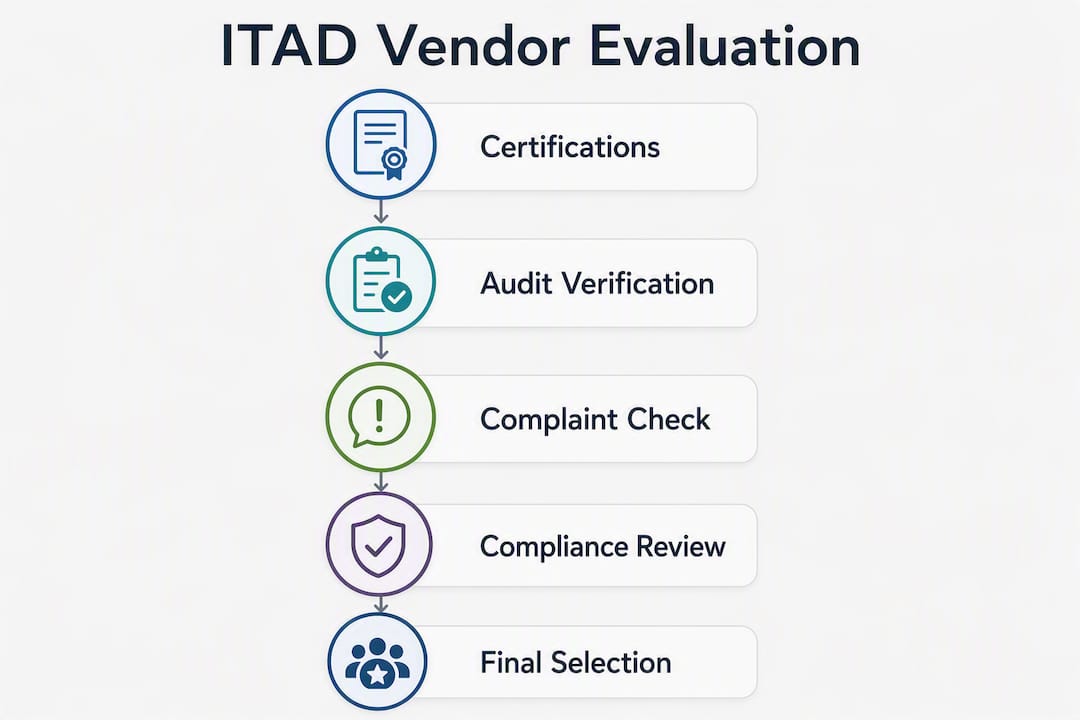
Start with certifications, then go deeper. R2v3 and e-Stewards are the two recognized recycler standards in the U.S. Both require third-party audits covering hazardous-material handling, data security, and downstream accountability. R2v3 maps directly to RCRA, export controls, and ISO 14001-style environmental management, which means a single certification covers a lot of the compliance ground your auditors will ask about. NAID AAA certification is the parallel standard for data-destruction providers specifically.

Beyond the certificate, check the actual audit date. Certifications expire and lapse. Ask for the current certificate number and verify it directly with the certifying body. Then ask for two or three client references in your industry — healthcare, finance, and government each carry specific data-privacy obligations, and a vendor experienced in your sector will know the documentation those auditors expect.
Check complaint records with the Better Business Bureau and your state’s attorney general office. Search the vendor’s name alongside “EPA violation” or “data breach.” One incident is not automatically disqualifying, but a vendor with no incident-response policy is. The e-Stewards Standard V4.0 explicitly requires a documented program for data security breaches — ask to see it.
Third-party certifications are recognized by state programs and regulators as evidence of proper processes, but they do not replace your own legal compliance obligations. Treat certification as a floor, not a ceiling.
What should you ask an e-waste disposal provider before hiring?
These questions cut through marketing language and get to the operational reality:
- What certifications do you hold, and when were they last audited? Ask for the certificate number and verify it independently.
- Do you offer on-site destruction, and can we witness or receive video documentation? High-security environments and SSDs often require witnessable physical destruction.
- What sanitization method do you use for SSDs vs. HDDs? Degaussing does not work on SSDs — physical shredding or NIST SP 800-88-compliant purge methods are required.
- What does your chain-of-custody process look like from pickup to final disposition? You want serial-number-level tracking, not just a weight receipt.
- Will you provide a Certificate of Destruction listing device serial numbers? A COA is the core audit artifact for regulated industries and ESG reporting.
- How do you handle lithium-ion batteries and solar panels? Swollen or damaged batteries can flip an asset from revenue-positive to cost-positive — hazardous handling fees apply.
- What insurance do you carry? Ask specifically for general liability, pollution liability, and data-breach coverage limits.
- Do you process downstream recycling domestically or overseas? If overseas, R2v3 requires documented export procedures and verified receiving-facility compliance.
Key Takeaways
Certified ITAD with a signed COA and verifiable chain-of-custody is the only defensible approach to local e-waste disposal for businesses managing data-bearing assets.
| Point | Details |
|---|---|
| Certifications first | Require R2v3 or e-Stewards certification and verify the current audit date before scheduling pickup. |
| COA and chain-of-custody | Collect a Certificate of Destruction listing serial numbers and a custody manifest for every disposal event. |
| On-site for SSDs | SSDs and classified media require on-site physical destruction or NIST SP 800-88-verified purge methods. |
| Battery and solar flagging | Flag lithium-ion batteries and solar panels upfront — hazardous handling changes both cost and logistics. |
| Usedcartridge | Usedcartridge provides on-site destruction, COA documentation, and asset recovery with free quotes and local pickup. |
The mistake most IT teams make when disposing of e-waste
Most organizations treat disposition as a one-time logistics problem. It is actually a recurring compliance exposure. The teams that get burned are the ones who waited too long, accepted a vendor’s verbal sanitization guarantee, or split their disposal across three different local recyclers with no unified audit trail.
Delay is the most expensive mistake. IT assets lose resale value fast — typically within 90 days of decommission. More critically, devices sitting in a storage room are a data-breach liability with no chain-of-custody protection.
On-site vs. off-site destruction comes down to data sensitivity and device type. On-site physical shredding is the right call for SSDs, NVMe drives, mobile devices, and any classified or regulated environment where you need a witness signature or video record. Off-site sanitization is acceptable for lower-sensitivity assets when the vendor provides documented NIST SP 800-88 methods, serial-number-level tracking, and downstream tracing. Centralized certified services are the only reliable protection during a data-privacy audit — DIY or fragmented approaches cannot produce verifiable proof of destruction.
Cost reality: ITAD disposition involves more line items than most teams budget for.
| Cost Component | Typical Range |
|---|---|
| Transportation | ~$150 |
| Data destruction (per event) | ~$75 |
| Compliance documentation | ~$125 |
| Vendor commission | ~30% |
| Internal labor (4 hrs) | ~$200 |
ITAD value recovery becomes economically efficient only when net revenue exceeds recycling costs by roughly 40%. Below that threshold, a recycling-only disposition is usually the cleaner choice.
Pro Tip: Run an internal redeployment audit before calling any vendor. Redeploying mid-range hardware inside your organization often yields more value than a discounted secondary-market payout.
Usedcartridge handles certified e-waste disposal near you
When your priority is a defensible audit trail and zero data-breach exposure, the vendor selection criteria above point in one direction.

Usedcartridge provides on-site HDD and SSD destruction with witness and video documentation, certified off-site sanitization aligned to NIST SP 800-88 Rev. 2, R2/e-Stewards-aligned recycling, and specialized handling for lithium-ion batteries and solar panels. Every job includes a chain-of-custody manifest and a Certificate of Destruction with serial-number-level detail, ready for audits and ESG reporting. Asset recovery is available with buyout and revenue-share pricing, and Usedcartridge assesses device value before recommending the right disposition path.
Pricing depends on volume, device mix, and whether batteries or solar panels are involved. Local pickup is available, with nationwide partner coverage for multi-site organizations. To get a quote specific to your asset inventory, request an IT asset recovery disposition quote or schedule local e-waste pickup directly on the site.
Authoritative U.S. sources for e-waste and ITAD compliance
Use these to verify vendor claims and prepare your compliance documentation:
- NIST SP 800-88 Rev. 2 — The federal standard for media sanitization. Defines Clear, Purge, and Destroy methods and specifies when physical destruction is required. Reference this when evaluating a vendor’s SSD and HDD sanitization claims.
- R2v3 (Responsible Recycling) — The leading recycler certification. Covers hazardous-material handling, data security, export controls, and downstream accountability. Accepted by most state programs as evidence of proper process.
- e-Stewards Standard V4.0 — The alternative recycler certification with explicit data-security breach-response requirements. Recognized by auditors and ESG reporting frameworks.
- EPA/RCRA Electronics Stewardship — Governs hazardous-waste identification, storage time limits (90/180 days), manifesting, and permitted disposal for electronics. Violations carry significant civil penalties.
- EPA CRT Rules — Specific guidance on CRT glass handling, the conditional exclusion from hazardous-waste rules, and what recyclers must document.
“R2 certification is frequently recognized by state programs; NAID AAA is the industry standard for data-destruction providers. Certification helps but does not eliminate the need to follow federal and state rules.” — E-Waste Compliance, R2 Consultant
This article provides general compliance information, not legal advice. Confirm current federal and state requirements with the EPA, your state environmental agency, or a qualified compliance professional before finalizing your disposal program.