
E pollution is the contamination caused by discarded electronics, the toxic metals, flame retardants, and chemical residues that leach out when phones, laptops, batteries, and appliances get burned, dumped, or dismantled without proper controls. The scale is already staggering.
The world generated a very large amount of e-waste in 2022, and only a small percentage of it was formally collected and recycled, according to the Global E-waste Monitor 2024. That leaves nearly 48 million tonnes a year moving through informal channels, backyard burn piles, unregulated scrapyards, and landfills, where it releases lead, mercury, and cadmium into soil, water, and air.
What to do right now:
- Never burn or manually smash old electronics to recover metals; this is one of the most toxic exposure routes there is.
- Route devices to a certified e-waste recycler rather than a general trash hauler or unverified broker.
- Keep children and pregnant household members away from any device dismantling, battery leakage, or e-waste storage areas.
Key Takeaways
E pollution stems from mismanaged e-waste releasing lead, mercury, and other toxicants, and only a small percentage of the very large amount generated in 2022 was formally recycled.
| Point | Details |
|---|---|
| Scale of the problem | The world generated a very large amount of e-waste in 2022, with a small percentage formally recycled. |
| Health risk is real and documented | Unsound recycling releases up to 1,000 chemical substances, with children and pregnant people most vulnerable. |
| Informal processing is the biggest hazard | Open burning and acid baths expose workers and communities to lead, mercury, cadmium, and arsenic. |
| Certification separates safe from risky recyclers | Ask for chain-of-custody proof and certificates of destruction before handing over any device. |
| Usedcartridge offers a certified compliance path | Usedcartridge provides audit-ready data destruction and documented e-waste recycling for organizations. |
Table of Contents
- What Are the Headline Facts on E-Waste Right Now?
- What Counts as E-Waste or E-Pollution?
- How Big Is the E-Waste Problem, and How Fast Is It Growing?
- How Does E-Waste Pollute Air, Soil, and Water?
- What Health Effects Does E-Waste Exposure Cause?
- What Are 10 Examples of E-Waste?
- How Is E-Waste Processed, and Why Does the Method Matter?
- How Do We Prevent and Manage E-Pollution at Scale?
- What International Rules Govern E-Waste?
- What Can You Do Today to Reduce E-Pollution?
- How Should Businesses Manage E-Waste Compliantly?
- Frequently Asked Questions
- Sources
What Are the Headline Facts on E-Waste Right Now?
The numbers behind e pollution move fast, and mostly in the wrong direction. Here’s what defines the current picture:
- a very large amount of e-waste generated globally in 2022, per the Global E-waste Monitor 2024.
- Only a small proportion of that stream was documented as properly collected and recycled.
- The e-waste stream has grown by an average of 2.3 billion kilograms per year since 2010.
- Recent analyses estimate ongoing growth of roughly 3% to 5% annually, according to a 2026 review in Frontiers in Environmental Science.
| Metric | Figure |
|---|---|
| Global e-waste generated (2022) | a very large amount |
| Formally collected and recycled | a small percentage |
| Average annual increase since 2010 | 2.3 billion kg |
The gap between those two numbers, a very large amount produced versus barely a fifth of it properly processed, is the real story. Roughly three-quarters of the world’s e-waste has no documented, safe endpoint. It doesn’t vanish. It ends up in informal recycling yards, open dumps, or waterways, where the damage compounds year over year.
What Counts as E-Waste or E-Pollution?
E-waste, sometimes labeled WEEE (waste electrical and electronic equipment) or e-scrap in industry documents, covers any device that runs on electricity or batteries and has reached the end of its useful life. That includes obvious items like phones and laptops, but also thermostats, medical equipment, and solar panels.
The distinction between “e-waste” and “e-pollution” matters. E-waste is the object, the dead router, the cracked phone screen, the drained battery pack. E-pollution is what happens when that object is mismanaged: when its lead solder leaches into groundwater, when its flame retardants vaporize during open burning, when its mercury-containing components crack open in an unlined landfill. A phone sitting safely in a certified recycler’s sorting bin is e-waste. That same phone smashed open on a dirt lot to strip out copper wire is e-pollution.
A few categories worth knowing before the examples section further down:
- Small IT and telecom equipment: phones, routers, tablets.
- Large equipment: refrigerators, washing machines, solar panels.
- Temperature-exchange equipment: air conditioners, heat pumps.
- Screens and monitors: TVs, laptop displays.
- Small mixed equipment: toasters, power tools, toys with circuit boards.
Each category carries a different hazard profile, which is exactly why generic “throw it in the recycling bin” advice falls short.
How Big Is the E-Waste Problem, and How Fast Is It Growing?
The trajectory is what should worry you more than any single-year snapshot. E-waste generation has climbed steadily for over a decade, and the infrastructure built to handle it hasn’t kept pace.
Global generation sat at roughly 53.6 million tonnes in 2019 and reached a very large amount by 2022, an increase that outpaced most national recycling programs’ expansion plans. Some regional analyses project the stream could reach nearly 75 million tonnes by 2030 if current consumption and disposal patterns hold, a trend outlined in a Springer chapter on the environmental impacts of e-waste management. The Global E-waste Monitor 2024 confirms the annual growth rate has averaged 2.3 billion kilograms since 2010, a pace that shows no sign of slowing.
| Year | Global e-waste generated | Formal collection/recycling rate |
|---|---|---|
| 2019 | ~53.6 million tonnes | Only a small proportion documented |
| 2022 | a very large amount | a small percentage |
| 2030 (projected) | ~75 million tonnes | Rate largely unresolved |
That 2030 projection column intentionally stays vague on the recycling rate. No credible source has published a confident forecast for future formal recycling percentages, because the answer depends entirely on policy choices governments haven’t finished making yet.
Three forces are driving the climb:
- Shorter product life cycles. Phones, laptops, and appliances are designed with planned obsolescence baked in, and consumers replace working devices faster than a decade ago.
- Rising global consumption. Electronics ownership is expanding fastest in regions that historically generated the least e-waste, adding volume even where infrastructure lags.
- Weak takeback infrastructure. Many countries still lack mandatory manufacturer takeback programs, so devices default to household trash or informal scrap dealers instead of certified processors.
The Frontiers 2026 review frames this as a structural mismatch: the pace of electronics manufacturing and disposal is outrunning the pace of circular-economy infrastructure built to absorb it. E-waste isn’t just a heavier stream, either. It’s a more chemically complex one, with reviewers cataloging more than 1,000 distinct chemical constituents across modern devices, some recoverable, many hazardous, most poorly tracked once a device leaves a household.
Regional distribution adds another wrinkle. Asia generates the largest absolute volume of e-waste, driven by manufacturing hubs and rapid electronics adoption, while high-income regions generate the most e-waste per capita. Neither pattern lines up neatly with where the formal recycling capacity actually exists, which is part of why so much e-waste crosses borders, legally and otherwise, before it reaches a final resting place.
How Does E-Waste Pollute Air, Soil, and Water?
Mismanaged e-waste doesn’t stay contained. It moves through three main pathways, and each one leaves a distinct fingerprint on the surrounding environment.
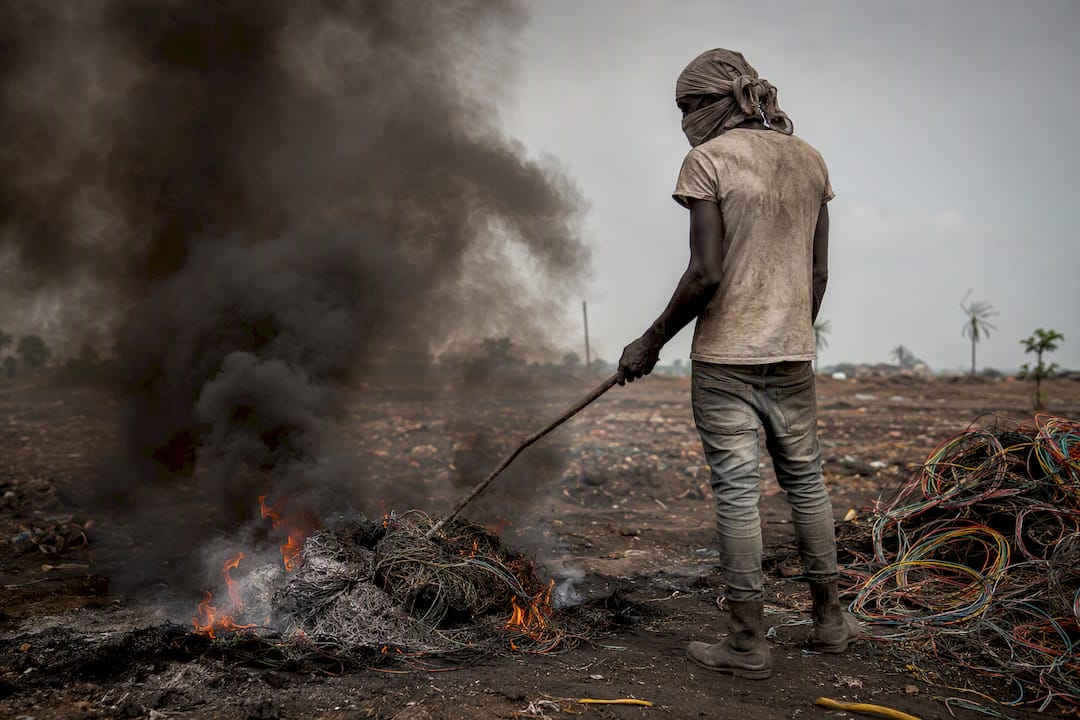
Open burning is the most visually dramatic route. Informal recyclers burn cables and circuit boards to strip out copper and other metals, releasing dioxins, furans, and polycyclic aromatic hydrocarbons (PAHs) directly into the air. These compounds don’t disperse and disappear; they settle onto nearby soil and vegetation, where they persist for years.
Acid leaching is the quieter, arguably more corrosive process. Workers submerge circuit boards in strong acid baths to dissolve gold, silver, and other precious metals out of the material. The leftover acid slurry, laced with heavy metals, frequently gets dumped into nearby ditches, streams, or unlined pits, because proper hazardous-waste disposal costs money that informal operations don’t spend.
Landfill leachate is the slowest-moving but longest-lasting pathway. Batteries, circuit boards, and cathode-ray tube glass buried in unlined landfills allow rainwater to percolate through the waste, picking up lead, cadmium, and mercury on the way down into groundwater. Unlike a burn plume, leachate contamination can take decades to surface in a water supply, and by the time it does, remediation is exponentially harder than prevention would have been.
The downstream ecosystem effects follow a predictable pattern:
- Soil contamination near informal processing sites frequently shows heavy metal concentrations many times above background levels, rendering nearby land unsuitable for agriculture.
- Water pollution spreads the contamination footprint well beyond the original dump or burn site, affecting drinking water sources and irrigation supplies downstream.
- Bioaccumulation allows heavy metals and persistent organic pollutants to concentrate up the food chain, so fish and livestock near contaminated sites carry measurably higher toxin loads than those raised elsewhere.
- Biodiversity loss follows when soil and water become too contaminated to support the plant and insect life that local ecosystems depend on.
Communities living near major informal e-waste processing hubs consistently show measurable environmental contamination, a pattern the Global E-waste Monitor 2024 and multiple peer-reviewed studies have documented across different regions. Mercury deserves particular attention here, since it’s used in older flat-panel displays and certain switches, and it doesn’t break down. Once released, it persists in sediment and can convert into methylmercury, the form that accumulates most readily in fish tissue. Usedcartridge’s explainer on mercury in electronics recycling covers how certified processors isolate and contain this specific hazard rather than letting it disperse.
What Health Effects Does E-Waste Exposure Cause?
The health picture is where e pollution stops being an abstract environmental statistic and becomes a direct, documented risk to real people. The WHO fact sheet on e-waste) states that unsound recycling can release up to 1,000 different chemical substances, and several of them are well-studied neurotoxicants.
Here’s what’s actually in the waste stream, and what each substance does to the body:
- Lead, found in solder and CRT glass, impairs neurological development and is especially damaging to children’s growing brains.
- Mercury, present in some switches and flat-panel backlighting, damages the nervous system and kidneys and can impair fetal brain development.
- Cadmium, used in older rechargeable batteries, accumulates in kidneys and bone and is classified as a carcinogen.
- PBDEs (brominated flame retardants), embedded in plastics and circuit boards, disrupt thyroid hormone function and have been linked to developmental delays.
- PAHs, released during open burning, are associated with respiratory irritation and long-term cancer risk.
- Dioxins and furans, byproducts of burning plastics and cables, are persistent, highly toxic, and accumulate in fatty tissue over a lifetime.
A systematic review of e-waste health outcomes found that people living near e-waste processing sites carry significantly elevated levels of heavy metals and persistent organic pollutants in their blood and tissue compared to unexposed populations. The same review links this exposure to adverse neonatal outcomes, neurodevelopmental delays, and other measurable health effects, particularly among populations where informal recycling is a primary economic activity.
Children and pregnant people face the sharpest risk. Some of these toxins cross the placenta directly, interfering with fetal development during the exact window when the nervous system is forming. Children also absorb heavy metals more efficiently than adults and tend to spend more time in or near contaminated soil and dust, whether they’re playing nearby or, in some regions, working alongside adults at informal recycling sites.
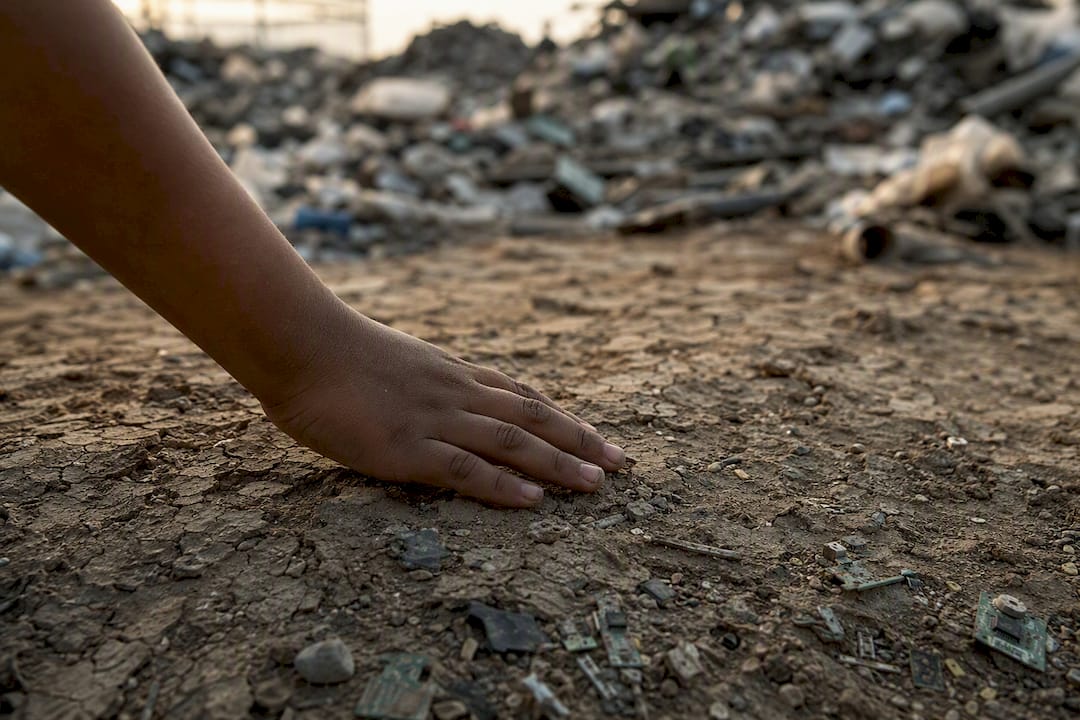
Exposure pathways aren’t limited to people who work directly with e-waste, either. Contaminated dust, soil, and groundwater carry these toxins into surrounding neighborhoods, meaning the health burden extends well past the workers at the processing site itself. Reducing your own exposure risk comes down to a short list: never handle cracked batteries or CRT screens bare-handed, keep young children away from any device disassembly, and route anything electronic to a recycler with documented safety protocols rather than a curbside scrapper.
What Are 10 Examples of E-Waste?
If you’re trying to figure out what actually counts, here’s a practical rundown of the items people ask about most.
- Smartphones — recycle through a certified electronics program; never trash due to battery content.
- Laptops and desktop computers — wipe data before recycling; certified recyclers handle secure destruction.
- Printers and multifunction devices — many components are recyclable; check for a takeback or mail-back program first.
- Batteries (lithium-ion and lead-acid) — never place in curbside trash; battery leakage is a fire and chemical hazard.
- Televisions and monitors — older CRT models contain lead glass and need specialized handling.
- Small kitchen appliances — toasters, blenders, and similar items with circuit boards belong in e-waste streams, not general trash.
- Routers and networking equipment — often overlooked, but contains the same circuit-board hazards as computers.
- Medical devices — require data wiping if they store patient information, plus proper hazardous-material handling.
- Solar panels — contain recoverable metals and some hazardous materials; specialized recycling streams are still developing.
- Power tools and cordless equipment — battery packs need separate handling from the tool body itself.
How Is E-Waste Processed, and Why Does the Method Matter?
The difference between formal and informal e-waste processing is the difference between contained hazard and released pollution. Formal recycling follows a defined sequence: collection at a certified drop-off point, sorting by material and device type, demanufacturing to separate hazardous components, mechanical shredding, metals recovery through controlled smelting or chemical extraction, and finally safe disposal or containment of whatever hazardous residue remains.
Informal processing skips nearly every safeguard in that chain. Workers dismantle devices by hand with no protective equipment, burn cables in open pits to strip copper, and submerge circuit boards in acid baths to dissolve out precious metals, exactly the practices the EPA’s e-waste program identifies as exposing both workers and surrounding communities to lead, mercury, cadmium, and arsenic.
| Factor | Formal recycling | Informal processing |
|---|---|---|
| Worker safety | Protective equipment, controlled exposure | Bare-hand contact, no ventilation |
| Environmental outcome | Contained emissions, documented disposal | Open burning, uncontrolled leachate |
| Material recovery | Systematic, higher yield on rare metals | Inconsistent, focused on easy-access metals |
| Certification | Audited, third-party verified | None |
The gap in outcomes isn’t marginal. It’s the difference between a controlled industrial process and an unregulated one that treats human exposure as an acceptable cost of doing business.
How Do We Prevent and Manage E-Pollution at Scale?
System-level fixes matter more than individual choices, though both play a role. The interventions with the biggest documented impact fall into a few clear categories:
- Eco-design, which builds devices for easier disassembly and fewer mixed materials from the start.
- Repair and reuse, extending device lifespans before they enter the waste stream at all.
- Takeback systems, where manufacturers or retailers accept old devices at the point of a new purchase.
- Extended producer responsibility (EPR), legal frameworks that make manufacturers financially responsible for end-of-life management of what they sell.
- Certified recyclers, third-party audited to verify safe processing and documented chain-of-custody.
- Worker protections, mandatory safety equipment and health monitoring for anyone handling hazardous e-waste streams.
Certification matters more than most people realize when comparing recyclers. A certified processor has been independently audited against defined environmental and safety standards, meaning there’s a paper trail proving where your device actually ended up and how it was handled. An uncertified operation offers no such proof, even if it advertises “recycling” on its sign.
Pro Tip: Ask any recycler for their certification documentation before handing over a single device. If they can’t produce it on request, treat that as a red flag, not an oversight.
National-level programs illustrate what this looks like at scale. The Frontiers 2026 review points to circular-economy models that combine eco-design mandates with expanded formal collection infrastructure as the most effective documented path toward closing the recycling gap. Public-private partnerships, where governments set collection targets and private recyclers build the processing capacity to meet them, have shown measurable improvement in formal recycling rates in the regions that have adopted them seriously.
What International Rules Govern E-Waste?
A handful of frameworks shape how e-waste moves across borders and how countries build national policy around it.
- The Basel Convention and its Ban Amendment regulate the transboundary movement of hazardous waste, including e-waste, and restrict certain exports from wealthier nations to countries with weaker processing safeguards, as detailed on the Basel Convention’s official site.
- The Global E-waste Monitor, produced through the UN University and International Telecommunication Union, sets the standard methodology for measuring e-waste generation and recycling rates worldwide.
- UNEP initiatives support national governments in building e-waste policy and coordinate broader environmental programs that intersect with electronics disposal.
- International E-Waste Day, observed each October, raises public awareness and pushes governments and manufacturers toward stronger takeback commitments.
These frameworks directly shape what’s legal. A country that has ratified the Ban Amendment can’t legally accept certain hazardous e-waste exports from wealthier nations, which is part of why verifying where your recycler actually sends materials matters. Domestic policy in most countries, including the United States, still lags behind what the Basel Convention recommends, which is exactly why chain-of-custody documentation from your recycler isn’t a bureaucratic formality. It’s the only way to confirm your device didn’t get exported somewhere it was never supposed to go.
What Can You Do Today to Reduce E-Pollution?
Reducing your own contribution to e pollution comes down to a short, prioritized sequence rather than a long list of vague good intentions.
- Refuse and repair first. Before replacing a working device, check whether a repair shop or manufacturer program can extend its life another year or two.
- Reuse or donate functional electronics. A laptop that no longer meets your needs may still have years of life left for someone else.
- Wipe data before disposal. Use sanitization standards like those in NIST Special Publication 800-88, which governs proper media sanitization for data-bearing devices.
- Handle batteries separately. Never toss lithium-ion or lead-acid batteries in general trash; damaged cells can spark fires in collection trucks.
- Find a certified drop-off or mail-back program. Many manufacturers and retailers offer these at no cost.
- Verify the recycler. Ask for certification proof and, ideally, a certificate of destruction for anything containing personal data.
Pro Tip: If you’re disposing of a printer along with its cartridges, don’t assume they go through the same stream. Usedcartridge’s step-by-step guide to printer recycling breaks down how cartridges and printer hardware often need separate handling to be recovered properly.
How Should Businesses Manage E-Waste Compliantly?
Organizations face a different risk calculus than individuals. A business disposing of old laptops, servers, or networking equipment isn’t just managing environmental exposure, it’s managing data liability, regulatory audit risk, and often contractual obligations to clients about how sensitive information gets destroyed.
Before signing with any e-waste vendor, an IT department or facility manager should ask a specific set of questions:
- Chain-of-custody documentation. Can the vendor show exactly where each asset goes, from pickup through final disposition?
- Certificates of destruction. Is there a documented, audit-ready certificate for every data-bearing device, not just a verbal assurance?
- Domestic processing verification. Does the vendor process materials domestically, or does the equipment get brokered overseas where safeguards may be weaker?
- Audit reports. Can the vendor produce third-party audit results on request, rather than only marketing claims?
A compliant service flow typically looks like this: scheduled pickup from the business location, secure transport under documented chain-of-custody, certified on-site or off-site data destruction, material recovery and value assessment for reusable IT assets, and a final audit-ready report the organization can file for compliance purposes.
This is where the gap between a general hauler and a certified partner shows up clearly. A general waste hauler might take equipment off your hands, but it likely can’t produce a certificate of destruction, verify domestic processing, or document chain-of-custody the way a compliance audit requires. Usedcartridge’s guide to managing redundant electronics walks through what a compliant disposition process should include, and its examples of managed IT recycling for decision-makers show what that process looks like when it’s executed correctly.
Pro Tip: Insist on domestic processing verification specifically. The EPA has documented how equipment routed through third-party brokers can end up exported to regions without safe processing infrastructure, exposing your organization to reputational and legal risk long after you thought the equipment was gone.
How We Compiled the Numbers and What They Don’t Show
The figures in this article draw from the Global E-waste Monitor 2024, the WHO fact sheet on e-waste, and a peer-reviewed systematic review on e-waste health outcomes, cross-referenced against EPA and Basel Convention guidance.
Two limitations are worth naming plainly. Informal recycling activity is, by nature, undocumented, so the true global volume of e-waste processed unsafely is likely higher than official figures capture. Geographic reporting also varies widely; some countries maintain detailed e-waste tracking while others report little to no data, which means global averages can obscure sharp regional differences in both generation and exposure risk.
A Publisher’s View on Handling This Responsibly
We’ve watched the gap between e-waste generated and e-waste properly processed widen for years, and it doesn’t close through good intentions alone. It closes through documentation: certificates of destruction, verified domestic processing, and audit trails that hold up when a regulator or a client asks hard questions. That’s the standard we hold our own operations to, and it’s the standard we’d urge any organization to demand from a vendor, whether that vendor is us or someone else.
A Certified Path for Organizations That Need This Handled Right
Usedcartridge is built for organizations that can’t afford a vague answer about where their old equipment ended up. Where a general hauler offers pickup and little else, Usedcartridge provides on-site and off-site data destruction, audit-ready certificates of destruction, and compliant recycling documented from pickup to final disposition.

That documentation matters most when a client, auditor, or regulator asks for proof, not just a promise. Usedcartridge’s equipment destruction services cover secure handling of data-bearing devices on-site or through certified off-site processing, and the e-waste recycling services page outlines the full range of asset types covered, from laptops and servers to networking equipment and solar panels.
If your organization has a backlog of retired IT equipment sitting in storage, the first step is simple: request a quote for IT asset recovery and disposition and get a documented plan for pickup, destruction, and certification before that equipment becomes a liability instead of a recovered asset.
Frequently Asked Questions
What is e pollution in simple terms?
E pollution is the environmental and health damage caused by electronic waste that’s burned, dumped, or processed without proper safeguards, releasing toxic metals and chemicals into air, soil, and water.
How much e-waste does the world produce each year?
The world generated a very large amount of e-waste in 2022, and that figure has been climbing by an average of 2.3 billion kilograms annually since 2010, according to the Global E-waste Monitor 2024.
What percentage of e-waste is actually recycled?
Only a small proportion of global e-waste was documented as formally collected and recycled in 2022. The rest moves through informal channels, landfills, or unregulated processing.
What chemicals make e-waste dangerous?
Lead, mercury, cadmium, brominated flame retardants (PBDEs), polycyclic aromatic hydrocarbons, and dioxins are among the most common hazardous substances, and unsound recycling can release up to 1,000 distinct chemical compounds overall.
Who is most at risk from e-waste exposure?
Children and pregnant people face the highest risk, since several e-waste toxins cross the placenta and interfere with early neurological development.
How can businesses dispose of electronics safely and legally?
Businesses should use certified recyclers that provide chain-of-custody documentation and certificates of destruction, verify domestic processing, and request audit reports before signing a service agreement.
Are solar panels considered e-waste?
Yes, solar panels count as e-waste at end of life and contain both recoverable metals and materials that require specialized handling, making certified recycling important rather than optional.
This article is general information, not a substitute for advice from a qualified doctor. Consult a qualified healthcare professional about your own circumstances before acting on anything here.
Sources
- The Global E-waste Monitor 2024
- Health consequences of exposure to e-waste: an updated systematic review
- Embracing sustainability: reducing ecological and human health risks from e-waste exposure through adoption of safer management approaches — Frontiers (2026)
- Cleaning Up Electronic Waste (E-Waste) | US EPA
- Basel Convention on the Control of Transboundary Movements of Hazardous Wastes and Their Disposal