
PV modules are recyclable through established mechanical processing and emerging thermal, chemical, and laser methods. Owners should triage every retired module for reuse or refurbishment first, then route anything unfit for a second life to a certified recycler with documented chain of custody. Aluminum and glass come back reliably; silicon and silver recovery still varies by process and plant.
TL;DR:
- High-purity material recovery, especially for silicon and silver, requires advanced processes like laser or water-jet delamination, which are still in development.
- Mechanical recycling remains dominant due to low cost and scalability but tends to produce low-grade silicon and silver fragments unsuitable for reuse.
- Proper triage and documentation before decommissioning can significantly improve reuse potential and streamline compliance with varying state regulations.
- Hazardous materials like lead solder or cadmium compounds demand trained handling and proper disposal to avoid liability and ensure safety.
- Combining PV module, inverter, and battery pickups into a single logistics operation reduces costs and simplifies chain-of-custody documentation.
Table of Contents
- What Are the Main PV Module Recycling Methods?
- What Materials Get Recovered, and Why Purity Matters
- The Real Barriers: EVA, Hazards, and Logistics
- Navigating U.S. Solar Panel Waste Rules and Programs
- Decommissioning a PV Array: A Step-by-Step Checklist
- A Practical Chain-of-Custody Workflow for Decommissioning
- Why Owners Should Plan Now, Not When the Market Matures
- Get Compliant, Audit-Ready PV Recycling Handled
- Where to Go Deeper on PV Module Recycling
- Sources
What Are the Main PV Module Recycling Methods?
Most PV module recycling today starts with mechanical processing: shredding or crushing modules, then separating glass, aluminum framing, and metal wiring with screens and magnets. It’s the workhorse of the industry because it’s cheap and scales easily, though it tends to grind silicon wafers and silver contacts into low-grade fragments mixed with glass fines. IEA-PVPS identifies mechanical, thermal, chemical, and laser-based technologies as the four core pathways, and notes mechanical recycling remains the commercial benchmark while the others are still maturing.
Thermal methods burn or pyrolyze the encapsulant to loosen the glass-cell bond, which frees higher-quality silicon than shredding does. The tradeoff is energy use and emissions control, since burning EVA plastic releases volatile compounds that require scrubbing.
Chemical and solvent delamination dissolves the encapsulant layer instead of destroying it, preserving intact silicon wafers and metal contacts for higher-value reuse. The catch is reagent cost and solvent waste streams that need their own disposal plan.
- Mechanical: fast, low cost, downgrades silicon and silver
- Thermal: recovers cleaner silicon, higher energy and emissions burden
- Chemical: preserves wafer quality, generates solvent waste
- Laser and water jet delamination: pilot-stage, aims to separate layers with minimal material loss
Laser and water-jet delamination are the technologies to watch. They’re not yet commercial at scale, but early results suggest they could recover materials at purity levels the older methods simply can’t touch.
What Materials Get Recovered, and Why Purity Matters
More than 85% of a typical module’s mass is glass, aluminum, and metal components that are already recyclable through existing routes, according to the Department of Energy. Aluminum framing goes straight back into scrap metal markets. Glass, if separated cleanly from the encapsulant, feeds into construction aggregate or new glass manufacturing. Copper wiring recovers at near-standard scrap value.
Pilot data point: Water-jet delamination trials have produced silver-rich fractions reaching up to 97% purity in research settings, though this remains pilot-stage work, not a commercial standard.
Silicon and silver are the hard part. Standard shredding contaminates silicon with glass dust and adhesive residue, so it typically ends up in low-value applications rather than back into new cells. IEA-PVPS’s advanced recycling research confirms mechanical recycling is cost-effective for bulk separation but consistently downgrades silicon and silver, and that high-purity recovery needs a precision process layered on top. Contamination is the whole game here: a module with a clean tear-down is worth more to a downstream buyer than one full of mixed glass and metal fines.
The Real Barriers: EVA, Hazards, and Logistics
The encapsulant adhesive, EVA, is the industry’s biggest headache. It’s engineered to bond permanently to glass and silicon so the module survives 25 years outdoors. That same durability makes it brutal to remove without heat, solvent, or force, and it’s the reason a “simple” recycling process rarely stays simple.
Older modules can carry lead solder or, in some thin-film types, cadmium compounds, which means handling requires trained workers, proper ventilation, and documented disposal of any hazardous fraction. This isn’t optional paperwork. It’s the difference between a compliant recycling run and a liability.
Then there’s scale. A single pallet of modules rarely justifies a dedicated pickup, and global PV waste is projected to reach 200 million metric tons by 2050, a volume current collection infrastructure isn’t built for yet.
- EVA separation drives most of the processing cost and complexity
- Hazardous fractions require trained handling and documentation
- Low shipment volumes push per-unit recycling costs up
- Regional recycler availability still varies widely across the country
Pro Tip: Consolidate your decommissioning schedule. Bundling PV modules with inverter, battery, and IT-asset pickups in a single logistics run cuts per-unit transport cost and simplifies your chain-of-custody paperwork into one set of documents instead of three.
Navigating U.S. Solar Panel Waste Rules and Programs
There’s no single federal mandate governing solar panel waste management in the United States. The EPA’s solar panel recycling guidance covers disposal options and hazardous-waste classification questions, while DOE’s end-of-life management resources push design and pre-source strategies to cut waste before it ever reaches a recycler. Beyond that, it’s largely a state-by-state patchwork.
Some states have moved further than others. Washington has debated producer-responsibility rules, and California routes certain module types through its hazardous-waste framework depending on composition. A review of PV recycling regulations across regions found this fragmentation stands in contrast to the EU, where WEEE and extended producer responsibility rules have built more mature, predictable recycling systems.
For U.S. organizations, that gap means:
- Check state hazardous-waste classification before shipping, since it varies by module chemistry
- Keep transport documentation aligned with your state’s e-waste and hazmat rules
- Expect more state-level requirements to emerge as installed capacity ages into retirement
- Track your state’s disposal regulations directly rather than relying on generic guidance
Decommissioning a PV Array: A Step-by-Step Checklist
Retiring an array isn’t a single event. It’s a sequence, and skipping a step usually costs you money or compliance risk later.
- Triage first. Test each module’s output and document serial numbers before anything gets touched. Modules performing above 80% of rated capacity are often strong reuse or refurbishment candidates rather than recycling material.
- Dismantle and segregate. Separate inverters, batteries, racking, and modules into distinct streams. Mixing them complicates both handling and paperwork.
- Vet your recycler. Ask about certifications, where recovered materials actually go, and whether they provide recovery-rate reporting you can use for compliance.
- Bundle logistics and get your certificate. Combine pickups where possible and request an audit-ready certificate of recycling before the trucks leave your site.
Pro Tip: Photograph module condition and serials during triage. If a dispute over reuse eligibility or recovery reporting ever comes up, that documentation is your evidence.
A Practical Chain-of-Custody Workflow for Decommissioning
An audit-ready workflow starts before the truck arrives, not after. Document each module’s condition and ownership, then schedule a secure pickup with paperwork that tracks the load from your dock to the recycler’s facility. Combining PV modules with inverter and IT-asset pickups in the same run, an approach that pairs well with battery disposal planning, cuts logistics cost meaningfully, since one scheduled trip covers three waste streams instead of three separate ones.
- Confirm ownership and condition records before pickup is scheduled
- Request itemized certificates of recycling and material recovery reports
- Retain every document for compliance audits, not just the pickup receipt
- Fold inverter and battery decommissioning into the same operational workflow where site access allows it
Why Owners Should Plan Now, Not When the Market Matures
Recycling markets for silicon and silver aren’t mature yet, and pretending otherwise sets unrealistic expectations. Higher-purity recovery technologies like laser and water-jet delamination are still years from commercial scale. That’s not a reason to wait. Documentation habits, recycler vetting, and chain-of-custody discipline built today carry forward regardless of which technology eventually wins. Getting audit-ready now beats scrambling later.
— Keith
Get Compliant, Audit-Ready PV Recycling Handled
Coordinating separate vendors for panels, inverters, batteries, and old IT hardware multiplies your paperwork and your risk exposure. Some service providers combine PV module recycling with inverter and IT-asset recovery in a single scheduled pickup, backed by chain-of-custody documentation and a certificate of recycling for every load.

Before requesting a quote, gather your module counts, site access details, and any performance records from your triage step. That information lets providers scope pickup logistics and documentation accurately on the first call. Combining your e-waste and solar decommissioning into one workflow can reduce the number of vendors to manage. If you’re also retiring servers, laptops, or drives alongside your array, an IT asset recovery quote can be bundled into the same visit. Reach out to schedule a site assessment and get a firm quote before your next decommissioning date.
Where to Go Deeper on PV Module Recycling
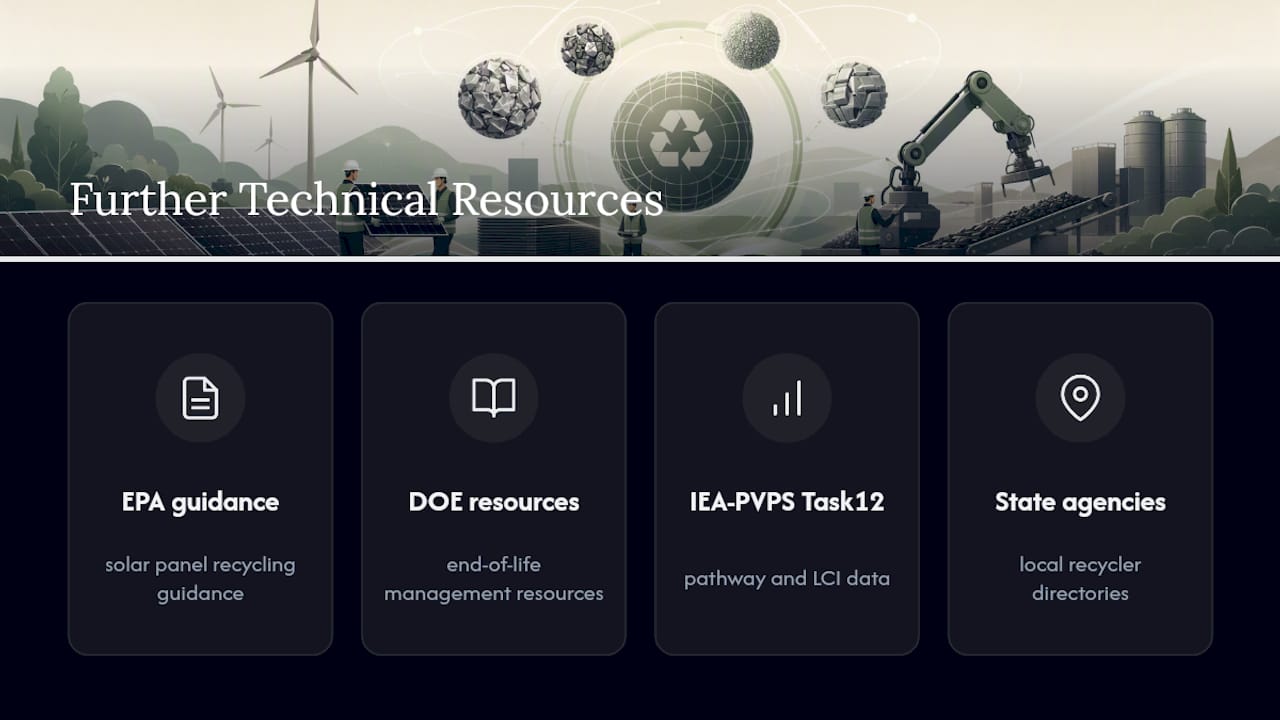
For technical detail beyond this guide, start with the EPA’s solar panel recycling guidance, DOE’s end-of-life management resources, and IEA-PVPS Task 12 reports for pathway and LCI data. Check your state environmental agency for local recycler directories.
Sources
- EurekAlert — press release on PV waste projection
- DOE — Beyond recycling: reducing waste from solar modules
- US EPA — Solar panel recycling
- IEA-PVPS — T12 status recycling (2025)