
A certificate of destruction proves that data or media were irreversibly destroyed. A certificate of recycling documents where materials ended up and how they were processed after that. Data-protection audits ask for the first; environmental and e-waste compliance checks ask for the second. Many organizations need both, tied to the same disposal event, because the two documents answer completely different legal questions.
TL;DR:
- A certificate of destruction proves irrecoverable data removal, requiring detailed device identification, destruction method, timestamps, and operator signatures for audit approval.
- A recycling certificate tracks material types and weights but does not confirm that sensitive data was securely destroyed, making both documents necessary for compliance in most cases.
- Destruction certificates must include specific details such as serial numbers, NIST-sanctioned sanitization methods, and facility location; vague paperwork is typically rejected.
- Vendors should be asked to specify the destruction process, provide serial-number tracking, and hold certifications like R2 or NAID to ensure trustworthiness.
- Combining both documentation types from the same disposal event simplifies audit readiness and chain-of-custody verification for IT asset managers.
Table of Contents
- Recycling Vs Destruction Certificate: The Core Definitions
- Which Certificate Do You Actually Need?
- What a Compliance-Grade Destruction Certificate Must Include
- What a Certificate of Recycling Actually Records
- How to Request and Verify a Certificate You Can Actually Trust
- How UsedCartridge Documents Every Disposal Event
- Why the Paperwork Deserves More Attention Than It Gets
- Get an Audit-Ready Certificate for Your Next Disposal
- Sources
- FAQ
Recycling Vs Destruction Certificate: The Core Definitions
A certificate of destruction (COD) records that a specific device, drive, or data set was rendered permanently unreadable. A compliant COD identifies the exact hardware by serial number, states the destruction method, and carries operator and witness signatures. Think hard-drive shredding, degaussing, or cryptographic erasure of an SSD before it leaves your building.
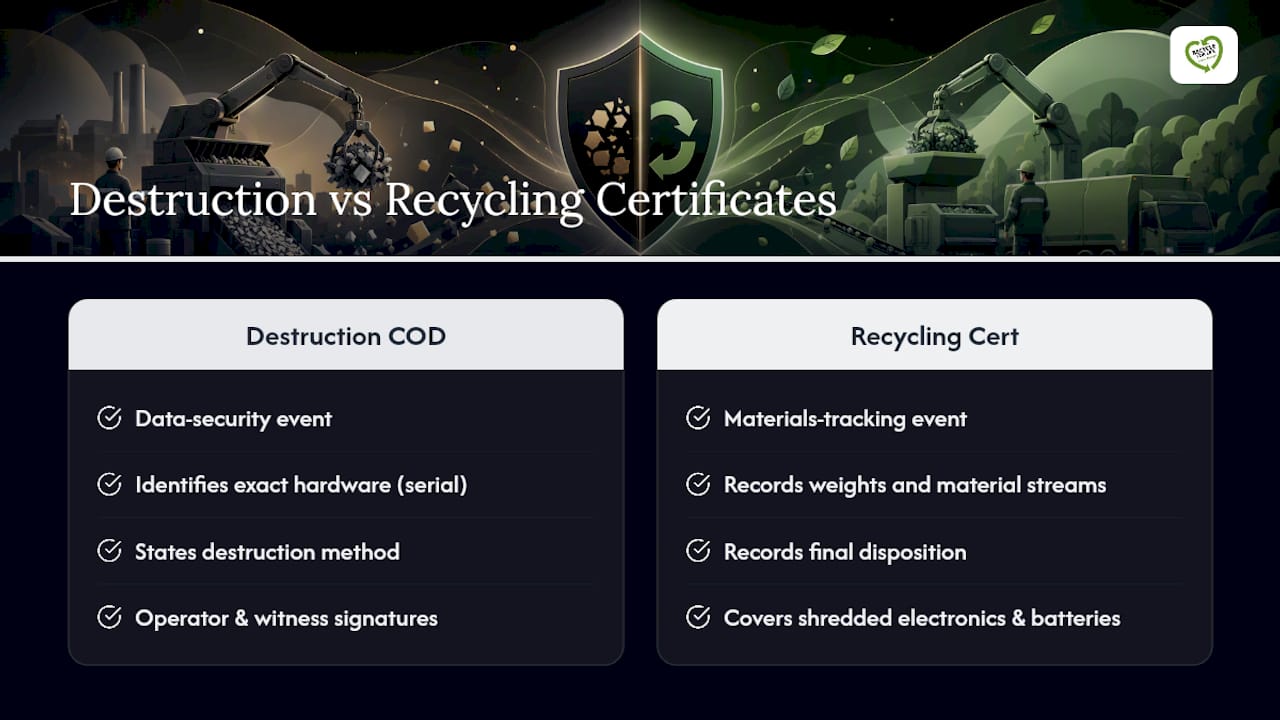
A certificate of recycling records what happened to the physical materials afterward: the weights collected, the material streams they were sorted into, and the final disposition (smelted, refined, landfilled, or resold as recovered commodity). Paper shredding certificates work the same way at a smaller scale, but for electronics, the recycling certificate typically covers the shredded remains, batteries, circuit boards, and casings once the data-bearing components are gone.
Generation points differ too. A COD is usually issued at the point of destruction, often on-site if a technician witnesses the shredding truck or drive crusher in your parking lot. A recycling certificate is usually issued later, once the downstream processor has weighed and sorted the material at their plant. One document is a data-security event. The other is a materials-tracking event. As LegalClarity notes, they’re often produced by the same vendor but for entirely separate compliance files.
Which Certificate Do You Actually Need?
The two documents carry different evidentiary weight depending on what you’re being audited for. A COD proves data elimination; auditors under HIPAA, PCI DSS, or state data-breach laws want that proof tied to a specific serial number, not a general statement that “old computers were recycled.” A recycling certificate proves environmental compliance; auditors checking state e-waste laws or landfill-ban rules want weights and downstream processor names, not proof that a hard drive was wiped.
Decide which document you need by asking two questions:
- Did the equipment hold regulated or sensitive data (customer records, health information, payment data)? If yes, you need a COD referencing a destruction standard.
- Does your state or industry require proof of proper e-waste handling, separate from data concerns? If yes, you need a recycling certificate.
- Are both true at once, as they usually are for retired office computers? Then you need both documents, cross-referenced to the same pickup or destruction event.
Most businesses disposing of laptops, servers, or drives fall into that third bucket. A recycling certificate alone doesn’t tell a HIPAA auditor anything about whether patient data was destroyed. A COD alone doesn’t tell an environmental regulator where the metals and plastics ended up.
What a Compliance-Grade Destruction Certificate Must Include
Auditors reject a startling share of destruction certificates, and it’s almost always for the same handful of missing details. NIST SP 800-88 Section 4.8 spells out the fields a COD needs, and vague paperwork gets thrown out regardless of how legitimate the actual destruction was.
A compliant COD generally needs:
- Per-device identifiers — serial number, asset tag, and make/model for every unit, not a batch count.
- Sanitization method with standard reference — specify cryptographic erase, overwrite, degaussing, or physical shredding, and cite the applicable NIST SP 800-88 level (Clear, Purge, or Destroy).
- Start and end timestamps, including time zone, for the destruction event.
- Operator name and, where required, a witness signature.
- Equipment ID and certificate ID so the document can be cross-referenced against internal asset records.
- Facility location where destruction took place.
Method matters as much as documentation. An SSD generally requires cryptographic erase rather than the overwrite passes that work on a spinning hard drive, because flash memory’s wear-leveling can leave data in cells a simple overwrite never touches. Physical shredding is the fallback when erase verification isn’t possible.
Auditors reject roughly 23% of CoD documents for missing mandatory data fields, most commonly generic method descriptions like “securely destroyed” with no serial numbers attached. Keep destruction records for the length of your industry’s audit retention window, typically several years, and cross-check them against your own asset manifest before filing them away.

What a Certificate of Recycling Actually Records
A recycling certificate is built around materials, not devices. Expect it to list:
- Material types processed (circuit boards, plastics, batteries, glass, ferrous and non-ferrous metals)
- Quantities or weights, usually by category
- The downstream processor or smelter that handled each stream
- Manifest or tracking numbers linking the shipment to a specific pickup
These fields satisfy state e-waste laws and landfill-ban requirements that regulate how electronics get processed once they leave your facility. What a recycling certificate does not do is prove anything about data. A device can be fully wiped or still holding a live customer database when it gets weighed at the recycling plant. If the equipment ever held regulated data, cross-reference the recycling certificate against a COD covering the same serial numbers before you consider the disposal complete.
How to Request and Verify a Certificate You Can Actually Trust
Ask vendors specific questions before you sign a service agreement, not after the shredding truck leaves.
- What exact method will be used, and does it map to a named standard (NIST SP 800-88, DIN 66399)?
- Will serial numbers be captured per device, or will the job be documented as a batch?
- Can I witness the destruction on-site, and will a witness signature appear on the certificate?
- Does the vendor hold R2, e-Stewards, or NAID / i-SIGMA certification, and will they sign a business associate agreement if the equipment held protected health information?
Red flags that should stop you from accepting a certificate: destruction method described only as “securely destroyed,” no serial numbers listed, no witness field, or no unique certificate ID. Chain-of-custody records should include scanned manifests, tamper-evident seals on transport containers, and timestamps at every handoff point.
Pro Tip: Store every certificate in a searchable, tamper-evident system the moment you receive it. Auditors ask for records under deadline pressure, and a five-minute retrieval beats a two-day scramble through email attachments.
How UsedCartridge Documents Every Disposal Event
Usedcartridge issues both types of certification because most clients need both. On-site data destruction, hard-drive destruction, recycling services, and IT asset disposition each generate their own certificate of destruction or recycling receipt, tied to per-device records: serial capture, operator and witness entries, and a unique certificate ID for every job. That documentation follows the step-by-step disposal workflow IT asset coordinators use to keep chain-of-custody intact from pickup through final processing.
Why the Paperwork Deserves More Attention Than It Gets
Most compliance failures I’ve seen traced back to a certificate treated as a formality instead of evidence. Centralize every certificate in one searchable system, and refuse to accept destruction method text that doesn’t name a standard. Secure destruction and responsible recycling aren’t competing priorities. Verify every certificate against the specific serial numbers on your asset list before you close the file.
— Keith
Get an Audit-Ready Certificate for Your Next Disposal
Usedcartridge is the option built specifically around the paperwork this article covers. Rather than piecing together a recycling receipt from one vendor and hoping a separate IT firm hands you a destruction certificate that actually names a standard, you get both documented from the same pickup event, with per-device serial capture built into the process from the start.

Whether you need on-site witnessed destruction for a server room full of drives or a straightforward recycling pickup for retired office equipment, the request process starts the same way: tell us what’s being disposed of and how sensitive the data was. For drives and data-bearing devices, start with on-site data destruction or hard-drive destruction if you need device-level shredding with a witnessed certificate. Ask for the certificate template up front so you know exactly which fields will show up on your paperwork before the job is scheduled.
Sources
Keep NIST SP 800-88 handy for sanitization levels, and look for R2, e-Stewards, or NAID / i-SIGMA certification when vetting a vendor. State e-waste laws vary, so check your state’s specific landfill-ban rules before assuming a recycling certificate alone covers your legal obligation.
- Certificate of destruction: what your CoD must include to pass an audit – Disposition Compliance
- What Is an E-Waste Certificate of Destruction? – LegalClarity
FAQ
What Does “Certificate of Destruction” Mean?
A certificate of destruction is a document confirming that a specific device or data set was permanently and irreversibly destroyed, identified by serial number, method, and timestamp. It’s the record a data-protection auditor asks for when checking that retired equipment no longer holds recoverable information.
Why Would a Company Want a Certificate of Destruction?
Companies need it as legal proof that regulated data (financial, health, or customer records) was eliminated before equipment left their control, protecting them from liability in a breach investigation or audit. It also satisfies contractual obligations many businesses have with clients or partners regarding data handling. Usedcartridge issues a COD with every data destruction service it performs.
Can You Fix a Car With a Certificate of Destruction?
No. A vehicle certificate of destruction is an entirely different legal document issued by a state DMV confirming a vehicle has been scrapped and its title permanently retired; it has no connection to IT or e-waste destruction certificates. Once a vehicle title carries that status, the vehicle generally cannot be legally re-registered for road use.
Can a Florida Certificate of Destruction Be Rebuilt?
That question refers to vehicle titling, not electronics disposal, and the answer depends on Florida’s specific DMV rules for salvage versus destroyed titles. Vehicle title rules vary significantly by state, so check with Florida’s Department of Highway Safety and Motor Vehicles directly rather than assuming a national standard applies.
Does a Recycling Certificate Prove My Data Was Destroyed?
No. A recycling certificate documents material weights and downstream processing, not data sanitization, so it never substitutes for a certificate of destruction on data-bearing equipment. If a device held sensitive data, request both documents referencing the same serial numbers.