
Cables and wires are recyclable, and the copper inside them is what holds the value. For businesses in Orange County, Los Angeles and San Diego, the simplest route is a free Recycle for Life business pickup, with a Certificate of Recycling within 3 days of every pickup. Sort first, then schedule your pickup.
TL;DR:
- Separate copper heavy building wire from thin data cable, keep working cords for reuse, and skip hand stripping because recyclers generally prefer unstripped bundles for mechanized processing.
- Clean copper wire usually earns more than aluminum wire or thin data cable; oil, dirt, and steel fittings can also lower the grade.
- Schedule a free business pickup for jobsite volumes, so cable leaves with the rest of the project’s e-waste and you get a Certificate of Recycling within 3 days.
- Keep oil-soaked, burned or damaged cable apart from clean loads, and book pickups early so material does not pile up at closeout.
Table of Contents
- What counts as recyclable cable and wire, and why does copper matter?
- Where should your cables and wires go?
- How should crews prepare cables for recycling?
- How do recyclers determine what your cable is worth?
- What are your options as a contractor or business?
- How long does cable recycling take from pickup to final material recovery?
- What does it cost to recycle cable at business volumes?
- Why cable recycling belongs in your jobsite closeout
- How we support contractors and businesses with bulk cable recycling
- FAQ
- Sources
What counts as recyclable cable and wire, and why does copper matter?
Almost anything with a metal conductor inside qualifies. As an electrician, you handle most of these categories on a regular basis:
- Consumer cords: power cords, extension cords and appliance leads
- Data and peripheral cables: Ethernet, HDMI and USB, which carry less metal per foot but add up in volume
- Building wire: Romex and THHN pulled from walls, conduit and ceilings during renovations
- Armored and industrial cable: heavier runs with thick conductors and metallic sheathing
The conductor decides the value. Copper is the main driver, and aluminum conductors are worth noticeably less per pound. A thick copper feeder cable may be worth more than a bundle of thin data cable, even if the data cable weighs the same. You can usually tell which one you have by scraping a small nick in the conductor: copper looks reddish, aluminum looks silver.
Construction matters too. Stranded conductors consist of fine wires, while solid conductors are one piece. Both can be processed with destruction and separation equipment, though bulky armored or jacketed cable may need extra handling. In industrial settings, separating copper from plastic with mineral-processing methods such as jigging and shaking tables has produced copper concentrates of around 97% in a case study, which shows how much of the metal can be recovered once the cable is granulated.
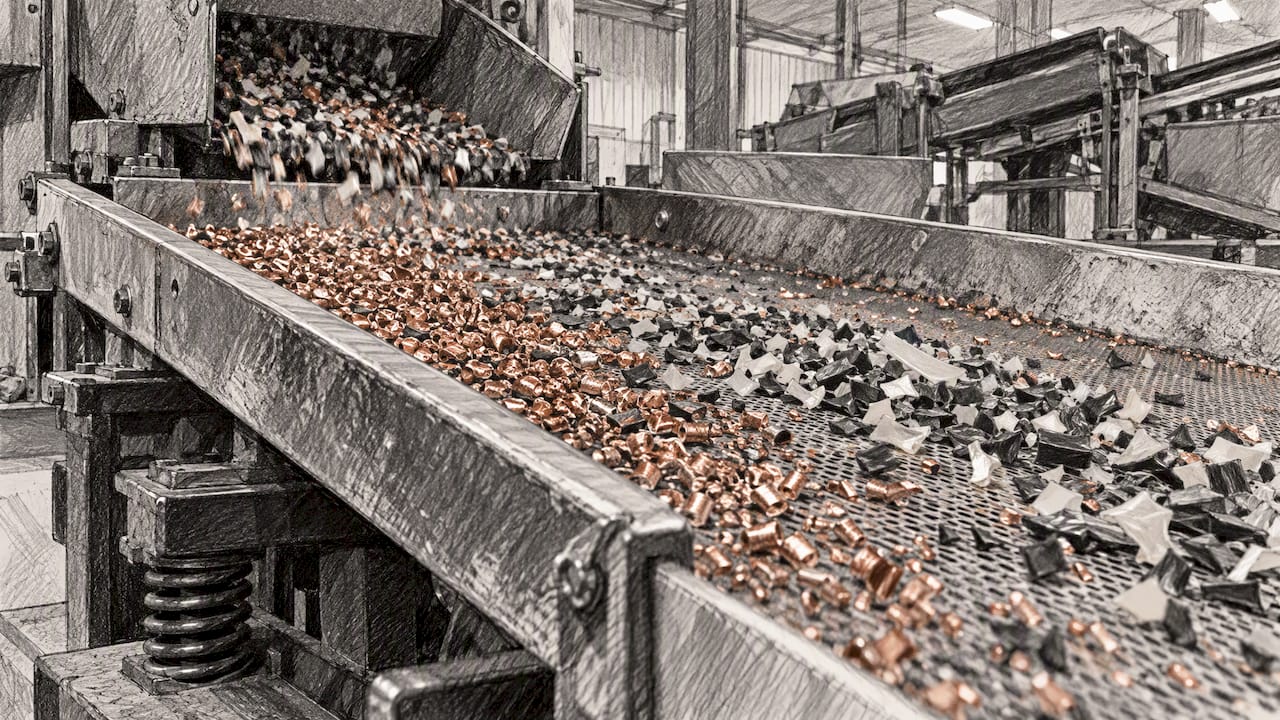
Your practical takeaway: pull copper-heavy runs out of mixed piles, and set aside any cord that still works. Working cords can be reused.
Where should your cables and wires go?
For a business, the answer is one route: schedule a free Recycle for Life pickup. We pick up cable and wire along with computers, peripherals and other e-waste from businesses in Orange County, Los Angeles and San Diego. We serve businesses only, and every job is a pickup, so nothing has to be hauled anywhere.
Within 3 days of every pickup, you get a Certificate of Recycling you can pass along to clients who ask for it.
Sort the cable before the pickup (see the next section), and set aside any cord that still works so your team can reuse it.
How should crews prepare cables for recycling?
Good prep prevents rejected loads and speeds up the handoff. Follow these steps:
- Sort by type. Keep building wire, extension cords, data cable and armored cable in separate bins.
- Pull working cables. Set aside anything reusable before the rest heads out.
- Bundle and coil. Tie coils tightly so they can be weighed and moved without tangling.
- Remove attached devices. Take off power bricks, adapters and hardware if your destination requires it.
- Skip the stripping. In professional recycling, hand-stripping insulation rarely pays for the labor, and recyclers generally prefer unstripped bundles they can run through mechanized processing.
A quick safety checklist for the crew: de-energize every run before cutting, snip plugs off only when the destination asks, and keep oil-soaked, burned or visibly damaged cable apart from clean loads. Wear gloves, because cut copper ends are sharp.
How do recyclers determine what your cable is worth?
Payout follows the metal market. The value of recycled wire is tied to live copper and aluminum commodity prices, so value rises and falls with the metal markets.
Grade comes next. Bare copper sits at the top, insulated copper wire pays less because the plastic has to be removed, tinned copper and mixed-metal cables get graded lower still, and shielding or heavy jacketing lowers the per-pound figure. Contamination hurts too. Oil, dirt, steel fittings and certain PVC insulation can cut an offer or get a load downgraded, so pre-sorting pays for itself.
What are your options as a contractor or business?
Once you pass a few bins of cable, logistics start to matter more than the per-pound price. Hauling loads yourself costs truck time and crew hours. A scheduled Recycle for Life pickup takes that off your crew’s plate.
Documentation is the other reason to consider managed service:
- Certificates of recycling your client may request for sustainability reporting
A rough decision guide: schedule a pickup when volumes build up, when your clients ask for certificates or when crew time is better spent on billable work. Book pickups early in a project so material is not piling up at closeout. Our guide to electronics disposal planning steps for businesses covers the scheduling side in more detail.
How long does cable recycling take from pickup to final material recovery?
The timeline has two parts: the pickup, then the processing. The pickup itself is quick, and a Recycle for Life Certificate of Recycling follows within 3 days.
Processing happens afterward, and you rarely see it. Material is sorted by type and grade, then destroyed or granulated, and the metal is separated from the plastic. Mechanical methods such as the ones in the mineral-processing case study work on cable that has been reduced to small particles. Industrial plants can also combine cold and hot treatments, and research on scrap copper cable recycling reports recovery rates near 99% for certain cable types, though that relies on specialized equipment and controlled conditions. The recovered metal then goes to smelters and mills and can be fed back into new cable.
For you, the timeline that matters is your paperwork. Plan the pickup before closeout so the certificate is in hand when your client asks for it.
What does it cost to recycle cable at business volumes?
For businesses in Orange County, Los Angeles and San Diego, a Recycle for Life pickup is free, so the real cost for most jobs is the time your crew spends sorting and bundling.
For larger volumes, build your estimate from these pieces:
- Labor and handling: sorting, bundling and loading, which is why stripping rarely pays
- Transport: your own truck time, or a pickup fee if a provider hauls for you
- Processing or service fees: some managed services charge for collection, container placement or documentation, and fees depend on material, volume and location
- Offsets: payout or credit for copper-heavy cable, which can cover part or all of the above
Fees vary by provider and by the mix of material, so the only reliable number is a written quote for your actual load. Large decommissioning projects with plenty of copper cabling can see meaningful value returned, while a load heavy in thin data cable or aluminum may roughly break even. Compare net figures, not per-pound prices: payout, minus hauling, minus labor, plus the value of the paperwork you receive.
If you are weighing recycling against a value-recovery plan for other electronics on the same job, our business guide to value recovery from electronics lays out how to compare options.
Why cable recycling belongs in your jobsite closeout
Most of the value people lose on cable is lost through habit, not bad prices. Wire gets tossed into a dumpster, mixed with debris or left behind because nobody owned the task. Our view is that cable recycling belongs in job closeout, right next to punch lists and cleanup.
Certificates of Recycling matter to clients and to your accountant. A managed pickup can save crew time compared with stripping on site, and that time may be worth more than the extra copper you would expose.
How we support contractors and businesses with bulk cable recycling
When your cable volume outgrows a trunk and a Saturday trip, we can take over the logistics. Our Recycling Services cover B2B e-waste recycling pickup, IT asset disposition and recovery, and local electronics recycling, so cable can move out alongside the old computers, peripherals and other equipment from the same project. We provide a Certificate of Recycling within 3 days of every pickup you can pass to clients for compliance needs.
Choose a managed pickup when volumes are large, when your client needs documentation, or when you would rather keep your crew billable; see our guidance on EV charging cable management standards for installers for cable handling best practices. Pickup is free for businesses in Orange County, Los Angeles and San Diego. Tell us what you have, how much, and where it is, and we will schedule the pickup. Call (714) 988-8109.

Request a quote or schedule a pickup through our IT asset recovery page and we will take it from there.
FAQ
Is cable wire worth scrapping?
Yes, when it contains copper and you have enough of it. Value follows live copper and aluminum prices, so sorted, copper-heavy cable is worth the effort while a few thin consumer cords are not.
How do you get rid of old cable wires?
If you are a business in Orange County, Los Angeles or San Diego, schedule a free Recycle for Life pickup. Sort cable by type first, and keep working cables aside for reuse.
Where can you get money for old cables?
Cable value follows copper and aluminum prices, and sorted, copper-heavy cable is worth the most. If your priority is getting cable off the jobsite with paperwork for your client, Recycle for Life gives businesses in Orange County, Los Angeles and San Diego a free pickup and a Certificate of Recycling within 3 days.
Can you get money for old wires?
You can, if the wire has enough metal and is reasonably clean. Sort by type and avoid contamination. Mixed or contaminated loads are worth less.
Sources
- Nexans – Frequently asked questions about CABLELOOP
- Industrial Recycling of Scrap Copper Cables and Wires: Combining Cold and Hot Treatments for Maximum Recovery and Minimal Emissions
- Separation of Copper from Electric Cable Waste Based on Mineral Processing Methods: A Case Study