
A solid e-waste vendor carries general liability, pollution liability and coverage tied to data handling, and can hand you a current certificate of insurance for each. If a vendor cannot, your company may be left holding the cost of a battery fire, a spill or a data leak. This guide shows which policies matter, which limits are typical, where standard policies leave gaps, and how to check a vendor before you sign.
TL;DR
- Ask every vendor for current certificates of insurance (COIs) covering general liability, auto, workers’ compensation and pollution liability.
- Standard general liability policies normally exclude pollution from items being recycled, so a separate pollution policy matters.
- Data from retired hard drives creates its own exposure. Ask how the vendor covers professional and cyber risk.
- Insurance does not replace good process. Pair the paperwork with registrations, audits and witnessed destruction.
- Recycle for Life is a B2B company that picks up from businesses in Southern California, and we are DTSC and EPA registered and subject to auditing.
Table of Contents
- What e-waste vendor insurance is supposed to cover
- The policies to look for
- Limits: what is typical and what is not
- The pollution exclusion most buyers miss
- Data risk and cyber coverage
- How to verify a vendor in five steps
- Our perspective
- Work with Recycle for Life
- FAQ
- Sources
What e-waste vendor insurance is supposed to cover
Electronics recycling mixes ordinary business risks with unusual ones. Trucks drive to your site, workers lift heavy equipment, and the material itself can burn or leak. It adds that the right pollution limit depends on what a facility accepts, how much, how it is stored and how it is processed.
The data side is just as real. Risk & Insurance reported that recyclers face first- and third-party liability when data from hard drives reaches the wrong hands. The same article noted that your company may remain liable for information a recycler failed to destroy, even when the contract obliges the recycler to destroy it. A vendor’s insurance helps, but it does not erase your own responsibility.
The policies to look for
A specialist program for recyclers gives a useful checklist. Amwins lists automobile, general liability, umbrella, property, impaired property, equipment breakdown, crime, inland marine, conversion, products, limited pollution, professional liability for document destruction, stock and workers’ compensation among the coverages recyclers may need. Not every vendor needs every line, but the list shows how many separate risks sit inside one pickup.
For most buyers, these are the ones to confirm first:
| Coverage | What it answers | Ask the vendor |
|---|---|---|
| General liability | Injury or property damage at your site | Limits per occurrence and aggregate |
| Commercial auto | Accidents involving the pickup vehicle | Does it cover the trucks that visit you? |
| Workers’ compensation | Injury to the crew on your premises | Current certificate on file |
| Pollution liability | Fires, spills and contamination from e-waste | Does it cover transportation and cleanup? |
| Professional or cyber liability | Data mishandled or exposed during disposal | Is it integrated with professional coverage? |
Limits: what is typical and what is not
Treat that as a floor for a conversation, not a guarantee that it fits your risk. A vendor hauling large volumes of batteries or CRT glass should be asking for more.
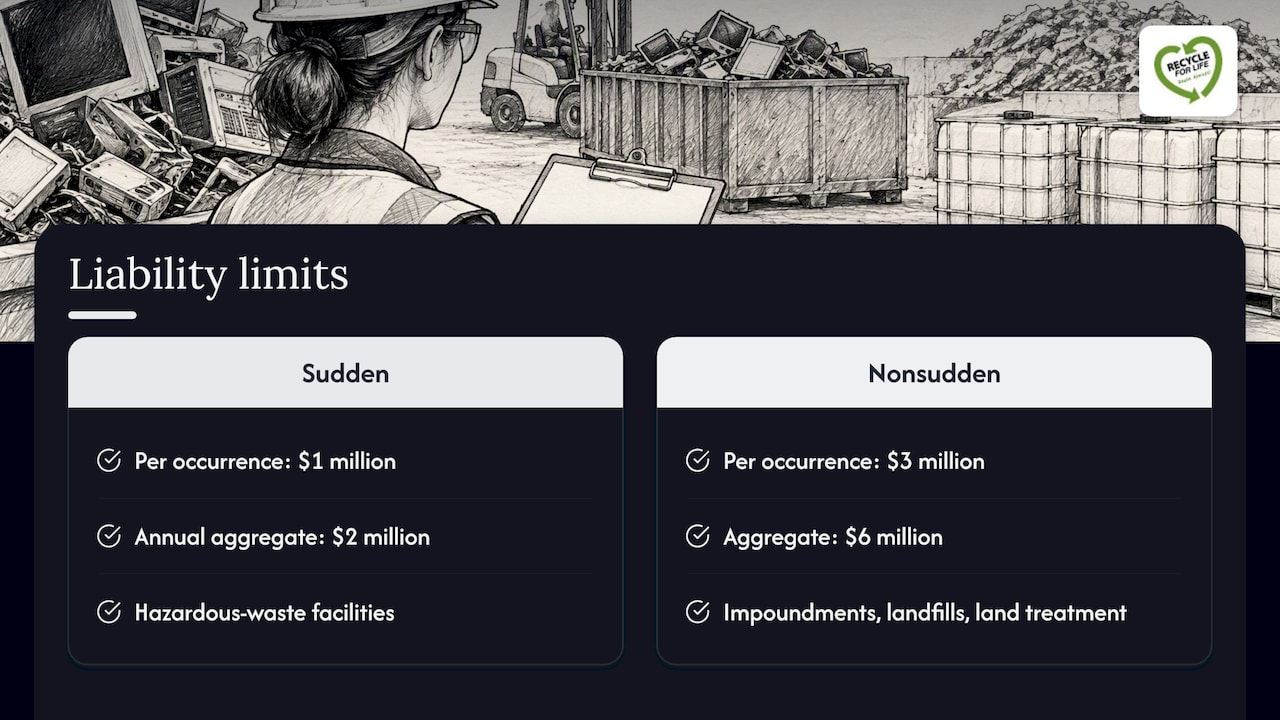
Federal rules set higher numbers for a different class of operator. Owners and operators of hazardous waste treatment, storage or disposal facilities must demonstrate liability coverage of $1 million per occurrence and $2 million annual aggregate for sudden accidental occurrences. Surface impoundments, landfills and land treatment facilities face $3 million per occurrence and $6 million aggregate for nonsudden occurrences. Those rules apply to specific hazardous waste facilities, so do not assume they describe every electronics recycler. Ask which rules apply to the vendor in front of you.
The pollution exclusion most buyers miss
This is the gap that surprises people. Elizabeth Bannister of Marsh advised recyclers to read policy language closely for these clauses and to buy affirmative pollution coverage, according to Risk & Insurance.
So when a vendor says “we are fully insured,” the next question is: which policy responds if a lithium battery ignites in the truck? The answer should name a pollution policy and its limit, not general liability.
Data risk and cyber coverage
Hard drives, laptops and copiers hold customer records, credentials and licensed software. The same Risk & Insurance piece explains that intellectual property exclusions in standard general liability can leave recyclers exposed for customer data or licensed software found on retired devices.
More recent reporting is practical. Resource Recycling reported in November 2025 that ITAD insurance experts recommended integrated professional and cyber liability policies, to cut disputes over whether a claim is a service error or a cyber incident. They also warned that contracts can shift broad breach costs onto vendors, so read the indemnification clause as carefully as the certificate.
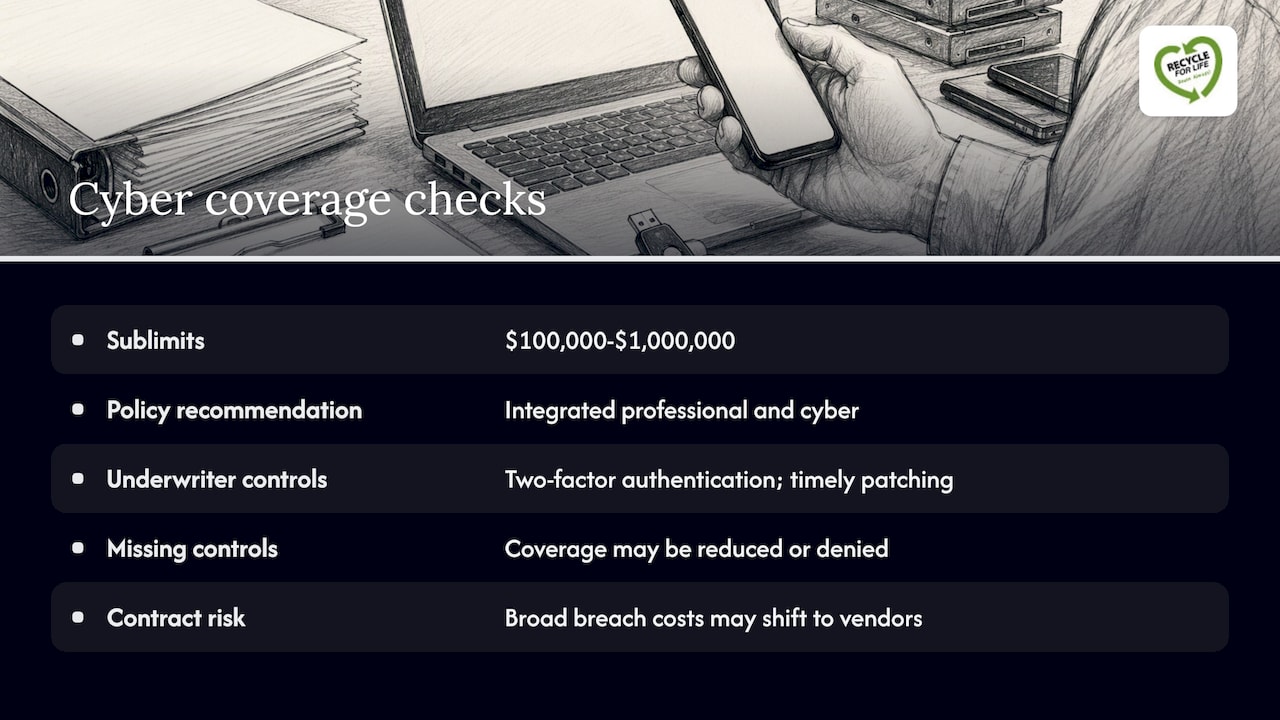
Cyber policies come with conditions. A 2023 report from the National Association of Insurance Commissioners (NAIC) says sublimits commonly range from $100,000 to $1,000,000, and that underwriters increasingly require measures such as two-factor authentication and timely patching. Coverage can be reduced or denied if those controls are missing. The same logic applies to you: basic cyber hygiene on your own systems is part of keeping your protection intact. For the disposal side, see our guide to digital security in recycling.
How to verify a vendor in five steps
- Check the dates and the limits. Confirm the policy period, the per-occurrence and aggregate limits, and the named insured.
- Ask about pollution coverage by name. Does it include transportation, cleanup and gradual conditions?
- Review your contract. Look for who bears breach costs and whether your company is named as an additional insured where appropriate.
- Match the paperwork to the process. Insurance is a backstop. Registrations, audits and a destruction method you can observe reduce the odds of a claim in the first place. Our guide to the vendor’s role in compliance and why auditing IT asset disposal matters go deeper.
If an insurance question comes up with a specific contract or a claim, bring in your broker or risk manager. They can read your actual policy language.
Our perspective
We see the same pattern with new clients. They ask about insurance first, and rightly so, but the best protection is a process that makes claims unlikely.
Recycle for Life is a B2B company that picks up from businesses across Southern California, from San Diego County to Los Angeles County. We are a DTSC and EPA registered company and we are subject to auditing. Pickup is free for businesses, and we handle it on a schedule that fits your facility.
For data, we do not ask you to take our word for it. On-site destruction uses a pneumatic punch, and your team can watch the drives being destroyed. The drives are destroyed afterward. We provide a Certificate of Recycling within 3 days of every pickup (and a Certificate of Destruction when drives are destroyed) that support your compliance files. Pair that with a vendor who can show you current insurance, and your risk file is in much better shape.
Work with Recycle for Life
If you are retiring IT equipment in Southern California, we pick it up from your business at no charge, whether it is a few workstations or a full office refresh. Hard drive destruction is free for 50 or more drives, and you can schedule witnessed, on-site drive destruction so your team sees the work done. Our computer recycling service covers the rest of the equipment.

To plan a pickup, start at Recycle for Life and tell us what you have and where it is.
FAQ
What insurance should an e-waste vendor carry?
At minimum, general liability, commercial auto, workers’ compensation and pollution liability. Vendors that handle drives and data should also have professional or cyber coverage. Ask for a certificate for each and check the dates and limits.
Does general liability cover a battery fire or chemical spill?
Usually not. Ask your vendor to name it.
Is the vendor’s insurance enough to protect us if data leaks?
No. Your company can stay liable for data a vendor failed to destroy, even with a contract in place. Combine vendor insurance with a destruction method you can witness, receipts for your records and a contract that spells out responsibility.
What limits are typical for a small recycling operation?
Larger or higher-risk vendors should carry more. Your broker can help set the right level for your contract.
Sources
- Amwins, RecycleGuard Insurance Program
- EPA, Liability Requirements for Hazardous Waste Facilities
- Risk & Insurance, Filling the E-Waste Insurance Gap
- Resource Recycling, Cyber risks confront ITAD work, contracts, coverage
- NAIC, 2023 Cyber Insurance Report