
Best starting point for local business-style collection: Recycle for Life. Best for equipment that must be destroyed before leaving your office: an arranged on-site destruction service. Best when agency purchasing or surplus rules control disposal: your approved disposition route. For government-office e waste pickup in 2026, confirm eligibility, authorize release, and arrange any data destruction before scheduling collection.
- Recycle for Life offers e waste pickup for businesses across Orange County, LA and San Diego; government offices should confirm eligibility before booking.
- Choose arranged on-site data destruction when your office requires destruction before equipment leaves the premises.
- A Certificate of Recycling records collection; a Certificate of Destruction documents an arranged destruction service.
- Follow your agency’s purchasing, records, and surplus-property procedures before releasing equipment.
Why this matters
A government office needs more than an empty storage room. You need permission to release public assets, a decision about stored information, and paperwork that matches the work performed.
The best e waste pickup service is the one that fits your approved release process—not simply the one that removes equipment. Start with the practical sequence: contact the provider, confirm equipment and location eligibility, arrange collection, and receive the Certificate of Recycling within 3 days. If destruction is required, arrange that service separately and request its Certificate of Destruction.
For a 2026 office cleanout, keep collection and data handling in the same work order but treat them as separate responsibilities. A truck leaving the building does not establish that the information on its contents has been destroyed.
What makes the best government-office e waste pickup service?
Use these criteria before comparing providers or requesting approval:
- Confirmed eligibility: Give the provider your government-office location and equipment list. Obtain confirmation rather than assuming business pickup terms apply.
- Clear destruction scope: Identify which devices contain information and whether destruction must happen on-site.
- Useful documentation: Ask what the Certificate of Recycling and any Certificate of Destruction will record.
- Authorized release: Check the agency’s purchasing, surplus-property, and records procedures before handing anything over.
- Practical building access: Confirm loading access, escort requirements, staging arrangements, and the person authorized to sign.
- Written service boundaries: Separate collection, recycling, destruction, and any additional work in the request.
These criteria keep the decision focused. A convenient collection arrangement is not a substitute for an approved disposal route or an agreed destruction method.
Government-office pickup options at a glance
The following ranking compares 3 service routes, not interchangeable providers. Choose the route that matches your office’s approval and information-handling requirements.
| Service route | Best for | Standout feature | Key limitation |
|---|---|---|---|
| Recycle for Life business pickup | Offices seeking collection across Orange County, LA and San Diego | Business pickup, a Certificate of Recycling within 3 days, and separately arranged destruction services | Government-office, equipment, and location eligibility require confirmation |
| Arranged on-site data destruction | Offices requiring destruction before equipment leaves | Places the destruction step at the office | Requires a separate scope, access plan, and documentation agreement |
| Agency-approved disposition route | Offices governed by an existing contract or surplus process | Keeps disposal within the agency’s authorized procedure | The approved route still needs explicit collection and data-handling instructions |
1. Recycle for Life: best local pickup starting point
Best for: Office and IT managers in Orange County, LA and San Diego seeking a practical collection arrangement, subject to government-office eligibility and agency approval.
Recycle for Life provides free business e waste pickup, computer and hard drive recycling, and on-site data destruction services. Government offices should confirm that their location, equipment, and proposed work qualify before booking; the business offer alone does not establish public-agency eligibility.
The service-led process suits a manager who needs to organize a batch of retired electronics without confusing collection with information disposal. The Certificate of Recycling supports collection records, while a Certificate of Destruction applies to arranged destruction services.
Recycle for Life pros:
- Business pickup provides a starting point for a local collection request.
- Computer and hard drive recycling are explicitly offered.
- On-site data destruction can be discussed alongside the collection request.
- The Certificate of Recycling and Certificate of Destruction serve distinct documentation needs.
Recycle for Life limitations:
- Government-office acceptance and agency vendor approval must be confirmed.
- Equipment acceptance and service-location eligibility require confirmation.
- Pickup alone does not destroy data, and destruction work is not automatically included in the free business pickup offer.
Send an inventory and describe the building before requesting a collection date. State whether your office needs on-site destruction, which items are covered, and who must receive the paperwork.
Verdict: Hold booking until eligibility, agency authorization, and destruction scope are confirmed. This is the first local collection inquiry to make when those conditions match your office’s needs.
2. Arranged on-site destruction: best for controlled data disposal
Best for: Government offices whose approved process requires information-bearing equipment to remain on-site until destruction.
An on-site destruction arrangement brings the destruction work to your premises. It is a distinct service decision, not a consequence of booking electronics collection.
For a 2026 retirement project, tell the provider what equipment is involved and what your office requires before anything leaves. Ask the provider to explain the proposed method in plain English and describe how completed work will be documented.
On-site destruction pros:
- Supports an office requirement to complete destruction before removal.
- Gives your designated representative a defined service event to coordinate.
- Separates destruction instructions from general recycling instructions.
On-site destruction limitations:
- Requires access arrangements and a suitable agreed work area.
- Does not replace records-retention review or authorization to destroy information.
- Requires separate confirmation of service terms and certificate details.
Agree in advance on what the certificate will record. A Certificate of Destruction records what was destroyed, the method and the date; serial numbers are listed when you supply your list before pickup. Confirm witnessing and the destruction method while arranging the job rather than assuming them.
A certificate should correspond to the arranged work. If some devices are collected without destruction, keep that distinction visible in the inventory and final records.
Verdict: Hold collection of restricted devices until the destruction method, authorization, and documentation are agreed. Choose this route when your office’s rules make on-site destruction necessary.
3. Agency-approved disposition: best for contract-led offices
Best for: Departments that must use an existing vendor contract, centralized surplus program, or another designated disposal procedure.
An agency-approved disposition route starts with your internal authorization process rather than an outside pickup request. Your purchasing, property, or IT team identifies the permitted route and the conditions for releasing equipment.
This is not a claim that every agency follows the same procedure. Use your own office’s instructions, including any distinction between reusable property, recycling, and destruction.
Agency-approved disposition pros:
- Keeps the disposal request tied to the office’s authorized process.
- Establishes who can approve asset release and sign collection paperwork.
- Helps coordinate departments that share equipment or disposal responsibilities.
Agency-approved disposition limitations:
- Approval does not by itself specify how data will be handled.
- An existing collection arrangement does not automatically include destruction.
- Individual departments still need an accurate inventory and building-access plan.
Ask the responsible team whether the approved route covers both physical equipment and stored information. If it covers collection only, resolve the data-handling step before transferring devices.
Verdict: Skip an independent booking when your agency requires another route. Follow the approved process, then confirm its collection and destruction details.
How the service routes are ranked
The order starts with a local pickup inquiry, then separates the two conditions that change that choice: an on-site destruction requirement and an agency-mandated disposal route.
The ranking rests on eligibility, destruction scope, documentation, authorization, and access—not unsupported claims about speed or government contracts. For your 2026 project, an agency requirement takes priority over the order shown here.
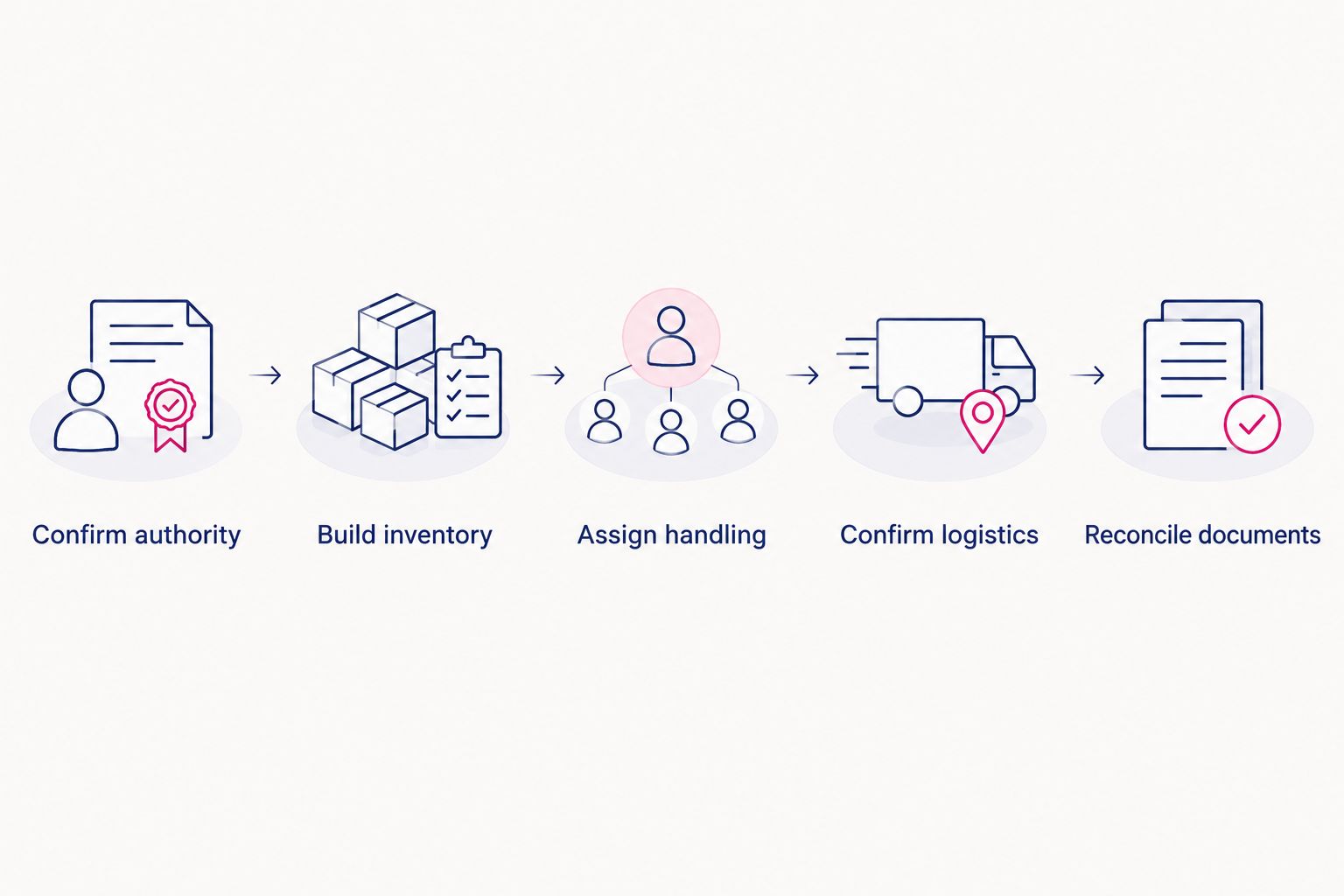
Prepare your pickup request in 5 steps
1. Confirm authority
Identify who can approve retirement, release assets, and authorize destruction of stored information. Check records-retention obligations before approving destruction; equipment retirement and permission to destroy its contents are separate decisions.
For a shared government building, name the department that owns each batch. A property manager coordinating access should not be treated as the owner of every tenant’s equipment.
2. Build inventory
List equipment types, quantities, asset tags, and serial numbers where your procedure requires them. Mark devices containing storage separately from equipment that your IT team has confirmed does not contain office information.
Do not rely on a box marked miscellaneous. A clear inventory lets the provider confirm acceptance and lets your staff reconcile what actually leaves.
3. Assign handling
Give each item a clear instruction: hold, recycle after approved preparation, or send for arranged destruction. Have your IT or information-security owner resolve uncertain devices before collection.
Deleting files or signing out of an account is not the same as completing an approved data-removal process. Ask the responsible team to document the method used rather than accepting a verbal assurance that a device is clean.
4. Confirm logistics
Provide the pickup address, floor, loading arrangements, access restrictions, and on-site contact. Explain whether devices are already gathered or remain in separate offices.
Confirm equipment and location eligibility before moving everything into a loading area. Ask for written confirmation of the collection scope and any separately arranged destruction work.
5. Reconcile documents
Compare the collection record with your inventory and note exceptions. Keep the Certificate of Recycling with the asset-release paperwork, then retain the Certificate of Destruction for the items covered by arranged destruction.
These 5 preparation steps give your office a repeatable handoff. They also identify the person responsible for resolving a missing item or a document that does not match the agreed scope.
When your inventory is ready, use the Contact Us page to request eligibility confirmation. Include your government-office location, equipment list, access details, and any destruction requirements so the service discussion starts with a defined job.
Keep the Certificate of Recycling and Certificate of Destruction separate
Your 2026 disposal file should distinguish 2 document types: the Certificate of Recycling and the Certificate of Destruction. Each answers a different question.
- Certificate of Recycling: Records collection, listing computers, laptops and screens by the piece and other e-waste by weight. Review it against the equipment handed over; do not treat it as evidence that stored information was destroyed.
- Certificate of Destruction: Documents the arranged destruction service. Confirm what items and work it covers rather than assuming it applies to the entire pickup.
The Certificate of Recycling arrives within 3 days of pickup. Ask where it will be sent and who will check it against the release record.
For certificates, agree on the required information before service. If your agency wants serial numbers or a particular sign-off, raise that while arranging the job and send your serial-number list before pickup, not after the equipment has left.
Which pickup route should your office choose?
For an eligible local office, start with a Recycle for Life e waste pickup inquiry and confirm approval before booking. Choose arranged on-site destruction when your office requires destruction before removal, and follow the designated disposition route when agency rules require it.
Keep your request short and concrete: what is leaving, who owns it, where it is located, what must happen to its information, and which documents you need. That gives the provider a useful scope without making assumptions about acceptance or service coverage.
For multi-department projects, appoint a single coordinator but keep ownership and authorization clear. One collection event can involve several separate decisions about records and equipment.
FAQ
What is the best e waste pickup service for a government office?
The best service fits your agency’s authorization process, equipment, location, and data-handling requirements. Recycle for Life is a business-pickup option across Orange County, LA and San Diego; confirm government-office eligibility and vendor approval before booking.
Can a government office request free business pickup?
A government office should ask whether its job qualifies for the provider’s free business pickup offer. Confirm equipment, location, and agency eligibility separately, and do not assume destruction work is included.
Does electronics pickup include hard drive destruction?
Electronics pickup alone does not establish that hard drives have been destroyed. Arrange destruction explicitly and confirm the items, method, and documentation covered.
Is a Certificate of Recycling the same as a Certificate of Destruction?
No. A Certificate of Recycling records collection and arrives within 3 days of pickup, while a Certificate of Destruction documents an arranged destruction service. Keep the documents separate and reconcile each against its agreed scope.
Should government-office hard drives be destroyed on-site?
Use on-site destruction when your office’s approved process requires destruction before removal. Have the responsible IT or security team approve the method and documentation before scheduling.
What should an office send before scheduling e waste pickup?
Send the equipment inventory, pickup location, access details, and requested data-handling instructions. Identify the authorized contact and ask the provider to confirm acceptance and service scope.
Can a property manager arrange pickup for government tenants?
A property manager can coordinate the request and building access with the tenants’ authorization. Each tenant should identify its equipment and provide the required release and data-handling approvals.
One last thing
Mark hold items as clearly as pickup items. Before the 2026 collection, separate equipment awaiting records review, ownership confirmation, or destruction approval from the authorized batch. Give the collection contact the same list your IT and property teams approved.
The final check is simple: if staff cannot explain why an item is authorized to leave, keep it out of the pickup batch until the responsible person resolves it.
Related guides
- Business electronics recycling in multi-tenant offices
- Business electronics recycling for property managers
- Hard drive destruction services for Tustin businesses