
Federal law does regulate battery disposal, but not evenly. The EPA enforces the Mercury-Containing and Rechargeable Battery Management Act and RCRA’s universal waste rules as a baseline, and households get limited exemptions that businesses don’t. Discarded lithium-ion batteries frequently trigger hazardous-waste codes D001 and D003 for commercial generators, and states like California and Kentucky layer on their own stewardship and take-back rules. Check your state agency before you dispose of anything.
TL;DR:
- Most hazardous waste classifications for lithium-ion batteries depend on state-specific rules beyond federal universal waste standards, which vary widely across regions.
- California’s stewardship law requires producers to fund collection programs with minimum site numbers, phased fees, and reporting, influencing broader state policies.
- Properly preparing batteries for recycling involves taping terminals, segregating by chemistry, avoiding physical damage, and isolating damaged or leaking cells.
- Organizations that discard batteries may become hazardous waste generators and must maintain detailed documentation, verify permits, and follow state-specific recordkeeping.
- Retailers typically accept used batteries through take-back or core-charge systems, while producers bear the main responsibility for funding and operating collection programs.
Table of Contents
- What Do Battery Recycling Laws Actually Require?
- How Do State Battery Recycling Laws Differ?
- How Should You Prepare Batteries for Recycling Safely?
- What Are Your Business’s Legal Obligations as a Generator?
- What Do Retailers and Producers Owe Consumers?
- What Happens if You Don’t Comply?
- What’s an Audit-Ready Battery Compliance Checklist?
- An Editorial Take on Where Compliance Actually Breaks Down
- How Usedcartridge Simplifies Battery Recycling Compliance
- Where to Verify Battery Recycling Laws Yourself
- Sources
What Do Battery Recycling Laws Actually Require?
Three federal layers govern how batteries get thrown away or recycled in the United States, and most people only know about one of them.
The oldest is Public Law 104-142, the Mercury-Containing and Rechargeable Battery Management Act, passed in 1996. It requires recycling of nickel-cadmium (Ni-Cd) and small sealed lead-acid (SSLA) batteries and phased mercury out of most battery chemistries sold in the U.S. It’s the reason a AA battery today doesn’t behave like the ones from the 1980s, but it says almost nothing about lithium-ion, the chemistry that now dominates phones, laptops, power tools, and EVs.
That’s where the Resource Conservation and Recovery Act (RCRA) comes in. Under RCRA, a discarded battery can become a “hazardous waste” the moment a business throws it out, depending on its chemical properties. The EPA notes that many discarded lithium-ion batteries meet the criteria for D001 (ignitable) and D003 (reactive) hazardous waste when generated by a commercial entity. Households are generally exempt from this classification. A business is not. If your office tosses out a box of dead laptop batteries, you may be generating regulated hazardous waste whether you intended to or not.
Universal Waste rules, codified at 40 CFR Part 273, exist to make compliance realistic. Rather than forcing every battery generator through the full hazardous-waste permitting gauntlet, Universal Waste status allows:
- Longer accumulation times before batteries must ship off site
- Reduced paperwork compared to full hazardous-waste manifesting
- Streamlined transport to a permitted recycler instead of a hazardous-waste disposal facility
- Coverage across most common battery types, including lithium-ion, nickel-cadmium, and lead-acid
Most states have adopted Universal Waste standards for batteries, but a handful haven’t, or have added their own twists. That’s a detail worth confirming with your state environmental agency before you assume the federal streamlined path applies where you operate.
Shipping adds a fourth layer. The Department of Transportation, through the Pipeline and Hazardous Materials Safety Administration (PHMSA), regulates how lithium batteries move in commerce. PHMSA issued a safety advisory in 2022 covering packaging, labeling, and carrier training specifically because damaged or improperly packed lithium cells have caused fires in cargo holds and waste facilities. If your organization ships batteries to a recycler, DOT packaging and labeling rules apply on top of whatever EPA classification governs the waste itself.
How Do State Battery Recycling Laws Differ?
Federal law sets the floor. States build the rest of the house, and the architecture varies a lot depending on which state you’re standing in.
Four basic program types show up across the country:
- Producer-funded stewardship programs, where battery manufacturers pay into a collection and recycling system instead of leaving disposal costs to consumers or municipalities
- Mandatory retailer take-back, requiring stores that sell batteries to accept used ones at the point of sale
- Deposit or core-charge regimes, most common with lead-acid automotive batteries, where a fee is refunded when the old battery is returned
- Landfill and incineration bans on specific chemistries, most often rechargeable and lithium-based batteries
California offers the clearest recent example of the stewardship model. The Responsible Battery Recycling Act of 2022 (AB 2440) requires producers of “covered batteries” (mostly single-use and rechargeable batteries under a certain size, with separate provisions for battery-embedded products) to fund and run collection programs. The law sets minimum numbers of collection sites relative to population density, requires annual reporting, and phases in fee provisions for embedded-battery products between 2026 and 2028. It also folds in and effectively supersedes older California laws like the Rechargeable Battery Recycling Act, so a business that thought it was compliant under the old framework needs to recheck its obligations.
California’s model matters beyond its borders. AB 2440 requires statewide stewardship plan approval, collection-site minimums tied to population, and staged fee provisions running through 2028. Several other states are actively modeling their own bills on this structure.
Kentucky just joined the stewardship-program club. The Kentucky Covered Battery Stewardship Act, enacted in 2026, requires the creation of a formal stewardship program with collection-site listings, plan approval, and chemistry-specific reporting on collected weights. The statute sets a program-establishment deadline of June 30, 2027, giving producers and the state a defined runway to stand up the infrastructure. If your organization operates in Kentucky, that 2027 date belongs on your compliance calendar now, not later.
Lead-acid batteries run on a different track almost everywhere. Most states require a core charge, refundable deposit, at the point of sale, and retailers are frequently obligated to accept used batteries regardless of where the customer originally bought them. Rules on caps, refund amounts, and acceptance windows vary by state, and Battery Council International maintains state-by-state summaries that are worth bookmarking if your organization handles automotive or industrial batteries across multiple states.
The practical takeaway: don’t assume your state mirrors California or Kentucky. Some states have no stewardship law at all and rely entirely on the federal Universal Waste framework. Others have landfill bans with no accompanying collection mandate, which creates a compliance gap businesses have to solve on their own. Check your state environmental agency’s website, and cross-reference it against Call2Recycle’s state law mapping, which the EPA itself references as a practical resource for tracking program-specific rules.
How Should You Prepare Batteries for Recycling Safely?
Lithium-ion batteries don’t fail quietly. A punctured or crushed cell can go into thermal runaway, and thermal runaway in a truck full of cardboard and packing material is how recycling centers and waste haulers end up on the local news.
Follow these steps before any battery leaves your building:
- Tape the terminals. The EPA specifically recommends taping battery terminals to prevent short circuits from contact with other metal objects or batteries.
- Bag them separately. Each battery, or at minimum each battery type, should go into its own plastic bag rather than loose in a bin with others.
- Never crush, puncture, or incinerate. Physical damage is the single most common trigger for a thermal event in storage or transit.
- Isolate anything damaged, swollen, or leaking. A battery showing physical distress should be moved to secondary containment (a sealed metal or fire-resistant container) and kept away from other waste streams until a hazardous-waste specialist or the manufacturer can advise on handling.
- Segregate by chemistry. Lithium-ion, lead-acid, and nickel-cadmium batteries should never share the same storage container, both for safety and because they’re regulated differently.
Damaged cells deserve their own callout. A battery that’s swollen, cracked, or leaking electrolyte isn’t a candidate for your standard drop-off bin or a bulk shipment box. It needs isolation and, in most cases, a call to a certified hazardous-waste handler rather than a wait-and-see approach.
Pro Tip: Keep a small stock of painter’s tape and quart-sized zip bags at every device collection point in your office. It costs almost nothing and it’s the single fastest way to prevent a battery fire before it starts.
Organizations that handle any real volume of batteries should also set storage limits (how many pounds of a given chemistry can accumulate before pickup), train staff on identifying damaged cells, and document the training. That documentation isn’t just good practice. It’s often what an insurer or a permitted recycler will ask to see before they’ll accept your shipment.
What Are Your Business’s Legal Obligations as a Generator?
The moment your organization discards a battery, you may become a “hazardous waste generator” under RCRA, and that status comes with paperwork you don’t want to discover after an inspection.
Start by figuring out your generator category. The EPA’s Very Small Quantity Generator (VSQG) category covers organizations producing small amounts of hazardous waste per month, and it comes with lighter recordkeeping requirements than higher-volume categories. But VSQG thresholds are federal minimums. Several states impose tighter limits or additional notification requirements, so a company that qualifies for VSQG status under federal rules might still face stricter state obligations. Confirm your category with your state environmental agency rather than assuming the federal threshold is the only one that applies.
Documentation is where most organizations get exposed, not because they’re disposing of batteries improperly, but because they can’t prove they disposed of them properly. Keep:
- Weights collected, broken out by battery chemistry (lithium-ion, lead-acid, nickel-cadmium, alkaline)
- Receipts and invoices from every pickup or drop-off
- Manifests or bills of lading for any shipment to a recycler
- Certificates of recycling or destruction from the receiving facility
- A chain-of-custody record if the batteries changed hands more than once before final processing
Retention expectations vary by state, but three years is a reasonable floor for most hazardous-waste-adjacent recordkeeping, and longer if your organization operates under sector-specific rules (financial services, healthcare, government contracting) with their own document retention mandates.
The recycler and transporter you choose matters as much as your own paperwork. Using a permitted facility isn’t optional window dressing. It’s the difference between transferring liability cleanly and staying on the hook if batteries you handed off get dumped illegally downstream. Verify permits directly with the facility or your state agency rather than taking a vendor’s word for it, and keep that verification on file alongside your other records. A detailed electronic disposal compliance checklist can help you map generator status against your specific waste streams if batteries are just one piece of a larger e-waste program.

What Do Retailers and Producers Owe Consumers?
Retailers sit in an odd position: they didn’t manufacture the battery, but many state laws make them the collection point anyway.
One-for-one take-back is the most common retailer model. A store selling a certain volume of batteries has to accept a comparable number back from customers, sometimes with a cap on daily or per-visit returns, and usually with signage requirements telling shoppers the service exists. The specifics (which battery types qualify, whether there’s a cap, what the signage has to say) vary by state, which is part of why a national retailer’s battery return policy can look different from one store location to the next.
Lead-acid batteries run on the core-charge model instead. The core charge is a refundable fee added at purchase, returned when the customer brings back an old battery. It’s designed to make sure lead-acid batteries, which contain both lead and sulfuric acid, don’t end up in a landfill or a curbside bin. Battery Council International’s state summaries show that core-charge amounts and refund windows aren’t standardized nationally, so a business managing fleet vehicles across state lines needs to track the rules for each one.
Producer stewardship laws, the AB 2440 and Kentucky model, put the bulk of the obligation upstream. Producers have to:
- Fund and operate an approved collection and recycling program
- Meet minimum collection-site density relative to population
- Report collected weights and program performance, usually annually
- Provide consumer notices about where and how to return covered batteries
Collection sites participating in these programs typically face their own training and safety requirements, echoing the terminal-taping and segregation practices covered above, because a retail collection bin full of loose lithium cells is exactly the kind of fire risk these laws exist to prevent.
What Happens if You Don’t Comply?
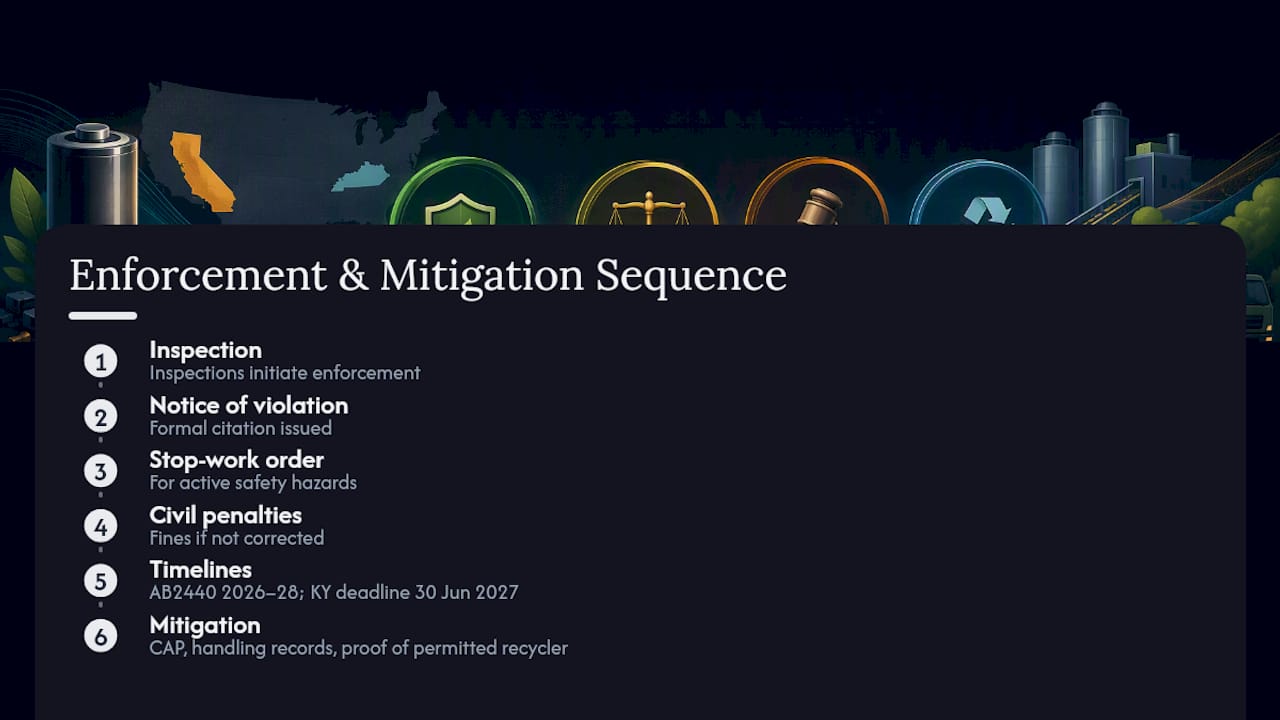
Enforcement for battery-related violations usually follows the same pattern as other hazardous-waste and environmental rules: inspections first, then notices of violation, then civil penalties if the problem isn’t corrected. State environmental agencies have authority to issue stop-work orders on a facility or shipment if they find an active safety hazard, which is a real risk for any operation storing damaged lithium cells improperly.
Timelines matter more than most organizations realize. AB 2440’s fee provisions for battery-embedded products phase in between 2026 and 2028, and Kentucky’s program has a hard June 30, 2027 establishment deadline written into the statute. Missing a phase-in date isn’t necessarily catastrophic on its own, but it’s the kind of gap that turns a routine inspection into a longer conversation with regulators.
If your organization does get cited, the mitigation path is usually straightforward: a corrective action plan, documentation showing the batteries in question were properly handled after the fact, and evidence that you’ve since switched to a permitted recycler if that was the underlying problem. Regulators generally respond better to organizations that can show they fixed the process than ones that argue about the citation.
What’s an Audit-Ready Battery Compliance Checklist?
Most compliance failures come from skipping steps, not from ignorance of the law. A written checklist closes that gap faster than any policy memo will.
- Inventory and label every battery by chemistry and approximate weight before it leaves normal use.
- Segregate and tape terminals immediately upon collection, using separate containers by chemistry.
- Classify the waste stream: household exemption, VSQG, Universal Waste, or full hazardous waste, and apply the matching procedure for each.
- Verify your recycler and transporter hold current permits before batteries leave your site, not after.
- Collect documented chain-of-custody records and a certificate of recycling for every shipment.
- Train staff on identifying damaged cells and following your segregation procedure, and document that training happened.
- Update procurement policies so new equipment purchases account for compliant end-of-life disposal from day one.
- Escalate to legal counsel or a certified e-waste service when volumes are large, batteries are embedded in equipment you can’t easily disassemble, or you’re operating across multiple state jurisdictions with conflicting rules.
Organizations that skip step 3, waste classification, are the ones most likely to end up commingling household-collected batteries with commercial waste streams, a mix that can trigger full hazardous-waste generator obligations for the entire collected batch instead of the lighter Universal Waste path.
For organizations juggling batteries alongside broader IT and electronics disposal, folding this checklist into a wider electronics disposal plan tends to catch gaps a battery-only checklist misses, like what happens to the lithium cell still sitting inside a laptop nobody flagged as “battery waste.”
An Editorial Take on Where Compliance Actually Breaks Down
The failures I see aren’t exotic. They’re mundane: someone tosses a mixed box of dead batteries into one bin instead of three, nobody writes down the weight before the recycler hauls it away, and a facility manager assumes their state mirrors California’s rules when it doesn’t come close. Chemistry mixing and missing documentation cause more regulatory exposure than any dramatic illegal dumping scenario.
Storage and paperwork are boring. They’re also where the actual risk reduction lives.
— Keith
How Usedcartridge Simplifies Battery Recycling Compliance
Tracking generator status, state stewardship rules, and DOT shipping requirements across every location your organization operates is a full-time job on top of whatever your team was already hired to do. Usedcartridge handles the compliance layer for you: on-site pickup for lithium-ion, lead-acid, and mixed battery streams, recycling through certified facilities, and documentation built for an audit rather than assembled after the fact.

Every pickup comes with chain-of-custody records and a certificate of recycling, the exact paperwork this article just walked through as the difference between a clean disposal and an open liability. That matters whether you’re managing a handful of laptop batteries a year or a fleet’s worth of lead-acid cores. Usedcartridge’s e-waste recycling and logistics service also covers the devices those batteries came out of, so you’re not running two separate vendors for one waste stream.
Getting a quote takes a short list of details: battery and device types, approximate weights, and your site address. From there, Usedcartridge schedules pickup and handles the rest. Request a quote for asset recovery and recycling and get your documentation in order before your next inspection, not after.
Where to Verify Battery Recycling Laws Yourself
Primary sources beat secondhand summaries every time, especially with state law changing as fast as it currently is.
- EPA: Used lithium-ion batteries, for hazardous-waste classification and generator responsibilities
- EPA: Used household batteries, for consumer-facing handling and disposal guidance
- DOE consumer guide to battery recycling, for a plain-language breakdown by battery type
- California AB 2440 full text, for the Responsible Battery Recycling Act’s exact provisions
- Kentucky Covered Battery Stewardship Act (2026), for the new program’s statutory language
- Battery Council International state law summaries, for lead-acid and retailer-specific state comparisons
This article is general information, not a substitute for advice from a qualified lawyer. Consult a qualified legal professional about your own circumstances before acting on anything here.
Sources
- Used lithium-ion batteries | US EPA
- Used household batteries | US EPA
- Mercury-Containing and Rechargeable Battery Management Act (Public Law 104-142) | US EPA
- AB 2440 Responsible Battery Recycling Act of 2022 | California Legislature
- Kentucky Covered Battery Stewardship Act (2026) | Kentucky Legislature