
A certificate of destruction is a signed, dated document proving that specific paper records or electronic media were destroyed by a named method and provider. It exists to protect you: it’s your evidence during an audit, your defense in litigation, and your proof of compliance if a regulator ever asks how you disposed of sensitive information. What belongs on the certificate depends heavily on the media type.
- Audit proof: shows an auditor exactly when, how, and by whom records were destroyed
- Regulatory compliance: satisfies documentation duties under HIPAA, FACTA, and similar laws
- Liability protection: shields your organization if destroyed data later surfaces in a breach claim
- Media-specific detail: paper certificates note shred method and volume; electronic certificates need serial numbers and sanitization standards
TL;DR:
- A valid certificate of destruction must include specific details such as the destruction date, materials, method, vendor information, and an authorized signature.
- Electronic media certificates require serial numbers, standard references like NIST or IEEE, and verification logs to confirm complete destruction.
- Certificates referencing vague statements like “documents were destroyed” lack the necessary traceability and are considered receipts, not compliance evidence.
- Vendors should provide audit-ready certificates with chain-of-custody records, certification numbers, and job references, verified through recognized bodies like NAID or i-SIGMA.
- Retain destruction certificates for at least as long as original records are kept, typically six years for health data under HIPAA, and ensure documentation is detailed enough for audit tracing.
Table of Contents
- What a Certificate of Destruction Includes and When You Need One
- A Checklist for Evaluating Paper vs. Electronic Certificates
- How to Get a Certificate of Destruction, Step by Step
- Why Electronic Media Certificates Need Serial Numbers and Named Standards
- How UsedCartridge Documents Destruction With Audit-Ready Certificates
- Certificate of Destruction vs. Certificate of Disposal vs. a Shredding Receipt
- Key Takeaways
- Sources
What a Certificate of Destruction Includes and When You Need One
A compliant certificate isn’t a form letter. It has to carry enough specific detail that someone outside your company could reconstruct exactly what happened to the material in question.
At minimum, look for these elements on any certificate you receive or issue:
- Date and time of destruction
- Description of materials (boxes of files, hard drives, tapes, mobile devices)
- Destruction method used (shredding, degaussing, cryptographic erasure, physical disintegration)
- Vendor information, including company name and contact details
- Job or reference number tied to the specific service event
- Authorized signature from someone accountable for the work
Several legal triggers make this documentation non-optional rather than a nice extra. Healthcare organizations destroying protected health information fall under HIPAA’s retention and safeguard duties, and HHS guidance makes clear that documentation of destroyed PHI belongs in your compliance file. Retailers and lenders disposing of consumer report information answer to the FTC’s FACTA Disposal Rule, which requires “reasonable measures” to protect that data, and a certificate is the standard way to prove you took them. Financial institutions face similar duties under GLBA, and litigation holds or cyber insurance policies often demand the same paper trail.
Pro Tip: Retain destruction certificates for at least as long as you were required to retain the original records. HIPAA’s six-year documentation rule is a useful baseline even outside healthcare.
A Checklist for Evaluating Paper vs. Electronic Certificates
Not every certificate deserves your trust just because it has a letterhead. Run it through this checklist before you file it away.
For paper destruction, confirm the certificate specifies:
- Shred method (cross-cut or micro-cut, since strip-cut shreds are far easier to reconstruct)
- Whether destruction happened on-site or was transported off-site
- Quantity, stated in boxes, pounds, or bins, not a vague “bulk” reference
For electronic media, the bar is higher because the risk of residual data is higher:
- Device serial numbers and make/model, not just a device count
- Destruction method: degaussing, physical shredding, or cryptographic erasure
- Verification status confirming the method actually completed and was checked, not just attempted
Then there’s the audit layer that applies to both paper and electronic jobs. A legitimate vendor certificate should reference a certification number from a recognized body like NAID/i-SIGMA, which audits providers on chain-of-custody procedures, employee screening, and destruction protocols. It should also include chain-of-custody notes documenting who handled the material at each step, and a unique job reference number you can trace back to your own service order.
Pro Tip: If a certificate lists a certification body, look up that number in the certifier’s own directory rather than taking the vendor’s word for it. A real NAID/i-SIGMA number resolves to a specific, currently accredited company.
One detail trips up a lot of buyers: a vague “documents were destroyed” line with no method, no quantity, and no signature isn’t a certificate. It’s a receipt, and receipts don’t hold up the same way in an audit.
How to Get a Certificate of Destruction, Step by Step
Getting a usable certificate takes a little more than checking a box during checkout. Here’s the sequence that actually protects you.
- Request the certificate when you book the service, not after the truck leaves. Vendors sometimes treat certificates as an add-on, so put it in writing before the job starts.
- Confirm the vendor’s certifications before you sign anything. Ask directly whether they hold NAID/i-SIGMA accreditation and what destruction standards they follow for electronic media.
- Verify the completed certificate includes every required field: date, method, description, vendor details, job number, and an authorized signature. A certificate missing any one of these is weak evidence.
- Ask for supporting documentation beyond the certificate itself, such as erasure logs, sample reports, or serial-numbered device lists tied to the job.
- File the certificate with your retention records, ideally alongside the original document retention schedule so both expire, or don’t, together.
If you’re documenting an internal destruction event rather than hiring a vendor, the same rigor applies. Record the date, the method used, the employee responsible, and any verification steps taken, then have that person sign the record. Pro Tip: Save every certificate as a PDF with a consistent naming convention (vendor, job number, date) so a compliance officer can locate it in seconds during an audit, not days.
Why Electronic Media Certificates Need Serial Numbers and Named Standards
Paper destruction is relatively forgiving: a box is a box. Electronic media is a different animal, because a single drive can hold years of sensitive records, and “we destroyed some hard drives” is functionally meaningless without identifiers.
A defensible electronic certificate should list:
- Serial numbers or asset IDs for every drive, SSD, tape, or mobile device processed, since this is what actually ties the certificate to your chain-of-custody records
- The specific standard applied, most commonly NIST SP 800-88 for media sanitization or IEEE 2883 for erasure of modern storage, with ISO references where a vendor’s quality system requires them
- Verification evidence, whether that’s an automated erasure log, a statement that cryptographic keys were destroyed, or photographic proof of physical disintegration
Modern erasure tools generate machine-readable reports that back up the certificate’s claims, and those reports are worth requesting as attachments rather than trusting a one-line summary. It’s also worth correcting a common assumption: destruction doesn’t have to mean physical shredding. Verified cryptographic erasure, properly logged, meets the same bar as long as the certificate documents the method and confirms it completed.
How UsedCartridge Documents Destruction With Audit-Ready Certificates
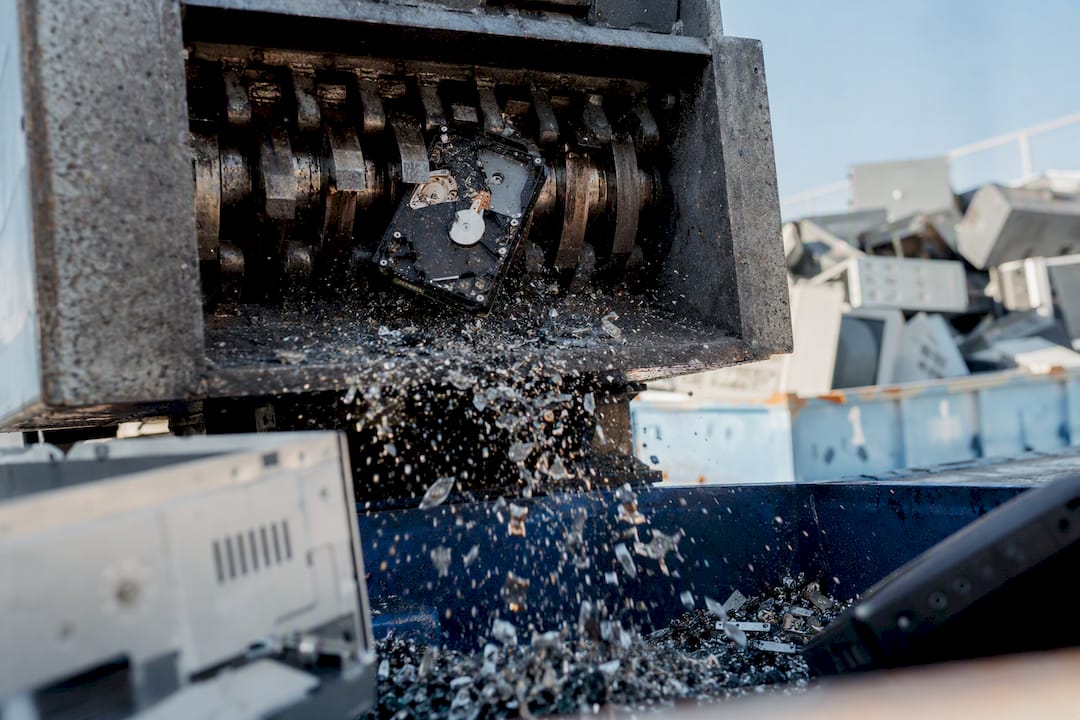
Vendor documentation is only as good as what it actually proves. UsedCartridge issues signed certificates that tie back to job-specific reports, so a compliance officer isn’t left guessing what happened to a given batch of drives.
- Certificates reference the destruction method used and include job reference numbers for traceability
- Sample reports and certificate formats are available through the certified hard drive destruction guide, which walks through what a compliant electronic destruction record should contain
- Documentation practices are built to align with retention schedules, so certificates can be filed alongside a business associate agreement when protected health information is involved
A certificate that lists a job number, a method, and a signature is only useful if you can actually trace it back to the specific devices destroyed. That traceability is the entire point of the paperwork.
Retain the certificate the same way you’d retain any compliance record: attached to the relevant policy file, not floating in an inbox.
Certificate of Destruction vs. Certificate of Disposal vs. a Shredding Receipt
These three terms get used interchangeably, and that’s where a lot of buyers get burned. They are not the same document, and treating them as equivalent can leave a real gap in your compliance file.
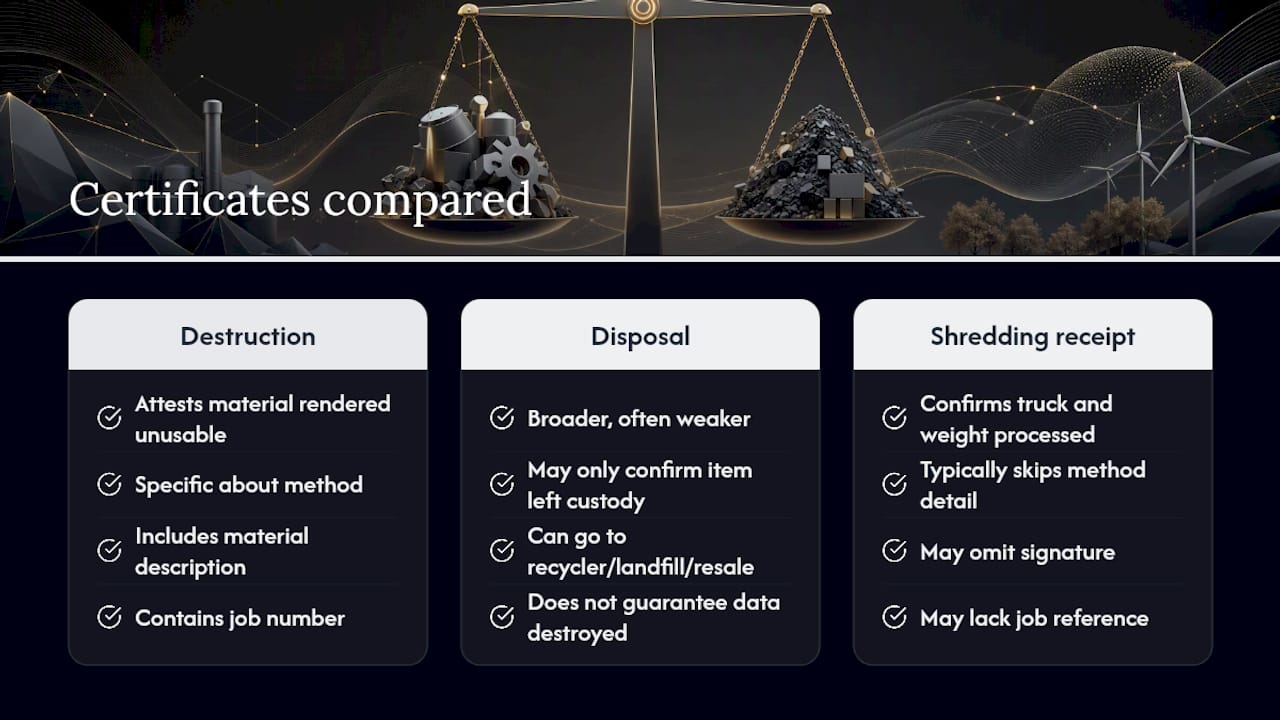
A certificate of destruction attests that material was rendered permanently unusable and unrecoverable, whether that’s shredded paper, degaussed tape, or cryptographically erased flash memory. It’s specific about method and includes the identifying details covered earlier: date, description, job number, signature.
A certificate of disposal is broader and often weaker. It can simply confirm that an item left your custody and went to a recycler, landfill, or resale channel, without any claim that data was actually destroyed. If your electronics were resold for parts after a data wipe, a disposal certificate might be accurate; it isn’t proof that sensitive information was eliminated.
A shredding receipt is the thinnest of the three. It typically confirms that a shredding truck showed up and a certain weight of paper was processed, but many receipts skip the method detail, the signature, or any reference number you could trace during an audit. Some vendors use “receipt” and “certificate” as if they’re the same paperwork, and that loose language is exactly what an auditor will flag.
The practical rule: if the document doesn’t name the method, the material, a job reference, and an authorized signer, treat it as a receipt, not a certificate, and ask the vendor for the real thing.
Author’s practical priorities when accepting certificates
I’d rather see a certificate with a serial number and a job ID than one with polished language and nothing to verify. Certificates that cite NIST SP 800-88 or IEEE 2883 and attach a verification log hold up. When the compliance stakes are high, third-party certified destruction beats an internal note every time.
— Keith
An Audit-Ready Path Through UsedCartridge
If you’ve been comparing in-house shredding against hiring a vendor, the gap usually comes down to documentation you can actually defend. UsedCartridge handles both on-site and off-site destruction and backs every job with an audit-ready certificate, not a generic disposal note.

That means serial numbers on record, a job reference tied to your service, and a signed certificate you can drop straight into your retention file. You can review the equipment destruction process to see how on-site jobs are documented, or start with a free quote to see how a compliant destruction schedule fits your organization’s volume. If you’re also sanitizing digital files before disposal, a tool like FlowPDF’s redaction feature can handle the document-level cleanup that pairs with your hardware destruction records. Request a sample certificate before your next disposal cycle and see exactly what documentation you’ll get.
Key Takeaways
A certificate of destruction only protects you when it names the method, the material, and a verifiable job reference tied to an authorized signature.
| Point | Details |
|---|---|
| Definition matters | A certificate of destruction proves specific materials were destroyed by a stated method, not just handled or disposed of. |
| Required fields | Date, description, method, vendor info, job number, and signature are the non-negotiable core elements. |
| Electronic media needs more | Serial numbers, sanitization standard (NIST SP 800-88, IEEE 2883), and verification logs are essential for drives and devices. |
| Don’t confuse documents | Certificates of disposal and shredding receipts often lack the method detail and signatures that make a certificate audit-ready. |
| Choose verified vendors | UsedCartridge issues signed, job-referenced certificates for on-site and off-site destruction with sample reports available on request. |