
CJIS requires any media that stored or processed criminal justice information to be sanitized using NIST SP 800-88 methods before reuse or disposal: clear, purge (including cryptographic erase when it qualifies), or destroy. The method you pick depends on data sensitivity and the device type, and the process is worthless to an auditor without a verification step and a paper trail behind it. Get the method and the documentation right, and the rest of this comes down to procedure.
TL;DR:
- Agencies should assign responsibility for documentation and verification of sanitization to ensure compliance with CJIS requirements and proper chain-of-custody.
- Cryptographic erase is now recognized as an effective purge method for self-encrypting drives, but only when properly validated and used according to device-specific commands.
- Physical destruction remains the most reliable method for SSDs and high-sensitivity media when encryption and cryptographic erase are not confirmed or suitable.
- Using outdated or non-standard tools without verification logs can lead to audit failures, making independent validation and detailed records essential.
- Standardized, documented procedures and trained personnel are critical, along with keeping detailed certificates that include device serials, methods used, and witness signatures for audit readiness.
Table of Contents
- What Does CJIS Require for Media Sanitization?
- NIST SP 800-88 Rev. 2: The Technical Standard Behind Every CJIS Sanitization Decision
- Clear, Purge, or Destroy: Which Method Fits Which Media?
- What Records Do Auditors Expect for Sanitized Media?
- Why Do SSDs and SEDs Need Different Handling Than Hard Drives?
- Building an Audit-Ready Sanitization Checklist
- Step-By-Step Sanitization for Common Agency Scenarios
- How to Choose and Validate Sanitization Tools
- What Should a Certificate of Destruction Include?
- Who Should Perform Media Sanitization, and What Training Do They Need?
- What Audits Actually Catch: A Provider’s View
- How Usedcartridge Helps Agencies Meet CJIS Sanitization Requirements
- Sources
- FAQ
What Does CJIS Require for Media Sanitization?
The FBI’s Disposal of Media Policy and Procedures spells out the obligation directly: any physical or electronic media that has held criminal justice information must be sanitized before it leaves agency control, whether that means resale, donation, return to a lessor, or the scrap bin. The CJIS Security Policy doesn’t hand agencies a single sanitization recipe. Instead it points them to NIST SP 800-88 as the technical basis and expects each agency to translate that standard into a written, enforceable disposal program.
That program has to be more than a memo. Auditors expect documented roles, an approved method for each media type, and evidence that sanitization actually happened, not just that it was scheduled. A drive that gets tossed in a surplus pile without a sanitization record is a policy failure even if nobody ever recovers data from it.
The stakes are not abstract. Improper disposal of CJI-bearing media can trigger a finding during a CJIS audit, and repeated or severe failures can put an agency’s access to CJIS systems at risk. Every officer or analyst who ever touched that drive is exposed by extension.
NIST SP 800-88 Rev. 2: The Technical Standard Behind Every CJIS Sanitization Decision
CJIS policy sets the requirement; NIST SP 800-88 Rev. 2 tells you how to satisfy it. The standard defines the three accepted sanitization categories, clear, purge, and destroy, and explains which one is appropriate based on the media type and where that device is headed next (internal reuse, resale, or scrap).
Rev. 2 also formalizes cryptographic erase as a purge-level method for self-encrypting drives, a significant shift from older guidance that leaned almost entirely on overwriting. It walks through device-specific sanitize commands, including ATA Secure Erase and NVMe Format/Sanitize, and it flags that sanitization techniques age out as storage technology changes. What worked on a spinning hard drive in 2015 does not necessarily work on a modern solid-state drive.
Beyond method selection, the standard frames sanitization as a program, not a one-off task. That means documented policy, assigned roles, verification procedures, and alignment with system categorization under FIPS 199 and NIST SP 800-53 controls. Agencies handling higher-sensitivity CJI categories should be applying stricter minimum methods, not just picking whatever is fastest. A deeper walkthrough of these rules is available in Usedcartridge’s guide to NIST data destruction.
Clear, Purge, or Destroy: Which Method Fits Which Media?
Each method leaves a different level of residual risk, and picking the wrong one is the single most common compliance gap agencies run into.
- Clear uses standard read/write commands to overwrite all addressable storage locations, protecting against simple recovery tools. It works for HDDs headed for internal reuse but offers weak assurance for high-sensitivity CJI.
- Purge applies techniques that resist laboratory-level recovery attacks, block erase commands, ATA Secure Erase, or cryptographic erase on self-encrypting drives (SEDs) where the encryption key is destroyed rather than the data itself.
- Destroy physically alters the media so it can no longer function or be reconstructed, shredding, disintegration, or incineration to a specified particle size.
- Overwrite limitations: multi-pass overwriting is unreliable on flash-based media because wear-leveling can leave data in cells the overwrite pass never touches.
- Decision rule: map sensitivity tiers to minimum methods. Low-sensitivity, internally reused HDDs may only need clear. Media that ever held unencrypted CJI destined for external transfer should default to purge or destroy, never clear alone.
When in doubt, destroy. It’s the only method that removes ambiguity entirely, which is why many agencies default to it for anything leaving their custody.
What Records Do Auditors Expect for Sanitized Media?
Sanitization without proof is functionally the same as no sanitization at all, from an audit standpoint. Verification confirms the method actually worked, whether through vendor tool logs showing a completed pass, independent sample testing on a batch of drives, or third-party lab validation for high-value destruction jobs.
Every sanitized device needs a record with these fields, at minimum:
- Device serial number or asset ID
- Media type and capacity
- Sanitization method applied (clear, purge, or destroy, with technique specified)
- Operator name and, where applicable, a witness signature
- Verification result (pass/fail, tool used)
- Final disposition (reuse, resale, recycle, scrap)
- Date and timestamp
A missing serial number on one drive in a batch of two hundred is often what triggers a broader audit finding, not the sanitization method itself.
Pro Tip: Build your sanitization log as a structured spreadsheet or database from day one, not a folder of scanned certificates. Auditors move faster, and so will you, when a serial number search returns a result in seconds instead of an afternoon.
Why Do SSDs and SEDs Need Different Handling Than Hard Drives?
Modern storage breaks a lot of assumptions built into older sanitization habits, and this is where agencies most often get tripped up.
- Multi-pass overwriting, the old three-pass standard, does not reliably reach every data-bearing cell on an SSD because of wear-leveling and over-provisioning.
- Cryptographic erase is only valid if the drive encrypted data from the moment it was written and the encryption keys were properly managed; verify this before relying on it as a purge method.
- Degaussing works only on magnetic media matched to the correct coercivity rating, and it does nothing to flash-based storage like SSDs or USB drives, since there’s no magnetic domain to disrupt.
- Physical destruction remains the most reliable fallback for SSDs and SEDs when cryptographic erase can’t be confirmed or the drive is going somewhere with zero trust attached.
- Removable flash media (USB drives, memory cards) should generally be treated like SSDs, not like old-style HDDs, for method selection purposes.
Building an Audit-Ready Sanitization Checklist
A workable agency program comes down to six repeatable steps, applied consistently across every device.
- Inventory and classify every device by media type and the sensitivity of data it held.
- Select the minimum acceptable method for that sensitivity tier and media type, using SP 800-88 guidance.
- Perform sanitization using an approved tool, technique, or destruction vendor.
- Verify the result through tool logs, sample testing, or independent validation.
- Document every field listed in the records section above.
- Finalize disposition and route the device to reuse, resale, recycling, or scrap.
Assign clear ownership: who classifies media, who performs sanitization, who signs off on verification. If a third-party vendor handles destruction, procurement language should require a certificate of destruction with serialized detail, not a generic statement. Retain those certificates alongside your internal logs, filed by date and device batch, so they surface in seconds during an audit rather than a scramble. Practical disposal workflow guidance can help standardize the tagging step most agencies skip.
Step-By-Step Sanitization for Common Agency Scenarios
Retiring patrol laptops with encrypted HDDs. Confirm full-disk encryption was active from deployment, initiate cryptographic erase through the OEM tool or ATA Secure Erase command, then verify with a read-back test on a sample of the batch. Document each device individually even when processed as a group.
Decommissioning a records-management server with SSDs. Check whether the array uses self-encrypting drives. If yes, run vendor-validated cryptographic erase per drive. If encryption wasn’t active from the start, don’t rely on crypto erase. Escalate to NVMe Sanitize commands or physical destruction instead.
Disposing of body camera storage cards. Treat these as flash media regardless of size. Multi-pass overwrite is not reliable here. Use manufacturer-supported secure erase where available, or default to physical destruction given the small unit cost and the sensitivity of footage involved.
Retiring evidence room scanners or copiers with internal storage. These devices are frequently overlooked because nobody thinks of them as “media.” Locate the internal drive, apply the same classification and sanitization steps as any HDD or SSD, and log it exactly like a workstation.
Bulk decommissioning during a technology refresh. Batch classify by model and encryption status first, then process by tier. Devices with confirmed cryptographic erase capability move fastest. Everything else, including any device where encryption status can’t be confirmed, defaults to physical destruction rather than a rushed overwrite pass.
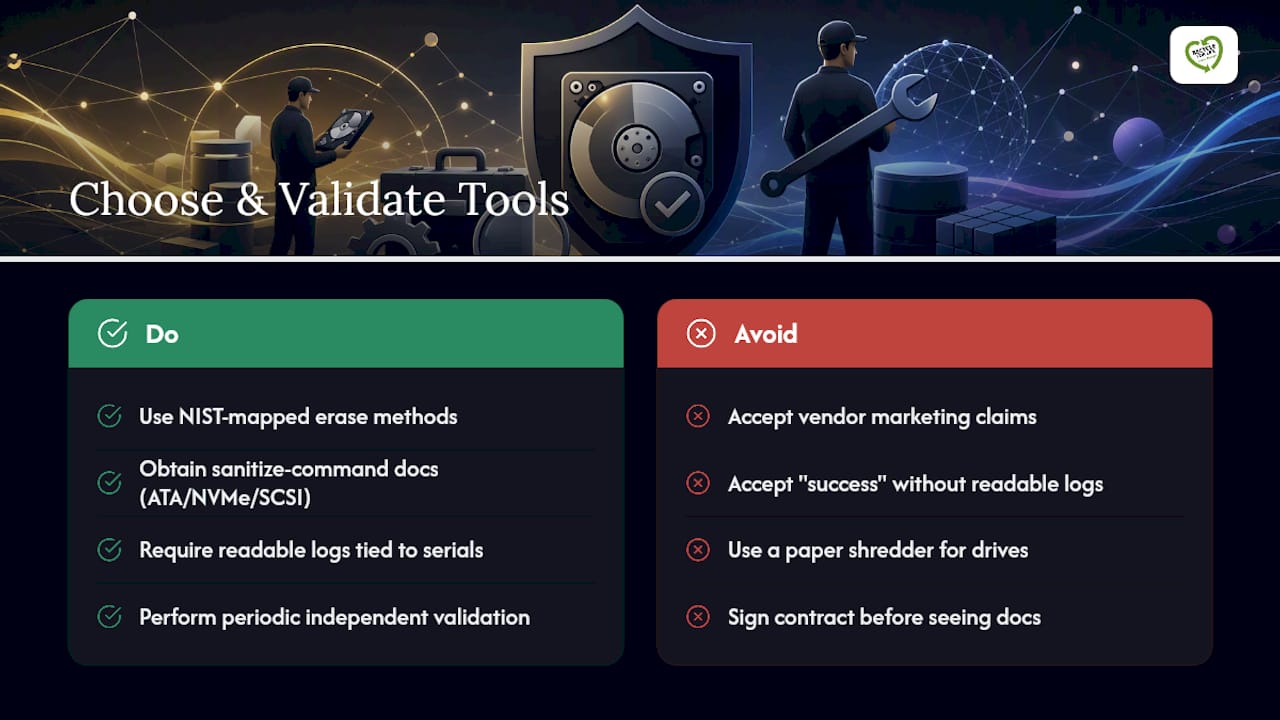
How to Choose and Validate Sanitization Tools
Not every commercial wiping tool produces defensible results, and vendor marketing claims are not a substitute for verification. Start by confirming the tool implements methods that map directly to SP 800-88 categories, block erase, cryptographic erase, or NIST-recognized overwrite patterns, rather than a proprietary “military-grade” process with no published standard behind it.
Ask vendors for documentation showing which sanitize commands their software issues to the drive controller (ATA Secure Erase, NVMe Format, SCSI Sanitize) and whether the tool logs a verification pass automatically. A tool that simply reports “success” without a readable log entry tying that result to a specific serial number gives you nothing to show an auditor.
For destruction equipment, whether in-house shredders or a contracted vendor, confirm the output particle size meets or exceeds NIST-referenced destruction specifications for the media type. A shredder built for paper is not adequate for hard drive platters or solid-state chips.
Periodic independent validation matters more than any single vendor claim. That might mean sending a sample batch of “wiped” drives to a data recovery lab once or twice a year to confirm nothing recoverable remains, or having a second technician spot-check destruction output against your particle-size requirement. Vendor-reported success rates are not proof; a lab result or a physical inspection is.
Procurement language should require any third-party destruction vendor to provide method documentation and a sample chain-of-custody form before a contract is signed, not after the first pickup.
What Should a Certificate of Destruction Include?
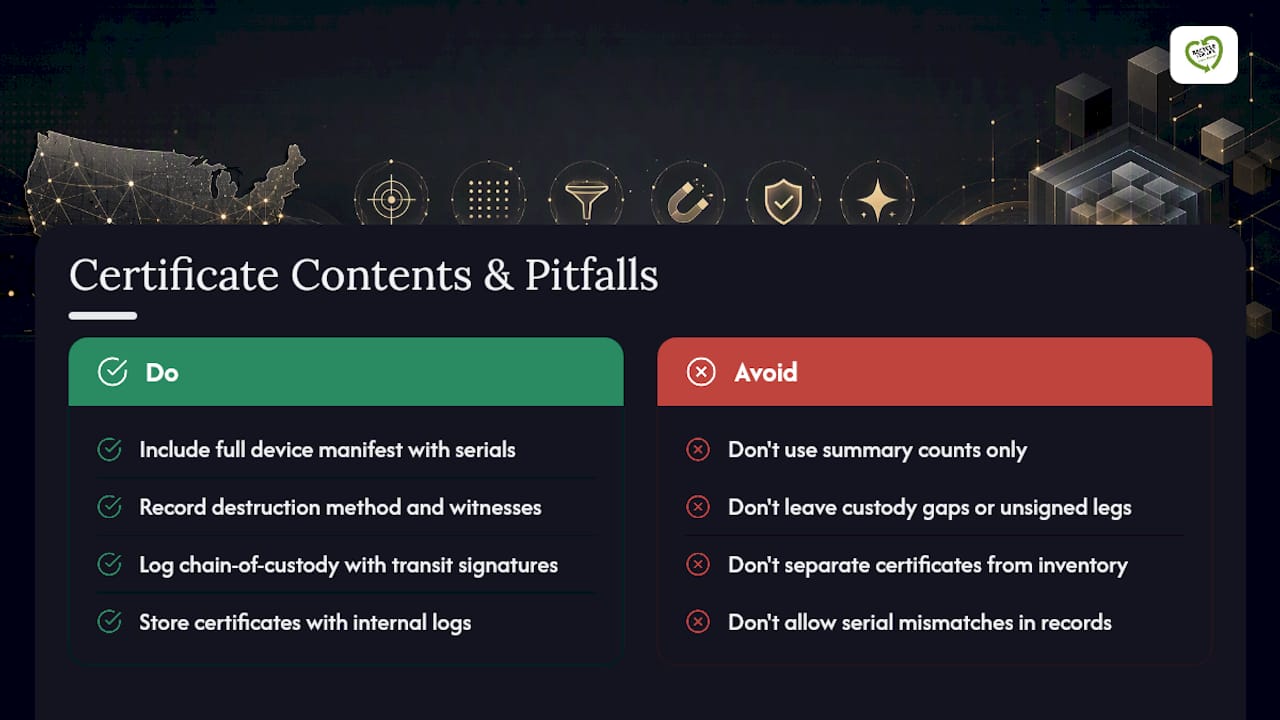
A certificate of destruction is only as good as the detail behind it. The strongest templates capture the requesting agency and department, the date and location of destruction, and a full device manifest listing serial numbers, asset tags, and media type for every unit processed, not a summary count.
Beyond the manifest, the certificate needs the destruction method used, on-site shredding, off-site incineration, cryptographic erase, and confirmation of who performed the work and who witnessed it. A signature line for an agency representative who observed the process (or reviewed video evidence of it) turns the certificate from a vendor claim into agency-verified proof.
Chain-of-custody detail matters as much as the destruction event itself. The strongest records track the device from the moment it left agency possession, transport method, custody transfer signatures, time in transit, through to the destruction event and final disposition of the destroyed material (recycled, landfilled per environmental rules, or otherwise). Any gap in that chain, a pickup with no signed manifest, a transport leg with no custody log, is exactly what triggers audit findings even when the destruction itself was done correctly.
Store certificates alongside your internal sanitization logs rather than as a separate, disconnected filing system. When device serial numbers on the certificate match your internal inventory records exactly, cross-referencing during an audit takes minutes instead of days.
Who Should Perform Media Sanitization, and What Training Do They Need?
Sanitization competence isn’t something to assume from a general IT background. Personnel performing clear, purge, or destroy operations need specific training on the tools and commands they’ll actually use: how to verify encryption status before attempting cryptographic erase, how to confirm a secure erase command completed rather than silently failed, and how to recognize when a device needs escalation to physical destruction.
Formal certification programs exist through organizations like CompTIA and data destruction industry bodies, and agencies should document whatever training path staff complete, along with renewal intervals, since sanitization techniques and device technology both shift over time. A technician trained only on HDD overwrite procedures five years ago is not equipped to handle NVMe Sanitize commands or SED cryptographic erase without additional instruction.
Beyond initial training, build in periodic refreshers tied to changes in guidance. When NIST updates SP 800-88 or CJIS policy revises disposal requirements, retrain the staff responsible for executing the program, not just the compliance officer who reads the update.
Assign a named individual or small team as the agency’s sanitization program owner, someone accountable for keeping procedures current, reviewing verification logs, and signing off on documentation completeness before records go into long-term storage. Diffuse responsibility across an entire IT department without a clear owner is how gaps go unnoticed until an audit finds them. Reducing how much sensitive data lives on end-user devices in the first place, through practices like the ones covered in this PII data masking guide, also lowers the stakes any single sanitization failure carries.
What Audits Actually Catch: A Provider’s View
The failures that show up in real audits rarely trace back to the sanitization method itself. They trace back to missing serial numbers, gaps in chain-of-custody paperwork, and drives sanitized with a method that was current five years ago but never got updated for SSDs. The fix is almost always operational, not technical: standardized tagging before pickup, a witness present for on-site destruction, and periodic independent checks instead of trusting a tool’s self-reported success.
— Keith
How Usedcartridge Helps Agencies Meet CJIS Sanitization Requirements
Usedcartridge gives agencies a direct path to audit-ready compliance instead of piecing one together from spreadsheets and vendor promises. Where a general IT contractor might wipe a drive and call it done, Usedcartridge provides witnessed on-site data destruction with a documented certificate for every device processed, matching the serial-level detail auditors actually ask for.

That means hard drive destruction handled at your facility rather than shipped off-site into a custody gap, plus recycling and IT asset recovery for equipment that’s ready to leave inventory once sanitization is confirmed. Agencies managing a technology refresh or evidence room equipment turnover can request a compliance quote and get a sample certificate of destruction before committing to a pickup date, so your compliance officer knows exactly what documentation to expect. Visit Usedcartridge to start that conversation and get your next disposal cycle on the calendar.
Sources
Keep these primary references on hand rather than relying on secondhand summaries. The full SP 800-88 Rev. 2 text covers method definitions and program structure in detail. The FBI’s Disposal of Media Policy and Procedures and the CJIS Security Policy resource center carry the governing agency requirements.
- SP 800-88 Rev. 2, Guidelines for Media Sanitization | CSRC
- Guidelines for Media Sanitization (PDF) | NIST
- Disposal of Media Policy and Procedures
- CJIS Security Policy resource center | LE FBI
FAQ
What Are the CJIS Compliance Requirements for Media Sanitization?
Agencies must sanitize any media that held criminal justice information using clear, purge, or destroy methods from NIST SP 800-88 Rev. 2 before reuse, resale, or disposal. The CJIS Security Policy also requires documented verification and recordkeeping for every sanitized device.
What Do the NIST Guidelines Say About Media Sanitization?
NIST SP 800-88 Rev. 2 defines three sanitization categories, clear, purge, and destroy, and specifies which method fits which media type and reuse scenario. It formally recognizes cryptographic erase as a valid purge method for properly encrypted self-encrypting drives.
What Network Requirements Does CJIS Compliance Involve?
CJIS network requirements cover advanced authentication, encryption of CJI in transit and at rest, and controlled access to systems handling criminal justice information, details maintained in the full CJIS Security Policy. Media sanitization is a separate but related requirement, since improperly sanitized devices can expose the same data those network controls are meant to protect.
Does Usedcartridge Provide Documentation for CJIS Audits?
Usedcartridge provides certificates of destruction with serialized device detail for on-site data destruction services, the kind of record auditors expect to see tied to CJIS disposal requirements. Pricing details vary and are available directly on the provider’s site.
Can Overwriting Alone Satisfy CJIS Sanitization Requirements?
Overwriting, the “clear” method, is acceptable only for lower-sensitivity data on media headed for internal reuse. For CJI on solid-state drives or media leaving agency control, NIST guidance points toward purge-level methods like cryptographic erase or physical destruction instead.