
Intact and broken cathode ray tubes headed for legitimate recycling can skip full hazardous-waste regulation under a federal conditional exclusion, but only when specific conditions hold. The controlling rules sit in 40 CFR § 261.4(a)(22) and §261.39, enforced by the EPA. Exclusions most often collapse over three failures: speculative accumulation, outdoor or high-temperature processing, and export shipments moving without proper consent paperwork.
TL;DR:
- The federal conditional exclusion from hazardous waste regulation for CRTs applies only when storage, processing, and shipping conditions strictly meet specified criteria.
- Over 25 states impose additional rules beyond federal requirements, so multistate facilities should verify their exact local regulations to ensure full compliance.
- Maintaining detailed records, including chain-of-custody documentation, manifesting, and accurate tracking of recycling thresholds, is essential to preserve the exclusion status.
- Exporting CRTs requires filing notices at least 60 days pre-shipment, obtaining EPA acknowledgment of consent, and matching shipment documentation to avoid enforcement actions.
- Monitoring inventory levels, vendor reliability, and proper downstream disposal processes helps prevent illegal stockpiling or conversion of shipments into regulated waste.
Table of Contents
- Understanding CRT Disposal Regulations Under Federal Law
- Does Your State Follow the Federal CRT Exclusion?
- What Belongs on a CRT Compliance Checklist?
- What Are the Export Rules for CRT Waste?
- What Triggers Enforcement Action on CRT Waste?
- How Do You Vet a CRT Recycling Vendor?
- What Documentation Should a Compliant Vendor Provide?
- Author Recommendations: Where To Start This Quarter
- Certified CRT Handling and Documentation From Usedcartridge
- Primary Sources for CRT Disposal Compliance
- Sources
- FAQ
Understanding CRT Disposal Regulations Under Federal Law
The federal CRT rule doesn’t deregulate these units. It conditions their exemption on verifiable recycling behavior. A standard color monitor or television tube contains roughly four pounds of lead on average, which is exactly why the default classification is hazardous waste unless you can document an unbroken recycling path.
Under §261.39, used and broken CRTs escape solid waste classification when handlers meet a defined set of conditions:
- Store CRTs inside a building or in containers designed to prevent breakage and weather exposure, not stacked outdoors under tarps.
- Process CRT glass without high-temperature treatment that would volatilize the lead, since heat drives the metal into vapor and changes the waste’s hazard profile entirely.
- Ship intact units or processed glass with paperwork identifying the destination as a legitimate recycling facility.
- Keep speculative accumulation under control, meaning glass and tubes don’t pile up faster than they move to a recycler.
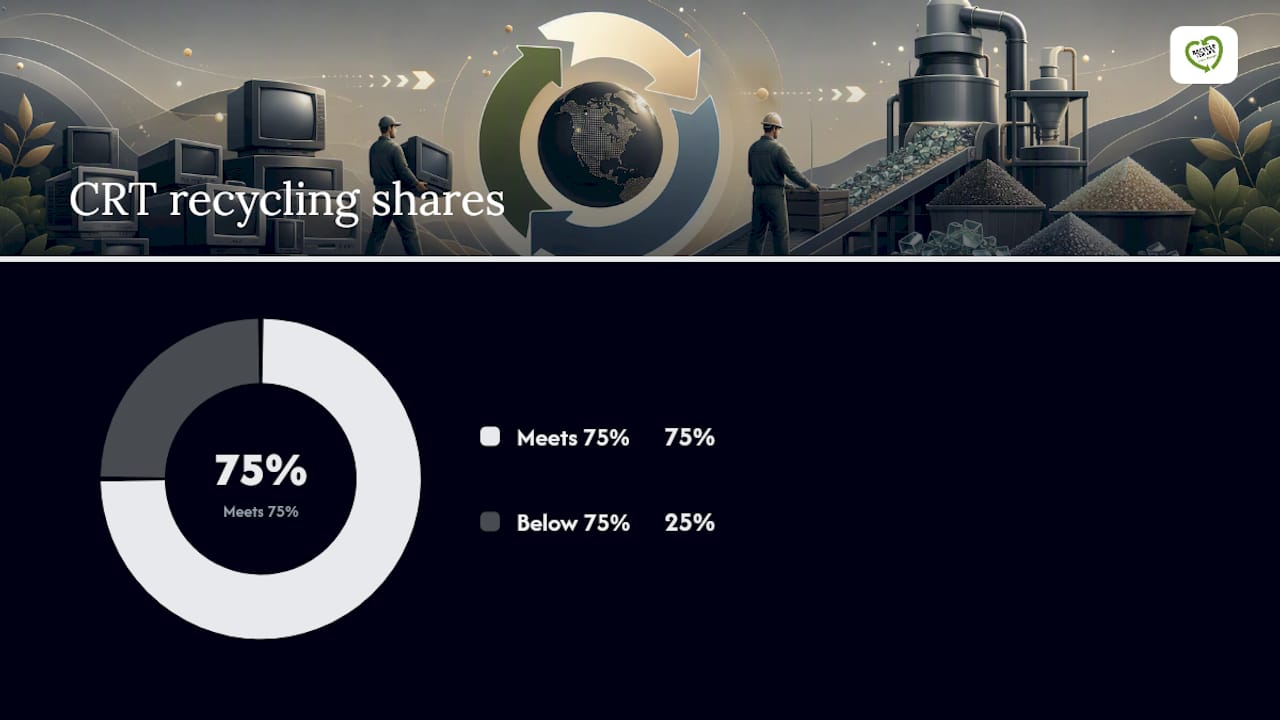
If a facility held CRTs at the start of the calendar year, at least 75% by weight or volume must move to recycling during that same year. Fail that math and the entire inventory reverts to regulated solid waste, with disposal obligations calculated retroactively.
When CRT glass ends up in a use that amounts to disposal rather than recycling, Part 266 Subpart C standards or Land Disposal Restrictions kick in instead of the conditional exclusion. That distinction matters for any facility considering “beneficial reuse” claims for CRT glass that never actually reaches a smelter or glass manufacturer.
Does Your State Follow the Federal CRT Exclusion?
Federal exclusion is a floor, not a ceiling. Some states impose additional handling, labeling, or transport requirements on top of what EPA allows, and a handful haven’t adopted the federal exclusion language at all. California’s Department of Toxic Substances Control, for instance, runs its own CRT and CRT glass disposition framework that compliance teams operating there need to check separately from the federal text.
At least 25 states plus Washington, D.C. maintain electronics-recycling laws that can be more prescriptive than the federal baseline, covering everything from retailer takeback mandates to landfill bans on CRT devices.
To verify where your facilities actually stand:
- Check EPA’s state program summaries alongside your state agency’s own hazardous waste division page.
- Consult NCSL’s extended producer responsibility tracker for a state-by-state legislative comparison.
- Confirm whether your state requires separate CRT permitting or registration beyond RCRA.
For multi-state operations, applying the strictest state rule as your company-wide baseline avoids the headache of running different protocols site by site, and it closes enforcement gaps auditors love to find.
What Belongs on a CRT Compliance Checklist?
Preserving the conditional exclusion comes down to five operational disciplines, ranked roughly by how often inspectors flag them:
- Storage. Keep CRTs and CRT glass inside a building or in weatherproof, breakage-resistant containers. Segregate broken units from intact ones and label containers clearly as CRT waste awaiting recycling.
- Processing. Perform all breaking, crushing, or glass separation indoors. Never use high-temperature treatment methods that could volatilize lead into vapor.
- Transportation. Use containers rated for CRT glass and attach shipping documentation naming the recycler by name and address, not a general “electronics recycler” placeholder.
- Speculative accumulation tracking. Run a rolling calculation of what came in versus what shipped out for recycling. If you’re below the 75% threshold heading into a fiscal quarter, flag it before the calendar year closes.
- Recordkeeping. Retain manifests, transfer receipts, downstream recycler contracts, and weight tickets that tie specific shipments to specific recycling outcomes.
Pro Tip: Run your speculative-accumulation math quarterly, not annually. Facilities that only check once a year routinely discover the shortfall in December, when there’s no time left to move inventory before the deadline hits.
Auditors increasingly expect a documented chain-of-custody workflow that traces a unit from intake through final material recovery, not just a signed manifest sitting in a filing cabinet.
What Are the Export Rules for CRT Waste?
Exporting CRTs for recycling adds a separate compliance layer on top of domestic storage and processing rules. Before a shipment leaves the country, exporters must file an electronic export notice through RCRAInfo’s Waste Import Export Tracking System at least 60 days ahead of the shipment, and they need an EPA Acknowledgement of Consent from the receiving country before anything moves.
Key export obligations include:
- Filing Electronic Export Information through the Automated Export System at the time of shipment, matching the AOC’s terms exactly.
- Including a copy of the AOC with the physical shipment, since customs and receiving-country inspectors will ask for it.
- Filing annual export reports by March 1, summarizing quantities shipped and destination facilities for the prior year.
- Notifying EPA before changing the destination facility named in an existing AOC, since shipping to an unlisted recipient voids the consent.
Shipping without a valid AOC on file is one of the fastest ways to convert a routine export into an enforcement case.
What Triggers Enforcement Action on CRT Waste?
Once any of these triggers, the conditional exclusion evaporates and the material reverts to hazardous waste retroactive to when the violation began.
Liability doesn’t stop at the recycler. Generators can be held responsible even after CRTs leave their dock, particularly when the downstream path turns out to be indefinite storage rather than actual recycling. Regulators tend to look for:
- Stockpiles visible in satellite imagery or during site visits that exceed what throughput records claim.
- Missing or inconsistent transfer receipts between generator and recycler.
- Recyclers with no verifiable outlet for processed glass, since the market for CRT glass has largely dried up.
Corrective action usually means an immediate audit of current inventory against the speculative accumulation test, plus a review of every downstream contract still in force.
How Do You Vet a CRT Recycling Vendor?
Because CRT glass demand collapsed years ago, some recyclers have shifted from processing to warehousing, which quietly converts your compliant shipment into someone else’s speculative accumulation problem. A proper vendor audit checks:
- Physical site conditions: indoor processing areas, temperature-controlled equipment, and documented throughput rather than growing pallets of unprocessed tubes.
- Confirmed downstream outlets: proof that glass moves to an actual glass manufacturer or lead smelter, or that the recycler meets Subpart C standards for any use constituting disposal.
- Contract language requiring proof-of-recycling documentation, audit rights on demand, and indemnification if the vendor’s practices trigger your generator liability.
Pro Tip: Ask every prospective vendor for their most recent 12-month throughput report before signing anything. A recycler that can’t produce one in a day probably isn’t tracking it internally either.
Retain transfer receipts, insurance certificates, permits, and annual export summaries for every vendor relationship. A responsible recycling review of these documents once a year catches gaps before an inspector does.
What Documentation Should a Compliant Vendor Provide?
A vendor handling your CRT stream should hand you the same paper trail you’d need to defend the exclusion yourself: chain-of-custody records from pickup through final processing, audit-ready certificates of recycling or destruction, signed transfer receipts, and written confirmation from the downstream recycler describing what actually happened to the material.
These deliverables mirror what computer recycling and e-waste logistics providers typically supply for regulated electronics streams. Treat vendor documentation as supporting evidence, not a substitute for checking the primary CFR text and your state agency’s own rules directly. Auditors and regulators will ask for EPA and state-sourced proof regardless of how thorough a vendor’s paperwork looks.
Author Recommendations: Where To Start This Quarter
Run your speculative-accumulation numbers this week, not at year-end. Confirm whether your operating states have adopted the federal exclusion or layered on stricter rules. Schedule a downstream recycler audit before your next contract renewal, and build an annual export-reporting calendar now so March 1 deadlines never sneak up. Keep every primary-source citation, EPA guidance, CFR text, state agency letters, filed alongside your audit records, not just referenced from memory.
— Keith
Certified CRT Handling and Documentation From Usedcartridge
Some CRT recycling vendors provide compliance officers with paperwork built for audits, including chain-of-custody tracking, audit-ready certificates, and downstream recycler confirmation, the documentation recommended for CRT vendors.

For organizations still relying on informal disposal arrangements or vendors who can’t produce a 12-month throughput report on request, that gap is where speculative-accumulation violations quietly start. Usedcartridge’s electronic waste recycling services cover CRT monitors and televisions alongside broader IT asset streams, with pickup scheduling and free quotes built around what your compliance program actually needs to document. If your next CRT disposal cycle needs a paper trail that holds up under a state inspection, request a compliance-focused quote before your current inventory ages past the 75% threshold.
Primary Sources for CRT Disposal Compliance
Keep these on file for audit defense: the EPA’s frequent questions page on CRT regulation, the full text of 40 CFR § 261.39, EPA’s electronics stewardship regulations page, and your state’s electronics-recycling law tracker.
- EPA CRT and CRT glass frequently asked questions
- 40 CFR §261.4(a)(22) and §261.39 full regulatory text
- State agency electronics-recycling law pages and NCSL’s EPR tracker
Sources
- Frequent Questions About the Regulation of Used Cathode Ray Tubes (CRTs) and CRT Glass | US EPA
- 40 CFR § 261.39 – Conditional Exclusion for Used, Broken Cathode Ray Tubes (CRTs) and Processed CRT Glass Undergoing Recycling | LII / Cornell
FAQ
How Much Does It Cost To Dispose Of A CRT?
Costs vary by weight, volume, and whether the unit qualifies for the conditional recycling exclusion versus full hazardous-waste handling, so a vendor quote based on your actual inventory is the only reliable figure.
What Should You Do With An Old CRT Monitor?
Route it to a recycler that processes CRT glass indoors and can document where the lead-containing glass ultimately goes, rather than a general electronics drop-off with no downstream verification.
What Electronics Should Never Be Thrown In The Trash?
CRT monitors and televisions, along with batteries and other lead- or mercury-containing devices, should never go into regular trash because their hazardous components trigger regulated disposal requirements.
What Regulations Govern CRT Disposal?
The controlling federal rules are 40 CFR §261.4(a)(22) and §261.39, enforced by the EPA, with many states layering on additional or stricter electronics-recycling requirements.
Can Usedcartridge Handle CRT Disposal For My Organization?
Yes, Usedcartridge processes CRT monitors and televisions as part of its electronic waste recycling services, providing pickup, documentation, and certificates suited to compliance recordkeeping.