
Global e-waste hit 62 million tonnes in 2022, yet only 22.3% was formally collected and recycled. For IT managers and sustainability officers, that gap is not just an environmental statistic. It represents real liability: regulatory penalties, data breach exposure, and reputational damage hiding inside every decommissioned server rack and retired laptop. This guide covers the full picture, from environmental impact and material recovery, to data security requirements and operational best practices, so your organization can turn e-waste from a compliance burden into a measurable sustainability win.
Table of Contents
- Why e-waste recycling matters for sustainability
- Resource recovery and emissions: How recycling outperforms landfill
- Data security and regulatory compliance in e-waste management
- E-waste recycling at scale: Global jobs, informal sector, and best practices
- The bigger picture: Why recycling alone doesn’t solve e-waste
- Secure your company’s sustainability and compliance with expert e-waste solutions
- Frequently asked questions
Key Takeaways
| Point | Details |
|---|---|
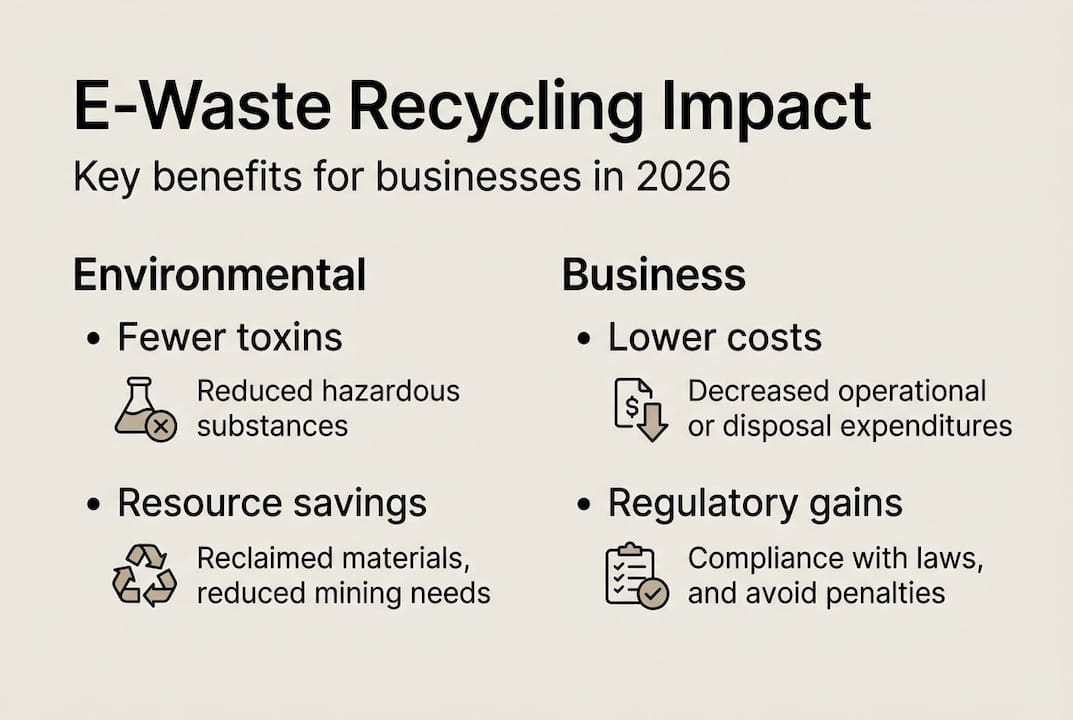
| Reduce environmental risks | Formal e-waste recycling prevents hazardous contamination and limits pollution. |
| Maximize resource recovery | Recycling retrieves valuable metals and cuts greenhouse gas emissions versus landfill. |
| Ensure compliance and security | Compliant disposal safeguards sensitive data and meets regulatory requirements. |
| Support jobs and best practices | E-waste recycling creates millions of jobs worldwide and encourages safe, formal practices. |
| Think beyond recycling | Sustainable success also requires upstream solutions like eco-design and EPR. |
Why e-waste recycling matters for sustainability
Electronic devices contain a mix of materials that sound harmless until they reach a landfill. Lead, mercury, cadmium, and brominated flame retardants leach into soil and groundwater when devices are improperly disposed of. Workers at informal recycling sites breathe toxic fumes when circuit boards are burned for metal extraction. These are not distant problems. They are direct consequences of disposal decisions made inside your IT department every quarter.
The financial scale is equally sobering. Externalized health and environmental costs from global e-waste reach $78 billion annually. That figure represents hospital bills, contaminated farmland, and ecosystem damage that never appears on a corporate balance sheet but gets paid by communities and governments around the world. As regulations tighten globally, more of those costs are being pushed back toward businesses through extended producer responsibility (EPR) laws and disposal fees.
The difference between formal and informal recycling is stark. Formal recyclers use controlled processes to safely neutralize hazardous substances. Informal methods, like open burning and acid baths, release toxins directly into the environment while recovering only a fraction of recoverable material. Choosing a certified partner for your formal e-waste recycling needs is not just an ethical choice. It is a risk management decision.
Here is what proper recycling prevents:
- Lead contamination in drinking water near disposal sites
- Mercury vapor releases during informal disassembly
- Carcinogenic dioxin emissions from open circuit board burning
- Soil acidification that damages agricultural land for decades
- Cadmium accumulation in food chains affecting communities near dump sites
Understanding types of e-waste your organization generates is the first step toward matching each device category with the right disposal pathway.
“E-waste recycling reduces environmental risks by preventing leaching of hazardous substances and avoids air pollution from informal methods.”
Pro Tip: Require that any recycling vendor you hire provides documented evidence of their process controls. Certifications like R2 (Responsible Recycling) and e-Stewards are baseline indicators that a company meets formal recycling standards.
Resource recovery and emissions: How recycling outperforms landfill
Recycling is not just about avoiding harm. It also creates measurable value. Electronics contain concentrations of gold, silver, copper, palladium, and rare earth elements that far exceed what is found in raw ore. One metric ton of circuit boards can yield more gold than 17 metric tons of mined ore. When your organization recycles formally, those materials re-enter the supply chain instead of sitting inert underground.
The emissions story is just as compelling. Formal recycling emits 90% less GHG than landfilling electronics. For companies tracking Scope 3 emissions, the disposal method for decommissioned IT equipment is a legitimate lever to pull.
| Disposal method | GHG emissions (relative) | Material recovery | Regulatory risk |
|---|---|---|---|
| Certified recycling | Very low | High (metals, plastics) | Minimal |
| Landfill | High | None | Significant |
| Informal recycling | Very high | Partial, unsafe | High |
| Incineration | Moderate | Negligible | Moderate |
Here is the sequential flow of how a formally recycled device becomes recovered raw material:
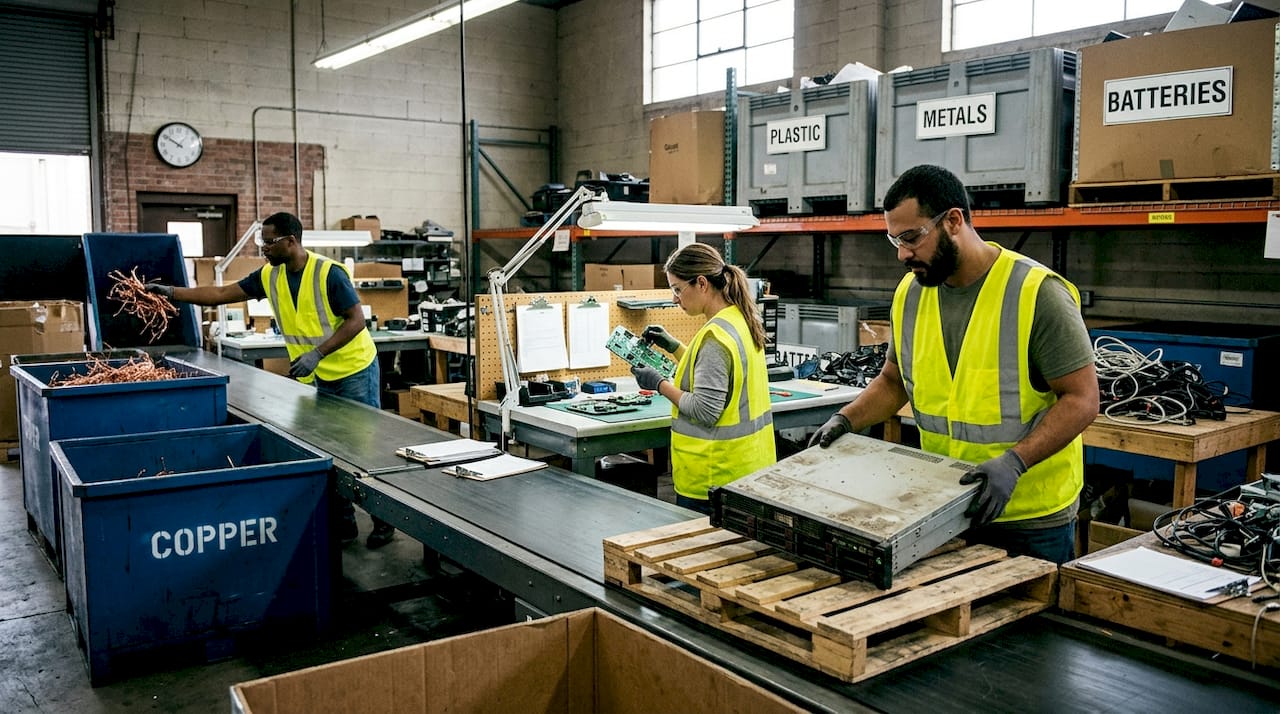
- Collection and inventory: Devices are logged with serial numbers and chain-of-custody documentation.
- Data destruction: Hard drives and storage media are wiped or shredded before physical disassembly.
- Manual disassembly: Batteries, screens, and circuit boards are separated by trained technicians.
- Mechanical processing: Shredders and separators break components into material streams.
- Smelting and refining: Precious metals are extracted through controlled thermal or chemical processes.
- Material reintegration: Recovered copper, gold, and plastics are sold back to manufacturers.
Explore asset recovery tips to understand how this value chain can offset the cost of decommissioning for your IT fleet. Businesses that track recovered material value often find that proper e-waste recycling pays for a portion of their logistics and disposal costs.
Pro Tip: When issuing an RFP for e-waste services, ask vendors to provide material recovery reports. Knowing exactly what was extracted from your old equipment supports both ESG reporting and internal cost justification.
Data security and regulatory compliance in e-waste management
Recycling is not just an environmental story. It is central to compliance and IT security. A decommissioned server that still holds customer data is a liability, regardless of where it ends up. Improper disposal does not just risk an environmental fine. It opens the door to data breaches that trigger notification requirements under laws like HIPAA, GDPR, and CCPA.
At the international level, the Basel Convention regulates transboundary e-waste movements, with 2025 amendments extending coverage to all categories of e-waste. This directly affects any U.S. business that ships retired equipment overseas, whether intentionally or through third-party brokers who may export waste without disclosure.
Data security risks from improper e-waste recycling include:
- Residual data on drives not formally wiped before resale or export
- Incomplete audit trails that cannot prove secure destruction if audited
- Third-party data leaks when brokers sell devices without proper sanitization
- Regulatory penalties under sector-specific laws when data storage devices are not certified-destroyed
- Reputational damage from incidents traced back to decommissioned equipment
| Feature | Certified secure recycling | Generic disposal |
|---|---|---|
| Data destruction verification | Certificate issued | None provided |
| Chain of custody documentation | Full, auditable | Incomplete or absent |
| Regulatory compliance | Basel, EPR, HIPAA-aligned | Not guaranteed |
| Environmental certification | R2, e-Stewards | Unlikely |
| Material recovery reporting | Provided | Rarely available |
Learn more about secure equipment recycling and how certified destruction protects your organization. For teams building a formal policy, the data destruction essentials resource and the certified hard drive destruction guide provide step-by-step frameworks.
Pro Tip: Always require a certificate of destruction (COD) from your recycling vendor. A COD should include the device serial number, method of destruction, and the date. Without it, you cannot prove compliance in an audit.
E-waste recycling at scale: Global jobs, informal sector, and best practices
E-waste management is a global workforce issue as much as it is an environmental one. E-waste activities support 6.32 million jobs worldwide. But 80% of those jobs exist in the informal sector, where workers handle toxic materials without protective equipment, labor protections, or environmental controls. That is not a supply chain abstraction. It is a direct consequence of where organizations send their retired equipment.
Informal recycling dominates in lower and middle income countries due to weak enforcement and high demand for recoverable metals. Workers use acid baths and open fire to extract copper and gold, exposing themselves and their communities to chronic toxicity. When a business ships e-waste through a broker that exports to these regions, it becomes part of that chain.
Choosing formal recycling processes is one of the most direct ways your procurement decisions affect global labor conditions.
Here is how to identify and work with compliant recycling partners:
- Verify third-party certifications (R2v3, e-Stewards) independently, not just from the vendor’s marketing
- Ask for downstream vendor lists to confirm where materials go after initial processing
- Require disclosure of any export activity and confirm it meets Basel Convention requirements
- Review audit reports from independent assessors, not just self-reported compliance summaries
- Include e-waste handling standards in supplier codes of conduct for hardware vendors
“Integrating informal sector workers into formal systems, alongside stronger EPR policies, is the only path to equitable and effective e-waste governance at scale.”
As an IT leader, your vendor selection is a policy lever. The businesses that demand certified, transparent recycling partners drive market pressure toward better practices industry-wide.
The bigger picture: Why recycling alone doesn’t solve e-waste
Here is something most e-waste guides won’t say plainly: recycling, done perfectly, still isn’t enough. The volume of global e-waste grows faster than recycling capacity expands. Even if formal collection rates doubled overnight, the root problem, devices designed for short life cycles with few recyclable materials, would keep feeding the crisis.
Upstream eco-design and producer responsibility are necessary complements to recycling, not optional extras. That means advocating for procurement policies that prioritize devices with longer support cycles, repairability scores, and manufacturer take-back programs.
Businesses have more influence here than they realize. When your organization’s procurement policy specifies minimum product lifespans or requires manufacturer EPR participation, you send a clear signal to the market. Recycling is the foundation. Strategic recycling choices support it. But the finish line is a system where fewer devices need recycling in the first place because they were built to last, designed to be repaired, and returned to manufacturers who bear real responsibility for end-of-life management. Your internal sustainability program should include advocacy, procurement standards, and lifecycle tracking, not just a certified disposal vendor.
Secure your company’s sustainability and compliance with expert e-waste solutions
If this guide clarified one thing, it should be that e-waste decisions touch environmental liability, data security, regulatory compliance, and even global labor conditions simultaneously. That is a lot to manage with a patchwork of vendors and manual tracking.

UsedCartridge.com provides business e-waste logistics built specifically for organizations that need certified, auditable, and secure disposal. From on-site hard drive destruction with certificates of destruction to full IT fleet decommissioning with material recovery reporting, every step is documented. Request an IT asset recovery quote tailored to your organization’s device volume and compliance requirements. When you’re ready to recycle electronic waste with full confidence in the chain of custody, we’re ready to support you.
Frequently asked questions
What risks do businesses face with improper e-waste disposal?
Improper e-waste disposal exposes organizations to regulatory penalties, environmental liability, and data breaches from residual information on unwiped storage devices. Environmental risks and regulatory issues compound quickly when auditors trace improper disposal back to a specific organization.
How can organizations confirm if an e-waste recycler is compliant?
Look for independently verified certifications like R2v3 or e-Stewards, request downstream vendor disclosures, and confirm alignment with Basel Convention requirements or applicable local EPR regulations. Self-reported compliance without third-party audits is not sufficient.
What materials can be recovered from business e-waste?
Recycled electronics yield gold, silver, copper, palladium, and rare earth elements. Valuable materials recovery through formal recycling reduces the need for primary mining and supports a circular supply chain.
Is recycling alone enough to address e-waste challenges?
No. Recycling is essential but insufficient without upstream eco-design policies and extended producer responsibility frameworks that reduce device generation at the source.